
In the modern manufacturing landscape, ductile iron castings have emerged as a cornerstone material due to their excellent mechanical properties, cost-effectiveness, and versatility. Among these, heavy section ductile iron castings, characterized by wall thicknesses exceeding 200 mm, present unique challenges and opportunities. These components are critical in industries such as mining, power generation, and heavy machinery, where durability and performance under extreme conditions are paramount. This article, drawn from extensive production experience, delves into the intricate process of manufacturing a large-scale ductile iron end cover casting. The focus is on overcoming the inherent difficulties associated with thick sections, including graphite degeneration, shrinkage porosity, and ensuring consistent metallurgical quality. Through a detailed exploration of casting design, melting practices, and treatment methodologies, we aim to provide a robust framework for producing high-integrity ductile iron castings.
The successful production of heavy section ductile iron castings hinges on a synergistic approach that integrates advanced simulation, meticulous process control, and a deep understanding of metallurgical principles. In our practice, we employed state-of-the-art tools and traditional foundry wisdom to navigate the complexities. The following sections will systematically cover the casting process design and optimization, the melting and treatment strategies, and the final validation of the ductile iron casting’s properties. Throughout this discussion, the term ‘ductile iron casting’ will be frequently emphasized to underscore its centrality to the topic. We will incorporate mathematical models and tabular data to succinctly summarize key parameters and outcomes, thereby enhancing the technical depth of this exposition.
Casting Process Design and Numerical Optimization
The initial phase in manufacturing a heavy section ductile iron casting involves designing a casting process that ensures soundness, dimensional accuracy, and mechanical performance. For the end cover casting in question, which weighed 22.6 metric tons and featured a maximum wall thickness over 200 mm, the design was particularly demanding. The geometry included numerous ribs and varying section thicknesses, creating pronounced thermal gradients and potential hot spots. Our primary objective was to establish a feeding system that effectively compensated for solidification shrinkage while leveraging the graphitic expansion inherent to ductile iron.
We adopted a three-part molding system with the large face oriented downward to facilitate filling and reduce labor intensity. The molds were constructed using phenolic-modified furan resin no-bake sand, known for its high strength and dimensional stability. A key design element was the implementation of a bottom-gating, open, and dispersed ingate system. This configuration promotes calm filling, minimizes turbulence and oxide entrapment, and reduces the temperature gradient along the flow path. The gating ratio was carefully calculated to ensure a smooth transition from the sprue to the casting cavity. The modulus method was instrumental in determining the required feeding capacity. The modulus (M) of a section, defined as the volume-to-surface area ratio, is a critical parameter for predicting feeding requirements:
$$ M = \frac{V}{A} $$
where \( V \) is the volume and \( A \) is the cooling surface area. Sections with a higher modulus solidify more slowly and require adequate feeding. For the thick sections of this ductile iron casting, the modulus exceeded 10 cm, necessitating robust feeding systems.
To address the thermal hotspots created by the thick ribs and the main body, we strategically placed insulating risers and chills. Insulating risers, with their low thermal conductivity linings, delay solidification, allowing them to feed the casting for a longer duration. Chills, typically made of iron or graphite, are used to accelerate cooling in specific areas, thereby eliminating isolated hot spots and promoting directional solidification towards the risers. The combined use of risers and chills helps to orchestrate a controlled solidification pattern, which is vital for preventing shrinkage defects in a heavy section ductile iron casting. The effectiveness of this approach can be modeled using the Chvorinov’s rule, which relates solidification time (t) to the modulus:
$$ t = k \cdot M^{n} $$
Here, \( k \) is a constant dependent on the mold material and casting conditions, and \( n \) is typically around 2. By modifying the local modulus with chills, we effectively reduce \( t \) in targeted regions.
To validate and refine the initial process design, we utilized ProCAST simulation software. Numerical simulation allows for the virtual analysis of filling, solidification, and defect formation, significantly reducing the trial-and-error cost. Multiple iterations were performed to optimize the placement and sizing of risers and chills. The final simulation output, particularly the shrinkage porosity prediction, showed that defects were successfully confined to the insulating risers, with only minor indications in the chill-adjacent zones. This gave us high confidence in the process viability before any metal was poured. The table below summarizes the key casting process parameters adopted for this ductile iron casting.
| Process Parameter | Specification / Value |
|---|---|
| Casting Orientation | Large face down (three-part mold) |
| Molding Sand | Phenolic-modified furan resin no-bake |
| Gating System Type | Bottom-gated, open, dispersed ingates |
| Feeding Method | Insulating risers + External chills |
| Simulation Software | ProCAST |
| Key Design Goal | Directional solidification towards risers |
The rigging design, including the gating and feeding system, is arguably the most critical factor determining the internal soundness of a heavy section ductile iron casting. Our experience confirms that a disciplined approach combining theoretical calculation, empirical rules, and advanced simulation is indispensable.
Melting Practice and Chemical Composition Design for Ductile Iron
The foundation of a high-quality ductile iron casting lies in the melting practice and the precise control of chemical composition. For heavy sections, the challenges are magnified due to prolonged solidification times, which can lead to graphite flotation, degeneration, and the formation of deleterious phases. Therefore, every step—from charge material selection to final treatment—must be meticulously planned and executed.
We began with the selection of raw materials. To produce a superior ductile iron casting, we used high-purity pig iron as the primary charge material, constituting approximately 70% of the metallic charge. This pig iron is characterized by very low levels of trace elements (sum less than 0.1%), which minimizes the formation of intergranular inclusions that can impair toughness. The balance of the charge consisted of selected steel scrap with consistent and known composition to provide the necessary carbon differential and control residual elements. A high-quality, low-sulfur recarburizer was used to adjust the carbon content precisely. The melting was carried out in a medium-frequency coreless induction furnace, which provides excellent temperature control and stirring action for homogeneity.
The design of the chemical composition is a delicate balancing act aimed at achieving the target microstructure (predominantly ferritic with controlled pearlite for grade QT500-7) while ensuring good castability and resistance to section-sensitive defects. The table below outlines the target composition range we established for this ductile iron casting.
| Element | Target Range (wt.%) | Rationale and Consideration |
|---|---|---|
| Carbon (C) | 3.4 – 3.7 | Promotes graphitization, improves fluidity. High levels can lead to early graphite precipitation. |
| Silicon (Si) | 2.0 – 2.3 | Strong graphitiser, ferrite strengthener. Controlled to avoid chunk graphite formation in heavy sections. |
| Manganese (Mn) | ≤ 0.5 | Pearlite stabilizer. Minimized to prevent carbide networks at cell boundaries. |
| Phosphorus (P) | ≤ 0.05 | Kept as low as possible to avoid phosphide eutectic and cold brittleness. |
| Sulfur (S) | ≤ 0.02 | Low level is crucial to reduce Mg consumption and oxide/sulfide inclusions. |
| Magnesium (Mg) | 0.04 – 0.06 (Residual) | Essential for spheroidization. Optimal range ensures nodularity without excessive chilling. |
| Rare Earths (RE) | 0.01 – 0.03 (Residual) | Neutralizes trace elements, aids in nodularity. Excess can promote degenerate graphite. |
The carbon equivalent (CE) is a vital composite parameter that influences the freezing range and shrinkage behavior. It is calculated as:
$$ CE = C + \frac{1}{3}(Si + P) $$
For our composition, the CE ranged between approximately 4.3 and 4.5, placing it near the eutectic point, which is beneficial for fluidity and reducing shrinkage tendency in ductile iron castings.
The melting protocol involved superheating the iron to above 1500°C and holding for 5-10 minutes. This high-temperature treatment facilitates “self-deoxidation” and reduces the oxygen content of the melt, a critical step for improving the response to subsequent spheroidization. After holding, the temperature was allowed to drop naturally to the treatment range of 1400-1440°C before tapping. This careful temperature management is essential to control nucleation and growth kinetics during solidification of a heavy section ductile iron casting.
Spheroidization and Inoculation Treatment via Wire Feeding
The transformation of flake graphite to spheroidal graphite is the defining metallurgical operation in producing ductile iron castings. For heavy sections, the treatment method must ensure consistent and deep penetration of the nodulizing agent to prevent fading in the slowly cooling cores. We employed the wire feeding method for both spheroidization and inoculation, a technique renowned for its efficiency, environmental friendliness, and precise control.
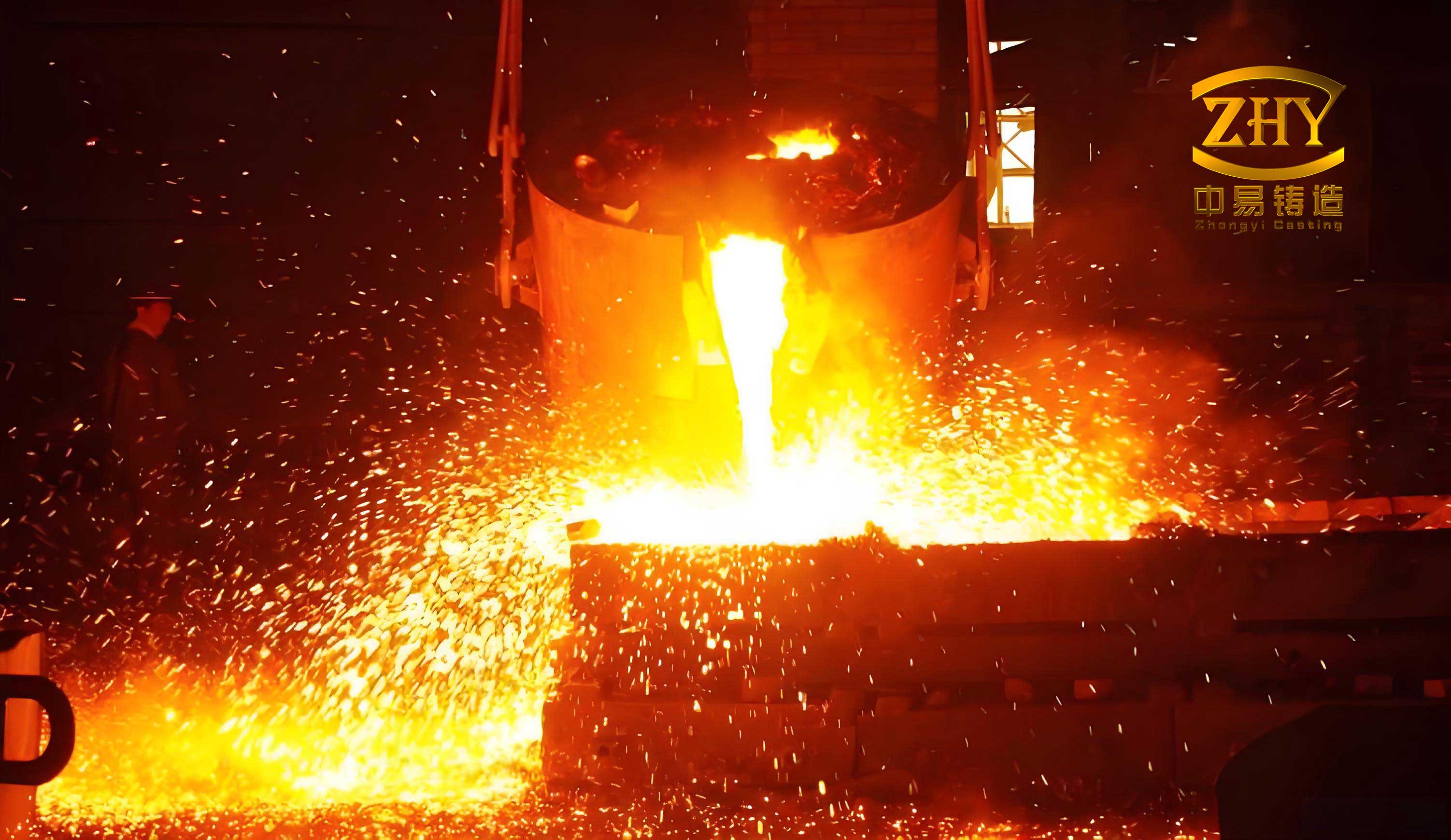
Upon tapping at the prescribed temperature, the base iron was transferred to a treatment ladle. The wire feeding process involved continuously injecting two types of cored wire into the molten iron. A high-magnesium ferrosilicon wire (13 mm diameter) was used for spheroidization, and a silicon-based inoculating wire (13 mm diameter) was used concurrently for primary inoculation. The wire is fed mechanically at a controlled speed, ensuring it plunges deep into the melt where it dissolves, releasing the active agents. This method offers superior magnesium recovery (often exceeding 70%) and minimal fume generation compared to conventional sandwich methods.
The reactions during wire feeding can be complex. The key spheroidizing reaction involves magnesium vaporization and dissolution:
$$ \text{Mg (from wire)} \rightarrow \text{Mg (dissolved in iron)} $$
The dissolved magnesium then reacts with sulfur and oxygen:
$$ \text{Mg} + \text{S} \rightarrow \text{MgS} \quad \text{(slag)} $$
$$ \text{Mg} + \text{O} \rightarrow \text{MgO} \quad \text{(slag)} $$
These reactions cleanse the melt and create the conditions for graphite to grow spherically. The residual magnesium content, as indicated in the composition table, is critical; it must be sufficient to maintain nodularity throughout the long solidification of a heavy section ductile iron casting but not so high as to promote excessive carbides or dross.
Inoculation is equally vital. It increases the number of graphite nucleation sites, leading to a finer and more uniform distribution of graphite nodules. This refines the eutectic cells and improves the mechanical properties, particularly ductility. The inoculation effect is time-sensitive; hence, we supplemented the wire inoculation with a late stream inoculation during pouring, adding 0.1% of a barium-bearing ferrosilicon inoculant. The efficacy of inoculation can be related to the undercooling (\(\Delta T\)) and the resultant nodule count (N). Empirical relationships often take the form:
$$ N = A \cdot e^{-B / \Delta T} $$
where \(A\) and \(B\) are constants. Effective inoculation reduces the undercooling required for graphite nucleation, thereby increasing \(N\). A high nodule count is particularly beneficial in heavy sections to prevent the growth of large, degenerate graphite.
After treatment, the slag was thoroughly skimmed, and the surface was covered with a layer of insulating compound to minimize heat loss and reoxidation. The pouring temperature was maintained between 1330°C and 1360°C, following a “slow-fast-slow” pouring sequence to ensure smooth filling without turbulence. The entire treatment and pouring protocol is designed to preserve the metallurgical quality of the ductile iron casting from the ladle to the mold cavity.
Microstructure, Mechanical Properties, and Non-Destructive Evaluation
The final validation of the production process for a heavy section ductile iron casting lies in the assessment of its microstructure and mechanical properties, coupled with rigorous non-destructive testing (NDT). For the end cover casting, test coupons were attached to the casting itself (as per the standard for heavy sections) to provide a representative sample of the material’s properties in critical areas.
The microstructure examination revealed a highly satisfactory outcome. The graphite morphology was predominantly spheroidal, with a nodularity level exceeding 95%. The graphite size was rated as ASTM 6 (approximately 30-50 nodules per mm²), which is appropriate for a section of this thickness. The matrix consisted of a ferritic base with a controlled amount of pearlite (typically 10-20%), aligning perfectly with the requirements for QT500-7 grade ductile iron. The absence of significant chunk graphite, flotation, or carbide networks at the cell boundaries confirmed the effectiveness of our composition control and treatment practices for this ductile iron casting.
The mechanical properties, derived from tensile tests on the attached test blocks, are summarized in the following table. All values are averages of three specimens and comfortably meet the specified standards for QT500-7 ductile iron.
| Mechanical Property | Standard Requirement (QT500-7) | Average Measured Value |
|---|---|---|
| Tensile Strength (Rm) | ≥ 420 MPa | 515 MPa |
| Yield Strength (Rp0.2) | ≥ 290 MPa | 390 MPa |
| Elongation (A) | ≥ 7 % | 15 % |
| Hardness (HBW) | 170 – 230 HB | 207 HB |
The excellent combination of strength and ductility, evidenced by the high elongation value, is a testament to the sound ferritic matrix and well-formed graphite spheres. This balance is crucial for components like end covers that may experience complex loading in service. The hardness value falls squarely within the desired range, indicating good machinability.
Non-destructive testing is a non-negotiable quality gate for critical ductile iron castings. The entire casting was subjected to 100% ultrasonic testing (UT) in accordance with EN 12680-3 and 100% magnetic particle testing (MT) per EN 1369. The acceptance criteria were stringent, requiring a quality level of Grade 2. The inspection results confirmed that the casting was free from any significant internal discontinuities (like shrinkage cavities or hot tears detectable by UT) and surface defects (like cracks or cold laps detectable by MT). This successful NDT outcome underscores the internal soundness achieved by our optimized casting process for this heavy section ductile iron casting.
Conclusion and Key Takeaways for Heavy Section Ductile Iron Casting Production
The production of the thick-walled end cover casting demonstrates a viable and reliable pathway for manufacturing high-integrity heavy section ductile iron castings. The success was not attributable to a single factor but to the holistic integration of several disciplined practices. Firstly, a scientifically designed casting process, validated and refined through numerical simulation (ProCAST), is essential. This process must incorporate appropriate feeding systems like insulating risers and chills to manage solidification and harness the graphitic expansion pressure. Secondly, the metallurgical foundation must be solid. This involves selecting high-purity charge materials, designing a chemical composition that balances graphitization potential with matrix control, and implementing precise melting and superheating practices. Thirdly, the treatment methodology is critical. The wire feeding process for spheroidization and inoculation proved highly effective, offering excellent control over residual magnesium and nucleation potential, which is paramount for the slow-cooling conditions of a heavy section ductile iron casting.
The final product validation through microstructure analysis, mechanical testing, and comprehensive NDT confirmed that all target specifications were met. The ductile iron casting exhibited the required nodular graphite structure, a ferritic-pearlitic matrix delivering QT500-7 properties, and exceptional internal and surface quality. This case study reinforces that with careful attention to process design, metallurgical control, and quality assurance, the challenges of producing heavy section ductile iron castings can be consistently overcome, enabling their reliable use in the most demanding industrial applications. Future work may focus on further optimizing the cooling curves through advanced chill designs or exploring the effects of novel inoculants on the nodule count in the very core of ultra-heavy section ductile iron castings.