
In my extensive experience with lost foam casting, particularly for large-scale components, I have tackled numerous challenges in producing high-quality gray cast iron parts. One notable project involved the manufacturing of a crossbeam for a high-speed punching machine, a massive gray cast iron casting weighing 8.6 tons. This component, with dimensions of 1400 mm in height, 1500 mm in width, and 2600 mm in length, and an average wall thickness of 60 mm, presented significant difficulties due to its susceptibility to deformation and other defects. Through meticulous process control and innovative techniques, we achieved a successful one-shot casting, from molding to pouring. This article details the factors affecting deformation, strategies for prevention, and addressing inclusions and slag defects, all from a first-person perspective, with emphasis on the gray cast iron material.
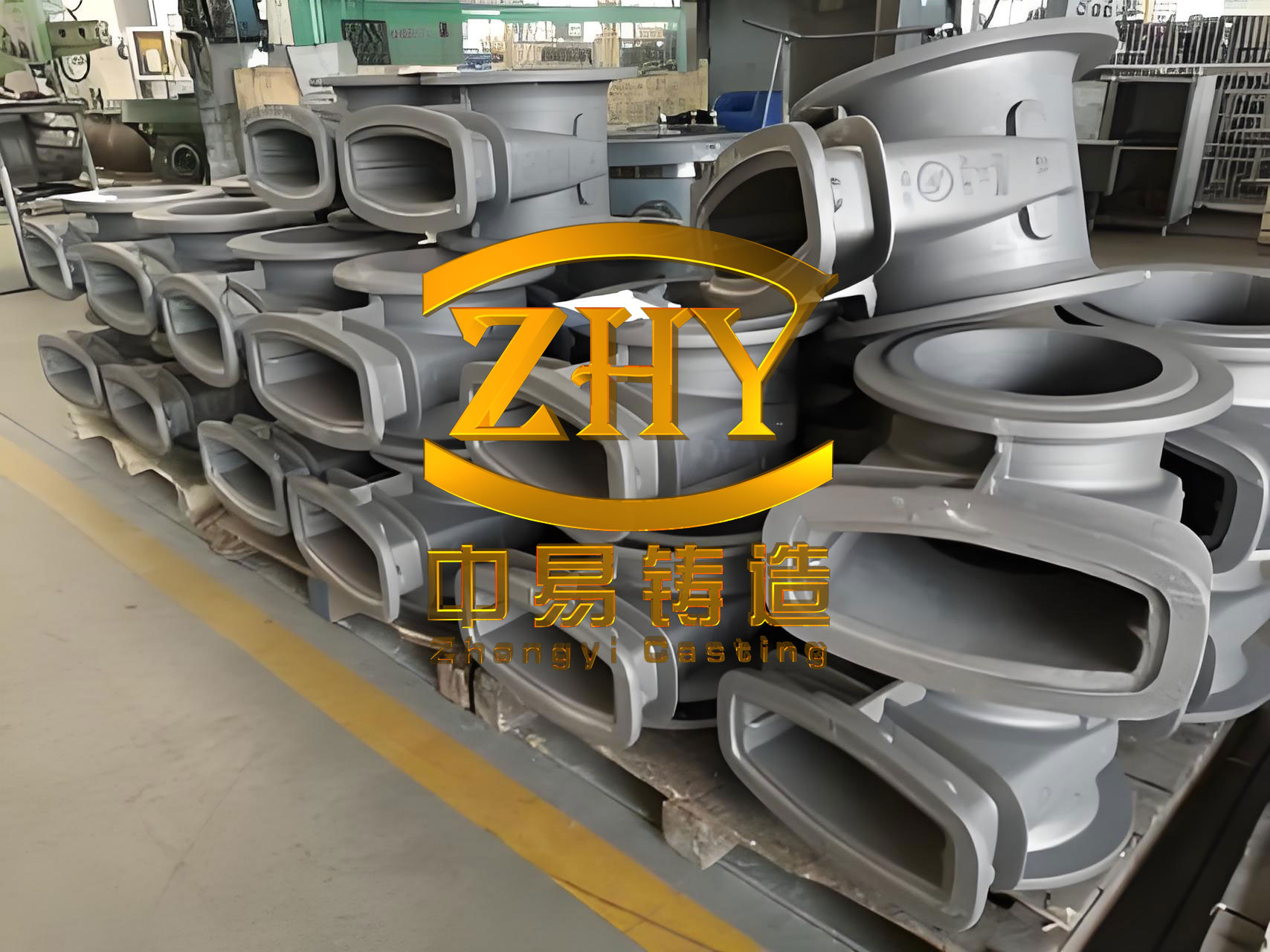
The production of such a massive gray cast iron casting requires attention to every detail. The lost foam process, while efficient, introduces unique risks, especially for thin-walled or large structures. Deformation is a primary concern, as it can compromise dimensional accuracy and structural integrity. Based on my observations, deformation in gray cast iron castings during lost foam casting can arise from multiple sources, which I categorize and summarize below.
Factors Leading to Deformation in Gray Cast Iron Castings
Deformation in massive gray cast iron castings often occurs during the pattern handling, coating, and molding stages. I have identified several critical factors that contribute to this issue, as listed in Table 1. Each factor relates to mechanical stress or thermal effects on the foam pattern, which directly translates to the final gray cast iron part.
| Factor Number | Description of Factor | Impact on Gray Cast Iron Casting |
|---|---|---|
| 1 | Improper placement on drying racks, leading to misalignment. | Causes uneven stress, resulting in warping of the gray cast iron component. |
| 2 | Excessive coating thickness during first dip, causing flow accumulation at bottom corners. | Adds weight pressure, deforming the foam pattern and affecting gray cast iron dimensions. |
| 3 | Unstable drying rack placement with large gaps, leaving pattern sections unsupported. | Leads to sagging or bending, mirrored in the gray cast iron casting. |
| 4 | Handling large, thin-walled patterns during transport to drying oven. | Physical拉扯 (pulling) distorts the pattern, impacting gray cast iron accuracy. |
| 5 | Aggressive sand flow with high speed and coarse particles during molding. | Sand impact force deforms the pattern, causing deviations in gray cast iron shape. |
| 6 | Uneven sand distribution, with excessive accumulation in one area. | Creates localized pressure, squeezing and deforming the gray cast iron pattern. |
| 7 | Clogged sand rain holes with coating shells or foam debris, causing uneven sand flow. | Leads to asymmetric sand impact, resulting in prolonged deformation. |
| 8 | Off-center sand discharge from bags during molding. | Causes imbalanced sand pressure,挤压 (squeezing) the gray cast iron pattern. |
| 9 | Lack of anti-deformation supports like wood strips or fiber rods for frame structures. | Allows stress buildup, leading to warping in gray cast iron castings. |
| 10 | Using hot sand sprayed with water for rapid reuse, increasing sand weight. | Heavier sand compacts the pattern during vibration, deforming gray cast iron features. |
| 11 | Inaccurate foam cutting and assembly without quality checks. | Introduces initial distortions that carry over to the gray cast iron product. |
To quantify the risk of deformation, I often consider the stress on the foam pattern. The deformation stress $\sigma_d$ can be approximated by the following formula, which accounts for sand pressure and pattern strength:
$$ \sigma_d = \frac{F}{A} = \frac{\rho_s \cdot g \cdot h \cdot A_p}{A_p} = \rho_s \cdot g \cdot h $$
where $\rho_s$ is the bulk density of the sand (in kg/m³), $g$ is gravitational acceleration (9.81 m/s²), $h$ is the sand height above the pattern (in meters), and $A_p$ is the pattern area. For gray cast iron castings, minimizing $\sigma_d$ is crucial to prevent pattern collapse. In practice, I keep $\rho_s$ low by using dry, fine sand and control $h$ during molding.
Preventive Measures for Deformation in Gray Cast Iron Castings
For the massive gray cast iron crossbeam, I implemented a comprehensive approach to counter deformation. The gating system was designed with a sprue of 70 mm × 70 mm, three bottom runners of 80 mm × 80 mm, one top runner of 80 mm × 50 mm, and four short runners of 80 mm × 50 mm, all supported by a welded steel frame. Common defects like long iron fins, deformation, collapse, carbon deposits, expansion, sand inclusion, top shrinkage, machining white spots, and corner burning were addressed through process optimizations.
The coating formulation was critical. I used zirconium-aluminum powder from Guangdong as the base material, with Guilin No. 5 as an additive, to enhance refractoriness and permeability. Anti-deformation was achieved by fixing the pattern with fiber rods and wood strips. The steps are summarized in Table 2.
| Step | Action | Purpose for Gray Cast Iron Quality |
|---|---|---|
| 1 | Cut and assemble foam pattern according to drawings, sealing gaps with paper tape. | Prevents coating leakage and ensures accurate gray cast iron dimensions. |
| 2 | Attach gating system to lower part of pattern, reinforced with fiber rods. | Stabilizes the system, reducing stress on the gray cast iron pattern. |
| 3 | Design multiple slag traps and risers at the top of the pattern. | Removes gas and carbon residues from the gray cast iron melt. |
| 4 | Apply coating via spraying four times, achieving ~3 mm thickness, with extra brushing on critical areas. | Ensures uniform protection and permeability for the gray cast iron casting. |
| 5 | Dry pattern at 45–50°C in a controlled oven. | Prevents thermal distortion of the foam, preserving gray cast iron shape. |
| 6 | Use crane with slings to place pattern in flask, with bottom sand bed of 200 mm. | Minimizes handling damage and supports the heavy gray cast iron pattern. |
| 7 | Fill sand gradually with vibration, hand-tamping corners to avoid fins. | Reduces sand impact, preventing deformation in gray cast iron walls. |
| 8 | Install steel bars between pattern walls and flask to counteract thermal expansion. | Counters stress-induced deformation during gray cast iron solidification. |
| 9 | Place a vacuum frame on top before final sand filling, then cover with plastic film. | Ensures even vacuum distribution for the gray cast iron pouring process. |
| 10 | Pour at 1390°C with vacuum of 0.07 MPa, hold for 50 minutes, shakeout after 30 hours. | Optimizes filling and solidification of the gray cast iron, reducing defects. |
The pouring temperature for gray cast iron is crucial. I use the following empirical formula to determine the optimal temperature $T_p$ based on wall thickness $t$ (in mm):
$$ T_p = 1400 – 0.5 \cdot (t – 50) \, \text{°C} $$
For an average thickness of 60 mm, this gives $T_p = 1400 – 0.5 \cdot (10) = 1395°C$, closely matching our 1390°C practice. This ensures proper fluidity while minimizing thermal shock to the mold for gray cast iron.
After shakeout and shot blasting, the gray cast iron casting exhibited excellent appearance with no significant deformation, sand adhesion, or fins, marking a milestone in large-scale gray cast iron production.
Inclusion and Slag Defects in Gray Cast Iron Castings: Causes and Prevention
Inclusions and slag defects are common in lost foam casting of gray cast iron, manifesting as black-gray spots or sand particles on machined surfaces. These defects arise from sand, coating, or foam residues entering the melt. In my work, I analyze the gating system and casting surface post-shakeout to identify issues. For instance, a swollen sprue or runners indicate sand penetration, while white spots on fractures suggest sand inclusions, and black-gray areas signify slag or carbon deposits from incomplete foam pyrolysis.
The causes of these defects in gray cast iron castings are multifaceted, as outlined in Table 3.
| Cause Category | Specific Cause | Effect on Gray Cast Iron |
|---|---|---|
| Pattern and Coating Issues | Unstable or leaky pouring cup,吸入 (sucking) sand. | Introduces sand into the gray cast iron melt, causing inclusions. |
| Coating cracks or脱落 at gating connections. | Allows sand ingress, leading to冲砂 (sand wash) in gray cast iron. | |
| Process Parameters | Inadequate coating thickness on gating system. | Reduces erosion resistance, increasing slag formation in gray cast iron. |
| High pouring head or temperature. | Enhances冲刷 (erosion), damaging coating and contaminating gray cast iron. | |
| Improper vacuum level or sand grain size. | Causes gas entrapment or sand fluidization, affecting gray cast iron quality. | |
| Material Factors | Foam density too high or low. | Leads to incomplete gasification or coating penetration,留下 (leaving) residues in gray cast iron. |
To prevent these defects in gray cast iron castings, I focus on every process step. For foam selection, I use 16 g/cm³ density for the pattern and 18 g/cm³ for the gating system to balance strength and gasification. Coating must have high temperature resistance, permeability, and adhesion. I prepare the coating with 200-mesh zirconium-aluminum powder and Guilin No. 5, ensuring viscosity stability. The coating thickness $C_t$ is optimized using:
$$ C_t = k \cdot \sqrt{t} $$
where $t$ is the wall thickness in mm, and $k$ is a material constant (≈0.5 for gray cast iron). For 60 mm thickness, $C_t ≈ 0.5 \cdot \sqrt{60} ≈ 3.87$ mm, aligning with our 3 mm practice after adjustments for permeability.
During molding, I inspect the coating for cracks, especially at gating junctions. The sand filling process is gentle, with initial sand bed height $h_b$ calculated to support the pattern without excess pressure:
$$ h_b = 0.1 \cdot H_p $$
where $H_p$ is the pattern height. For 1400 mm, $h_b = 140$ mm, though we used 200 mm for added safety in this massive gray cast iron casting. Vibration is minimized until the pattern is fully buried.
Pouring operations are critical. I maintain a low pouring head to reduce turbulence, and use a ceramic filter at the ladle nozzle to trap slag. The pouring temperature $T_{pour}$ for gray cast iron is set based on component size:
$$ T_{pour} = T_{base} + \Delta T \cdot \frac{V}{A} $$
where $T_{base}$ is 1380°C for gray cast iron, $\Delta T$ is 10°C per unit volume-to-area ratio, and $V/A$ is the casting’s volume-to-surface area ratio. For large castings like this, $T_{pour}$ is kept at 1390–1420°C to ensure fluidity without excessive thermal shock.
Vacuum control is equally important. The vacuum pressure $P_v$ is determined by the casting’s geometry and material. For gray cast iron, I use:
$$ P_v = P_0 \cdot e^{-0.001 \cdot t} $$
where $P_0$ is the initial vacuum (0.07 MPa), and $t$ is time in seconds. This exponential decay model helps maintain adequate suction during pouring without drawing in sand. We held 0.07 MPa for 50 minutes to support the gray cast iron solidification.
Sand selection is key: I use 10–20 mesh silica sand or 20–30 mesh ceramsand for gray cast iron, ensuring proper permeability and minimal fines. Regular dedusting of sand is essential to maintain vacuum efficiency and prevent defects in gray cast iron castings.
Conclusion
Producing massive gray cast iron castings via the lost foam process demands a holistic approach, integrating careful pattern handling, optimized coating, precise molding, and controlled pouring. By addressing deformation factors through structural supports and process adjustments, and mitigating inclusion defects via material and parameter control, I have successfully cast an 8.6-ton gray cast iron crossbeam with high dimensional accuracy and surface quality. The gray cast iron material’s properties were fully leveraged, with repeated emphasis on its behavior during solidification and cooling. This experience underscores that in lost foam casting, every step—from foam assembly to shakeout—is interconnected, and rigorous attention to detail is paramount for achieving defect-free gray cast iron components. The formulas and tables presented here serve as practical guides for similar projects, ensuring that gray cast iron remains a reliable material for large-scale industrial applications.