
The reliable operation of complex mechanical systems often hinges on the performance of critical structural components. Among these, bearing housings play an indispensable role, providing essential support, alignment, lubrication, and protection for rotating assemblies. The development of robust casting processes for medium to large-scale, high-integrity bearing housings is therefore of significant practical importance to the advancement of equipment manufacturing. This article details a complete foundry engineering project, focusing on the casting process design and optimization for the upper half of a front bearing housing manufactured from grey iron. The objective was to establish a reliable and efficient sand casting process capable of producing sound castings free from internal defects, utilizing modern simulation tools to guide and validate the design.
The component in question is the upper half of a front bearing housing for a turbine assembly. Its primary functions are to carry static and dynamic loads, precisely locate and protect the bearings, and serve as a sealed reservoir for lubricating oil. Consequently, the casting must possess substantial mechanical strength, stiffness, and dimensional stability under operational stresses and thermal gradients. The geometry is inherently challenging for a grey iron casting process. With overall envelope dimensions of approximately 1095 mm x 910 mm x 380 mm and a finished weight of 566 kg, it features significant variations in wall thickness. The average wall thickness is 25 mm, but sections range from a minimum of 20 mm to localized massive areas reaching 153 mm—a thickness differential factor of nearly 8:1. This disparity creates pronounced thermal masses, or hot spots, which are prone to shrinkage defects if not properly managed. Furthermore, the internal geometry includes several bearing pedestals with flanges, side windows, and a long, curved oil gallery, all complicating mold and core making. The technical specification explicitly requires the absence of shrinkage cavities, porosity, gas holes, and sand inclusions that could impair functionality.
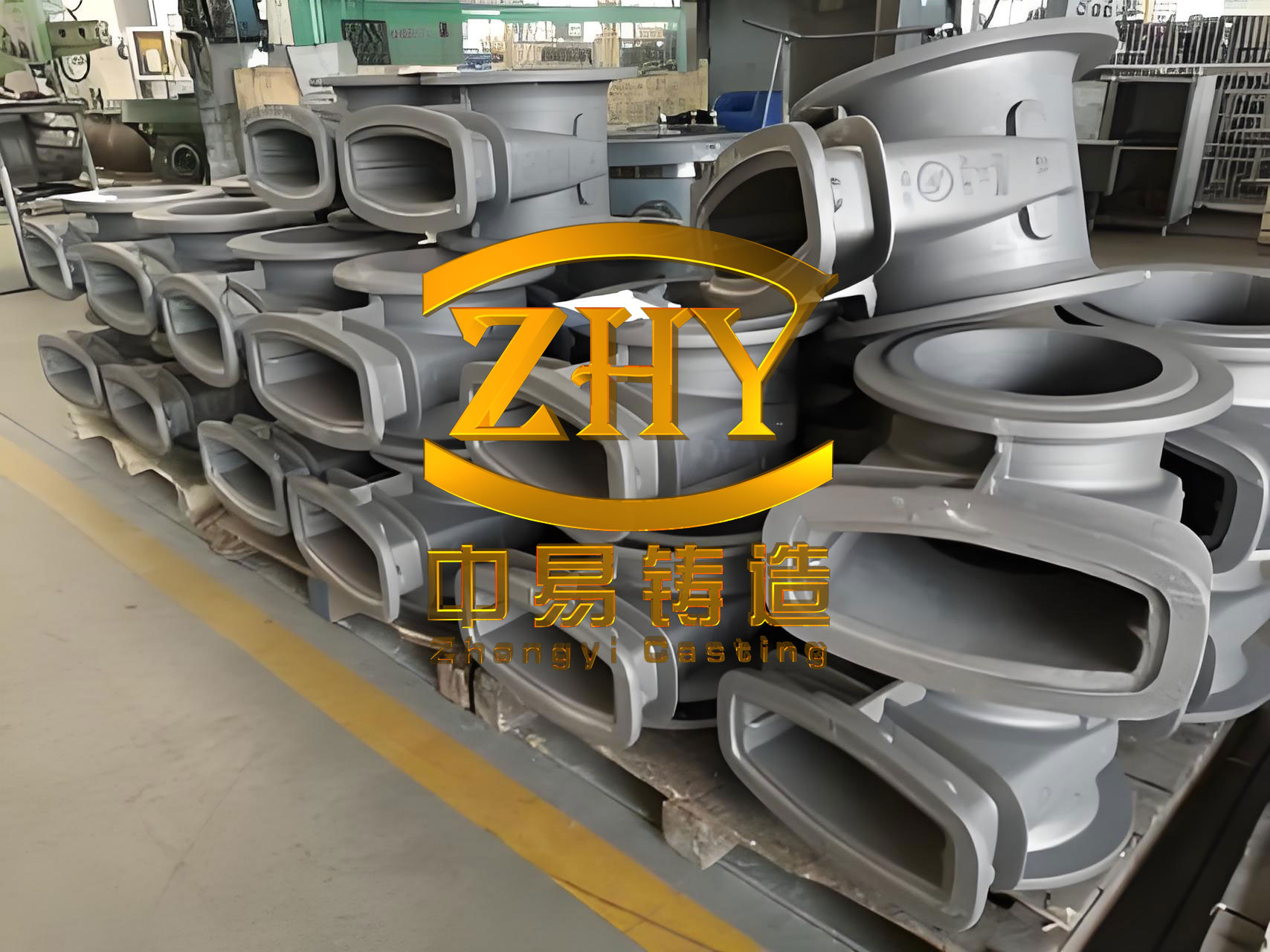
The material selected was Grade HT250 grey iron. This alloy offers a favorable combination of castability, machinability, and damping capacity, making it suitable for such an application. A key metallurgical advantage in grey iron casting is the graphite expansion phenomenon during eutectic solidification. As the flake graphite grows within the eutectic cells, the associated volumetric expansion compensates for a portion of the liquid and solidification shrinkage occurring in the inter-dendritic regions of the austenite. This inherent self-feeding characteristic must be carefully leveraged in the feeding system design to achieve economic yields without compromising quality.
The production was planned for low-volume batch runs. The molding and coring method chosen was furan resin no-bake sand, selected for its good dimensional accuracy, collapsibility, and suitability for complex core assemblies. The coatings applied were alcohol-based graphite washes.
Structural Analysis and Foundry Method Definition
The first step in any grey iron casting process design is a meticulous analysis of the component’s geometry to translate the engineering drawing into a viable casting model. Key considerations include identifying which features will be created by machining versus casting, applying appropriate machining allowances, and incorporating draft angles for pattern release. For this bearing housing upper half, the conversion from part to casting model involved adding metal to all surfaces requiring finish machining and defining drafts on vertical faces.
The major structural challenge was the severe wall thickness variation. The table below summarizes the critical sectional dimensions that drive the thermal design of the process.
| Geometric Feature | Dimension / Thickness (mm) | Foundry Significance |
|---|---|---|
| Overall Envelope | 1095 x 910 x 380 | Defines flask size and sand volume. |
| Average Wall Thickness | 25 | Base for calculating solidification time. |
| Minimum Wall Thickness | 20 | Governs fluidity requirements and filling time. |
| Maximum Wall Thickness (Hot Spot) | 153 | Primary location for shrinkage risk; requires focused feeding/chilling. |
| Key Internal Ribs & Pedestals | 40 – 80 | Secondary hot spots; may require local thermal control. |
Casting Process Scheme Design
Pouring Position and Parting Line Selection
Determining the optimal orientation of the casting within the mold—the pouring position—is fundamental. Based on established principles for grey iron casting, the orientation was selected to place the large, flat top surface upward and to position critical bearing mounting surfaces laterally or downward. This upward-facing large area provided an ideal location for placing feeding risers. The parting line was ingeniously designed as a complex, non-planar surface that followed the contour of the casting’s major internal cavity. This strategic choice maximized the use of the drag mold to form the bulk of the internal void, dramatically simplifying the coring assembly. Instead of requiring multiple intricate cores to form the main cavity, this approach minimized their number.
Core System Design
Despite the efficient parting line, two sand cores were necessary to form the undercut features that could not be molded by the main cope and drag. Core #1 was designed to form the frontmost bearing pedestal. Core #2, more complex, was responsible for forming the adjacent bearing pedestal and the integral,蜿蜒的 oil supply gallery. The use of furan resin sand ensured these cores had sufficient strength and thermal stability to withstand metal pressure while maintaining the precise dimensions required for this critical grey iron casting.
Gating System Engineering
The gating system’s function is to deliver molten metal into the mold cavity smoothly, completely, and with minimal turbulence. For this grey iron casting, a pressurized, bottom-gating system was selected. The “pressurized” design (where the cross-sectional area decreases from the sprue base to the ingates) promotes rapid filling and a self-skimming action. Bottom filling minimizes splashing and oxidation, which is crucial for preventing slag defects and ensuring a calm fill.
The total cross-sectional area of the ingates (the choke) was calculated first. An empirical formula for the pouring time \( t \) (in seconds) of grey iron castings is often used as a starting point:
$$
t = S \sqrt[3]{G}
$$
Where \( G \) is the casting weight in kg (573 kg) and \( S \) is an empirical coefficient based on wall thickness. For a mean wall thickness of ~25 mm, a suitable coefficient leads to a calculated pouring time of approximately 35 seconds.
Using the choke area calculation methods for grey iron casting, the required total ingate area \( \sum A_{ingate} \) was determined. The system was designed with a ratio of sprue base area : runner area : ingate area = 1.4 : 1.2 : 1. Eight ingates were distributed along the bottom of the casting to ensure even filling. Key gating parameters are summarized below:
| Gating Element | Quantity | Cross-Sectional Shape | Total Area (cm²) | Design Rationale |
|---|---|---|---|---|
| Sprue | 1 | Circular (Tapered) | 37.0 | Provides metallostatic head. |
| Runner | 2 | Trapezoidal | 32.0 | Distributes metal to ingates; aids slag trap. |
| Ingate | 8 | Trapezoidal | 26.4 | Choke area; controls pour rate and fill time. |
The pouring temperature was set at 1350°C, a standard range for HT250 grey iron casting to ensure adequate fluidity without excessive superheat.
Numerical Simulation and Initial Defect Prediction
With the initial gating layout defined, numerical simulation using ProCAST software was employed to virtualize the process. A 3D model of the casting with the gating system (but no feeders or chills) was meshed with over 1.1 million volume elements. Boundary conditions included the 1350°C pour temperature, 35-second fill time, and appropriate interfacial heat transfer coefficients (e.g., 1000 W/m²K between sand and metal).
The filling analysis confirmed a tranquil, progressive fill from the bottom up, with no significant air entrapment or surface turbulence. The critical output was the solidification and shrinkage analysis. The simulation predicted severe centerline shrinkage porosity in the massive 153-mm thick section and in other isolated heavy ribs and bosses. Furthermore, a large surface sink was visually predicted on the top of the heaviest section, confirming this area as the primary thermal center requiring feeding. This validated the initial thermal analysis and provided a clear map for remedial action.
Feeding System (Riser) Design and Optimization
To counteract the predicted shrinkage, a feeding system was designed. For grey iron casting, the modulus method (Chvorinov’s Rule) is a common technique, where the riser’s solidification time must exceed that of the region it feeds. The feeding demand is less than for steel due to graphite expansion, allowing for smaller, more efficient risers in successful grey iron casting practice.
A combination of riser types was selected:
- A large, open top riser placed directly over the main thick section. This served as the primary feed metal reservoir and also as an observation point during pouring.
- Two insulated side risers placed on secondary heavy sections. Insulating sleeves increase their feeding efficiency by slowing solidification.
- Several small vent/atmosphere risers placed on high points to allow gas escape and provide pressure relief.
The dimensions were calculated using modulus extensions and empirical checks. The table below lists the key riser design parameters.
| Riser ID | Type | Location (Feeds) | Key Dimension (mm) | Function |
|---|---|---|---|---|
| R1 | Open Top (Necking) | Central Massive Hub | Diameter: 180, Height: 250 | Primary feeder for main hot spot. |
| R2, R3 | Insulated Sleeve | Lateral Heavy Ribs | Diameter: 120, Height: 150 | Feed secondary thermal centers. |
| R4-R7 | Vent/Aeration | Various High Points | Diameter: 30-40 | Escape for air and gases from cavity. |
A new simulation including these risers showed dramatic improvement. The massive sink defect was eliminated, and shrinkage in the main hub was largely transferred into the primary riser. However, the simulation indicated that isolated regions—specifically at the junctions of side walls with heavy bosses and around the window openings—still exhibited micro-porosity. The thermal gradients were insufficient to draw feed metal from the risers into these isolated, chunky areas before the feeding paths solidified. This signaled the need for directional solidification control via chilling.
Chill Design for Directional Solidification
To achieve soundness throughout the grey iron casting, the principle of directional solidification must be enforced: the region farthest from the riser solidifies first, and solidification progresses sequentially toward the riser, which solidifies last. Chills are used to accelerate cooling in specific areas, effectively modifying the local solidification time and creating the desired thermal gradient.
Based on the residual defect map from the riser-only simulation, five external chills were designed and placed:
- Three contoured chills (Chill 1# and two Chill 2#) were placed against the thick side walls adjacent to the window openings and heavy bosses. Their contoured shape maximized contact area.
- Two cylindrical chills were placed beneath small, thick circular bosses on the lower face of the casting.
Chill size is critical; an undersized chill is ineffective, while an oversized one can cause chilling defects. A common guideline is that the chill volume or mass should be sufficient to absorb the heat from the local hot spot without becoming saturated. For steel chills in grey iron casting, a simple relationship can be considered for thickness:
$$
T_{chill} \approx (0.8 \text{ to } 1.2) \times T_{casting\_section}
$$
Where \( T \) represents thickness. For the main 150mm thick areas, chills of 150mm thickness were specified. The chill design summary is as follows:
| Chill ID | Quantity | Form | Placement Location | Thickness (mm) |
|---|---|---|---|---|
| Chill 1# | 1 | Contoured Plate | Side wall near main hub | 150 |
| Chill 2# | 2 | Contoured Plate | Side walls at window openings | 150 |
| Chill 3# | 2 | Cylindrical Pad | Under small thick bosses | 20 |
The final simulation, incorporating the optimized gating, riser, and chill design, was run. The results demonstrated a complete elimination of shrinkage porosity defects within the casting body. The solidification sequence clearly showed the lighter sections and chilled areas solidifying first, progressively moving towards the insulated risers. The last liquid metal existed in the primary risers, confirming successful directional solidification. All predicted shrinkage was contained within the riser heads, which are removed during cleaning.
Final Process Parameters and Conclusion
The iterative design and simulation process converged on a robust and efficient grey iron casting process for the bearing housing upper half. The table below consolidates the final key process parameters.
| Process Category | Final Parameter / Specification |
|---|---|
| Casting Method | Furan No-Bake Sand, Gravity Pour, One Casting per Mold |
| Parting Line | Complex Curved Surface (Minimized Core Use) |
| Metal Grade | Grey Iron HT250 |
| Pouring Temperature | 1350 °C |
| Gating System | Pressurized Bottom-Gate, Ratio 1.4 : 1.2 : 1, Pour Time ~35 s |
| Feeding System | 1 Open Top Riser + 2 Insulated Risers + 4 Vents |
| Auxiliary Cooling | 5 External Steel Chills (3 Contoured, 2 Cylindrical) |
| Process Yield | ~85% (Casting Weight / Total Poured Weight) |
| Predicted Quality | Sound Casting, Free of Internal Shrinkage & Porosity |
In conclusion, this project successfully engineered a complete manufacturing process for a complex grey iron casting. The core achievements were:
- The adoption of a curved parting plane significantly simplified the mold and core assembly for this geometrically challenging component.
- The integrated design of a bottom-pour gating system, a hybrid risering scheme (leveraging the self-feeding properties of grey iron), and strategically placed chills established a controlled directional solidification pattern.
- The extensive use of numerical simulation was instrumental. It allowed for virtual prototyping, accurate defect prediction in the initial grey iron casting design, and systematic optimization of riser and chill placement without costly physical trials. This led to a first-time-right process capable of producing high-integrity castings with a high yield.
This methodology underscores the modern approach to foundry engineering: combining fundamental principles of solidification science with advanced simulation tools to develop reliable and economical processes for critical grey iron castings.