
In my extensive experience with lost foam casting, producing oversized grey iron castings presents unique challenges, particularly regarding deformation and defect control. Recently, I successfully oversaw the production of a critical component—a crossbeam for a high-speed punch press—weighing 8.6 tons, with dimensions of 2600 mm in length, 1500 mm in width, and 1400 mm in height, and an average wall thickness of 60 mm. This grey iron casting is not only massive but also prone to distortion, requiring meticulous attention to every process step. Through rigorous control measures in molding, boxing, and pouring, we achieved success in a single attempt, setting a new benchmark for high-quality, large-scale grey iron castings production.
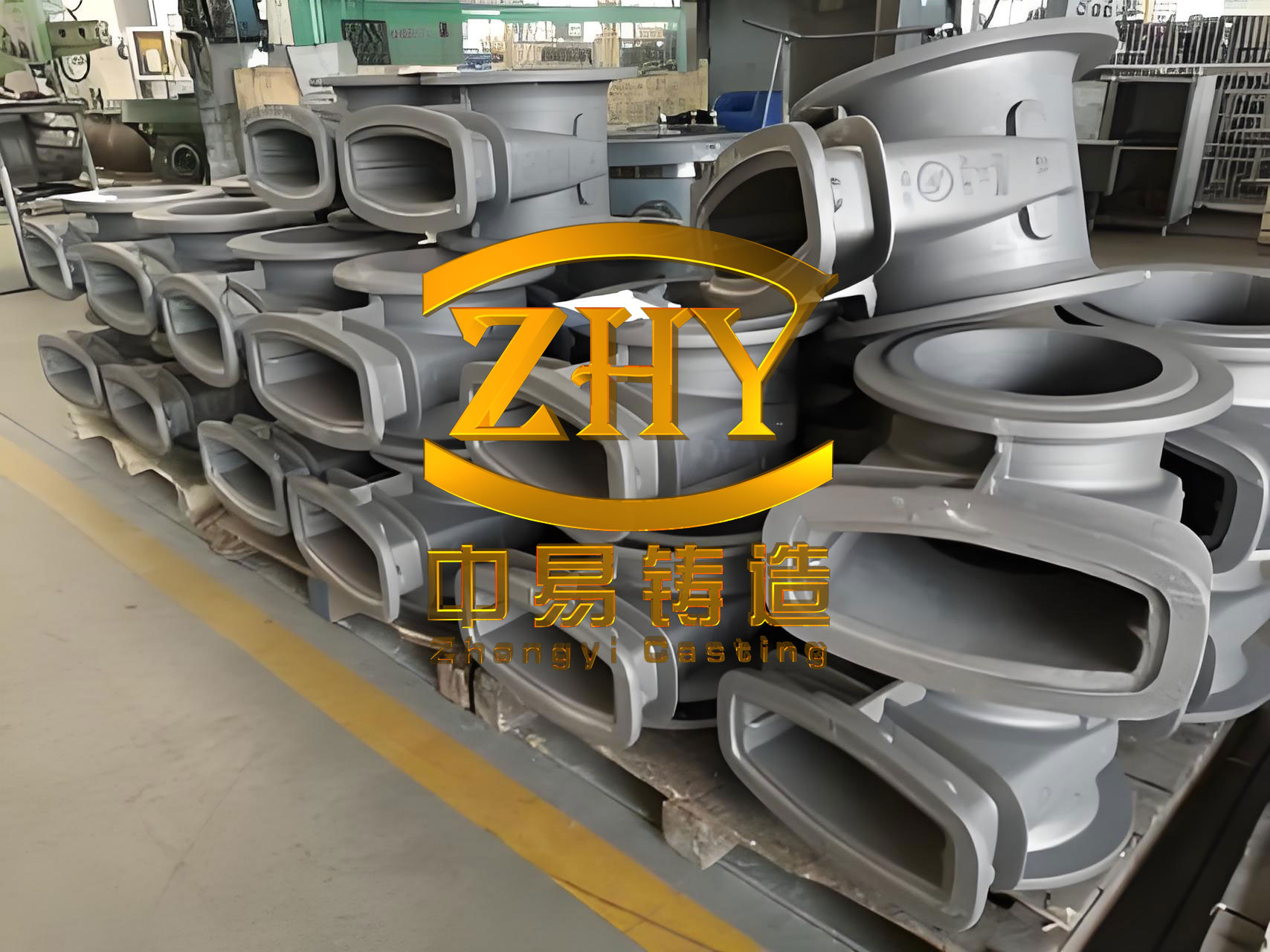
The success of such grey iron castings hinges on understanding and mitigating deformation factors. Deformation can occur at multiple stages, compromising the dimensional accuracy and structural integrity of the final product. Below, I detail the primary causes of deformation in lost foam casting of large grey iron castings, derived from hands-on observation and analysis.
| Factor Number | Description of Deformation Cause | Impact on Grey Iron Castings |
|---|---|---|
| 1 | Irregular placement or misalignment of the drying rack, leading to uneven support. | Induces stress concentration, causing warping in thin-walled sections of grey iron castings. |
| 2 | Excessive coating thickness during the first dip or brush application, causing pooling and heavy weight at bottom corners. | Adds gravitational load, distorting the foam pattern before casting. |
| 3 | Unstable placement on the drying rack with inadequate support spacing, leaving sections unsuspended. | Leads to sagging or bending due to lack of uniform support. |
| 4 | Handling large, thin-wall patterns during transfer to the drying oven, causing拉扯 (pulling) stresses. | Results in immediate deformation, especially in machine tool components. |
| 5 | Aggressive sand flow with coarse particles and high velocity during molding. | Generates impact forces that dent or shift the pattern. |
| 6 | Non-uniform sand filling, with accumulation in specific areas rather than progressive, even rise. | Creates lateral pressure, squeezing and deforming the pattern. |
| 7 | Clogging of rain sandfall holes by coating shells or foam debris, causing uneven sand distribution and prolonged localized impact. | Leads to asymmetric deformation over time. |
| 8 | Off-center sand discharge from bag systems, creating an imbalance in sand volume within the flask. | Causes differential compaction and pattern distortion. |
| 9 | Absence of anti-deformation aids like wooden strips or fiber rods in frame-structured patterns. | Allows framework to buckle under thermal and mechanical stresses during processing. |
| 10 | Reusing high-temperature sand cooled with excessive water spray, increasing sand density and weight during vibration. | Amplifies compaction forces, crushing the underlying pattern. |
| 11 | Inaccurate manual foam cutting and assembly without quality checks, introducing misalignment during bonding. | Results in inherent geometric inaccuracies before coating. |
To counteract these issues, we implemented several design and procedural modifications. The gating system was engineered with robust dimensions: a sprue of 70×70 mm, three bottom runners of 80×80 mm, one top runner of 80×50 mm, and four short runners of 80×50 mm. Additionally, a steel frame vacuum frame was fabricated to ensure stability. Common defects in such grey iron castings include iron fins, distortion, mold collapse, carbon inclusions, mold expansion, sand penetration, top shrinkage cavities, machining white spots, and corner burn-on. Our targeted improvements focused on both operational and design aspects.
The coating formulation is critical for defect prevention. We used a zircon-aluminum powder as the base aggregate, combined with a specialized additive to enhance properties. For anti-deformation, fiber rods and wooden strips were integrated to fix the pattern geometry. The process flow for producing these grey iron castings is summarized below:
| Process Step | Key Actions | Parameters for Grey Iron Castings |
|---|---|---|
| Pattern Making | Cut and bond foam according to drawing specifications; seal seams with paper tape to prevent coating infiltration. | Foam density: 16 g/L for pattern, 18 g/L for gating. |
| Gating System Attachment | Attach sprue and runners to the pattern’s mid-lower section; reinforce with fiber rods. | Ensure alignment and secure bonding to avoid gaps. |
| Riser Design | Place multiple risers at the top to vent gases and slag, preventing carbon accumulation. | Riser volume calculated based on casting mass: $$ V_{riser} = 0.2 \times M_{casting} $$ where \( M_{casting} \) is in kg. |
| Coating Application | Apply coating via spraying in four layers; target thickness ~3 mm; touch up corners and gating manually. | Coating viscosity: 40-50 s (Ford cup); drying temperature: 45–50°C. |
| Molding | Lift pattern into flask using crane; fill sand gradually with bottom sand bed ~200 mm; vibrate lightly while hand-tamping corners. | Sand grain size: 20–30 mesh; vibration amplitude: <0.5 mm. |
| Deformation Prevention | Install steel braces between pattern walls and flask to counteract thermal expansion stresses. | Brace spacing: every 500 mm along length. |
| Vacuum Setup | Place vacuum frame on top after sand filling; cover with plastic film; position pouring cup. | Vacuum pressure: 0.07 MPa; ensure seal integrity. |
| Pouring | Control pouring temperature and rate; use slag filters. | Pouring temperature: 1390°C for grey iron castings; pouring time: ~60 s. |
| Solidification & Shakeout | Maintain vacuum for 50 min; shakeout after 30 hours. | Cooling rate: <10°C/min to avoid residual stresses. |
Post-shakeout, the grey iron castings exhibited excellent surface quality with no significant defects, demonstrating the efficacy of our approach. This achievement advances the capability to produce premium, heavy-section grey iron castings domestically.
Another pervasive issue in lost foam casting of grey iron castings is slag inclusion, which encompasses sand, coating residues, and other impurities entrapped during pouring. These manifest as dark gray spots or sand particles on machined surfaces, impairing tool life and finish. The root causes often trace back to operational lapses. By inspecting the gating system and casting surface after shakeout, one can diagnose such defects: thickened sprue necks, rough runner surfaces, or excessive burn-on indicate sand wash or slag entry. Fractured risers showing white spots signify sand penetration, while blackish areas suggest slag or carbon inclusions. Top surfaces with chopped, powdery textures point to incomplete foam degradation and carbonaceous deposits.
The causes of slag inclusion and sand wash are multifaceted. Firstly, improper sealing of the pouring cup or loose gating attachments can draw in sand. Secondly, coating cracks or poor adhesion at bonded junctions allow coating infiltration. Thirdly, inadequate gating design, excessive pouring head, incorrect temperatures, or suboptimal vacuum settings contribute. Lastly, sand grain distribution and cleanliness play roles—too coarse sand promotes penetration, while fines hinder permeability.
Our preventive strategy emphasizes rigorous process control. For pattern materials, we select foam with density ~16 g/L for the main body and ~18 g/L for gating to balance strength and gas evolution. The bonding process is scrutinized for gaps, with paper tape reinforcement to block coating seepage. Coating formulation is tailored for grey iron castings: we use a zircon-aluminum base (200 mesh) with additives to ensure high-temperature resistance, permeability, and adhesion. Coating thickness is optimized via the relationship: $$ \delta_c = k \cdot \sqrt{t} $$ where \( \delta_c \) is coating thickness in mm, \( t \) is drying time in hours, and \( k \) is a material constant ~0.5 for our mix. This ensures uniform coverage without cracking.
During molding, we verify coating dryness and integrity, especially in recesses. The sand fill is controlled to avoid direct impingement, using a “rising water” approach with minimal vibration until full burial. Pouring parameters are critical; we calculate the pouring head pressure \( P \) using: $$ P = \rho \cdot g \cdot h $$ where \( \rho \) is iron density (7000 kg/m³), \( g \) is gravity (9.81 m/s²), and \( h \) is head height in meters. For our grey iron castings, \( h \) is kept below 0.5 m to reduce冲刷. Pouring temperatures are set as:
| Material Type | Pouring Temperature Range (°C) | Rationale for Grey Iron Castings |
|---|---|---|
| Grey Iron | 1380–1420 | Balances fluidity and minimal gas evolution. |
| Thin-Wall Grey Iron | 1480–1500 | Prevents cold shuts and ensures fill. |
| Ductile Iron | 1420–1480 | Derived from higher superheat (>1500°C melt). |
| Steel Castings | 1500–1580 | For completeness, though not directly for grey iron castings. |
Vacuum management is synchronized with pouring: we initiate vacuum 5–10 minutes before tapping, maintain at 0.07 MPa for grey iron castings, and adjust based on wall thickness. Excessive vacuum can accelerate metal flow, causing mold collapse or sand ingress if coatings are flawed. We use slag filters at the ladle lip to trap impurities. Sand selection is precise—20–30 mesh silica sand or ceramic sand is preferred for grey iron castings, as it offers optimal permeability and minimal fines. Regular dedusting of sand is essential to maintain vacuum efficiency and prevent defects.
In summary, producing massive grey iron castings via lost foam casting demands a holistic approach. Every step—from pattern making to pouring—must be controlled to mitigate deformation and slag inclusion. Our experience shows that with disciplined procedures, appropriate materials, and adaptive designs, high-integrity grey iron castings can be consistently achieved. This not only enhances product quality but also pushes the boundaries of what’s possible in heavy casting manufacturing, solidifying the role of lost foam casting in advancing grey iron castings production.