
Lost foam casting is a process known for high dimensional accuracy, smooth surface finish, minimal machining allowances, and low cost. Castings are free of flash and burrs, reducing cleaning costs. With numerous advantages, it has been widely adopted globally. Currently, domestic lost foam gray iron casting processes and equipment are relatively mature. However, with the growing demand for lightweight components, replacing some gray iron castings with aluminum alloy castings has become a trend. Our company has been researching lost foam aluminum alloy technology for nearly a decade, achieving a yield rate over 98%, which is at the leading domestic level. Our existing production line comprises a U.S.-made Fugang line, a German Strikowest melting furnace, a U.S.-made Pyrotek aluminum purification system, a German ABB robotic pouring system, and other auxiliary equipment. There are no professional design and manufacturing suppliers domestically. According to our company’s plan, we aim to transform an idle domestic lost foam gray iron casting production line into an aluminum alloy line with minimal investment.
The transition from gray iron castings to aluminum alloy castings involves significant equipment modifications, as the processes differ substantially despite both using lost foam casting. Based on our experience with an imported U.S. aluminum alloy lost foam line and the current equipment status, we identified key issues and implemented solutions. This article details the transformation process, focusing on equipment retrofitting points and post-upgrade efficiency gains.
Initially, the gray iron casting line consisted of two shared lines, each including two medium-frequency melting furnaces, one semi-automatic pouring machine, one molding and pushing line, two vacuum systems, one sand mixing and treatment system, one bag-type dust collector for melting furnaces, three dust removal systems for molding and sand treatment, and auxiliary equipment like cooling towers, compressed air filters, and casting conveyor chains. This setup was optimized for high-temperature gray iron castings, but required overhaul for aluminum alloy production.
The core challenges centered on melting, aluminum purification, molding line precision, sand treatment, and dust collection. Below, we analyze each aspect with technical discussions, tables, and formulas to summarize the transformation.
Melting Equipment Retrofit
In gray iron castings production, medium-frequency induction furnaces are common due to their fast melting speed and low metal loss, as eddy currents generate heat within the charge via skin effect. However, for aluminum alloys, these furnaces pose issues. During melting, the “hump” phenomenon causes aluminum to absorb gas, leading to excessive porosity in castings. Moreover, the original tilting mechanism limited continuity, requiring transfer to pouring stations, resulting in intermittent supply and significant temperature drops. Energy consumption was also higher compared to gas-fired furnaces. After over a month of trial with medium-frequency furnaces, casting quality and productivity fell short. Thus, we decided to replace them with new gas-fired melting furnaces.
The energy efficiency difference can be expressed using the heat balance equation for melting:
$$
Q_{\text{input}} = Q_{\text{melting}} + Q_{\text{loss}}
$$
where \( Q_{\text{input}} \) is the energy input, \( Q_{\text{melting}} \) is the energy required to melt the metal, and \( Q_{\text{loss}} \) represents losses. For gray iron castings, the melting point is around 1150–1200°C, but pouring temperature exceeds 1500°C, whereas aluminum alloys melt at about 660°C with pouring at 760°C. The lower temperature range reduces energy demand, making gas furnaces more suitable. Table 1 compares key parameters.
| Parameter | Gray Iron Castings | Aluminum Alloy |
|---|---|---|
| Melting Temperature (°C) | ~1200 | ~660 |
| Pouring Temperature (°C) | >1500 | 760 |
| Typical Melting Equipment | Medium-Frequency Furnace | Gas-Fired Furnace |
| Energy Consumption (kWh/t) | High | Moderate |
| Gas Absorption Risk | Low | High in Medium-Frequency |
By switching to gas furnaces, we improved temperature stability and reduced costs, essential for high-quality aluminum castings. This change also aligns with the lightweight trend away from traditional gray iron castings.
Aluminum Melt Purification System
Aluminum purification is unique to aluminum alloy casting, requiring entirely new equipment. Two common flows exist: one involves multiple transfers leading to gas absorption and temperature drops up to 100°C, lower efficiency (~4 minutes per piece), and inaccurate pouring due to tilting mechanisms, causing metal utilization losses of 120–180 kg per 2 tons. The other uses a continuous flow with in-line degassing and filtration, enabling robotic pouring with higher precision and stability. We opted for the latter to enhance yield.
The purification efficiency can be modeled using the degassing equation:
$$
C_f = C_0 e^{-k t}
$$
where \( C_f \) is the final gas concentration, \( C_0 \) is the initial concentration, \( k \) is the rate constant, and \( t \) is treatment time. Continuous systems maximize \( k \) by maintaining flow. Table 2 outlines the comparison.
| Flow Type | Transfer Steps | Temperature Drop (°C) | Pouring Efficiency | Metal Utilization |
|---|---|---|---|---|
| 1# (Intermittent) | Multiple | Up to 100 | Low (4 min/piece) | Lower |
| 2# (Continuous) | Minimal | <50 | High (Robotic) | Higher |
We installed a Pyrotek purification system with in-line degassing and filters, coupled with robotic pouring for precise, stable delivery. This upgrade minimized losses, crucial for moving from gray iron castings to aluminum alloys.
Molding and Pushing Loop Modification
The original loop used hydraulic cylinders to push boxes, transferred via shuttles. Issues included wear on bumpers between carts—each cart wearing 0.5 mm on average led to a total shortening of 19 mm for 38 carts, plus deformations and adhered debris, causing inconsistent push lengths. This variability prevented fixed-point pouring. Additionally, hydraulic pushes caused severe shaking upon stopping, risking gas absorption or deformation in unfurled castings.
We redesigned the loop by connecting all carts with pins to form a closed, gap-free chain, eliminating relative motion and wear. Hydraulic positioning devices were added at molding, pouring, and knockout stations to ensure push accuracy. The drive system was upgraded to servo ball screws, improving synchronization and control, reducing shake, and boosting yield. The precision requirement for aluminum alloys is stricter than for gray iron castings, demanding such enhancements.
The pushing force can be analyzed with:
$$
F = m a + f_{\text{friction}}
$$
where \( F \) is the force, \( m \) is the mass of carts and sand, \( a \) is acceleration, and \( f_{\text{friction}} \) is friction. Servo systems optimize \( a \) to minimize jerk. Table 3 summarizes changes.
| Aspect | Original (Gray Iron) | Modified (Aluminum Alloy) |
|---|---|---|
| Drive Mechanism | Hydraulic Cylinders | Servo Ball Screws |
| Cart Connection | Loose, with Gaps | Fixed, No Gaps |
| Positioning Accuracy | Low | High (with Hydraulic Locks) |
| Shaking upon Stop | Severe | Minimal |
| Suitability for Fixed Pouring | No | Yes |
This retrofit enabled robotic pouring, enhancing productivity and quality for aluminum castings, a leap from gray iron castings processes.
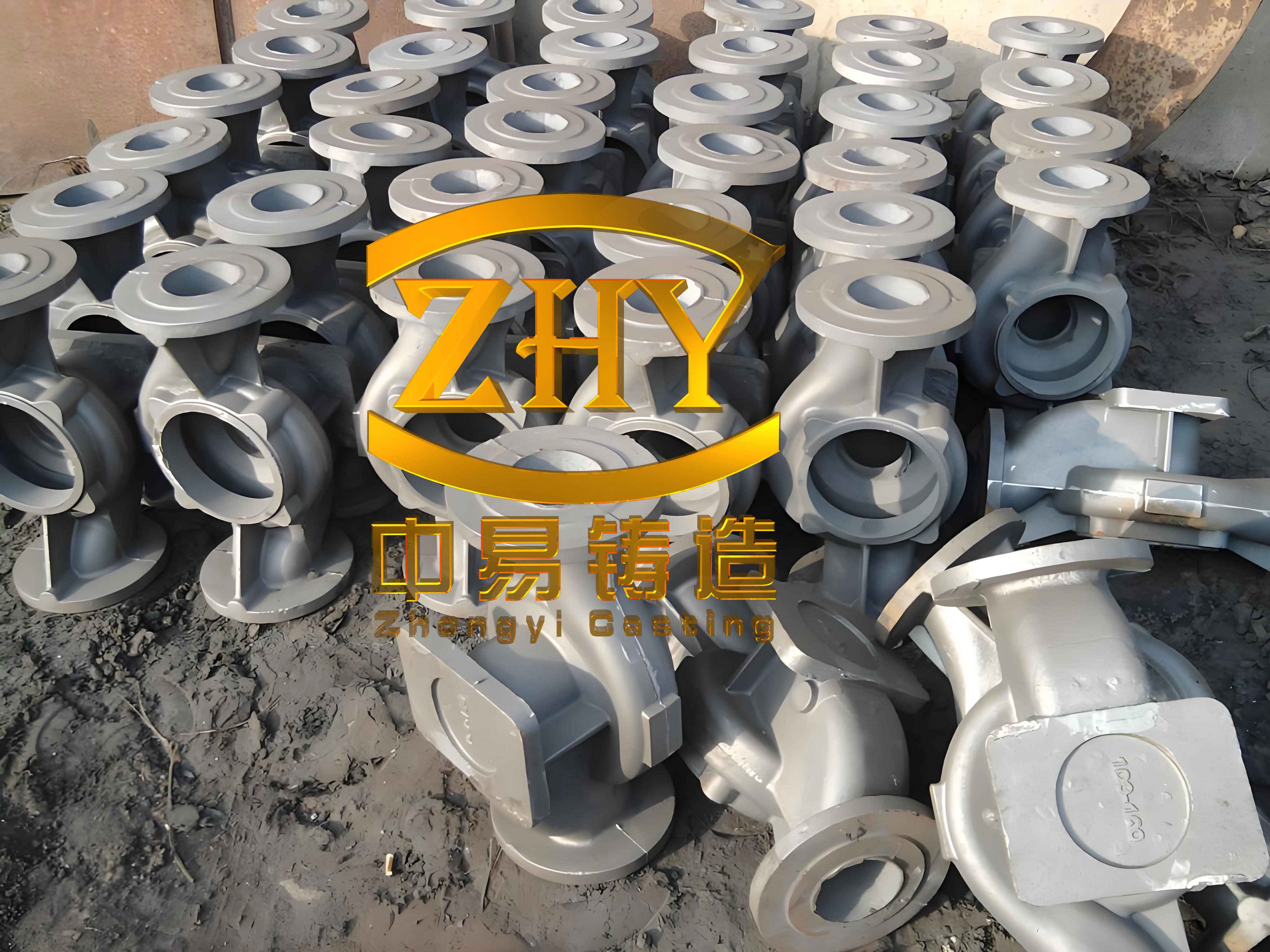
The image illustrates typical gray iron castings, highlighting the traditional components that are now being replaced by lightweight aluminum alternatives in many applications.
Sand Treatment System Adjustments
Gray iron castings are poured above 1500°C, while aluminum alloys are at 760°C. This lower temperature reduces sand discharge temperature from ~300°C to below 200°C, making original sand treatment overcapacity. Excess cooling lowered sand temperature beyond the optimal range, causing defects. We removed two fluidized coolers after recalculation.
Lost foam aluminum casting lacks vacuum systems and has more EPS residues, which rely on sand adsorption. Oily coatings on sand reduce flowability, hinder vibration molding, and clog gaps, leading to issues like back-spray. We added an intermittent online sand calciner before the cooler, using natural gas to heat sand to 600°C, burning off contaminants and whitening sand. The system capacity is 30 t/h; tests showed calcining 3 t/h (10% of total) suffices. Excessive calcining wastes energy.
The sand temperature dynamics can be expressed as:
$$
T_s(t) = T_0 + \Delta T e^{-\lambda t}
$$
where \( T_s(t) \) is sand temperature over time, \( T_0 \) is ambient temperature, \( \Delta T \) is initial rise, and \( \lambda \) is cooling rate. For aluminum, \( \Delta T \) is smaller than for gray iron castings, requiring less cooling. Table 4 shows sand treatment specs.
| Parameter | Gray Iron Castings Line | Aluminum Alloy Line |
|---|---|---|
| Pouring Temperature (°C) | >1500 | 760 |
| Sand Discharge Temperature (°C) | ~300 | <200 |
| Cooling Capacity | High (Excess) | Optimized |
| EPS Residue Handling | Minimal | Calciner Added |
| Calcining Rate | None | 3 t/h (10% of total) |
This adjustment ensured proper sand conditions, critical for aluminum quality unlike gray iron castings production.
Other Equipment Upgrades
Process changes generate smoke with viscous EPS residues, unsuitable for bag-type dust collectors. We switched to a three-stage wet scrubber. However, our imported line used carbon steel pipes, which corroded within six months, and the scrubber shell failed in a year. For this retrofit, we used 304 stainless steel for pipes and scrubber, and corrosion-resistant nylon pumps.
The dust collection efficiency can be estimated with:
$$
\eta = 1 – \exp\left(-\frac{A}{Q}\right)
$$
where \( \eta \) is efficiency, \( A \) is a parameter depending on scrubber design, and \( Q \) is flow rate. Wet scrubbers handle sticky residues better, vital for aluminum’s EPS byproducts compared to gray iron castings.
Implementation and Results
After evaluating multiple suppliers, we selected a gas-fired melting furnace from Dongda Sanjian with 2 t/h melting and 4 t holding capacity, a Pyrotek purification system, a pushing loop and sand calciner designed by Beijing Tianzhe Lost Foam Technology Co., Ltd. The retrofitted line achieves 25 boxes per hour, operated by 7 personnel, with equipment uptime over 85%. Yield for heavy transmission housings stabilizes above 98%.
The transformation demonstrates that with targeted modifications, a gray iron castings line can be successfully converted to aluminum production. Key factors include melting method, purification continuity, precise pushing, sand treatment tuning, and durable dust collection. This shift supports lightweight trends while leveraging existing infrastructure.
In summary, the retrofit involved: replacing medium-frequency furnaces with gas ones to avoid gas absorption; installing continuous purification and robotic pouring for efficiency; redesigning the pushing loop for accuracy; optimizing sand treatment with calcining; and upgrading to wet scrubbers with stainless steel. These changes enabled high-yield aluminum casting, contrasting with traditional gray iron castings processes. The success underscores the adaptability of lost foam technology across materials, though equipment must be tailored to specific alloy needs.
Throughout this project, we considered the legacy of gray iron castings while embracing aluminum advancements. The experience highlights how industrial evolution requires both innovation and practical retrofitting, ensuring competitiveness in modern manufacturing landscapes.