
In the realm of metal casting, sand casting remains one of the most widely used processes due to its versatility, cost-effectiveness, and ability to produce complex shapes. However, the precision of cast components is a critical quality metric that directly impacts their performance, material efficiency, and post-casting machining requirements. As a practitioner in the field, I have observed that the accuracy of sand casting parts is often compromised by various factors, with the mold—comprising patterns, core boxes, templates, and other tooling—playing a pivotal role. This article delves into the intricate relationship between sand casting molds and casting accuracy, exploring the factors that influence precision and proposing systematic methods for enhancement. Through detailed analysis, including the use of tables and mathematical formulations, I aim to provide a comprehensive guide for improving the dimensional fidelity of sand cast components, which is essential for meeting international standards and enhancing competitiveness in global markets.
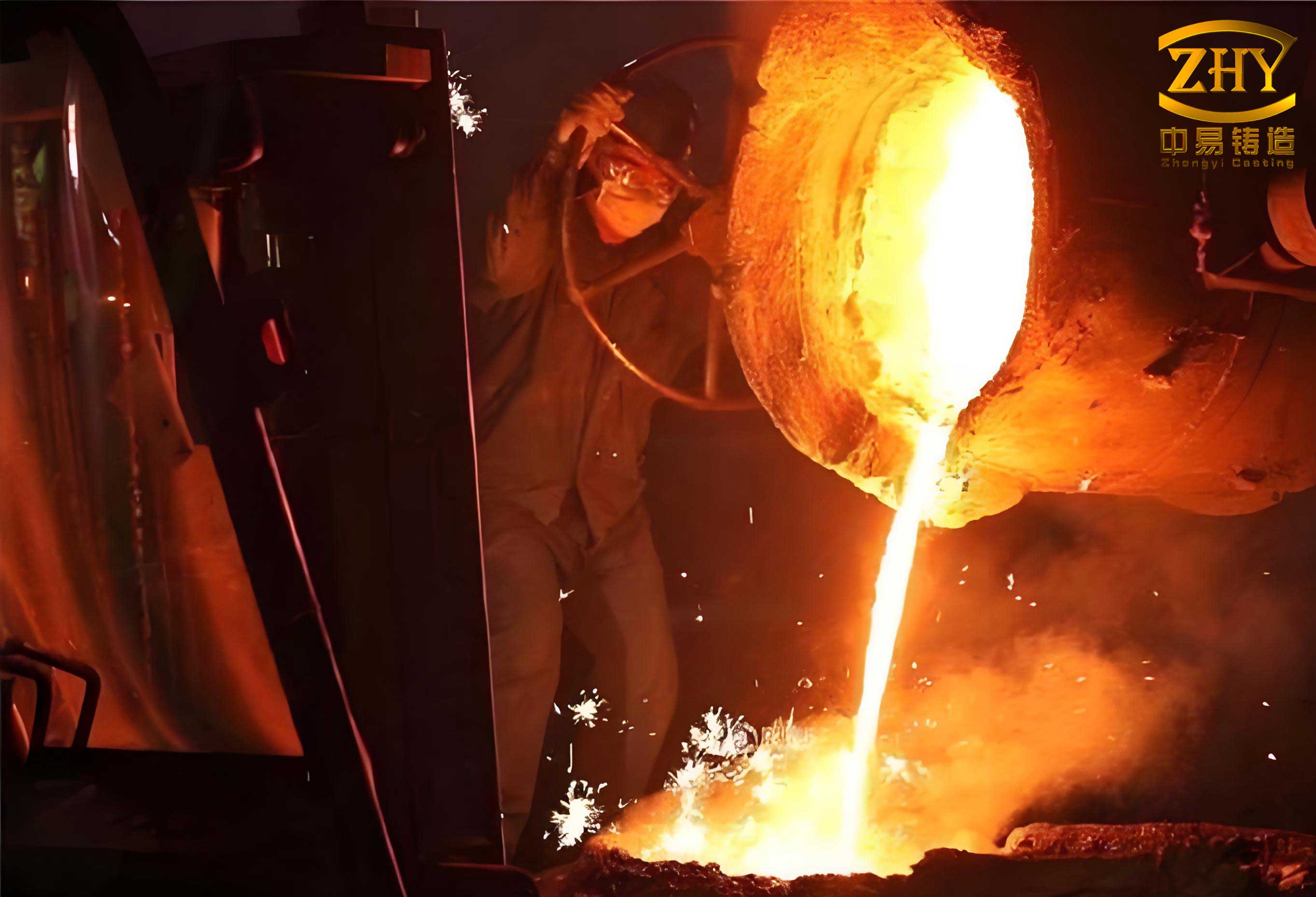
The fundamental principle of sand casting involves creating a mold cavity by compacting sand around a pattern, which is then removed to leave a negative impression. Molten metal is poured into this cavity, and upon solidification, the casting is extracted. The accuracy of the final casting is inherently tied to the precision of the mold, which in turn depends on the design, manufacturing, and management of the mold components. In contemporary manufacturing, especially with the advent of Industry 4.0, there is a growing demand for high-precision castings that minimize machining allowances and reduce material waste. Unfortunately, in many operations, the focus on mold precision is often overlooked, leading to castings that fail to meet stringent tolerances. This issue is particularly pronounced in sand casting, where the mold is typically destructible and subject to wear and tear. Through this discussion, I will emphasize how optimizing mold-related parameters can significantly elevate the quality of sand casting outcomes.
Before delving into specifics, it is essential to understand the key components of a sand casting mold. The pattern, usually made of wood, metal, or plastic, defines the external shape of the casting. The core box is used to form cores that create internal features. Templates and pattern plates ensure consistent pattern placement, while mold boxes (flasks) hold the sand in place. Each of these elements contributes to the overall dimensional error of the casting. The cumulative effect of errors from these sources can be expressed through an error propagation model. For instance, the total dimensional deviation in a sand casting can be approximated as:
$$ \Delta_{total} = \Delta_{pattern} + \Delta_{core} + \Delta_{mold\_assembly} + \Delta_{shrinkage} + \Delta_{thermal} $$
Where:
– $\Delta_{pattern}$ is the manufacturing error of the pattern.
– $\Delta_{core}$ is the error associated with core making and placement.
– $\Delta_{mold\_assembly}$ is the error due to mold assembly, including misalignment.
– $\Delta_{shrinkage}$ is the error from uncertain metal shrinkage.
– $\Delta_{thermal}$ accounts for thermal distortions during cooling.
In sand casting, the mold-related errors ($\Delta_{pattern}$, $\Delta_{core}$, $\Delta_{mold\_assembly}$) are often dominant and can be controlled through proper mold engineering. The shrinkage error, while material-dependent, can be mitigated by accurate pattern scaling. The shrinkage relationship is given by:
$$ L_{casting} = L_{pattern} \times (1 + S) $$
Here, $L_{casting}$ is the final casting dimension, $L_{pattern}$ is the pattern dimension, and $S$ is the linear shrinkage factor of the metal. The uncertainty in $S$ leads to a shrinkage error $\delta L_{shrinkage} = L_{pattern} \cdot \delta S$, where $\delta S$ is the variation in shrinkage. Thus, controlling pattern dimensions and shrinkage predictability is crucial for accuracy in sand casting.
The factors affecting casting accuracy in sand casting are multifaceted. Firstly, mold design flaws, such as inadequate draft angles or improper gating, can cause dimensional inaccuracies and surface defects. Secondly, manufacturing tolerances of mold components directly translate to casting variances. For example, a pattern with poor surface finish will impart that roughness onto the casting. Thirdly, the fit and alignment of mold parts, such as the pins and bushes used for mold assembly, are critical; excessive clearance can lead to mismatches (e.g., shift or flash). Fourthly, operational practices, including mold handling, sand compaction, and pouring techniques, introduce variability. Lastly, mold wear over time degrades precision, necessitating regular maintenance. These factors are interrelated, and their impact is amplified in high-volume sand casting production where consistency is paramount.
To quantify the influence of mold alignment, consider the misalignment error due to pin-and-bush clearance in mold assembly. If a mold box uses two pins of diameter $d_p$ and bushes of diameter $d_b$, the radial clearance is $c = d_b – d_p$. Assuming the pins are centrally located, the maximum possible lateral shift $\delta_{shift}$ between mold halves can be approximated as:
$$ \delta_{shift} = \frac{c}{\sqrt{2}} $$
This shift directly contributes to casting dimensional error and mismatch. Therefore, controlling clearance is vital for precision in sand casting.
One of the primary methods to improve casting accuracy is the rational selection of fit tolerances for mold components. In sand casting, the pins and bushes used for aligning mold halves (e.g., in pattern plates or flasks) must have carefully chosen tolerances to ensure precise assembly without excessive play. Based on production volume and method, different tolerance grades are recommended. The following tables summarize proposed fit tolerances for various sand casting scenarios.
| Production Method | Tolerance Grade | Application | Typical Clearance (mm) |
|---|---|---|---|
| High-pressure molding, mass production | H7/I | Precision sand casting with tight tolerances | 0.010 – 0.025 |
| Machine molding, batch production | H8/II | General sand casting for large batches | 0.025 – 0.050 |
| Hand molding, small-scale production | H9/III | Prototype or low-volume sand casting | 0.050 – 0.100 |
The tolerance grades (e.g., H7, H8) refer to ISO standard limits and fits, where H denotes a hole basis system. For sand casting molds, the selection should minimize cumulative error. The total assembly error $\Delta_{assembly}$ in a mold can be estimated as:
$$ \Delta_{assembly} = \sqrt{ \Delta_{pin}^2 + \Delta_{bush}^2 + \Delta_{wear}^2 } $$
Where $\Delta_{pin}$ and $\Delta_{bush}$ are manufacturing tolerances of pins and bushes, and $\Delta_{wear}$ accounts for wear-induced enlargement. For high-precision sand casting, tighter tolerances (e.g., H7) reduce $\Delta_{assembly}$, thereby enhancing casting accuracy.
| Nominal Diameter Range (mm) | H7/I Tolerance (High Precision) | H8/II Tolerance (Medium Precision) | H9/III Tolerance (Low Precision) |
|---|---|---|---|
| 10 – 18 | +0.018 / 0 | +0.027 / 0 | +0.043 / 0 |
| 18 – 30 | +0.021 / 0 | +0.033 / 0 | +0.052 / 0 |
| 30 – 50 | +0.025 / 0 | +0.039 / 0 | +0.062 / 0 |
| 50 – 80 | +0.030 / 0 | +0.046 / 0 | +0.074 / 0 |
| 80 – 120 | +0.035 / 0 | +0.054 / 0 | +0.087 / 0 |
These values are illustrative; actual tolerances should be based on specific sand casting requirements. For instance, in high-pressure sand casting, where molds are subjected to significant forces, tighter fits prevent distortion and misalignment.
Another critical aspect is the manufacturing tolerance of the mold components themselves, such as patterns and core boxes. The dimensional accuracy of these parts sets the baseline for casting precision. In sand casting, patterns are often made from metal (e.g., aluminum or iron) for durability, and their manufacturing deviations must be controlled. The following table provides guidelines for metal pattern and core box tolerances based on casting accuracy classes.
| Dimension Range (mm) | Class I: High Precision (e.g., Iron molds, hot core boxes) | Class II: Medium Precision (Machine molding) | Class III: Low Precision (Hand molding) |
|---|---|---|---|
| ≤ 50 | ± 0.10 | ± 0.16 | ± 0.25 |
| > 50 – 120 | ± 0.12 | ± 0.19 | ± 0.30 |
| > 120 – 260 | ± 0.16 | ± 0.25 | ± 0.40 |
| > 260 – 500 | ± 0.21 | ± 0.32 | ± 0.52 |
| > 500 – 800 | ± 0.28 | ± 0.44 | ± 0.69 |
| > 800 – 1250 | ± 0.35 | ± 0.54 | ± 0.89 |
| > 1250 – 2000 | ± 0.50 | ± 0.79 | ± 1.25 |
| > 2000 – 3150 | ± 0.70 | ± 1.10 | ± 1.75 |
These tolerances reflect the permissible deviations during pattern fabrication. For sand casting, it is essential to consider that pattern errors are magnified by shrinkage. If a pattern has an error $\delta L_{pattern}$, the resulting casting error $\delta L_{casting}$ due to pattern inaccuracy alone is:
$$ \delta L_{casting} = \delta L_{pattern} \times (1 + S) $$
Thus, tighter pattern tolerances are warranted for high-accuracy sand casting. Additionally, the surface finish of patterns affects casting surface roughness; a smoother pattern yields a better casting finish, reducing post-casting machining.
Core-related dimensions also require careful tolerance control in sand casting. Core prints (the portions of cores that fit into mold cavities) must have appropriate clearances to ensure proper seating without causing dimensional interferences. The table below offers tolerance recommendations for core prints and core boxes in sand casting.
| Core Print Max Dimension (mm) | Core Box Tolerance (Negative) | Pattern Core Print Tolerance (Positive, Based on Casting Class) |
|---|---|---|
| ≤ 15 | -0.10 | +0.15 / +0.05 (Class I), +0.30 / +0.20 (Class II), +0.45 / +0.30 (Class III) |
| > 15 – 30 | -0.15 | +0.25 / +0.10 (I), +0.45 / +0.30 (II), +0.75 / +0.50 (III) |
| > 30 – 80 | -0.20 | +0.30 / +0.10 (I), +0.60 / +0.40 (II), +0.90 / +0.60 (III) |
| > 80 – 160 | -0.25 | +0.40 / +0.15 (I), +0.75 / +0.50 (II), +1.20 / +0.80 (III) |
| > 160 – 260 | -0.30 | +0.45 / +0.15 (I), +0.90 / +0.60 (II), +1.35 / +1.00 (III) |
| > 260 – 380 | -0.35 | +0.50 / +0.20 (I), +1.05 / +0.70 (II), +1.65 / +1.10 (III) |
| > 380 – 500 | -0.40 | +0.60 / +0.20 (I), +1.20 / +0.80 (II), +1.80 / +1.20 (III) |
| > 500 – 800 | -0.50 | +0.70 / +0.25 (I), +1.35 / +1.00 (II), +2.10 / +1.40 (III) |
| > 800 – 1000 | -0.55 | +0.85 / +0.30 (I), +1.65 / +1.10 (II), +2.40 / +1.60 (III) |
| > 1000 – 1250 | -0.60 | +0.90 / +0.30 (I), +1.80 / +1.20 (II), +3.00 / +2.00 (III) |
In sand casting, core print tolerances are asymmetric to facilitate core placement while preventing excessive movement. The negative tolerance on core boxes ensures a slight interference, reducing core shift during molding. The cumulative effect of core tolerances on casting accuracy can be modeled as a statistical sum, especially in complex sand castings with multiple cores.
Beyond tolerances, the management of molds is paramount for maintaining accuracy in sand casting. Mold components are subject to wear, damage, and dimensional degradation over time. A rigorous management system includes regular inspection, cleaning, and calibration. For instance, the wear rate of a pattern in sand casting can be estimated based on the number of cycles. If each molding cycle causes an average wear depth $w$, then after $n$ cycles, the dimensional change $\Delta_{wear}$ is:
$$ \Delta_{wear} = n \cdot w $$
Where $w$ depends on sand abrasiveness, pattern material, and molding pressure. For aluminum patterns in silica sand sand casting, $w$ might range from 0.001 to 0.01 mm per cycle. Thus, monitoring cycle counts and implementing preventive maintenance is crucial. Additionally, storage conditions—such as controlling humidity to prevent rust or warpage—affect mold longevity and precision in sand casting operations.
Operational practices also play a significant role. For example, in sand casting, improper mold assembly sequences—such as removing alignment pins before clamping—can cause mismatch errors. Training personnel to follow standardized procedures reduces human-induced variability. Moreover, using advanced technologies like 3D scanning for mold inspection can detect deviations early, allowing for corrective actions before casting production.
To synthesize the impact of mold parameters on casting accuracy, consider a holistic quality function for sand casting. The overall casting dimension $X$ can be expressed as:
$$ X = X_{nominal} + \epsilon_{pattern} + \epsilon_{core} + \epsilon_{assembly} + \epsilon_{shrinkage} + \epsilon_{process} $$
Where each $\epsilon$ term represents a random error component with a certain distribution (e.g., normal distribution). The total variance $\sigma^2_{total}$ is:
$$ \sigma^2_{total} = \sigma^2_{pattern} + \sigma^2_{core} + \sigma^2_{assembly} + \sigma^2_{shrinkage} + \sigma^2_{process} $$
By reducing the variances through tighter tolerances and better control, the casting accuracy improves. For sand casting, targeting a process capability index (e.g., $C_p \geq 1.33$) ensures that most castings fall within specification limits.
In conclusion, the precision of sand casting components is profoundly influenced by the design, manufacturing, and management of molds. Through rational selection of fit tolerances, adherence to stringent manufacturing tolerances for patterns and core boxes, and implementation of strict mold management protocols, foundries can significantly enhance casting accuracy. This not only aligns with international standards like ISO 8062 for casting tolerances but also reduces material usage and machining costs. As sand casting continues to evolve with automation and digital technologies, integrating these principles will be key to producing high-integrity castings for demanding applications. Ultimately, a proactive approach to mold engineering is indispensable for excellence in sand casting.
To further illustrate, let’s consider a case study in sand casting. Suppose a foundry produces engine blocks via sand casting. By optimizing mold pin-and-bush tolerances from H9 to H7, they reduced mismatch errors by 50%. Additionally, implementing regular pattern inspections every 500 cycles cut dimensional drift by 30%. These improvements translated to a 20% reduction in machining allowances, yielding substantial cost savings. Such examples underscore the tangible benefits of focusing on mold precision in sand casting.
In summary, every aspect of the mold—from its initial design to its end-of-life management—matters for casting accuracy. As we advance in the era of smart manufacturing, leveraging data analytics to monitor mold wear and predict failures will further refine sand casting processes. I encourage practitioners to adopt a systematic, data-driven approach to mold optimization, ensuring that sand casting remains a competitive and precise manufacturing method for years to come.