
As a practitioner in the field of foundry engineering, I have witnessed the evolution of sand casting from manual methods to today’s automated high-pressure molding lines. This advancement has significantly boosted productivity and improved the quality of sand castings, making it the most widely used method in modern large-scale machinery manufacturing. The advantages of sand casting are undeniable: it is not limited by part shape, size, or complexity; raw materials are readily available; production cycles are short; costs are low; and it can produce castings from almost all casting alloys. In this article, I will detail, from my first-hand experience, the comprehensive process of designing and manufacturing metal molds for sand castings, using the timing gear chamber of a diesel engine as a典型案例. This component is a typical thin-walled casting essential in diesel generators for mining, railways, construction sites, and various industrial applications. The demand for such sand castings is substantial, necessitating efficient and precise mold design.
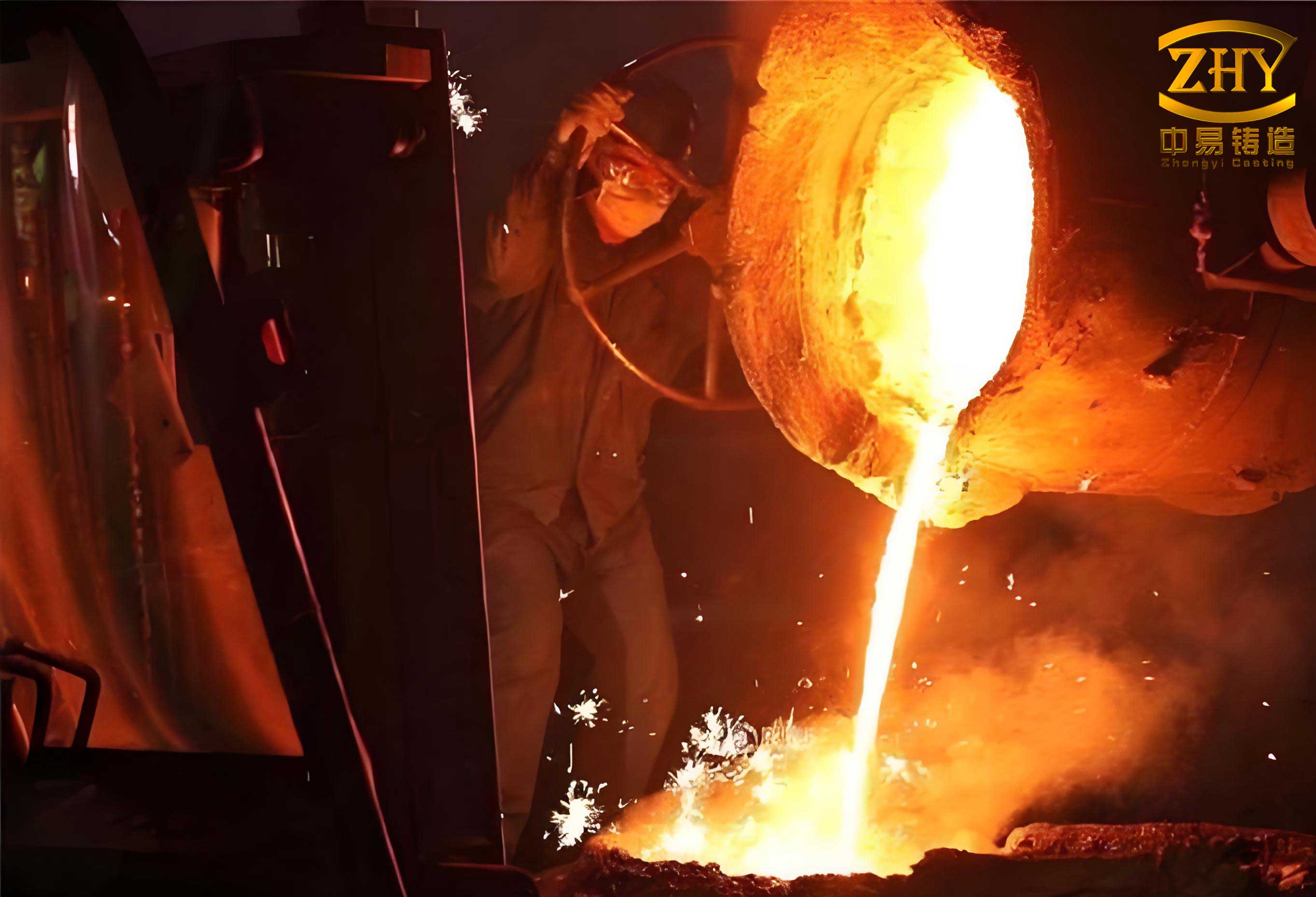
The core of producing high-quality sand castings lies in the metal mold, which is used to form the sand molds themselves. The design of this mold is more complex than that for injection molding, as it must account for铸造工艺 factors like shrinkage, machining allowances, draft angles, and fillets. The final sand castings are rough blanks that require subsequent machining. My focus here is on the metal mold that shapes the sand, enabling the mass production of consistent sand molds for casting.
Analysis of the Timing Gear Chamber Casting
The timing gear chamber is a critical component in diesel engine transmission systems. The casting material is gray iron HT200, requiring uniform wall thickness, regular shape, and smooth surface transitions. The technical specifications mandate stress relief aging, a hardness range of 170-241 HB, and the absence of penetrating defects like blowholes, sand inclusions, or slag. Achieving these in sand castings requires meticulous mold design. The part is approximately 400 mm in length, and to prevent warping during cooling, which could compromise machinability, the major mounting face requires a larger machining allowance. Key design considerations for the sand casting mold include:
- Shrinkage allowance for HT200.
- Machining allowances for various surfaces.
- Fillet radii for stress reduction.
- Draft angles for pattern removal from the sand mold.
These parameters are foundational for creating the 3D model of the casting blank.
| Parameter | Value | Remarks |
|---|---|---|
| Material Shrinkage | 1.0% | Linear contraction during solidification |
| General Machining Allowance | 2.5 mm | For holes > Φ10 mm and small faces |
| Major Face Allowance | 3.0 mm | Large mounting face to prevent warping |
| Unspecified Fillet Radius | R2 – R5 mm | Reduces stress concentrations |
| Unspecified Draft Angle | 0.5° – 1.0° | Facilitates pattern withdrawal |
| Cast Hardness | 170-241 HB | After aging treatment |
The shrinkage allowance is critical for dimensional accuracy. The linear shrinkage can be expressed as:
$$ L_{casting} = L_{pattern} \times (1 – S) $$
where $L_{casting}$ is the final casting dimension, $L_{pattern}$ is the pattern dimension on the metal mold, and $S$ is the shrinkage rate (e.g., 0.01 for 1%).
3D Modeling of the Casting Blank
Using CAD software (like Pro/ENGINEER), I construct a 3D model of the timing gear chamber blank, incorporating all the parameters from Table 1. This model serves as the reference for designing the sand mold cavity. Features such as threaded holes and定位销孔 are not modeled, as they will be machined post-casting. The 3D model ensures that all几何元素 account for the necessary allowances, forming the basis for the subsequent sand mold and metal mold design. This step is crucial for visualizing the final sand castings and planning the mold parting.
Design of the Sand Mold (Cope and Drag)
The sand mold consists of two halves: the cope (upper) and the drag (lower). The parting line must be carefully determined. For this timing gear chamber, due to the presence of two raised boss features (mounting pads), a stepped parting surface is necessary to enable proper mold opening. Within the CAD software’s molding simulation module, I define this parting surface and split the mold cavity workpiece into the cope and drag. The sand mold cavity is designed to fit a standard molding flask. The dimensions of the associated pattern plate are critical for integration into automated molding lines.
| Component | Dimension (mm) | Description |
|---|---|---|
| Pattern Plate (Base) | 700 x 500 | Mounting area for metal mold halves |
| Initial Workpiece (Drag) | 700 x 500 x 250 | Volume for creating the drag sand mold |
| Initial Workpiece (Cope) | 700 x 500 x 200 | Volume for creating the cope sand mold |
The design of the gating system is paramount for producing sound sand castings. The cross-sectional area of the runners must be calculated based on the casting weight and wall thickness to ensure proper filling and feeding. For this casting, with an approximate weight of 25 kg and a dominant wall thickness of 6 mm, the required total runner cross-sectional area $A_{req}$ can be estimated using empirical formulas. A common rule for gray iron sand castings relates runner area to casting weight and section thickness. The actual runner area $A_{act}$ must satisfy $A_{act} \geq A_{req}$.
An empirical formula for the choke area (at the sprue base) for gray iron is often derived from:
$$ A_c = k \sqrt{W} $$
where $A_c$ is the choke area (cm²), $W$ is the casting weight (kg), and $k$ is a factor typically between 0.6 and 1.0 for medium-sized sand castings. For a more precise runner design, the total runner cross-sectional area is calculated based on the intended filling time and flow velocity. The fundamental fluid flow equation is:
$$ Q = A \cdot v $$
where $Q$ is the volumetric flow rate, $A$ is the cross-sectional area, and $v$ is the flow velocity. For sand castings, the pour time $t$ is estimated, and the required flow rate is $Q = V_{casting} / t$, where $V_{casting}$ is the casting volume. However, for this case, I use a standard practice table.
| Element | Design Value | Calculation/Reasoning |
|---|---|---|
| Casting Weight (W) | ~25 kg | From 3D model volume & density of HT200 (~7.2 g/cm³) |
| Required Runner Area (A_req) | ~6.0 cm² | Empirical: A_req ≈ 0.24√W (cm²/kg^{0.5}) for wall thickness ~6mm |
| Ingate Design (each, 2 off) | Length: 80 mm, Height: 8 mm | Rectangular, placed on straight edges for easy cleaning |
| Single Ingate Area | 6.4 cm² | A_ingate = 8.0 cm * 0.8 cm = 6.4 cm² |
| Total Ingate Area (A_act) | 12.8 cm² | 2 * 6.4 cm² = 12.8 cm² |
| Verification | A_act (12.8) > A_req (6.0) | Design is safe, ensures adequate feed metal |
| Cross Runner (in Cope) | Trapezoidal: Top 60mm, Bottom 50mm, Ht 20mm | Area = ((60+50)/2)*20 = 1100 mm² = 11.0 cm² |
The relationship is verified: $A_{act} = 12.8 \, \text{cm}^2 > A_{req} \approx 6.0 \, \text{cm}^2$, confirming the gating design is suitable for these sand castings.
Design of the Metal Mold for Sand Production
The metal mold (pattern) is the reverse image of the sand mold cavity. It is mounted on the pattern plate and used in molding machines to produce the cope and drag sand molds rapidly. In CAD, I create an assembly, importing the drag sand cavity and the initial workpiece. Using a Boolean subtraction operation, I generate the 3D shape of the drag half of the metal mold. This shape is then complemented with a base plate, ingates, and定位销孔 for alignment with the cope half. A critical feature added is a “crush band” or压拔缝 around the perimeter. This is a raised ridge (e.g., 2-3 mm wide, 2 mm high) that ensures a tight seal between the cope and drag sand molds during closing, preventing metal penetration and improving casting dimensional accuracy. The complete drag metal mold design includes these elements.
The same process is repeated for the cope half. The cross runner is often designed as a separate piece for easier machining and material savings, then assembled onto the cope metal mold. The final metal mold assembly must ensure proper venting for the sand, but that is more a function of the sand mold itself. The design priorities for the metal mold are durability (to withstand high-pressure molding), precision, and features that facilitate the production of consistent sand molds.
| Mold Half | Key Features | Dimensions/Notes |
|---|---|---|
| Drag (Lower) Metal Mold | Main cavity imprint, base plate, two ingates,定位销孔, crush band. | Overall thickness ~80mm; material HT200. |
| Cope (Upper) Metal Mold | Main cavity imprint, cross runner mount,定位销孔 receptacles, crush band. | Overall thickness ~60mm; material HT200. |
| Cross Runner (Separate) | Trapezoidal cross-section. | Top=60mm, Bottom=50mm, Height=20mm. Bolted to cope. |
| Crush Band | Continuous peripheral ridge. | Width: 2-3 mm, Height: 2 mm. Ensures sand mold seal. |
The volume of the metal mold blocks can be estimated for material costing. If the drag mold block has approximate plan dimensions of 700×500 mm and a height of 80 mm, its volume $V_{drag}$ is:
$$ V_{drag} = 700 \, \text{mm} \times 500 \, \text{mm} \times 80 \, \text{mm} = 28 \times 10^6 \, \text{mm}^3 = 0.028 \, \text{m}^3 $$
The weight, using a density $\rho$ for HT200 of about 7200 kg/m³, is:
$$ W_{drag} = \rho \times V_{drag} = 7200 \times 0.028 \approx 202 \, \text{kg} $$
Similar calculations apply to the cope. This highlights the substantial material use in large metal molds for sand castings.
Manufacturing and Machining of the Metal Mold
With the 3D design complete, the manufacturing phase begins. The selected material for the metal mold is HT200, chosen for its good castability, wear resistance, and stability—essential for producing thousands of sand molds. The manufacturing process involves two main steps: first, producing a rough casting of the mold blocks themselves, and second, precision machining.
- Pattern Making for the Mold Blocks: A wooden master pattern of the mold blocks is created, incorporating the same 1.0% shrinkage allowance. This wooden pattern is used in a sand casting process to produce rough cast iron (HT200) blanks for the drag and cope metal molds. This recursive use of sand casting to make the tooling for sand castings is standard practice.
- CNC Machining: The rough cast blanks are then mounted on a 5-axis machining center. Using the CNC program generated from the 3D CAD model, the final precise geometry is machined. This includes the intricate cavity details, the ingates,定位销孔, crush band, and mounting surfaces. Machining parameters are critical for surface finish and accuracy, which directly affect the quality of the resulting sand castings.
| Machining Operation | Tool Type | Cutting Speed (v_c, m/min) | Feed Rate (f_z, mm/tooth) | Depth of Cut (a_p, mm) | Objective |
|---|---|---|---|---|---|
| Roughing | Face Mill (Carbide) | 80-120 | 0.15-0.25 | 2.0-5.0 | Remove bulk material quickly |
| Semi-Finishing | Ball Nose End Mill | 100-150 | 0.1-0.2 | 0.5-1.5 | Approach final shape, leave stock |
| Finishing (Cavity) | Ball Nose End Mill (Fine) | 150-200 | 0.05-0.1 | 0.1-0.3 | Achieve precise cavity surface |
| Finishing (Planes) | End Mill | 120-180 | 0.08-0.15 | 0.2-0.5 | Ensure flat mounting surfaces |
The material removal rate (MRR) during roughing is an important metric for efficiency:
$$ MRR = a_p \times a_e \times v_f $$
where $a_p$ is the depth of cut, $a_e$ is the width of cut, and $v_f$ is the feed velocity. The feed velocity $v_f$ is related to spindle speed $N$ (RPM), number of teeth $Z$, and feed per tooth $f_z$ by:
$$ v_f = N \times Z \times f_z $$
And spindle speed $N$ is derived from cutting speed $v_c$ and tool diameter $D$:
$$ N = \frac{1000 \times v_c}{\pi \times D} $$
These formulas guide the programming of the CNC machine to optimize the machining of the HT200 mold blocks.
Quality Control and Production Validation
After machining, the metal mold halves are assembled on the pattern plate and checked for alignment, flatness, and cavity dimensions. A trial production run is conducted. Sand molds are produced using the new metal mold on an automated molding line. These sand molds are then used to cast timing gear chambers. The first-off sand castings are inspected for dimensional accuracy against the CAD model, and sectioned to check for internal soundness—ensuring no shrinkage porosity or inclusions in critical areas. Hardness tests are performed to verify they meet the 170-241 HB specification. Only after these validation steps is the metal mold approved for mass production of sand castings.
The entire process, from 3D modeling to validated production, underscores how modern CAD/CAM and simulation tools have revolutionized the design of molds for sand castings. They reduce reliance on trial-and-error, shorten development cycles, and lower costs, making the production of complex sand castings like the timing gear chamber more scientific and reliable.
Conclusion and Future Perspectives
In detailing the design and manufacturing journey of a metal mold for sand casting a timing gear chamber, I have highlighted the intricate interplay between casting工艺 parameters, mechanical design, and advanced manufacturing. The success of producing high-quality sand castings hinges on a holistic approach that integrates material science (shrinkage of HT200),几何设计 (draft, fillets), fluid dynamics (gating design), and precision machining. The use of metal molds in automated high-pressure molding lines is what enables the economical mass production of reliable sand castings for the automotive and machinery industries.
The future of sand casting模具 design lies in further integration of simulation technologies, such as solidification and stress analysis, directly into the CAD environment, allowing for even more optimized designs before any metal is cut. Additive manufacturing (3D printing) of sand molds directly from CAD data is also emerging, but for high-volume production, durable metal molds remain indispensable. As a designer, my goal is to continue leveraging these technologies to push the boundaries of what is possible with sand castings, ensuring they remain a competitive and vital manufacturing process for complex components. The principles outlined here—from the initial 3D blank model to the final CNC machined mold—form a robust framework for tackling the challenges of metal mold design for diverse sand castings.