
In the realm of internal combustion engines, the demand for high-performance components has steadily driven the adoption of advanced materials and manufacturing techniques. Among these, spheroidal graphite cast iron, commonly known as ductile iron, has emerged as a pivotal material for piston rings due to its exceptional combination of strength, thermal stability, and wear resistance. As an engineer and researcher deeply involved in the foundry industry, I have witnessed the evolution of various casting methods for producing spheroidal graphite cast iron piston rings, each with its unique advantages and challenges. This article aims to provide a comprehensive overview of these casting processes, focusing on single-piece, double-piece, and cylindrical casting methods, while integrating comparative analyses through tables and formulas to elucidate key aspects. The goal is to offer insights into the optimal practices and future directions for manufacturing high-strength spheroidal graphite cast iron piston rings, ensuring reliability and efficiency in diverse engine applications.
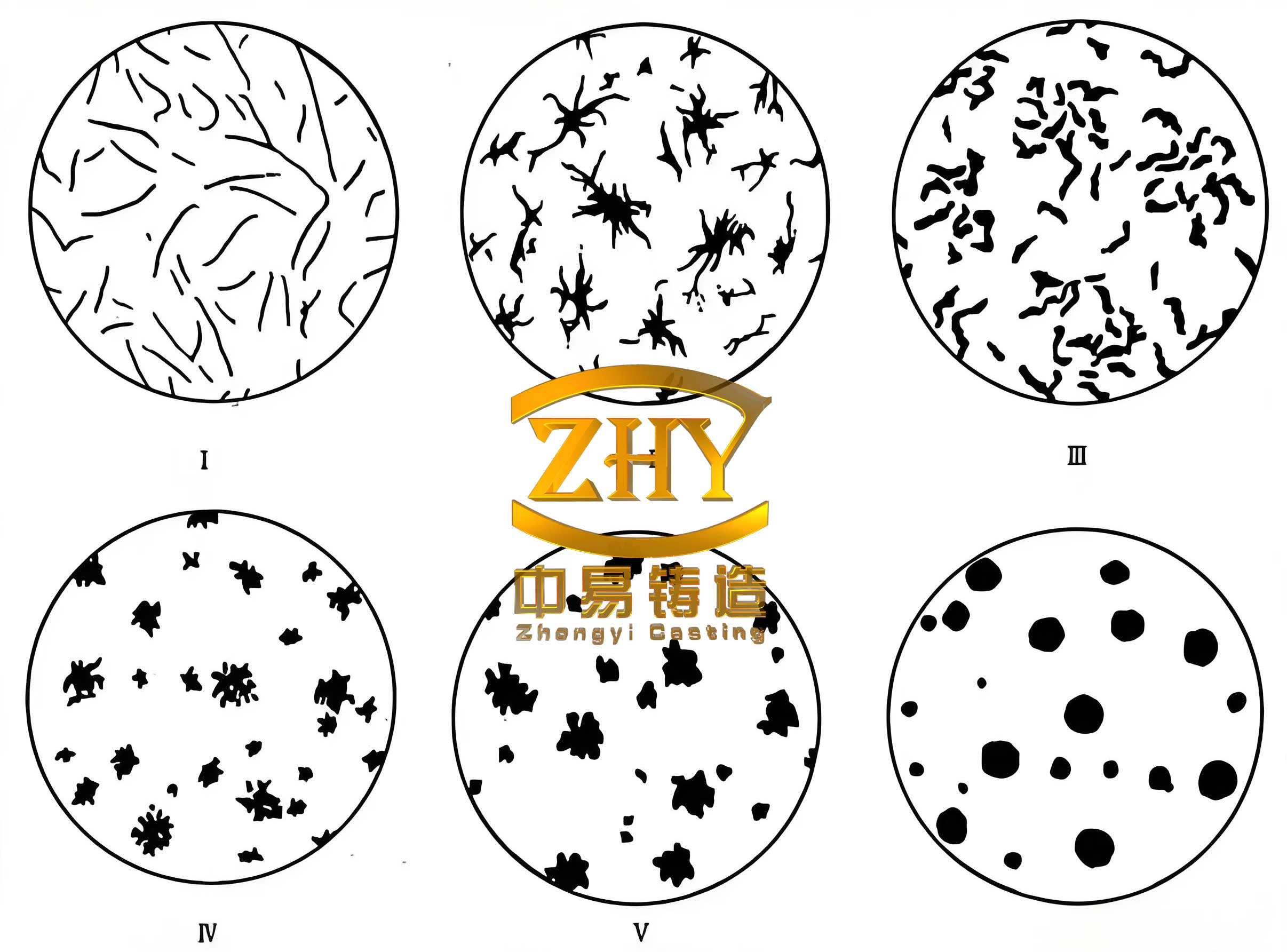
The intrinsic properties of spheroidal graphite cast iron stem from its microstructure, where graphite exists in spherical nodules rather than flakes, as seen in gray iron. This structure imparts superior mechanical properties, such as high tensile strength and ductility, which are critical for piston rings operating under severe thermal and mechanical stresses. The casting of spheroidal graphite cast iron piston rings involves several distinctive characteristics that influence the choice of process. Firstly, the castings are typically simple in geometry—whether as single-piece elliptical rings, double-piece elliptical rings, or cylindrical sleeves—allowing for relatively straightforward mold designs. However, the thin-walled nature of many rings, especially for small engines like motorcycles, poses challenges related to rapid cooling and fluidity of the molten metal. For instance, a single-piece spheroidal graphite cast iron ring for a motorcycle might have a cross-section as small as 2.2 mm × 3.5 mm, necessitating high pouring temperatures to prevent defects like cold shuts or misruns. Additionally, the “mushy solidification” behavior of spheroidal graphite cast iron increases susceptibility to shrinkage porosity and white iron formation, demanding precise control over alloy composition, melting, and spheroidization treatment. These factors underscore the importance of selecting an appropriate casting method to achieve defect-free components with consistent quality.
The fundamental casting processes for spheroidal graphite cast iron piston rings can be broadly categorized into single-piece elliptical sand casting, double-piece elliptical sand casting, and various cylindrical casting techniques, including manual sand casting, automated molding line casting, centrifugal casting, and lost foam casting (EPC). Each method has been developed to address specific production needs, ranging from high-volume manufacturing to niche applications. In single-piece elliptical sand casting, used primarily for small-diameter rings (e.g., below Ø65 mm), the mold design incorporates short risers (typically 3-4 per ring) to collect cooler metal and mitigate centerline shrinkage. This process often employs machines like the Z145 top-jolt squeeze molding machine or semi-automatic high-pressure molding systems in a stack-pouring configuration. While it offers direct machining without slicing, the low yield (10-20%) results in significant scrap回流, requiring efficient recycling strategies. For double-piece elliptical sand casting, which has become a mainstream approach, the mold produces two elliptical rings connected at the inner diameter with a定位 mark. This method leverages similar molding equipment but enhances productivity by allowing simultaneous casting of multiple rings. The elliptical design minimizes machining allowances, enabling profile turning of inner and outer diameters for optimal pressure distribution and thermal stability. Moreover, slicing the double-piece into single rings effectively eliminates中心 shrinkage defects, ensuring high integrity. This versatility makes double-piece casting suitable for a wide range of engine sizes, from agricultural machinery to automotive diesel engines.
Cylindrical casting methods offer alternative pathways for producing spheroidal graphite cast iron piston rings. Manual sand casting, though largely obsolete due to low efficiency and high scrap rates, involves hand-molding cylindrical sleeves with cores, suitable for low-volume production. In contrast, automated molding lines, such as Japan’s Koyo SM-50V or SM-60V or Disa’s vertical flaskless systems, enable high-speed production of short cylindrical sleeves with minimal machining allowances. These lines can achieve rates up to 500 molds per hour, making them ideal for large batches of standardized rings. Centrifugal casting, akin to methods used for cylinder liners, utilizes centrifugal浇注 machines to form cylindrical sleeves with uniform wall thickness. It offers simplicity and lower investment by eliminating sand handling systems, but the substantial machining allowances (e.g., 5 mm on inner and outer diameters) and inherent shrinkage porosity limit its appeal. Lost foam casting (EPC), employing expandable polystyrene patterns, provides another avenue for small-diameter rings, with relatively simple equipment and moderate productivity. However, persistent中心 shrinkage issues and the need for extensive slicing pose significant drawbacks. Throughout these processes, the consistent challenge is managing the solidification characteristics of spheroidal graphite cast iron to avoid defects while maintaining economic viability.
To quantitatively compare these casting methods, we can employ tables and formulas that highlight key parameters such as productivity, material utilization, defect propensity, and cost implications. For instance, the solidification time for a thin-walled spheroidal graphite cast iron casting can be approximated using Chvorinov’s rule, expressed as: $$ t_s = B \left( \frac{V}{A} \right)^n $$ where \( t_s \) is the solidification time, \( V \) is the volume, \( A \) is the surface area, \( B \) is a mold constant, and \( n \) is an exponent typically around 2. This formula underscores the rapid cooling in thin sections, necessitating high fluidity in the molten spheroidal graphite cast iron. Additionally, the probability of shrinkage defects can be modeled based on the feeding efficiency, often related to the modulus method: $$ M = \frac{V}{A} $$ where a higher modulus indicates slower cooling and greater risk of shrinkage if not properly fed. For spheroidal graphite cast iron, the mushy solidification requires careful design of risers and gating systems to ensure sound castings.
| 序号 | Casting Method | Advantages | Disadvantages |
|---|---|---|---|
| 1 | Single-Piece Elliptical Sand Casting | High productivity with machine molding; suitable for mass production; no slicing required, allowing direct grinding; short production cycle from casting to machining. | Poor formability for thin walls; stringent iron quality requirements; low metal yield (10-20%), generating大量回流; limited to small-diameter rings (e.g., motorcycle applications). |
| 2 | Double-Piece Elliptical Sand Casting | High efficiency with machine molding; good formability and easy cleaning; adaptable to various品种; eliminates中心 shrinkage after slicing; small machining allowances enable profile turning. | Requires slicing after grinding or with multi-blade cutters, needing high-precision slicing machines; significant investment in specialized slicing equipment. |
| 3 | Manual Sand Cylindrical Casting | Good formability with design modifications to reduce shrinkage; allows production of similar-diameter rings or oversize variants from one pattern. | Low productivity due to manual labor; high scrap rates; large machining allowances on inner/outer diameters; inefficient slicing; only suitable for larger-diameter rings. |
| 4 | Automatic Molding Line Cylindrical Casting | Very high productivity ideal for mass production; excellent surface quality and low scrap; good formability; design for short cylinders (elliptical or round) minimizes shrinkage; small machining allowances. | Limited adaptability to diverse品种; high investment (e.g., over $650,000 per line); requires efficient slicing machines; difficult to integrate small batches on the line. |
| 5 | Centrifugal Cylindrical Casting | Simple equipment and easy operation; high productivity for mass production; no sand system reduces investment; suitable for larger-diameter rings; one pattern can produce standard and oversize rings. | Large machining allowances on inner/outer diameters, with ends often discarded; presence of中心 shrinkage; low slicing efficiency; round rings may yield less optimal pressure curves compared to profile-turned ones; not ideal for small motorcycle rings. |
| 6 | Lost Foam (EPC) Cylindrical Casting | Relatively simple equipment and lower investment; straightforward molding with moderate productivity; small machining allowances on diameters. | Only suitable for small-diameter short cylinders; prevalent中心 shrinkage defects hard to eliminate; requires many slicing machines; not recommended for critical applications like OEM rings in high-load engines. |
Beyond qualitative comparisons, we can derive formulas to assess economic and technical metrics. For example, the overall cost per ring \( C \) can be expressed as: $$ C = C_m + C_p + C_s $$ where \( C_m \) is material cost, \( C_p \) is processing cost (including molding and melting), and \( C_s \) is slicing and machining cost. For spheroidal graphite cast iron, material costs are influenced by the yield \( Y \), defined as: $$ Y = \frac{W_c}{W_m} \times 100\% $$ where \( W_c \) is the weight of usable castings and \( W_m \) is the weight of molten metal poured. In single-piece casting, \( Y \) often falls below 20%, significantly impacting \( C_m \) due to high回流 rates. In contrast, double-piece casting improves yield by sharing gating systems, while cylindrical methods may have higher yields but incur greater machining costs. Another critical aspect is the defect rate \( D \), which can be modeled as a function of process parameters: $$ D = f(T_p, C_{eq}, t_s) $$ where \( T_p \) is pouring temperature, \( C_{eq} \) is carbon equivalent (affecting fluidity and shrinkage), and \( t_s \) is solidification time. For spheroidal graphite cast iron, maintaining a high \( T_p \) and optimal \( C_{eq} \) is essential to reduce \( D \), especially in thin-walled designs.
Looking toward future developments, the trajectory of casting methods for spheroidal graphite cast iron piston rings points to the refinement and expansion of double-piece elliptical casting, with emerging interest in quadruple-piece elliptical designs. Double-piece casting has established itself as the preferred method due to its balance of productivity, quality, and adaptability. Its ability to produce rings without中心 shrinkage through slicing, coupled with small machining allowances for profile turning, aligns with the stringent requirements of modern engines. Moreover, the use of high-pressure molding machines, such as three-station semi-automatic systems, enables efficient production lines that can handle diverse品种. This flexibility is crucial as engine designs evolve toward higher power densities and emissions regulations tighten, demanding more reliable spheroidal graphite cast iron components.
The next logical step is quadruple-piece elliptical casting, where the mold produces four elliptical rings per impression. This approach, pioneered by companies like Goetze in Germany, leverages high-pressure molding equipment to drastically reduce molding and cleaning labor, thereby lowering production costs. The key challenge lies in developing specialized slicing machines capable of handling quadruple pieces efficiently. With advancements in数控 technology, such machines are becoming feasible, promising further gains in productivity for high-volume spheroidal graphite cast iron ring manufacturing. In contrast, single-piece casting remains niche due to its low yield, while cylindrical methods face limitations: manual sand casting is obsolete; automated lines require prohibitive investments; centrifugal casting suffers from excessive machining; and lost foam casting grapples with inherent shrinkage defects. Thus, the industry is likely to consolidate around double-piece and quadruple-piece elliptical casting as the mainstay for spheroidal graphite cast iron piston rings.
In conclusion, the casting of high-strength spheroidal graphite cast iron piston rings encompasses a diverse array of methods, each tailored to specific production scales and technical constraints. Through detailed analysis, we observe that double-piece elliptical sand casting offers the most compelling combination of efficiency, quality, and versatility, making it the dominant approach for mass production. The integration of tables and formulas in this review highlights critical factors such as solidification behavior, defect management, and economic considerations, all central to optimizing spheroidal graphite cast iron processes. As the automotive and machinery sectors continue to demand higher-performance components, the evolution toward multi-piece elliptical casting—particularly quadruple designs—will drive further innovations in foundry technology. By embracing these advancements, manufacturers can ensure the reliable supply of spheroidal graphite cast iron piston rings that meet the rigorous demands of internal combustion engines worldwide, contributing to enhanced durability and efficiency in diverse applications.