
The cylinder head is a critical component in a multi-cylinder diesel engine, whose casting quality directly influences key performance metrics such as fuel consumption, power output, and exhaust temperature. The pursuit of optimal quality-to-cost ratios in high-volume manufacturing demands a deep understanding of available casting processes. This analysis, drawn from extensive firsthand experience in foundry operations and process development, delves into the technical intricacies, comparative advantages, and strategic application of sand casting and full mold casting (also known as evaporative pattern casting or lost foam casting) for producing complex cylinder heads. The focus remains on achieving dimensional accuracy, internal soundness, and superior surface finish in these demanding sand casting parts and their full mold counterparts.
The journey of manufacturing a cylinder head begins long before molten metal is poured; it starts with a precise digital definition of the part. Modern production relies on advanced Computer-Aided Design (CAD) to construct a three-dimensional product model. For a cylinder head, this is particularly challenging due to complex internal geometries like intake and exhaust ports. The process often involves reverse engineering from physical core models. Data points are captured from a prototype port model using a coordinate measuring machine (CMM). These point clouds are then used to generate complex, free-form surfaces within CAD software. The key to an accurate model lies in segmenting the port into logical sections—straight sections, swirling sections, and transition zones—and constructing surface patches guided by three-dimensional flow lines. The final solid model of the port is created by stitching these surfaces together, ensuring continuity. The complete cylinder head product model results from the Boolean union of the main body “skeleton” with all functional models like ports, valve guides, and cooling jackets.
This digital product model, however, is not the final blueprint for the pattern or mold. A fundamental metallurgical consideration must be applied: accounting for the solidification shrinkage of the metal. The pattern dimensions must be systematically enlarged. For a typical gray iron like HT250, the linear shrinkage allowance is approximately 1.0%. Therefore, the pattern model is uniformly scaled. The scaling factor $ S $ is applied to all linear dimensions of the product model $ D_{casting} $ to obtain the pattern dimension $ D_{pattern} $:
$$ D_{pattern} = D_{casting} \times (1 + S) $$
For instance, if $ S = 0.01 $ (1%), a 100 mm casting dimension requires a 101 mm pattern dimension. It is crucial to note that this scaling is applied before any other features like draft angles are added. This foundational step is common to both sand casting and full mold casting pattern development, ensuring the final sand casting parts meet dimensional specifications.
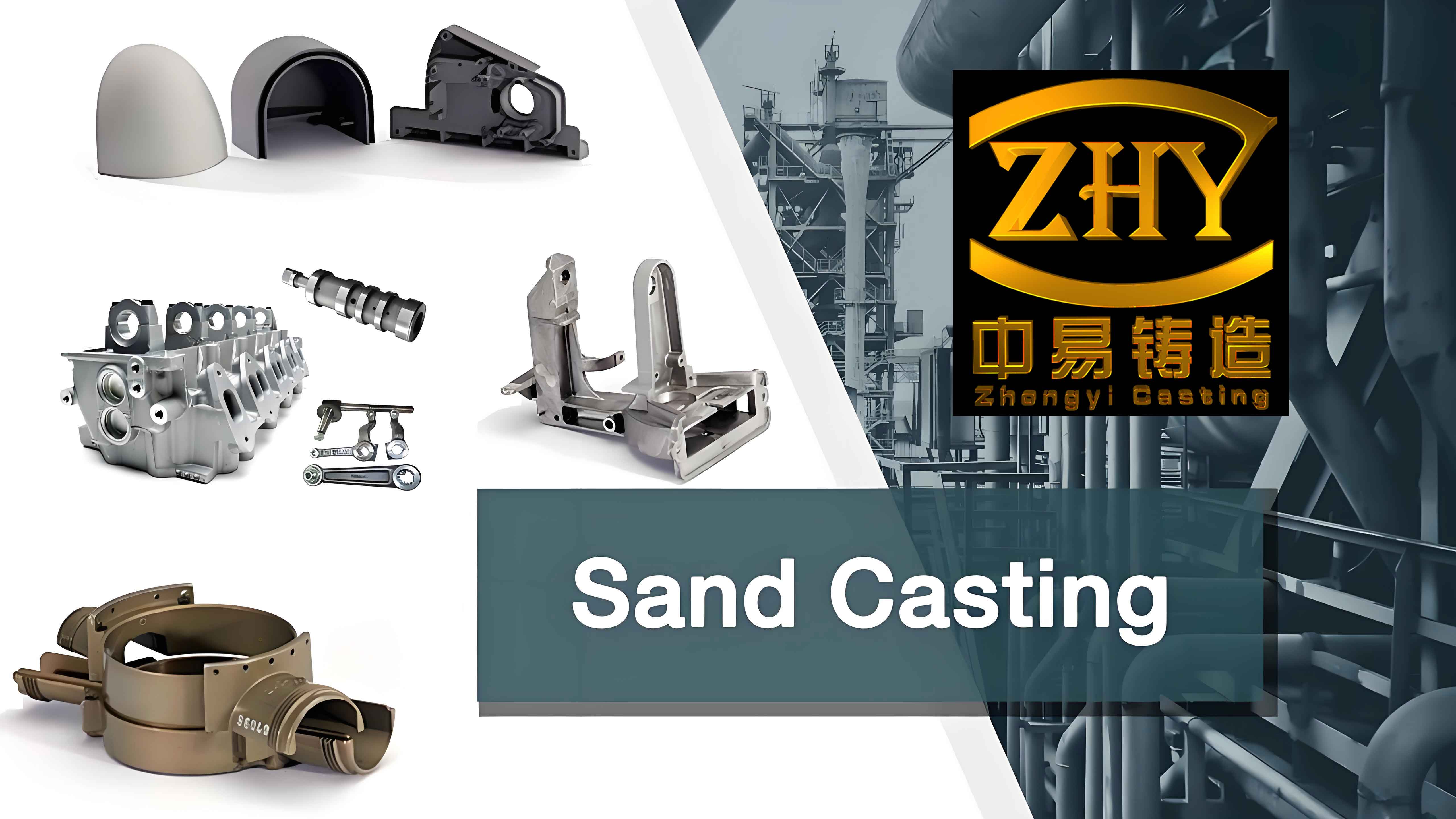
Sand Casting Production Technology for Cylinder Heads
Sand casting, the most ubiquitous metal casting process, involves creating a disposable mold from compacted sand. For complex sand casting parts like cylinder heads, the mold cavity is formed by an external pattern (for the outer shape) and internal sand cores (for the inner passages). The process strategy can vary significantly based on production volume.
For prototype development and very low-volume production, manual methods are employed. Wooden or epoxy resin patterns are used for molding, and cores are made by hand in core boxes. This approach offers maximum flexibility and the lowest initial tooling cost. Adjustments to the gating or risering system can be made rapidly. However, the consistency and quality of the resulting sand casting parts are highly dependent on the skill of the molder. Labor intensity is high, and productivity is low, making it unsuitable for mass production.
For high-volume manufacturing of cylinder heads, automated sand casting lines are essential. The process is characterized by the following elements:
- Mold Making: High-pressure molding machines (e.g., jolt-squeeze or impact molding) are used to produce dense, uniform mold halves (cope and drag) using green sand (a mixture of silica sand, clay, and water). The mold rigidity is critical for dimensional accuracy.
- Core Making: Complex internal cavities are created using bonded sand cores. Hotbox cores (where a thermosetting resin is cured by heat) and shell cores (where a sand-resin mixture forms a thin, hollow shell) are prevalent for cylinder head ports and water jackets. These processes produce accurate, high-strength cores with excellent surface finish.
- Assembly: Cores are precisely placed into the drag mold half before the cope is closed. This core assembly defines the intricate internal geometry of the final casting.
- Gating and Risering: A carefully designed system of channels (gates) feeds molten metal into the mold cavity. Riser reservoirs supply liquid metal to compensate for shrinkage during solidification, preventing internal porosity in the critical sections of the sand casting parts.
The table below summarizes the two primary approaches within sand casting for cylinder head production:
| Aspect | Manual / Low-Volume Sand Casting | Automated / High-Volume Sand Casting |
|---|---|---|
| Pattern/Mold Type | Wood, Epoxy Resin Patterns; Hand-rammed molds. | Metal Tooling for molding machines and core shooters. |
| Production Volume | Very low to low (prototypes, spares). | High to very high (mass production). |
| Labor Skill Requirement | Very High. | Moderate (machine operation focus). |
| Unit Cost at Low Volume | Lower (tooling cost amortized). | Extremely High (high tooling cost). |
| Unit Cost at High Volume | Prohibitively High. | Low (economies of scale). |
| Quality Consistency | Variable, operator-dependent. | High and repeatable. |
| Process Flexibility | Very High (easy to modify). | Very Low (costly and time-consuming tool changes). |
| Typical Application | R&D, niche markets, maintenance. | Automotive, engine manufacturing. |
Full Mold Casting Production Technology for Cylinder Heads
Full mold casting is a “cavity-less” casting process where a pattern made of expandable polystyrene (EPS) foam is embedded in unbonded sand. The molten metal vaporizes and replaces the foam pattern, exactly replicating its shape. For cylinder heads, this process presents unique advantages and specific technical requirements.
The first critical step is Pattern Design and Segmentation. The scaled CAD model of the cylinder head must be intelligently decomposed into foam pieces that can be easily manufactured via bead molding in aluminum tooling. Segmentation is driven by several factors: avoiding undercuts in the tooling, ensuring proper foam bead flow and fusion during molding, and facilitating easy assembly. A typical four-cylinder head might be split into four main sections: the lower firedeck section, the upper rocker cover section, and potentially separate sections for complex water jacket features. Reinforcement ribs are added to fragile pattern sections, which are later trimmed after the foam pieces are glued together into the complete, full-size pattern.
Unlike in sand casting, where draft is added to the final pattern, in full mold, draft angles are incorporated directly into the design of each segmented foam tool. The complete, glued foam pattern cluster, which includes the part pattern, the gating system, and often integrated risers (which become part of the casting), is then coated with a refractory ceramic coating. This coating is vital as it provides a barrier between the hot metal and the sand, preventing erosion and improving the surface finish of the final casting.
The next stage is Sand Compaction. The coated pattern cluster is placed in a flask and surrounded by loose, unbonded silica sand. The flask is then subjected to vibration on a multi-dimensional table to achieve high and uniform sand compaction around the pattern. The compaction density $ \rho $ is a critical parameter influencing mold rigidity and can be approximated as a function of vibration parameters:
$$ \rho = \rho_0 + k \cdot f \cdot t $$
where $ \rho_0 $ is the initial loose sand density, $ k $ is a compaction constant for the sand, $ f $ is the vibration frequency, and $ t $ is the vibration time. High mold rigidity is a standout advantage of the process, as it allows for the use of “unpressurized” or minimal-riser gating systems. The high cooling rate from the dense sand and the pressure from the vaporizing foam can promote directional solidification, reducing shrinkage defects.
Pouring and Finishing are the final steps. The flask is often placed under a slight vacuum during pouring, which draws fumes through the sand and helps stabilize the mold cavity as the foam vaporizes. After cooling, the sand is simply dumped out, and the castings, with their attached gating, are shaken out. The lack of parting lines and core joints typically results in castings with excellent surface finish and dimensional accuracy, requiring significantly less cleaning and machining compared to traditional sand casting parts.
Comparative Analysis: Sand Casting vs. Full Mold Casting
Choosing between sand casting and full mold casting for a component like a cylinder head requires a holistic evaluation across multiple technical and economic dimensions.
1. Dimensional Accuracy and Casting Quality: High-pressure automated sand casting produces very consistent and high-quality sand casting parts. However, potential inaccuracies can arise from core shift or mismatch at the mold parting line. Full mold casting, having no cores or parting lines in the traditional sense, inherently eliminates these sources of error. The castings often exhibit more uniform wall thickness and better dimensional consistency from cavity to cavity. Furthermore, the rapid cooling in unbonded sand can lead to a finer microstructure and higher hardness in full mold castings, as observed in practice with hardness increases of 15-35 HB over equivalent sand castings.
2. Design Flexibility and Complexity: Sand casting offers great design freedom but is constrained by the need to create separate cores and consider core prints and assembly. Intricate internal geometries can be challenging. Full mold casting offers superior capability for complex internal passages, as the foam pattern can be segmented and glued to form virtually any shape. Internal features like water jackets can be cast more accurately, potentially increasing cooling capacity and reducing machining needs.
3. Production Volume and Lead Time: Sand casting is exceptionally versatile across the volume spectrum. Manual methods are fast to set up for prototypes, while automated lines are unbeatable for millions of parts. Full mold casting requires significant upfront investment in precision aluminum tooling for foam pattern molding. This makes it less economical for very low volumes but highly competitive for medium to high volumes where its quality and finishing benefits offset the tooling cost. The pattern tooling, however, is generally less complex and costly than the complete set of core boxes and mold plates needed for an equivalent sand casting.
4. Material Yield and Cost Structure: In sand casting, the gating and risering system can constitute a significant portion of the total poured weight, which is remelted. The yield (casting weight/poured weight) is a key metric. Full mold casting often achieves higher yields because the gating can be more efficient and the need for large risers is reduced due to the mold rigidity. The cost equation also differs: sand casting has lower consumable material cost (green sand is reusable) but higher energy cost for core making and sand reclamation. Full mold casting has a higher consumable cost (EPS foam, ceramic coating) and the cost of unbonded sand handling, but lower energy consumption in mold making.
5. Environmental and Operational Factors: Sand casting with green sand and organic core binders generates volatile organic compounds (VOCs) during pouring and requires robust sand reclamation systems. Full mold casting generates styrene fumes during the vaporization of the EPS pattern, necessitating excellent ventilation and fume extraction systems, often aided by the vacuum applied to the flask. From an operational standpoint, full mold casting simplifies the foundry floor by eliminating core storage, core setting stations, and sand mixing lines for molding sand, though it adds foam pattern production and coating operations.
| Comparison Criteria | Automated Sand Casting | Full Mold Casting |
|---|---|---|
| Typical Dimensional Tolerance | ± 0.5 mm to ± 1.0 mm for critical dimensions. | ± 0.3 mm to ± 0.7 mm for critical dimensions. |
| Surface Finish (Ra) | 12.5 – 25 μm (500 – 1000 μin). | 6.3 – 12.5 μm (250 – 500 μin). |
| Pattern/Mold Tooling Cost | Very High (metal patterns, core boxes). | High (aluminum foam tooling). |
| Lead Time for Production Tooling | Long (complex multi-part tooling). | Moderate (segmented foam tools). |
| Material Yield | Moderate to High (50-70%). | High (often >70%). |
| Ability for Internal Complexity | High, but limited by core assembly. | Very High, near-total geometric freedom. |
| Production Volume Sweet Spot | Very High Volume (>50,000 parts/year). | Medium to High Volume (5,000 – 100,000 parts/year). |
| Key Operational Challenge | Core shift, sand inclusion defects, binder emissions. | Pattern quality control, foam density, coating integrity, fume management. |
Strategic Implementation and Concluding Perspectives
The decision between sand casting and full mold casting is not a matter of declaring one universally superior. It is a strategic choice based on product lifecycle stage, volume, quality targets, and total cost of ownership. For the development and validation phase of a new engine, where design iterations are frequent, low-volume sand casting using manual or rapid tooling methods is indispensable. It provides the necessary flexibility and speed to produce functional prototypes that are true representations of future sand casting parts.
Upon transitioning to mass production, the calculus changes. If the annual volumes are in the hundreds of thousands, highly automated green sand casting lines represent a proven, reliable, and cost-effective solution. The technology is mature, supply chains for materials are robust, and the process is well-understood. However, if the design is exceptionally complex, demands superior as-cast surface finish to reduce machining, or operates in a medium-volume niche, full mold casting presents a compelling alternative. Its ability to consolidate parts, improve yield, and enhance dimensional consistency can lead to significant savings in total manufacturing cost, despite a potentially higher piece price for the raw casting.
Looking forward, both processes continue to evolve. Sand casting benefits from advancements in simulation software for optimizing filling and solidification, the development of more environmentally friendly inorganic binders for cores, and increased automation in core handling and mold assembly. Full mold casting is seeing improvements in foam bead materials for better surface finish, more robust and permeable refractory coatings, and enhanced process control through sensor integration during pouring and compaction.
In conclusion, mastering the production of critical components like diesel cylinder heads requires a dual competency. Foundries must possess the deep traditional knowledge to perfect the art and science of producing flawless sand casting parts, while simultaneously embracing innovative processes like full mold casting. The optimal manufacturing strategy emerges from a clear-eyed analysis of all technical parameters—from the first CAD model to the final machined component—ensuring that the chosen casting method delivers not just a part, but a foundation for engine performance, reliability, and value.