
As someone deeply immersed in the manufacturing sector, I have witnessed firsthand the foundational role that casting plays in modern industry. Sand casting parts, in particular, form the backbone of equipment manufacturing, accounting for a significant proportion of components in various machinery. For instance, in internal combustion engines, sand casting parts constitute approximately 80% of the total components. This prevalence underscores the critical importance of sand casting parts in driving industrial progress. However, the traditional sand casting industry has long been plagued by inefficiencies, environmental concerns, and labor-intensive processes, often described as “crude and pollutive.” The reliance on manual labor, high energy consumption, and substantial waste generation has positioned the industry at a crossroads, necessitating a paradigm shift towards smarter, greener methodologies.
The advent of 3D printing technology, specifically applied to sand molds and cores, has emerged as a disruptive force, offering a pathway to revolutionize the production of sand casting parts. This innovative approach, known as sand mold 3D printing or binder jetting, utilizes additive manufacturing principles to fabricate complex sand molds directly from digital models, eliminating the need for traditional pattern-making and tooling. In this article, I will explore the technical intricacies, application benefits, and future trajectories of industrial-grade sand mold 3D printing, with a particular focus on its profound implications for enhancing the quality, efficiency, and sustainability of sand casting parts manufacturing. Throughout this discussion, I will emphasize the transformative potential of this technology for sand casting parts, which are ubiquitous in sectors ranging from automotive to aerospace.
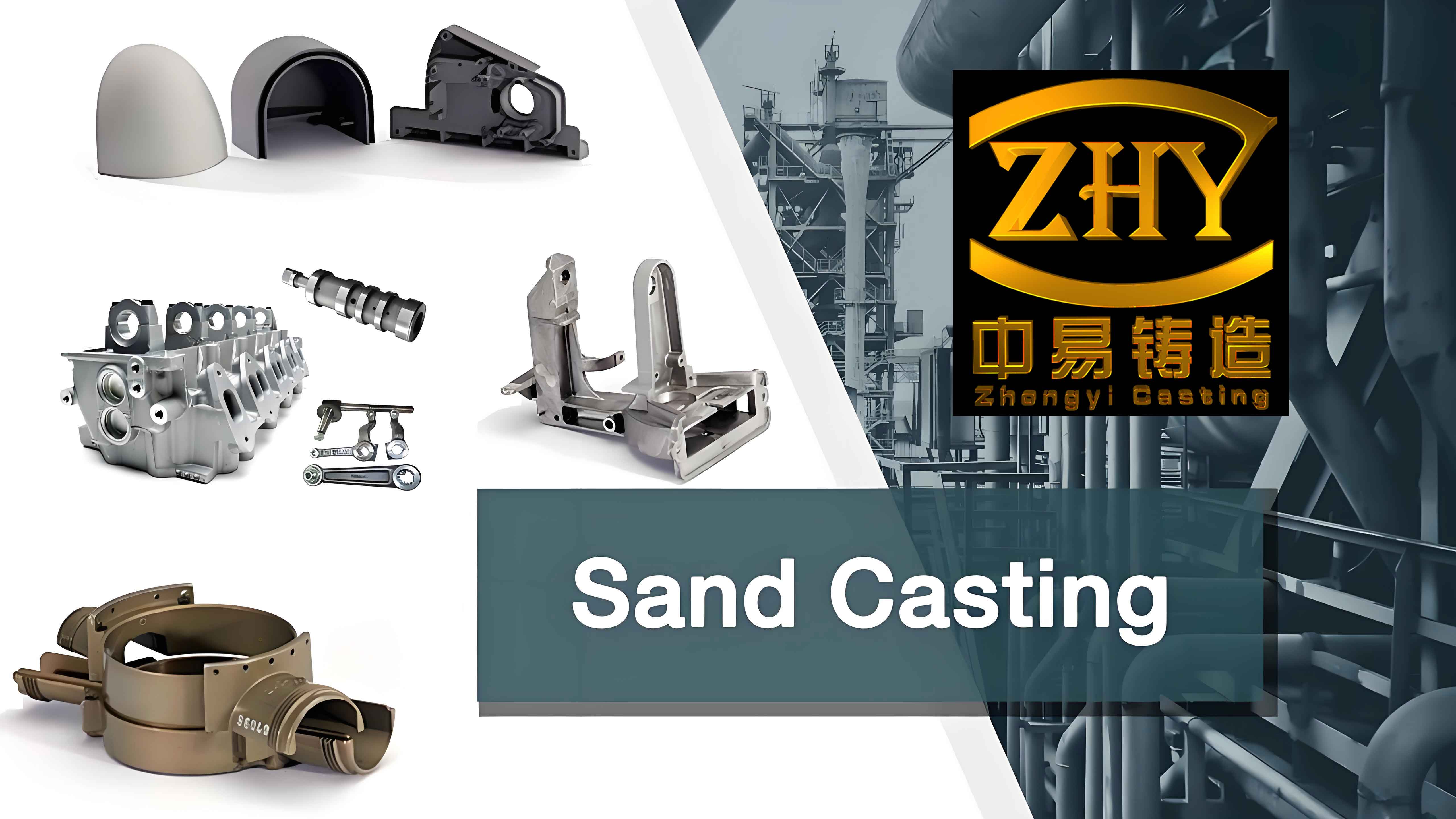
At its core, industrial sand mold 3D printing operates on the 3D Printing (3DP) or binder jetting principle. The process involves the sequential deposition of thin layers of foundry sand, which are selectively bonded by a printhead that deposits a liquid binder agent according to the cross-sectional data of the digital model. This layer-by-layer accumulation ultimately yields a full-scale, three-dimensional sand mold or core ready for metal pouring. The technical superiority of modern industrial systems lies in their ability to achieve high throughput and precision. Key advancements include the use of大规模集成阵列式打印头 (large-scale integrated array printheads) and dual build chambers operating simultaneously, which dramatically enhance production efficiency. For example, printing speeds can exceed 35 molds per hour, with build volumes reaching dimensions such as 2500 mm × 1800 mm × 1000 mm. The dimensional accuracy of printed sand molds for sand casting parts can achieve tolerances within ±0.35 mm, while the compressive strength of the bonded sand exceeds 6 MPa, ensuring robustness for casting various metals, including iron, steel, and aluminum alloys.
To quantify the performance parameters of industrial sand mold 3D printing systems, the following table summarizes key technical specifications that directly impact the production of sand casting parts:
| Parameter | Typical Value/Range | Significance for Sand Casting Parts |
|---|---|---|
| Printing Technology | Binder Jetting (3DP) | Enables direct digital-to-physical conversion of complex geometries for sand casting parts. |
| Build Volume (max) | 2500 × 1800 × 1000 mm³ | Allows production of large-scale sand casting parts in a single print. |
| Printing Speed | > 35 molds/hour | High throughput suitable for both prototyping and batch production of sand casting parts. |
| Dimensional Accuracy | ± 0.35 mm | Ensures precision in sand casting parts, reducing machining allowances. |
| Sand Mold Compressive Strength | > 6 MPa | Provides sufficient strength to withstand metallostatic pressure during casting of sand casting parts. |
| Layer Thickness | 0.2 – 0.3 mm | Affects surface finish and detail resolution of sand casting parts. |
The efficiency of the printing process can be modeled mathematically. The total printing time \( T_p \) for a sand mold can be expressed as:
$$ T_p = \frac{V_m}{R_p} + T_s $$
where \( V_m \) is the volume of the mold (in mm³), \( R_p \) is the volumetric printing rate (mm³/hour), and \( T_s \) is the setup and post-processing time. For dual-chamber systems, the effective throughput \( Q_e \) is doubled under optimal conditions:
$$ Q_e = 2 \times \frac{N_m}{T_p} $$
where \( N_m \) is the number of molds per build. This linear scaling demonstrates how advanced architectures boost productivity for sand casting parts manufacturing.
The application of 3D printed sand molds brings multifaceted benefits to the production of sand casting parts. Firstly, it drastically shortens the manufacturing lead time by condensing the traditional workflow—which involves pattern design, mold making, core making, and assembly—into a single-step digital process. This acceleration is crucial for prototyping and low-volume production of complex sand casting parts. Secondly, it enhances design flexibility, allowing for the creation of intricate internal geometries, conformal cooling channels, and optimized lightweight structures that are impossible or prohibitively expensive with conventional methods. This capability is particularly valuable for high-performance sand casting parts in aerospace and automotive applications. Thirdly, it improves the quality and consistency of sand casting parts by minimizing human error and variability associated with manual molding. The precision of 3D printed molds translates to better dimensional accuracy and surface finish in the final sand casting parts.
A comparative analysis between traditional sand casting and 3D printing-based sand casting for producing sand casting parts is presented below:
| Aspect | Traditional Sand Casting | 3D Printing-Based Sand Casting |
|---|---|---|
| Lead Time for New Parts | Weeks to months (due to tooling) | Days to weeks (digital tooling) |
| Design Complexity | Limited by pattern extraction | Nearly unlimited (freeform fabrication) |
| Cost Structure for Low Volumes | High (tooling amortization) | Lower (no tooling required) |
| Material Utilization | Higher waste (mold making) | Reduced waste (additive process) |
| Labor Intensity | High (skilled labor needed) | Reduced (automation friendly) |
| Environmental Impact | Higher energy and sand disposal | Potential for lower emissions and recycling |
The economic advantage can be quantified using a simplified cost model. The total cost \( C_t \) for producing sand casting parts via 3D printed molds includes fixed costs (machine depreciation, software) and variable costs (sand, binder, energy). For a batch size \( n \), the cost per part \( C_p \) is:
$$ C_p = \frac{F + V \cdot n}{n} $$
where \( F \) is fixed cost and \( V \) is variable cost per mold. For small \( n \), \( C_p \) is dominated by \( F/n \), but as \( n \) increases, \( C_p \) approaches \( V \). In contrast, traditional casting incurs high initial tooling cost \( T \), so:
$$ C_{p,\text{traditional}} = \frac{T + V_t \cdot n}{n} $$
where \( V_t \) is variable cost per part via traditional methods. The breakeven batch size \( n^* \) where 3D printing becomes cheaper satisfies:
$$ \frac{F + V \cdot n^*}{n^*} = \frac{T + V_t \cdot n^*}{n^*} $$
Solving yields \( n^* = \frac{T – F}{V – V_t} \), assuming \( V < V_t \) due to material savings. This illustrates the viability of 3D printing for custom or low-volume sand casting parts.
Moreover, the mechanical properties of the printed sand molds are critical for ensuring the integrity of sand casting parts. The compressive strength \( \sigma_c \) of the bonded sand can be derived from the binder-sand interaction. A simplified model considers the bonding force per unit area:
$$ \sigma_c = \phi \cdot \sigma_b \cdot \frac{A_b}{A_s} $$
where \( \phi \) is a packing factor, \( \sigma_b \) is the tensile strength of the binder bridge, \( A_b \) is the bonded area, and \( A_s \) is the cross-sectional area. Achieving \( \sigma_c > 6 \) MPa, as mentioned, requires optimized binder chemistry and sand granulometry. This strength ensures that molds withstand the ferrostatic pressure \( P \) during pouring, given by:
$$ P = \rho \cdot g \cdot h $$
where \( \rho \) is molten metal density, \( g \) is gravity, and \( h \) is the height of the metal head. For typical iron casting, \( P \) can reach 0.1 MPa, well within the safety margin of 3D printed molds for sand casting parts.
The industrialization of sand mold 3D printing is paving the way for smart foundries. By integrating 3D printers with robotics, automated guided vehicles (AGVs), and warehouse management systems, fully digital production lines for sand casting parts are becoming a reality. This integration not only boosts efficiency but also creates a cleaner, safer working environment, addressing the labor shortages and occupational hazards prevalent in traditional foundries. The shift towards “green manufacturing” is profound: 3D printing reduces the sand-to-metal ratio, minimizes waste, and lowers energy consumption per unit of sand casting parts produced. As the global market for castings is estimated at trillions, with sand casting parts representing a dominant share, the adoption of this technology could reshape the industry landscape.
Looking ahead, the evolution of industrial sand mold 3D printing will focus on enhancing print speed, enlarging build volumes, and developing advanced materials to cater to an ever-wider range of sand casting parts. Research directions include multi-material printing for graded properties, in-situ quality monitoring via sensors, and AI-driven process optimization. The ultimate vision is the establishment of networked smart foundries that leverage digital twins and IoT for predictive maintenance and real-time production control, thereby ensuring high-quality sand casting parts with minimal resource input.
In conclusion, as an advocate for manufacturing innovation, I firmly believe that industrial 3D printing of sand molds is a cornerstone for the future of foundries. It transcends the limitations of conventional methods, offering unprecedented agility, precision, and sustainability in producing sand casting parts. The journey from “crude and pollutive” to “smart and green” is underway, and 3D printing stands as a key enabler. By embracing this technology, the casting industry can not only improve its competitiveness but also contribute significantly to a sustainable industrial ecosystem. The dream of a strong, advanced casting sector, capable of supplying high-integrity sand casting parts for the world’s most demanding applications, is within reach, thanks to the relentless progress in additive manufacturing.