
In the field of advanced manufacturing, sand casting remains a critical process for producing complex and high-integrity components, particularly for aerospace and automotive applications. Among various alloys, Al-Si based casting alloys like ZL114A are widely used due to their excellent combination of strength, fluidity, and resistance to hot tearing. However, achieving consistent mechanical properties, especially elongation, in thick-section sand casting parts can be challenging. This article, from my perspective as a researcher in materials engineering, delves into the influence of modification treatments on the microstructure and mechanical properties of ZL114A alloy in sand casting. I will explore how strontium (Sr) and rare earth (RE) modifiers impact these sand casting parts, with a focus on elongation enhancement, utilizing extensive data, tables, and theoretical formulas to summarize findings.
Sand casting parts often exhibit variability in performance due to factors like solidification conditions and alloy composition. For ZL114A alloy, which is a hypoeutectic Al-Si alloy, the as-cast microstructure typically consists of α-Al dendrites and eutectic silicon phases. The morphology of eutectic silicon significantly affects mechanical properties; coarse, plate-like silicon phases can act as stress concentrators, reducing ductility. Modification treatments aim to refine these phases, thereby improving the toughness of sand casting parts. In this study, I compare unmodified, RE-modified, and Sr-modified ZL114A sand casting parts, analyzing their tensile strength and elongation after T6 heat treatment. The goal is to provide insights into optimizing modification strategies for high-performance sand casting parts.
The experimental approach involved preparing ZL114A alloy using high-purity materials to minimize impurity effects, which is crucial for aerospace-grade sand casting parts. The chemical composition was controlled according to standard specifications, as summarized in Table 1. Melting was conducted in a resistance furnace, followed by degassing and slag removal. For modification, two schemes were employed: RE modification using a mixed rare earth agent (rich in Ce and La) added at 0.3 wt.% of the melt, and Sr modification using Al-Sr10% master alloy added at 0.06 wt.% of the melt. An unmodified batch served as the baseline. After modification, the melt was poured into sand molds designed with phenolic resin sand and a gating system to produce samples of two thicknesses: 20 mm and 40 mm, simulating typical thick-section sand casting parts. These samples were subjected to T6 heat treatment—solution treatment at 540°C for 17 hours and aging at 165°C for 7 hours—before mechanical testing and microstructural analysis.
| Element | Standard Range | Actual Charge |
|---|---|---|
| Si | 6.5-7.5 | 6.8 |
| Mg | 0.45-0.75 | 0.66 |
| Ti | 0.08-0.25 | 0.15 |
| Be | 0.04-0.07 | 0.07 |
| Al | Balance | Balance |
The mechanical properties of the sand casting parts were evaluated through tensile testing, with results presented in Table 2. For each modification scheme, six samples (three per thickness) were tested, and the minimum, average, and maximum values for tensile strength and elongation are compared. The data reveal that tensile strength differences among the three schemes are minimal, within 5%, indicating that modification does not drastically alter strength in these sand casting parts. However, elongation varies significantly. Sr-modified sand casting parts exhibit the highest elongation, with an average increase of over 28% compared to unmodified and RE-modified parts. In contrast, RE-modified parts show the lowest elongation, with values as low as 1.5%, highlighting a detrimental effect on ductility.
| Modification Scheme | Tensile Strength (MPa) – Min/Avg/Max | Elongation (%) – Min/Avg/Max |
|---|---|---|
| Unmodified | 295 / 301.7 / 305 | 2.5 / 3.0 / 3.5 |
| RE-modified | 290 / 295.0 / 300 | 1.5 / 2.3 / 2.9 |
| Sr-modified | 310 / 304.2 / 315 | 3.5 / 4.1 / 5.0 |
To understand these mechanical behavior differences, I analyzed the microstructures of the sand casting parts. Optical microscopy and scanning electron microscopy (SEM) were used to examine the eutectic silicon morphology and presence of intermetallic phases. In unmodified sand casting parts, the eutectic silicon appears as coarse gray plates distributed in interdendritic regions, along with minor Al8FeMg3Si6 phases. For RE-modified sand casting parts, the eutectic silicon remains plate-like, and new dendritic or lamellar AlREMgSi compounds form, which are brittle and act as crack initiation sites. In Sr-modified sand casting parts, the eutectic silicon is refined into fine particles, significantly improving ductility. This refinement can be quantified using a relationship between silicon particle size and elongation. For instance, the Hall-Petch-type equation for ductility enhancement can be expressed as:
$$ \epsilon_f = \epsilon_0 + k_\epsilon \cdot d_s^{-1/2} $$
where $\epsilon_f$ is the fracture elongation, $\epsilon_0$ is a material constant, $k_\epsilon$ is a coefficient, and $d_s$ is the average silicon particle size. In Sr-modified sand casting parts, $d_s$ is reduced, leading to higher $\epsilon_f$. Additionally, the distribution of microporosity differs among the schemes. RE-modified sand casting parts exhibit clustered porosity defects, further reducing elongation, while Sr-modified parts show more dispersed porosity, minimizing stress concentrations.
The role of modification in sand casting parts can be further elucidated through solidification kinetics. During solidification of Al-Si alloys, the growth of eutectic silicon is influenced by modifiers like Sr, which adsorb at the silicon-liquid interface, inhibiting plate growth and promoting isotropic growth. This mechanism can be described by the Jackson-Hunt model for eutectic growth, where the undercooling $\Delta T$ is related to the interface velocity $v$ and particle spacing $\lambda$:
$$ \Delta T = \frac{K_1}{\lambda} + K_2 \sqrt{v} $$
Here, $K_1$ and $K_2$ are constants. For Sr-modified sand casting parts, the addition of Sr increases the undercooling, leading to a finer $\lambda$ and thus refined silicon particles. In contrast, RE modifiers may form stable compounds like AlREMgSi, which consume modifying elements and reduce effectiveness in silicon refinement for sand casting parts. This aligns with the observed microstructural outcomes.
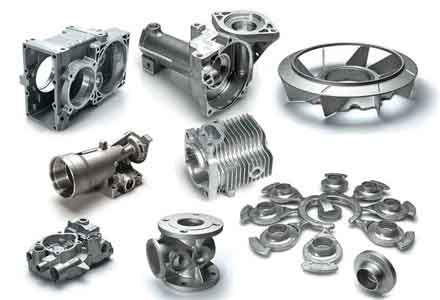
Porosity formation in sand casting parts is another critical aspect affecting mechanical properties. The total porosity volume $V_p$ can be modeled as a combination of gas porosity and shrinkage porosity, often expressed as:
$$ V_p = V_g + V_s = C_g \cdot [H] + \beta \cdot \Delta V_{shrink} $$
where $V_g$ is gas porosity dependent on hydrogen concentration $[H]$, $C_g$ is a constant, $V_s$ is shrinkage porosity, $\beta$ is a factor, and $\Delta V_{shrink}$ is the volumetric shrinkage during solidification. In Sr-modified sand casting parts, Sr addition does not significantly increase hydrogen content but alters porosity distribution, reducing clustered defects. This results in a more uniform strain distribution during tensile loading, enhancing elongation. For RE-modified sand casting parts, the formation of intermetallics may exacerbate shrinkage porosity, leading to clustered voids that degrade ductility.
To quantify the impact on tensile strength, I consider the strengthening contributions in these sand casting parts. The overall yield strength $\sigma_y$ can be approximated by summing various mechanisms:
$$ \sigma_y = \sigma_0 + \sigma_{ss} + \sigma_{gb} + \sigma_{ppt} + \sigma_{dis} $$
where $\sigma_0$ is the intrinsic strength of aluminum, $\sigma_{ss}$ is solid solution strengthening, $\sigma_{gb}$ is grain boundary strengthening (often modeled via Hall-Petch: $\sigma_{gb} = k_{gb} \cdot d^{-1/2}$ with $d$ as grain size), $\sigma_{ppt}$ is precipitation strengthening from phases like Mg2Si, and $\sigma_{dis}$ is dislocation strengthening. In sand casting parts after T6 treatment, precipitation strengthening dominates, and since modification minimally affects precipitation kinetics, tensile strength remains similar across schemes. However, elongation is more sensitive to microstructural features like silicon morphology and porosity, explaining the observed differences.
The industrial implications for sand casting parts are substantial. In aerospace applications, components such as missile shells or support beams require high elongation to withstand dynamic loads. My findings suggest that Sr modification is preferable for producing thick-section ZL114A sand casting parts, as it reliably enhances ductility without compromising strength. In contrast, RE modification may be less suitable due to its tendency to form brittle compounds and increase porosity clustering. This insight can guide foundries in selecting modification strategies to improve the performance and reliability of sand casting parts.
Further analysis of fracture surfaces supports these conclusions. SEM images of tensile fracture surfaces reveal that unmodified sand casting parts exhibit relatively flat, cleavage-like features indicative of brittle fracture. RE-modified sand casting parts show extensive cleavage planes with large voids from clustered porosity, consistent with low elongation. Sr-modified sand casting parts display finer dimples and tear ridges, characteristic of ductile fracture, correlating with higher elongation. This fracture behavior underscores the importance of microstructural control in sand casting parts.
In terms of process optimization for sand casting parts, factors like modification holding time and temperature play crucial roles. For Sr modification, a holding time of 30-40 minutes at 720-740°C allows for adequate dissolution and distribution of Sr, ensuring effective silicon refinement. Prolonged holding may lead to fade effects, where Sr potency decreases. For RE modification, the formation of AlREMgSi phases can be minimized by adjusting RE content or combining with other modifiers, but this requires further study. Additionally, the design of sand molds—such as the use of chills and gating systems—influences solidification rates and defect formation in sand casting parts. Integrating modification with optimized casting parameters can yield superior properties.
To generalize these results for other sand casting parts, I propose a framework for predicting elongation based on modification type and section thickness. For ZL114A alloy, a semi-empirical model can be developed:
$$ \epsilon = \epsilon_{base} – A \cdot t + B \cdot f_{Sr} – C \cdot f_{RE} $$
where $\epsilon$ is the elongation, $\epsilon_{base}$ is the base elongation for thin sections, $t$ is the section thickness, $f_{Sr}$ and $f_{RE}$ are weight fractions of Sr and RE modifiers, and $A$, $B$, $C$ are coefficients determined from experimental data. This model highlights that Sr addition positively affects elongation in sand casting parts, while RE addition has a negative effect, especially in thicker sections.
In conclusion, my investigation into modification effects on ZL114A sand casting parts demonstrates that Sr modification significantly improves elongation by refining eutectic silicon and reducing porosity clustering, whereas RE modification can degrade ductility due to brittle intermetallic formation and increased defects. These findings emphasize the critical role of modifier selection in enhancing the mechanical performance of sand casting parts for demanding applications. Future work could explore hybrid modification systems or advanced characterization techniques to further optimize these sand casting parts.
Throughout this article, I have emphasized the importance of sand casting parts in modern manufacturing, and how microengineering through modification can unlock their full potential. By leveraging tables, formulas, and detailed analysis, I aim to provide a comprehensive resource for engineers and researchers working with sand casting parts. The continuous evolution of modification technologies will undoubtedly lead to even better sand casting parts, driving innovation in aerospace, automotive, and beyond.