
In my experience working with industrial fabrication, particularly in the assembly of large-scale components like vehicle sidewalls and structural frames, I have encountered numerous challenges related to welding and metal casting defect remediation. One prominent case involved a high-chromium iron cylindrical casting used in a dust removal system, which exhibited significant metal casting defects such as shrinkage cavities and insufficient fill along the mold seam. These metal casting defects, if left unrepaired, would compromise the component’s performance in high-temperature, corrosive environments. This article delves into the intricacies of identifying, analyzing, and repairing such metal casting defects, focusing on a practical approach that combines welding technology with metallurgical principles. Throughout this discussion, I will emphasize the term “metal casting defect” to highlight its prevalence and criticality in manufacturing processes.
The workpiece in question, a cyclone separator outer barrel, presented a unique set of requirements. It must operate continuously above 600°C, resisting corrosion and abrasion from dust particles. The base material is a special high-chromium cast iron with a complex chemical composition that leads to inherent vulnerabilities. Specifically, the presence of high carbon and chromium promotes the formation of brittle carbides, increasing susceptibility to cracks and white iron formation—a common metal casting defect exacerbated during welding. The technical specifications for this material are summarized in Table 1.
| Element | Composition Range (wt%) | Role in Material |
|---|---|---|
| C | 2.8 – 3.6 | Promotes graphite formation but increases hardness |
| Si | 1.5 – 2.5 | Graphitizer, affects fluidity |
| Mn | 0.5 – 1.5 | Strengthener, influences hardenability |
| Cr | 14.0 – 18.0 | Corrosion resistance, forms carbides |
| P | ≤ 0.10 | Impurity, reduces toughness |
| S | ≤ 0.05 | Impurity, promotes hot cracking |
| Fe | Balance | Base metal |
The mechanical properties required for this high-chromium iron include a bending strength $\sigma_b \geq 600 \, \text{MPa}$, an impact value $a_k \geq 4.0 \, \text{J/cm}^2$, and a hardness $HB \geq 400$. Microstructurally, the matrix should consist primarily of austenite with carbides, minimal martensite, and allowable traces of troostite, but no pearlite or ferrite. Any metal casting defect that alters this microstructure, such as porosity or cracks, can lead to catastrophic failure under thermal cycling.
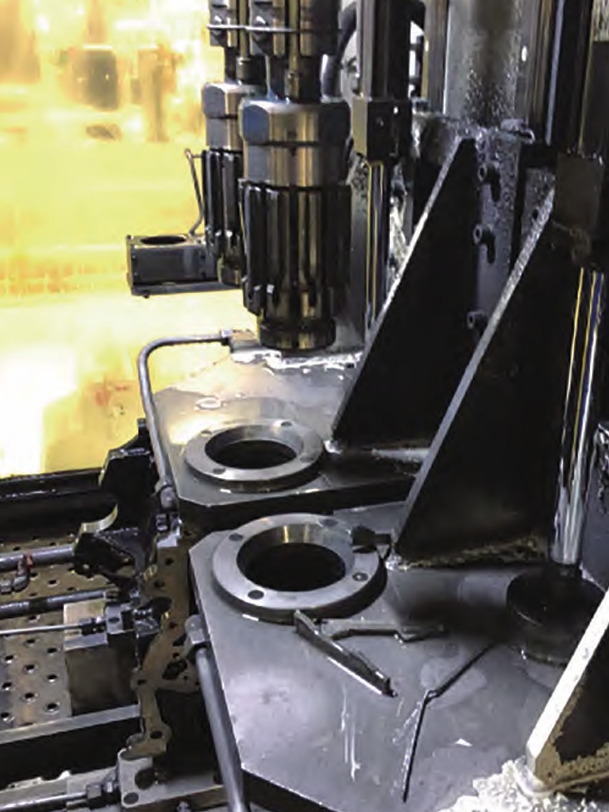
In welding similar components, such as sidewall panels for vehicle frames, I often deal with joints that appear as butt welds but are essentially lap joints. This is because, at the weld location—between upper and lower rollers—thin strips of compensating material are added. Two workpieces are aligned and clamped between these strips. This method, while improving surface flatness post-weld, introduces complexities in heat distribution and stress concentration, potentially masking underlying metal casting defects. The welding process parameters for such applications can be expressed using formulas for heat input and pressure. For instance, the heat input $Q$ during resistance seam welding is given by:
$$ Q = I^2 R t $$
where $I$ is the welding current, $R$ is the electrical resistance at the interface, and $t$ is the welding time. This heat input must be carefully controlled to avoid exacerbating any pre-existing metal casting defect in the base metal.
When comparing welding equipment, I have observed that domestic resistance seam welders often have fixed heads, requiring workpiece movement and making operator control difficult. In contrast, imported welders feature heads that slide on copper guides, with power supplied through these guides. This allows precise alignment and magnetic clamping of workpieces, reducing the risk of introducing new metal casting defects during welding. Table 2 summarizes key differences.
| Feature | Domestic Welder | Imported Welder |
|---|---|---|
| Head Mobility | Fixed, workpiece moves | Mobile on copper guides |
| Power Supply | Direct to rollers | Via guide rails |
| Alignment Ease | Challenging | Simplified with magnetic hold |
| Risk of Metal Casting Defect Aggravation | Higher due to vibration | Lower due to stability |
For assembly welding of frame columns, I employ gas-shielded welding with single-side welding and double-side formation, significantly boosting efficiency. In sidewall steel structure assembly, a dedicated fixture with thick copper pads is used. Here, pre-formed wall panels are positioned, and frame columns are aligned and fixed. Welding is performed using a gantry-type resistance spot welder with programmable control, ensuring consistent penetration without aggravating metal casting defects. The welding current path in this setup can be modeled as:
$$ I_{\text{path}} = \frac{V}{R_{\text{work}} + R_{\text{blind}}} $$
where $R_{\text{work}}$ is the resistance at the working electrode, and $R_{\text{blind}}$ is at the blind electrode, creating a fusion nugget. This precision is crucial when working near areas prone to metal casting defect.
Returning to the high-chromium iron casting repair, the metal casting defect manifested as an unfilled section approximately 10 mm deep and 500 mm long along the mold joint. This metal casting defect required补焊 in simple conditions, with the repaired zone matching the base metal in composition and performance. The challenges were multifaceted. First, the母材’s chemical composition had high variability, especially in carbon content (2.8–3.6%), which spans almost the entire range of typical cast irons. This variability affects mechanical properties and weldability, making it hard to control outcomes. The low sulfur and phosphorus levels ($\leq 0.05\%$ S, $\leq 0.10\%$ P) reduce impurities but increase the risk of冷裂纹 due to reduced fluidity. Moreover, the simultaneous high铬 and carbon leads to abundant chromium carbides ($\text{Cr}_{23}\text{C}_6$), a brittle phase that promotes white iron formation and crack sensitivity. The stress state was complex, with uneven wall thickness and residual casting stresses, compounded by welding thermal stresses. Since overall preheating or stress relief was impractical due to the component’s size (ø2000 mm), a localized approach was necessary.
To address this metal casting defect, I developed a gas welding repair protocol. The filler material was a wire cast from the same composition as the母材. A neutral or slightly carburizing flame was used with an oxygen pressure of 0.5–0.7 MPa and acetylene at 0.05–0.07 MPa, applying flux “CJ201” to minimize oxidation. Before welding, the metal casting defect area was ground to bare metal, and the workpiece was sheltered from wind to prevent rapid cooling. The core of the method involved symmetric环形加热 around the weld cross-section using two torches, preheating to 600–800°C (indicated by an orange-red glow) and gradually cooling post-weld to reduce thermal gradients. This heating serves as a stress-relief mechanism, critical for preventing裂纹 propagation from the metal casting defect. The temperature decay during cooling can be approximated by Newton’s law of cooling:
$$ \frac{dT}{dt} = -k (T – T_{\text{env}}) $$
where $T$ is the workpiece temperature, $T_{\text{env}}$ is ambient temperature, and $k$ is a cooling constant dependent on material and geometry. Peening the weld at 400–500°C with a conical tool (hardness HRC 50–55) helped release residual stresses. This entire process focused on mitigating the metal casting defect without altering the microstructure unfavorably.
The success of this repair hinged on controlling heat input and stress. Table 3 outlines the key parameters and their effects on metal casting defect repair quality.
| Parameter | Value/Range | Impact on Metal Casting Defect Repair |
|---|---|---|
| Preheat Temperature | 600–800°C | Reduces thermal shock, minimizes white iron |
| Welding Flame | Neutral to Carburizing | Limits carbon loss, prevents oxidation |
| Peening Temperature | 400–500°C | Relieves stresses, closes micro-cracks |
| Cooling Rate | Controlled gradual | Avoids martensite formation, reduces cracking |
| Filler Match | Identical to base | Ensures chemical and mechanical compatibility |
In practice, repairing two such castings proved successful, with post-weld tests showing tensile strength exceeding the base metal and bend angles meeting specifications. This underscores that even severe metal casting defects can be remedied with careful thermal management. The经验 highlights that the离散 in母材 composition requires adaptive techniques; for instance, the heat input must be adjusted based on real-time observation of pool fluidity. Furthermore, the presence of chromium carbides means that the weld zone must be kept above certain temperatures to avoid淬硬. The time-temperature-transformation (TTT) diagram for this high-chromium iron can be modeled as:
$$ f(T,t) = A e^{-Q/RT} (1 – e^{-kt}) $$
where $A$ is a pre-exponential factor, $Q$ is activation energy, $R$ is the gas constant, $T$ is temperature, $t$ is time, and $k$ is a rate constant. This equation helps predict phase transformations that could exacerbate a metal casting defect during cooling.
Beyond this specific case, I have applied similar principles to other welding scenarios. For example, in resistance spot welding of sidewalls, the electrode force and current are optimized to prevent defects like incomplete fusion—a type of metal casting defect that can occur in the weld nugget. The pressure $P$ applied by rollers in seam welding must balance deformation and heat generation:
$$ P = \frac{F}{A} \geq \sigma_y(T) $$
where $F$ is the force, $A$ is the contact area, and $\sigma_y(T)$ is the temperature-dependent yield strength of the material. Insufficient pressure can lead to poor contact, creating voids that mimic a metal casting defect in the weld.
In conclusion, repairing metal casting defects in high-chromium iron components demands a holistic understanding of material science and welding dynamics. The term “metal casting defect” recurs throughout this discussion because such imperfections are not merely surface flaws but deeply rooted in the casting and welding interplay. Key strategies include symmetric heating to manage stresses, precise filler matching, and post-weld peening. These methods ensure that the repaired zone meets operational demands, turning a potential failure point into a reliable joint. As industries push for higher performance in extreme environments, the ability to address metal casting defects through innovative welding techniques will remain paramount. Future work could explore automated thermal monitoring or advanced filler alloys to further enhance repair quality for persistent metal casting defects.