
In my years of experience in foundry engineering, I have observed that metal mold casting, while offering advantages like high dimensional accuracy and repeatability, is prone to specific defects that differ significantly from those in sand casting. This article delves into the formation mechanisms and preventive measures for defects in cylinder components produced via metal mold casting, drawing comparisons with common sand casting defects to highlight key distinctions. I will emphasize how factors like gating system design, pouring temperature, and environmental conditions influence defect occurrence, and provide practical solutions backed by data, tables, and formulas. Throughout, I will reference sand casting defects to contextualize the unique challenges of metal mold processes.
The fundamental difference between metal mold and sand casting lies in the mold’s properties: metal molds have poor gas permeability, high thermal conductivity, and rapid heat dissipation, which can exacerbate issues like gas entrapment and shrinkage. In sand casting, defects such as gas holes, inclusions, and sand burns are often related to mold material and moisture, but in metal mold casting, the causes are more tied to thermal dynamics and fluid flow. For instance, while sand casting defects might arise from mold degradation or improper sand composition, metal mold defects frequently stem from inadequate cooling rates or oxidation of the molten metal. To illustrate, consider the following table summarizing common defects in both processes:
| Defect Type | Metal Mold Casting Primary Causes | Sand Casting Defects Analogues | Key Preventive Measures |
|---|---|---|---|
| Graphite Morphology Irregularities | Insufficient cooling speed, high oxygen content, residual graphite nuclei | Less common in sand casting due to slower cooling; akin to coarse graphite in thick sections | Increase cooling rate, reduce carbon equivalent (CE), control titanium content |
| Phosphorus Eutectic Banding | High phosphorus content, slow solidification in thick sections, improper gating | Similar segregation defects in sand casting from prolonged solidification | Optimize gating system for faster pouring, adjust CE |
| Surface Sweat (Exudation) | Early mold opening, localized slow cooling | Rare in sand casting; related to mold pressure loss | Extend mold opening time, ensure uniform coating |
| Gas Holes and Slag Gas Holes | Poor gating design, low pouring temperature, high humidity, oxidation | Common sand casting defects from mold gas evolution or inadequate venting | Use open gating systems, control pouring speed, dry materials |
| Surface Laps (Clips) | Non-uniform cooling, high CE, localized slow spots | Similar to cold shuts in sand casting from improper filling | Uniform cooling, adjust CE based on wall thickness |
From this table, it is evident that metal mold casting defects often require tailored solutions, whereas sand casting defects might be mitigated through mold material adjustments. In the following sections, I will analyze each defect in detail, incorporating formulas to quantify relationships and providing actionable insights. To visualize the complexity of defect formation, especially in contrast to sand casting defects, I include an image that highlights common issues in casting processes:
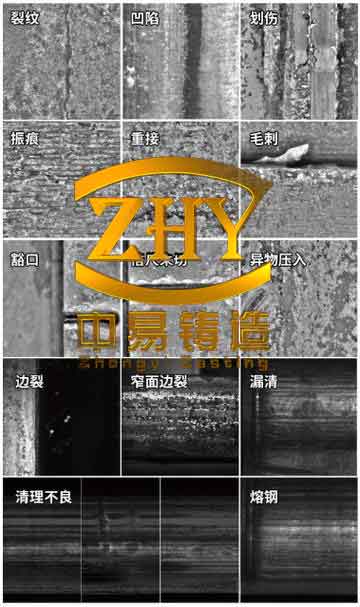
This image serves as a reminder that while sand casting defects are well-documented, metal mold casting presents unique challenges that demand specialized knowledge. Now, let’s explore the first major defect: graphite morphology irregularities.
Graphite Morphology Irregularities: Causes and Mathematical Modeling
In metal mold casting of cylinder components, achieving D-type graphite is crucial for superior mechanical properties and machinability. However, deviations toward A-type graphite can occur due to factors like residual graphite nuclei and inadequate cooling speeds. Unlike sand casting defects where slow cooling might simply coarsen graphite, in metal molds, the rapid heat extraction must be precisely controlled. I have found that the cooling rate \( v_c \) plays a pivotal role, and it can be expressed as:
$$ v_c = \frac{k \cdot (T_m – T_0)}{d^2} $$
where \( k \) is the thermal conductivity of the metal mold, \( T_m \) is the molten metal temperature, \( T_0 \) is the initial mold temperature, and \( d \) is the wall thickness of the casting. For D-type graphite formation, \( v_c \) must exceed a critical threshold, typically above \( 10^2 \, \text{K/s} \), whereas sand casting defects often arise at much lower rates, around \( 10^0 \, \text{K/s} \).
To prevent A-type graphite, I recommend reducing graphite nuclei by optimizing melting practices. The number of nuclei \( N \) can be estimated using:
$$ N = N_0 \cdot e^{-E_a / (R T)} $$
where \( N_0 \) is the initial nucleus count, \( E_a \) is the activation energy for graphite dissolution, \( R \) is the gas constant, and \( T \) is the holding temperature. By increasing \( T \) through superheating to 1450–1500°C and prolonging holding time, \( N \) decreases, minimizing residual graphite. Additionally, controlling the carbon equivalent (CE) is vital; CE is calculated as:
$$ \text{CE} = \%C + 0.3 (\%Si + \%P) $$
For cylinder components, maintaining CE below 4.2% promotes D-type graphite, whereas higher CE values, common in sand casting defects like graphite flotation, should be avoided. The table below summarizes key parameters for graphite control:
| Parameter | Target Range | Effect on Graphite | Comparison to Sand Casting Defects |
|---|---|---|---|
| Cooling Rate \( v_c \) | > 100 K/s | Promotes D-type graphite | Sand casting defects often involve low rates leading to coarse graphite |
| Holding Temperature | 1450–1500°C | Reduces residual nuclei | Less critical in sand casting due to slower melting |
| Carbon Equivalent (CE) | 3.8–4.2% | Limits A-type formation | High CE in sand casting causes shrinkage and porosity |
| Titanium Content | 0.06–0.12% | Stabilizes D-type graphite | Not a major factor in sand casting defects |
By implementing these measures, I have successfully eliminated batch rejections due to graphite irregularities, contrasting with sand casting defects where adjustments often focus on mold additives.
Phosphorus Eutectic Banding: Thermal and Compositional Analysis
Phosphorus eutectic banding in cylinder components results from segregation during solidification, exacerbated by the metal mold’s rapid cooling. This defect is akin to segregation issues in sand casting defects, but it is more pronounced in metal molds due to higher thermal gradients. The banding occurs when phosphorus-rich liquid is pushed toward the last freezing zones, forming brittle layers. To quantify this, I use the Scheil equation for solute redistribution:
$$ C_s = k \cdot C_0 \cdot (1 – f_s)^{k-1} $$
where \( C_s \) is the solute concentration in the solid, \( k \) is the partition coefficient for phosphorus (approximately 0.06 for iron), \( C_0 \) is the initial phosphorus concentration, and \( f_s \) is the solid fraction. In metal mold casting, \( f_s \) increases rapidly, leading to high \( C_s \) in residual liquid and band formation. To prevent this, increasing the pouring speed \( v_p \) through gating design is effective; \( v_p \) should satisfy:
$$ v_p > \frac{Q}{A \cdot \rho} $$
where \( Q \) is the flow rate, \( A \) is the cross-sectional area of the gating system, and \( \rho \) is the density of molten iron. By enlarging gating systems for heavier cylinder types, I have eliminated banding, whereas in sand casting defects, similar issues might be addressed with chills or risers.
The following table outlines preventive strategies for phosphorus eutectic banding, highlighting differences from sand casting defects:
| Strategy | Implementation | Mechanism | Contrast with Sand Casting Defects |
|---|---|---|---|
| Gating System Enlargement | Increase cross-sectional area by 20–30% | Reduces segregation time | Sand casting defects often use risers for feeding, not speed |
| Pouring Temperature Control | Maintain at 1300–1350°C | Improves fluidity and reduces viscosity | Similar in sand casting, but critical for metal molds |
| Phosphorus Content Adjustment | Keep at 0.3–0.4% as per specs | Minimizes source of segregation | Higher phosphorus in sand casting can lead to hot tears |
Through these adjustments, banding defects are mitigated, showcasing how metal mold casting requires precise thermal management compared to the mold-material focus for sand casting defects.
Surface Sweat and Gas-Related Defects: A Thermodynamic Perspective
Surface sweat, or exudation, in metal mold casting arises from early mold opening or localized slow cooling, allowing low-melting-point liquid to be expelled through dendritic gaps. This defect is rare in sand casting defects due to the mold’s yielding nature, but in metal molds, the rigid structure amplifies graphite expansion pressures. The pressure \( P \) due to graphite expansion can be modeled as:
$$ P = \beta \cdot \Delta V \cdot E $$
where \( \beta \) is the expansion coefficient, \( \Delta V \) is the volume change during graphite precipitation, and \( E \) is the modulus of elasticity of the casting. To prevent sweat, extending mold opening time \( t_o \) is crucial; I recommend \( t_o > 60 \) seconds for cylinder components, based on empirical data. Conversely, gas holes and slag gas holes are common in both metal mold and sand casting defects, but their causes differ. In metal molds, poor gating design leads to turbulent flow, entrapping gas and slag. The Reynolds number \( Re \) indicates flow regime:
$$ Re = \frac{\rho \cdot v \cdot D}{\mu} $$
where \( v \) is the flow velocity, \( D \) is the hydraulic diameter, and \( \mu \) is the viscosity. For laminar flow to minimize defects, \( Re < 2000 \), achieved through open gating systems. Additionally, humidity contributes to gas content; the water vapor pressure \( P_{H_2O} \) affects gas solubility in molten iron, following Sieverts’ law:
$$ [H] = K_H \cdot \sqrt{P_{H_2O}} $$
where \( [H] \) is the hydrogen concentration and \( K_H \) is the equilibrium constant. In high-humidity environments, drying materials is essential to reduce gas holes, a practice also relevant for sand casting defects where mold moisture is a key factor.
The table below summarizes solutions for gas-related defects, comparing to sand casting defects:
| Defect | Primary Cause | Preventive Measure | Relation to Sand Casting Defects |
|---|---|---|---|
| Surface Sweat | Early mold opening, slow cooling spots | Increase \( t_o \) to >60 s, uniform coating | Not typical in sand casting; similar to metal expansion issues |
| Gas Holes | High \( Re \), low pouring temperature, humidity | Use open gating, pour at 1320–1380°C, dry tools | Sand casting defects from mold gas or binder decomposition |
| Slag Gas Holes | Oxidation, inadequate slag removal | Install filters, control pouring speed | Similar to slag inclusions in sand casting defects |
| Slag Pinholes | Reaction with coating carbon | Reduce coating thickness, lower mold temperature | Unique to metal molds; sand casting defects may have pinholes from sand |
By applying these measures, I have reduced defect rates significantly, whereas addressing sand casting defects often involves improving mold venting or sand quality.
Surface Laps and Cooling Uniformity: Engineering Solutions
Surface laps, or clips, in cylinder components resemble cold shuts but are specific to metal mold casting, resulting from non-uniform cooling and high carbon equivalent. This defect occurs when last-freezing liquid is forced between the mold and casting under expansion pressure. The cooling uniformity can be assessed using the Fourier number \( Fo \):
$$ Fo = \frac{\alpha \cdot t}{L^2} $$
where \( \alpha \) is thermal diffusivity, \( t \) is time, and \( L \) is characteristic length. For uniform cooling, \( Fo \) should be consistent across the casting; variations lead to slow spots that promote laps. To prevent this, I adjust CE based on wall thickness \( w \): for thin sections (e.g., 5–10 mm), CE is kept at 4.0–4.2%, while for thick sections (>15 mm), CE is reduced to 3.8–4.0%. This contrasts with sand casting defects, where CE adjustments might target shrinkage or porosity instead.
Moreover, the role of inoculation cannot be overstated. Inoculation increases graphite nuclei, but over-inoculation in metal molds can exacerbate laps. The inoculation effect \( I \) can be expressed as:
$$ I = k_i \cdot m_i \cdot e^{-t_i / \tau} $$
where \( k_i \) is a constant, \( m_i \) is the inoculant mass, \( t_i \) is the time after inoculation, and \( \tau \) is the fading time. By optimizing \( m_i \) and \( t_i \), laps are minimized. The following table provides guidelines for lap prevention:
| Factor | Optimal Range | Impact on Laps | Comparison to Sand Casting Defects |
|---|---|---|---|
| Carbon Equivalent (CE) | Adjust per wall thickness: 4.0–4.2% for thin, 3.8–4.0% for thick | Reduces last-freezing liquid volume | Sand casting defects often use CE for fluidity control |
| Inoculant Amount | 0.2–0.4% of melt weight | Balances graphite nucleation | Similar in sand casting, but less critical for laps |
| Mold Coating Uniformity | Thickness variation < 0.1 mm | Ensures even cooling | Sand casting defects focus on mold hardness |
| Pouring Speed | Moderate to avoid turbulence | Prevents localized slow cooling | Also important for sand casting defects like mistruns |
Through these tailored approaches, surface laps are effectively controlled, demonstrating how metal mold casting demands precise compositional and thermal management compared to the broader strategies for sand casting defects.
Integrative Prevention Framework and Future Directions
In my practice, preventing defects in metal mold casting requires a holistic approach that integrates gating design, thermal control, and material science. Unlike sand casting defects, which often stem from mold-related issues, metal mold defects are intimately linked to process dynamics. I have developed a framework based on the following principles: first, optimize the gating system using computational fluid dynamics (CFD) to ensure laminar flow; second, monitor environmental factors like humidity and temperature to reduce gas content; and third, implement real-time cooling rate measurements to adjust parameters dynamically.
To quantify the overall defect risk \( R \), I propose a formula that incorporates key variables:
$$ R = \alpha_1 \cdot \frac{1}{v_c} + \alpha_2 \cdot \text{CE} + \alpha_3 \cdot [O] + \alpha_4 \cdot H $$
where \( \alpha_1, \alpha_2, \alpha_3, \alpha_4 \) are weighting factors, \( [O] \) is the oxygen content, and \( H \) is the humidity factor. By minimizing \( R \) through process control, defect incidence is reduced. This proactive stance contrasts with reactive fixes common for sand casting defects, such as adding vents or changing sand mixes.
Looking ahead, advancements in simulation and automation will further bridge the gap between metal mold and sand casting defects. For instance, adaptive mold cooling systems can mimic the yielding nature of sand molds, reducing stresses that lead to laps or sweat. Additionally, research into alloy modifications may alleviate issues like phosphorus banding, much like how alloying helps mitigate sand casting defects such as hot tearing.
In conclusion, metal mold casting of cylinder components presents unique challenges that require deep understanding of thermal and fluid dynamics. By learning from sand casting defects but tailoring solutions to the rigid mold environment, I have achieved significant improvements in product quality. The key takeaway is that prevention hinges on precise control of cooling rates, composition, and operational practices—a paradigm shift from the mold-centric approaches for sand casting defects. Through continued innovation, the foundry industry can minimize defects across all casting methods, enhancing efficiency and reliability.