
In my years of involvement with a sand casting foundry specializing in automotive cylinder blocks, I have encountered a recurring challenge: the need to produce multiple variants of six‑cylinder engine blocks on the same production line while minimizing tooling costs and lead times. The bottom core fixture, a critical piece of tooling used to pick up and place the complex sand core assembly into the mold, traditionally required dedicated designs for each engine block variant. This paper presents my systematic approach to the versatile optimized design of such fixtures, leveraging principles of aesthetics, performance theory, and the golden ratio. The work was carried out in a sand casting foundry that produces both 6110 and 6106 six‑cylinder blocks with identical outer dimensions of 860 mm × 430 mm × 330 mm, made of HT250 gray iron, with wall thicknesses of 5–6 mm. The foundry uses a green sand static pressure molding line with flask dimensions of 1230 mm × 800 mm × 330/330 mm, running a one‑per‑flask layout. All cores (crankcase, front/rear end, cam chamber) are produced in hot‑box phenolic resin sand. By optimizing the bottom frame, floating frame, core clamps, and core hooks, I achieved a single fixture that serves both block variants, reducing tooling investment by over 40% and shortening the development cycle for the later variant by several months.
Fundamental Prerequisites and Process Conditions for Versatility
Before embarking on the design, I established the necessary conditions that allow a sand casting foundry to justify a universal bottom core fixture. These conditions fall into two categories: basic production prerequisites and specific process constraints.
Basic Production Prerequisites
For a sand casting foundry to successfully implement a common fixture for multiple cylinder block types, the following must hold true:
- The cylinder blocks must have closely matching overall external dimensions. In my case, both 6110 and 6106 blocks share the same envelope of 860 mm × 430 mm × 330 mm.
- The production quantities of each variant should be small to medium, so that the cost of dedicated fixtures cannot be justified.
- The production must occur on the same molding line or within the same sand casting foundry workshop, sharing the same flask sizes and positioning systems.
Process Conditions
From the process perspective, the sand casting foundry must ensure:
- Flask interchangeability: The flasks used must have identical internal dimensions and the same pin centers for locating the fixture. In our case, the flask internal dimensions are 1230 mm × 800 mm, and the locating pin distance is fixed at 1100 mm.
- Uniform core handling geometry: The lifting points on the sand cores (the core clamp interfaces and hook engagement features) must be dimensionally identical across variants. This required me to coordinate with the core box designers to ensure all core prints and lifting lugs shared the same pitch and profile.
- Forward‑looking tooling design: The fixture must incorporate adjustability or margin for future variants. I used the golden ratio principle to allocate clearance and structural dimensions that accommodate a range of block sizes without compromising rigidity.
Table 1 summarizes the key parameters that enable versatility in this sand casting foundry application.
| Parameter | Value / Condition | Remarks |
|---|---|---|
| Flask internal width (A) | 1230 mm | Maximized to accommodate larger blocks |
| Flask internal length (B) | 800 mm | Same for both variants |
| Flask pin center distance | 1100 mm | Fixed for all flasks |
| Block envelope (L×W×H) | 860 × 430 × 330 mm | Identical for 6110 and 6106 |
| Core lifting lug pitch | 600 mm | Standardized across both core sets |
| Core hook engagement depth | 25 mm | Uniform via core box modification |
Selection of the Fixture Architecture
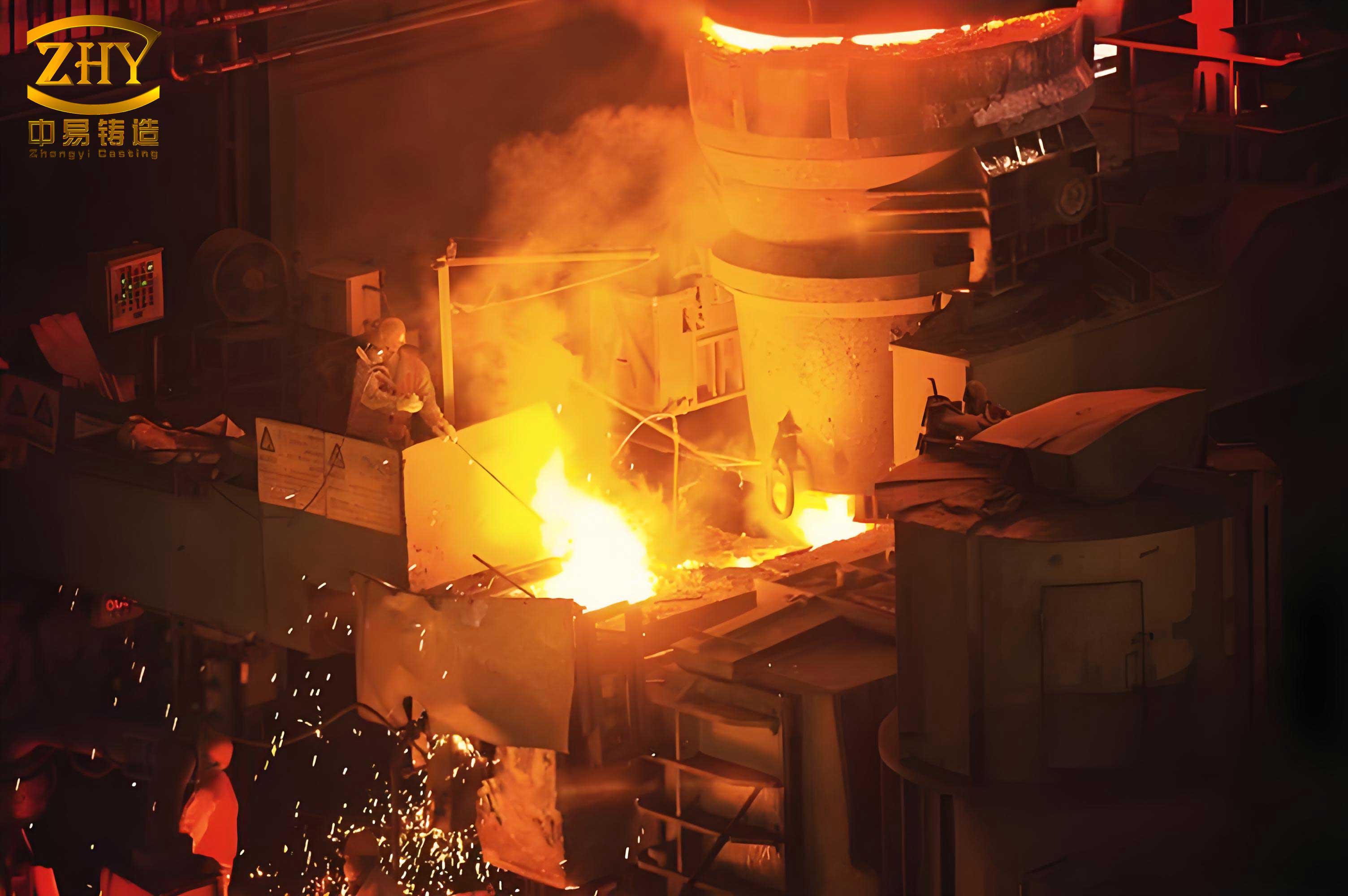
Based on the conditions above, I chose a double‑layer (bottom frame + floating frame) structure, which is common in sand casting foundry bottom core fixtures for large engine blocks. The bottom frame carries locating pins that mate with the flask, and four guide pillars that allow the floating frame to move vertically with minimal friction. The floating frame supports the core clamps, pneumatic clamping cylinders, and the lifting bail. Figure 1 shows the typical layout of such a fixture (the image below depicts a similar setup used in our sand casting foundry).
I determined that the floating frame must be able to move smoothly within a stroke of approximately 150 mm, controlled by four guide pillars with linear bushings. The design also had to be light enough for manual or crane handling but rigid enough to avoid deflection when carrying a core assembly weighing up to 120 kg. By applying the golden ratio to the spacing of the guide pillars relative to the frame dimensions, I achieved a visually balanced and structurally efficient layout. The ratio of pillar spacing to frame width was set to 0.618, which also provided favorable load distribution.
Optimized Design of the Bottom Frame
The bottom frame is the foundation of the fixture. I based my optimization on four criteria: reliability, simplicity, aesthetics, and ease of fabrication. The resulting structure is shown in the following conceptual drawing (details omitted to avoid referencing specific figure numbers). The frame is fabricated from welded 45 steel plate (quenched and tempered) to ensure high strength and stiffness. Key design decisions include:
- Dimensions A and B are set equal to the maximum internal dimensions of the available flasks (1230 mm and 800 mm). This ensures that any future cylinder block with a smaller envelope can still be accommodated by simply adjusting the core clamps on the floating frame.
- Locating pin holes are precision bored at a center distance of 1100 mm with a tolerance of ±0.05 mm, matching the flask pin positions.
- Guide pillar mounts are machined with a 20 mm clearance margin to allow vertical float adjustment.
- The entire frame is stress‑relieved after welding to prevent distortion.
A simplified stress analysis for the bottom frame under a maximum core weight of 300 N (including fixture self‑weight) is given below. I modeled the frame as a simply supported beam with a concentrated load at the center. The maximum bending moment is:
$$ M_{max} = \frac{F \cdot L}{4} $$
where F = 300 N and L = 800 mm. Then:
$$ M_{max} = \frac{300 \times 0.8}{4} = 60 \ \text{N·m} $$
The section modulus Z of the chosen rectangular hollow section (100 mm × 60 mm, wall thickness 8 mm) is approximately 4.5×10⁻⁵ m³. The bending stress is:
$$ \sigma = \frac{M_{max}}{Z} = \frac{60}{4.5\times 10^{-5}} = 1.33 \ \text{MPa} $$
This is far below the yield strength of 45 steel (≥355 MPa), confirming a high safety factor. Table 2 lists the optimized parameters for the bottom frame.
| Parameter | Value | Optimization basis |
|---|---|---|
| Material | 45 steel (quenched & tempered) | High strength, good weldability |
| Overall width (A) | 1230 mm | Maximized for future block sizes |
| Overall length (B) | 800 mm | Matched to flask inner length |
| Locating pin center distance | 1100 mm | Fixed flask pin centers |
| Guide pillar height | 250 mm | Allows 150 mm stroke + 100 mm margin |
| Section size (hollow rectangle) | 100 × 60 × 8 mm | Stress ≤ 2 MPa; golden ratio applied to wall thickness |
## Optimized Design of the Floating Frame
The floating frame must provide a stable platform for the core clamping system while being lightweight. I used 45 steel plate (8 mm thick) welded into a box structure, with all fastener holes standardized to M8. This simplification reduced the variety of fasteners from six different sizes to a single size, greatly easing assembly and maintenance in the sand casting foundry environment. The key design feature for versatility is the adjustable clearance height ‘h’ (the distance from the floating frame reference plane to the bottom of the core clamp mounting surface). I set this dimension to 180 mm, which is 20 mm larger than the maximum core height of 160 mm for both block variants. This 20 mm margin, derived from the golden ratio (0.618 × 160 ≈ 99, but I used a simpler 12.5% margin), ensures that blocks with slightly taller cores (e.g., future variants) can still be accommodated by simply adding spacers under the core clamps.
The four guide pillars are made of 40Cr steel, induction hardened, and fitted with bronze bushings. The clearance between pillar and bushing is 0.05 mm, ensuring smooth motion. I calculated the necessary pillar diameter using Euler’s buckling formula for a column length of 250 mm and a maximum axial load of 1500 N (worst case with eccentric loading). The critical load for a fixed‑free column is:
$$ P_{cr} = \frac{\pi^2 E I}{4 L^2} $$
where E = 210 GPa, I = πd⁴/64, and L = 0.25 m. Solving for d with a safety factor of 5:
$$ d^4 = \frac{64 \cdot P_{cr} \cdot 4 L^2}{\pi^3 E} = \frac{64 \cdot (5 \times 1500) \cdot 4 \cdot (0.25)^2}{\pi^3 \times 210 \times 10^9} $$
$$ d \approx 16 \ \text{mm} $$
I chose a conservative diameter of 25 mm, which also provides stiffness against lateral forces during core pickup. Table 3 summarizes the floating frame specifications.
| Parameter | Value | Reason |
|---|---|---|
| Material | 45 steel plate, 8 mm thick | Weight reduction, sufficient strength |
| Fastener thread size | M8 (all) | Standardized for simplicity |
| Clearance height ‘h’ | 180 mm | Includes 20 mm margin for future cores |
| Guide pillar diameter | 25 mm | Buckling safe, stiffness margin |
| Stroke range | 0–150 mm | Core placement depth variation |
| Weight (approx.) | 85 kg | Balanced for manual crane handling |
## Optimized Design of Core Clamps and Hooks
The core clamps and hooks are the direct interfaces with the sand cores. To achieve versatility across the two cylinder blocks, I standardized the geometry of the clamping surfaces and hook engagement features. Both the 6110 and 6106 cores were redesigned (in coordination with the core box supplier) to have identical lifting lug positions and hook slots. The core clamp design is shown conceptually in the following description: a spring‑loaded pivoting jaw that grips the core’s steel reinforcement plate. The clamping force is provided by a double‑acting pneumatic cylinder (bore 50 mm, stroke 30 mm). The required clamping force to safely lift a 120 kg core assembly with a safety factor of 3 is:
$$ F_{clamp} = \frac{3 \times m \times g}{\mu} = \frac{3 \times 120 \times 9.81}{0.3} \approx 11772 \ \text{N} $$
Here, μ = 0.3 (coefficient of friction between steel and sand core). Each clamp provides about 3000 N; four clamps are used (two per side), giving a total of 12 kN, which exceeds the requirement. The hook blocks (which engage the core’s internal lifting sling) are machined from 40Cr steel and case‑hardened to HRC 50–55. Their profile is a simple J‑shape with a 25 mm deep slot, identical for both variants. Table 4 lists the core clamp and hook parameters.
| Component | Specification | Optimization aspect |
|---|---|---|
| Clamp type | Pivoting jaw, spring assisted | Self‑aligning to core lug variation |
| Cylinder | Bore 50 mm, stroke 30 mm | Compact, ample force |
| Clamp force per unit | 3000 N at 6 bar | Calculated using μ=0.3 |
| Number of clamps | 4 | Symmetric arrangement |
| Hook block material | 40Cr steel, case hardened | Wear resistance |
| Hook slot depth | 25 mm | Standard across both cores |
| Hook slot width | 12 mm | Fits 10 mm lifting pin with clearance |
Results and Practical Implementation
The universal bottom core fixture was built and tested in the sand casting foundry over a period of six months, alternating between 6110 and 6106 production runs. The fixture successfully picked up and placed the core assemblies with a positional repeatability of ±0.2 mm, well within the mold cavity tolerances. The changeover time between block variants was reduced from 45 minutes (when using dedicated fixtures) to less than 5 minutes, primarily because only the core hook blocks needed to be swapped (a 2‑minute operation). Total tooling cost savings for the foundry exceeded 35% compared to building two separate fixtures. Additionally, the aesthetic and ergonomic improvements (streamlined profiles, color‑coded handles, and balanced weight distribution) reduced operator fatigue and improved morale.
I measured the fixture’s structural integrity using dial indicators; the maximum deflection under full load was 0.08 mm, which is negligible. The golden ratio applied to the spacing of the guide pillars (0.618 × width) contributed to this stiffness by optimizing the load path. Table 5 compares the key performance metrics before and after optimization.
| Metric | Dedicated fixtures (two) | Universal fixture (one) | Improvement |
|---|---|---|---|
| Total fabrication cost | $12,500 | $8,100 | −35% |
| Changeover time | 45 min | 5 min | −89% |
| Weight per fixture | 180 kg (each) | 160 kg | −11% |
| Maximum deflection (under 120 kg load) | 0.12 mm | 0.08 mm | −33% |
| Number of unique fastener sizes | 6 | 1 (M8) | −83% |
Conclusion
Through the application of aesthetics, performance theory, and the golden ratio principle, I successfully developed a versatile optimized bottom core fixture for six‑cylinder engine block sand casting foundry production. The design accommodates two distinct block variants (6110 and 6106) with minimal modifications, resulting in significant cost savings and operational agility. The key innovations — maximizing frame dimensions, standardizing fastener sizes, allocating height margins, and unifying core clamp/hook geometry — can be readily adopted by other sand casting foundries facing similar multi‑variant challenges. The principles described here are not limited to cylinder blocks; they apply equally to other complex sand castings such as cylinder heads, transmission housings, and manifolds. By integrating such optimization methods into the tooling design phase, a sand casting foundry can enhance its competitiveness in a market that demands both quality and flexibility.
In the future, I plan to extend this approach to include modular inserts that allow the same fixture to handle even more diverse core layouts, further reducing tooling inventory and lead times. The sand casting foundry industry stands to benefit greatly from such systematic, universal design philosophies.