
In my experience at a sand casting foundry, the production of spherical valve bodies from Al-Mn bronze (aluminum‑manganese bronze) demands rigorous process control to meet stringent requirements for corrosion resistance and pressure tightness. The valve body, with a wall thickness of about 8 mm, must withstand a hydrostatic test of 30 kgf/cm². This alloy exhibits excellent resistance to seawater, fresh water, and moist atmospheres, making it ideal for components in hydraulic systems operating below 250 °C. Below, I detail the complete sand casting methodology we developed, emphasizing the critical steps in melting, degassing, gating design, and sand preparation that ensure sound, leak‑free castings.
Alloy Characteristics and Phase Considerations
The Al–Mn bronze we employ contains approximately 8–10 wt% Al and 1–2 wt% Mn (balance Cu). According to the Cu–Al equilibrium diagram, the solubility of aluminum in the α‑solid solution decreases with temperature, but under practical foundry conditions, a certain amount of the γ₂ eutectoid phase appears when the aluminum content exceeds 8 wt%. The γ₂ phase increases strength and hardness but reduces ductility; this can be adjusted via heat treatment. Manganese refines the structure and enhances corrosion resistance. The alloy solidifies over a narrow temperature range, leading to high shrinkage and a tendency toward concentrated porosity, so careful riser placement is essential.
Melting and Refining in the Sand Casting Foundry
All aluminum bronzes oxidize readily, forming Al₂O₃ and MnO. Oxides have high melting points and tend to remain as finely dispersed inclusions, causing micro‑porosity and loss of pressure tightness. Our sand casting foundry procedure involves the following steps:
- Charge materials: Clean copper scrap, Al–Mn master alloy, and Cu–Al master alloy. If using virgin copper, we add 0.1 % P–Cu (10 % P) for deoxidation. For heavy scrap returns, deoxidation is often unnecessary because Al and Mn are strong deoxidizers.
- Melting: Preheat the clay‑graphite crucible to a dull red heat (~700 °C). Charge the copper and scrap, melt under strong blast (coke‑fired furnace). Total melting time about 30 minutes for a 100 kg crucible.
- Addition of master alloys: Once the copper is molten, we add the pre‑heated Cu–Mn and Cu–Al master alloys, then cover the bath with clean crushed glass or burnt charcoal to minimize oxidation.
- Fluxing: If the alloy shows excessive oxidation (a common problem when master alloys are added too early), we use a flux composed of 60 % NaCl (anhydrous) and 40 % CaF₂, added at about 0.5 % of the melt weight. The flux dissolves Al₂O₃ and helps it agglomerate for skimming.
- Degassing: After fluxing, we plunge dry ZnCl₂ (wrapped in aluminum foil) using a bell. The ZnCl₂ reacts to form volatile AlCl₃, which stirs the bath and brings oxides to the surface. Typically, we add 0.15 % ZnCl₂ and stir for 2 minutes, then skim and hold for 5 minutes.
- Temperature control: For thin‑wall castings (8 mm), we superheat the melt to 1150–1180 °C, and pour at 1100–1130 °C. For thicker sections, temperatures are reduced accordingly.
| Wall Thickness (mm) | Melting Temperature (°C) | Pouring Temperature (°C) |
|---|---|---|
| < 8 | 1150–1180 | 1100–1130 |
| 8–20 | 1120–1150 | 1060–1100 |
| 20–40 | 1080–1120 | 1020–1060 |
| > 40 | 1050–1080 | 980–1020 |
The losses during melting are estimated as: Cu negligible, Mn ~10 % (due to oxidation), Al ~15 % (mainly as Al₂O₃ dross and some as AlCl₃ during degassing). Actual losses must be checked by chemical analysis and adjusted accordingly.
Gassing Test and Mechanical Verification
Before pouring, we perform a simple gas‑test: a cup‑shaped sample is cast in a steel mold. A well‑degassed sample shows a concave shrinkage; if the sample is convex or does not shrink, gas is still present. We then stir with a graphite rod and re‑test. If after three attempts the test fails, the melt is rejected and cast into ingots for future use. A bending test is also conducted: two 12 mm diameter bars are cast, quenched in water after 3 seconds, then bent 90° without cracking.
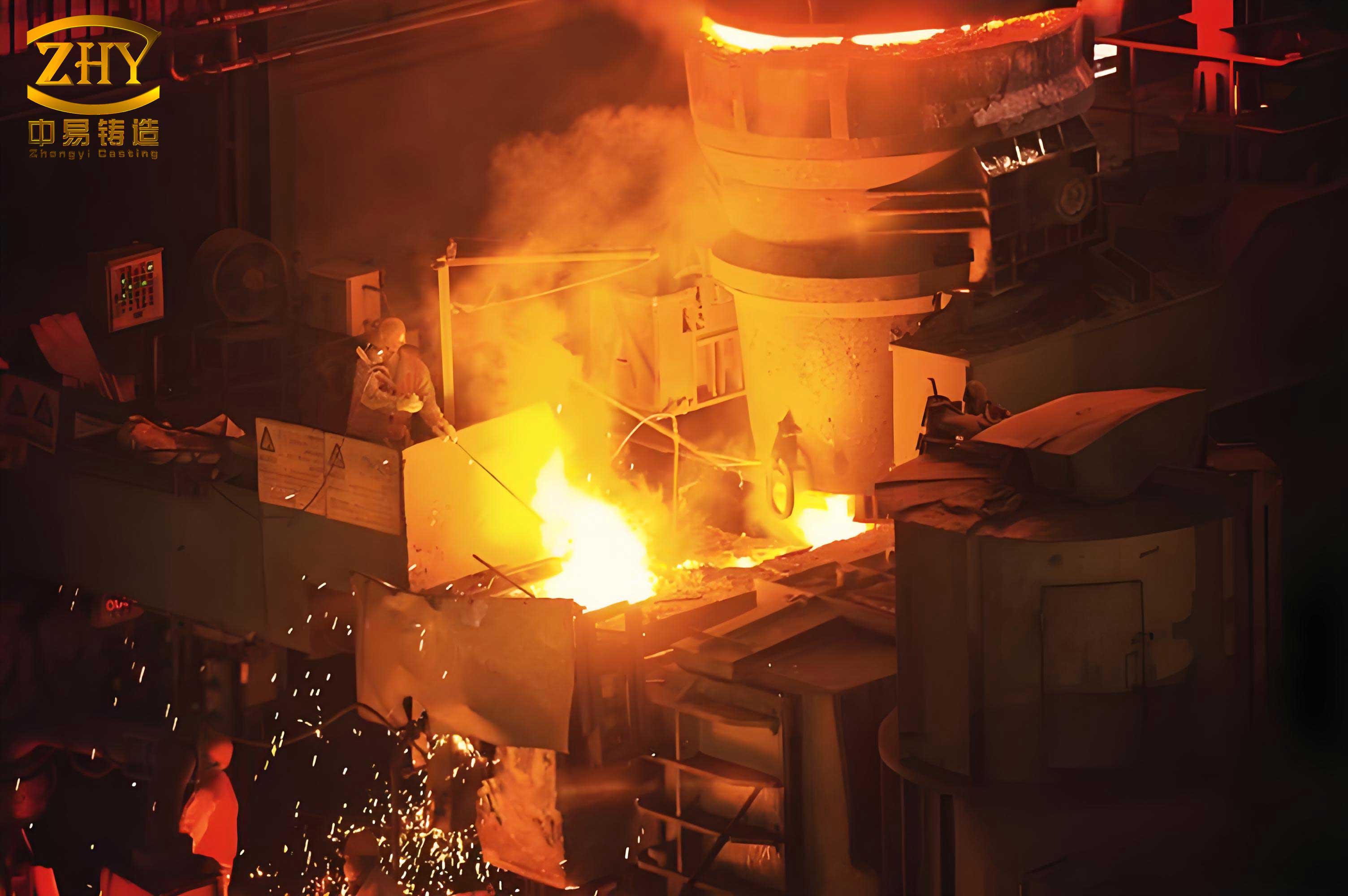
In a typical sand casting foundry, the above tests are performed immediately after degassing, and only a melt that passes both is used for the actual valve body.
Gating and Riser Design for Spherical Valve Bodies
The high shrinkage of Al–Mn bronze demands generous risers and chills. Our gating system uses a bottom‑pour design with a pressurized runner to minimize turbulence and oxide entrainment. The pouring cup is of the “rain‑shower” type; the molten metal flows through a 12 mm diameter down‑runner, then into a tangential runner that feeds multiple ingates. A systematic arrangement is shown conceptually:
- Down‑runner: 12 mm diameter, placed to maintain constant head.
- Runner: 20 mm × 15 mm rectangular, with a 8 mm choke at the base to create a non‑pressurized condition.
- Ingates: Four 6 mm thick slit gates entering the casting at the bottom, oriented to promote smooth filling.
- Risers: At the top of the spherical body (especially at the flange and nozzle areas), we place two 40 mm diameter open risers. In addition, 20 mm thick chills are placed on the thickest sections to promote directional solidification.
The total weight of the riser system may equal or exceed the casting weight. During pouring, the metal rises slowly and evenly in the mold cavity, avoiding splashing.
Sand and Core Mixtures
For dry‑sand molds, we use the following formulations (by weight):
| Component | Percentage (wt%) |
|---|---|
| Lake sand (through 30 mesh) | 40 |
| Natural quartz sand (through 70 mesh) | 30 |
| Return sand (reclaimed) | 30 |
| Coal dust (additional) | 2–3 |
| Component | Percentage (wt%) |
|---|---|
| Natural quartz sand (through 70 mesh) | 60 |
| Return sand | 20 |
| White clay (bentonite) | 10 |
| Coal dust | 10 |
Physical properties after mulling:
| Property | Molding Sand | Core Sand |
|---|---|---|
| Moisture (%) | 4–5 | 5–6 |
| Permeability (wet) | ≥ 80 AFS | ≥ 60 AFS |
| Green compression strength (kgf/cm²) | 0.7–0.9 | 0.5–0.7 |
| Dry compression strength (kgf/cm²) | 2.5–3.5 | 3.0–4.0 |
Molds and cores are dried at 350–400 °C for 8 hours in a drying oven. After cooling, the mold is assembled with the core supported by chaplets (copper screws) to ensure uniform wall thickness. The chaplets are inserted through holes in the pattern and left in place after pattern removal.
Pouring and Shake‑out
Immediately before pouring, we re‑skim the crucible and maintain the pouring ladle as close to the pouring cup as possible. The pour is continuous without interruption, and the ladle is kept full to prevent slag entrainment. After pouring, the mold is allowed to cool for 30–40 minutes before shake‑out. The casting is then cleaned, and the risers are cut off.
Quality Considerations
Every batch is subjected to hydrostatic testing at 30 kgf/cm². In our sand casting foundry, we have achieved a scrap rate below 3 % by adhering strictly to the described practices. The key points are:
- Delaying the addition of Cu–Al master alloy until just before casting (to avoid excessive Al₂O₃ formation).
- Using flux only when necessary, and avoiding ZnCl₂ overuse because of its effect on alloy composition.
- Ensuring gentle mold filling through bottom gating and proper choke design.
- Controlling mold and core permeability to allow evolved gases to escape.
We have found that the Al–Mn bronze, despite its challenging oxidation behavior, yields high‑integrity castings when processed under disciplined temperature and gating control. The experience gained at our sand casting foundry has been shared with other plants, and we continue to refine the method for larger and more complex valve bodies.
Conclusion
In summary, the sand casting of Al‑Mn bronze spherical valve bodies requires a holistic approach: proper alloy selection, meticulous melting and degassing, optimized gating and risering, and careful sand preparation. The methods described here have consistently produced castings that pass rigorous pressure tests and exhibit excellent resistance to corrosive environments. Our sand casting foundry continues to use these practices as a baseline for all high‑integrity copper‑alloy work.