
In my recent project, I was tasked with producing a large wheel hub for a belt conveyor system using lost foam castings technology. The hub had a diameter of 1250 mm and a single weight of 1500 kg, with a web plate thickness of 70 mm. The material was specified as ZG270-500, requiring good weldability and freedom from defects such as sand holes, blowholes, and non-metallic inclusions. The final product needed uniform machining allowance with no black skin after processing, and the heat-treated microstructure was to be ferrite plus pearlite. This article details the complete process I developed to achieve these requirements, emphasizing the critical role of lost foam castings in producing large, complex components efficiently.
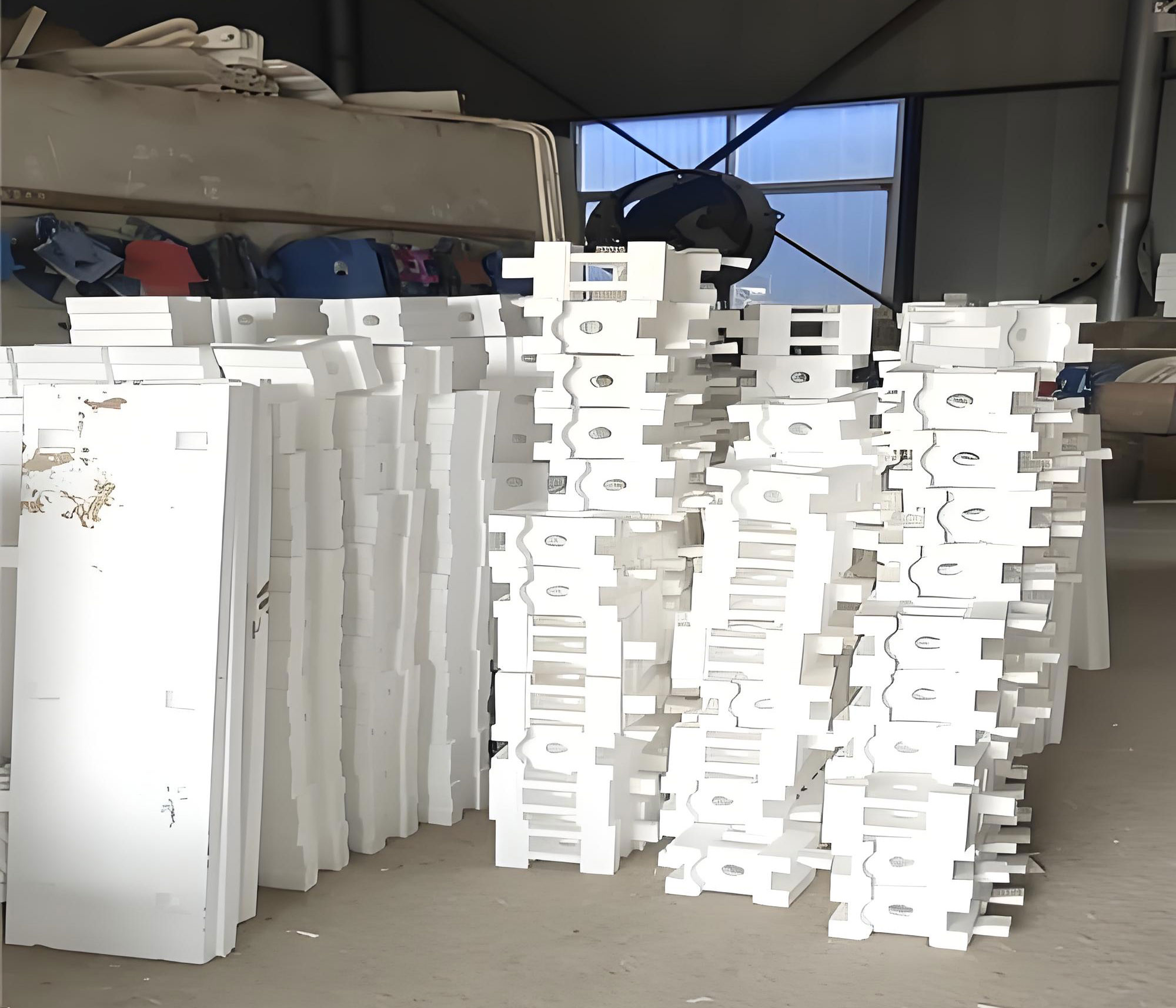
1. Pattern Manufacturing (White Pattern)
For lost foam castings, pattern fabrication can be done manually or using foam molding machines. Manual fabrication is suitable for small batches or single large castings with relatively simple geometry. Given the hub’s large size and tight schedule, I opted for manual assembly. The pattern was decomposed into three parts: the rim, the web plate, and the central hub. These were cut from EPS foam sheets and bonded together on a precise platform to ensure concentricity between the center and the rim. A machining allowance of 10 mm was applied on the radial surfaces, and an additional 3 mm was added in the vertical direction to compensate for shrinkage during casting. The pattern material density was selected as 22 g/cm³ for the main body to resist deformation during coating and sand packing, while the gating and riser sections used a lower density of 14 g/cm³ to reduce gas generation during pouring.
The dimensions and tolerances for pattern assembly are summarized in Table 1.
| Component | Material | Density (g/cm³) | Machining Allowance (mm) | Remarks |
|---|---|---|---|---|
| Rim, web, center | EPS (standard) | 22 | 10 radial, 13 vertical | Extra 3 mm vertically for shrinkage |
| Gating system, risers | EPS (low density) | 14 | N/A | Reduces gas evolution |
2. Gating and Riser Design
The design of the gating system is crucial for lost foam castings to ensure smooth filling, slag trapping, and feeding. I employed a stepped sprue system with multiple ingates to maintain a controlled rise of molten steel. The main sprue was 65 mm × 65 mm in cross-section. The bottom runner was 65 mm × 60 mm, with 100 mm long slag traps at both ends, connected to two 60 mm × 50 mm ingates. At the mid‑height of the hub, a secondary ingate (65 mm × 50 mm) was attached at a 45° angle to the main sprue. This ingate started feeding only when the steel level reached that point, helping to flush slag and gas into the slag‑collecting riser. A third ingate (65 mm × 50 mm) was positioned at the top of the main sprue, connecting directly into the feeder riser to deliver hot metal for effective feeding, reducing the riser volume by about one‑third.
Two types of risers were installed: a slag‑collecting riser (90 mm bottom × 100 mm top × 100 mm height × 100 mm width) placed opposite the secondary ingate at the mid‑level, and a feeding riser (200 mm bottom × 350 mm top × 400 mm height × 430 mm width) positioned directly above the hub center. The geometries are detailed in Table 2.
| Element | Cross-section (mm × mm) | Length/Height (mm) | Purpose |
|---|---|---|---|
| Main sprue | 65 × 65 | – | Central downcomer |
| Bottom runner | 65 × 60 | ~1500 | Distribute metal to two bottom ingates |
| Bottom ingates (×2) | 60 × 50 | ~200 | Initial filling |
| Secondary ingate | 65 × 50 | ~200 | Mid‑height filling, slag flushing |
| Top ingate | 65 × 50 | ~200 | Hot metal into feeder riser |
| Slag‑collecting riser | 90×100 (bottom), 100×100 (top) | 100 | Traps slag at mid‑level |
| Feeder riser | 200×430 (bottom), 350×430 (top) | 400 | Top feeding & shrinkage compensation |
The effective feeding distance of the riser was calculated considering the geometric modulus. For the hub, the riser volume \(V_r\) and casting volume \(V_c\) satisfied the condition:
$$ V_r = \frac{\varepsilon \cdot V_c}{\eta_r} $$
where \(\varepsilon\) is the solidification shrinkage of steel (approximately 3% for carbon steel), and \(\eta_r\) is the riser efficiency (taken as 0.5 for open risers with exothermic topping). This resulted in a riser volume about 25% of the casting volume, which matched our design.
3. Coating Preparation and Application
The coating for lost foam castings must provide a strong refractory barrier, good permeability for foam degradation products, and adequate strength to withstand sand pressure. I formulated a coating using the composition listed in Table 3.
| Material | Function | Quantity (kg) |
|---|---|---|
| Phenolic resin | Organic binder | 20 |
| Zircon flour | Refractory aggregate | 200 |
| Silica flour | Refractory filler | 50 |
| Polyvinyl acetate (PVA) glue | Inorganic binder | 8 |
| Carboxymethyl cellulose (CMC) | Composite binder | 15 |
| Lithium bentonite | Suspension agent | 5 |
| Sodium carbonate | Defoamer | 5 |
| Water | Vehicle | To reach target viscosity |
To prepare the coating, I first made a bentonite slurry by mixing lithium bentonite with warm water at a 1:10 ratio and stirring at high speed for 30–40 minutes. CMC was soaked in water to form a gel. These were combined with the other dry ingredients and water in a mixer, stirred for 2 hours, then transferred to the coating tank.
The entire pattern assembly (including gating and risers) was coated as a single unit to maintain integrity. Three coats were applied with intermediate drying. The first coat was 1 mm thick, dried at 45–50°C for 12 hours. The second coat was also 1 mm, dried for another 12 hours. The third coat, applied only on the gating system, joints, and hot spots, was 1–1.2 mm thick, followed by 12 hours of drying. After drying, the pattern was inspected for any white spots (uncoated areas) and repaired if necessary.
4. Molding and Sand Packing
For lost foam castings, the sand flask must provide adequate negative pressure and allow efficient gas evacuation. I used a steel flask measuring 1500 mm × 1500 mm × 2300 mm with vacuum extraction from the bottom and one side. Two 70 mm diameter vacuum pipes ensured sufficient flow rate to exceed the gas generation rate from foam pyrolysis.
The sand consumption parameters were: bottom sand bed 200 mm, minimum side clearance 150 mm, top sand cover 400 mm. The sand was silica sand (ceramic bead type, see Table 4) with a compaction angle of 40°. Vibration was applied in three dimensions with five vibration stations (positions marked in the original design) for 2 minutes each at an acceleration of 10 m/s² and frequency 30 Hz. A 40 mm thick magnesia‑carbon brick was placed at the base of the sprue to prevent erosion of the coating by prolonged metal flow.
| Parameter | Value |
|---|---|
| Flask size (mm) | 1500 L × 1500 W × 2300 H |
| Vacuum system | Bottom + side, dual 70 mm pipes |
| Sand type | Ceramic bead (spherical sand) |
| Bottom sand (mm) | 200 |
| Side clearance (mm) | ≥150 |
| Top sand cover (mm) | 400 |
| Vibration acceleration (m/s²) | 10 |
| Vibration frequency (Hz) | 30 |
| Number of vibration cycles | 5 (each 2 min, in 5 positions) |
| Compaction angle | 40° |
| Brick at sprue base | 40 mm thick MgO‑C brick |
5. Melting and Pouring
I used a 3‑ton medium‑frequency induction furnace with a silica dry‑rammed lining. The charge consisted of heavy scrap steel (thickness >6 mm) with carbon content ≤0.35% in the raw material, aiming for ≤0.30% carbon in the melt to avoid excessive gas and inclusions. The target composition is shown in Table 5.
| Element | C | Mn | Si | S | P |
|---|---|---|---|---|---|
| Target range | ≤0.30 | 0.6‑0.8 | 0.17‑0.37 | ≤0.035 | ≤0.035 |
The melt was superheated to 1680–1700°C, and 4.5 kg of aluminum shot was added in the ladle for deoxidation. The ladle was a 3‑ton stopper‑rod type, preheated to a dark red glow (≥700°C) before tapping. After tapping, 10 kg of rice hulls were placed on the melt surface for thermal insulation.
During pouring of lost foam castings, the negative pressure must be stable. I set the vacuum level to 0.06 MPa before pouring, dropping to 0.05–0.06 MPa during pouring. The pouring temperature was controlled at 1660–1670°C. A bottom‑pouring method was used with a 50 mm diameter nozzle brick. The pouring rate followed a slow‑fast‑slow pattern, keeping the pouring cup full throughout to prevent slag entrainment.
The pouring time \(t\) can be estimated from the filling rate \(Q\) and casting volume \(V\):
$$ t = \frac{V}{Q} $$
where \(V\) is approximately 0.2 m³ (1500 kg / 7500 kg/m³ ≈ 0.2 m³ for liquid steel). With a nozzle diameter of 50 mm and a ferrostatic height of about 2 m, the average flow rate \(Q\) was around 0.02 m³/s, giving a filling time of about 10 seconds. In practice, I allowed 12–15 seconds to ensure complete filling and avoid turbulence.
6. Cooling, Shakeout, and Cutting
After pouring, the casting was left in the flask for at least 12 hours to cool below 300°C before shakeout. Premature shakeout could cause thermal cracking due to differential cooling rates in thick and thin sections. Once cooled, the flask was emptied, and the casting was retrieved.
Risers and gating systems were cut off using oxy‑fuel cutting, leaving 3 mm allowance. The large top riser was cut in two or three passes to minimize heat input and prevent cracking. The casting was then shot‑blasted for surface cleaning.
7. Heat Treatment
The final step was normalizing to achieve the required ferrite‑pearlite microstructure. The casting was heated to 910°C, held for 2.5 hours, then furnace‑cooled to below 300°C before air cooling. The mechanical properties after heat treatment were verified: yield strength ≥345 MPa, tensile strength ≥590 MPa, elongation ≥14%, and reduction of area ≥35%.
8. Results and Discussion
All eight wheel hubs were produced within 15 working days. The use of lost foam castings technology eliminated the need for cores and complex mold assembly, reducing lead time and cost. The dimensional accuracy was within the 10 mm machining allowance, and no black skin remained after machining. Ultrasonic inspection revealed no shrinkage cavities or gas porosity. The heat‑treated microstructure was uniformly ferrite‑pearlite with no Widmanstatten or dendritic structures.
The success of this project underscores the importance of precise process parameter quantification in lost foam castings. Key factors included:
- Pattern density control (22 g/cm³ main body, 14 g/cm³ gating) to balance strength and gas evolution.
- Multi‑coat refractory coating with controlled thickness for both permeability and strength.
- Optimized stepped gating system with slag‑collecting risers and a top feeder riser.
- Strict temperature control during melting and pouring (1660–1670°C).
- Proper vacuum management (0.05–0.06 MPa).
- Extended cooling time before shakeout to avoid thermal stress.
In conclusion, the systematic application of engineering principles to lost foam castings allowed me to produce large, high‑integrity wheel hubs efficiently. The methods described here can be adapted for similar large steel castings, further expanding the industrial application of lost foam castings.