
In recent years, as environmental regulations become stricter and the costs of raw materials and labor continue to rise, the foundry industry has been pushed to develop more efficient, cost‑effective, and environmentally friendly casting processes. Among the available technologies, the resin coated sand (RCS) process has emerged as a particularly attractive solution for producing small‑to‑medium sized steel valve castings. I have been deeply involved in the practical application of RCS for valves ranging from 2 to 6 inches, and in this article I will share my experience regarding material selection, process design, and the prevention of common sand casting defects.
Resin coated sand consists of silica sand coated with a thin layer of thermosetting phenolic resin, hexamethylenetetramine (hexamine) as a curing agent, and calcium stearate as a lubricant. For ordinary cast iron parts, basic RCS is sufficient. However, for steel valve castings that require high dimensional accuracy, excellent surface finish, and low gas evolution, special grades of RCS are necessary. Table 1 summarizes the key parameters I require for the RCS used in our production line.
| Property | Required range | Test method (JB/T 8583‑2008) |
|---|---|---|
| Hot flexural strength (MPa) | 2.6–3.6 | Standard specimen at 230°C |
| Cold flexural strength (MPa) | 4.0–5.0 | Standard specimen at room temperature |
| Ignition loss (%) | <4.0 | 1050°C for 2 h |
| Melting point (°C) | 97–107 | Softening point test |
| SiO2 content (%) | >94 | Chemical analysis |
| Gas evolution (mL·g−1) | <25 | At 850°C for 3 min |
| Grain size distribution | 40/50 mesh <15%; 70/100/140 mesh >80%; 200/270/pan <5% | Sieve analysis |
To achieve high strength, high temperature resistance, low expansion, and low gas evolution, the RCS is modified through several approaches. High‑strength RCS is obtained by chemically or physically modifying the phenolic resin to increase its cohesive strength, and by surface treating the silica sand to improve the sand‑resin bond. Heat‑resistant low‑expansion RCS uses a blend of fresh sand and reclaimed sand that has been thermally calcined, and sometimes incorporates special sands such as zircon or olivine, though for cost reasons most of our production still relies on silica sand that is thoroughly pre‑calcined. Low‑gas‑evolution RCS achieves either a lower total gas volume because less resin is used, or a slower gas release rate that allows the metal skin to solidify before gas is liberated, which is critical for avoiding gas‑related sand casting defects.
The RCS process offers several advantages compared to other molding methods. Table 2 compares RCS with the sodium silicate (water glass) process, and Table 3 with the cold‑box process.
| Aspect | Resin coated sand | Sodium silicate sand |
|---|---|---|
| Advantages | High dimensional accuracy (CT7–CT8), low surface roughness (Ra 6.3–12.5 μm); high productivity; good storage stability of shells; excellent collapsibility; low sand‑to‑metal ratio; easy shakeout. | Low cost; good hot‑tearing resistance due to a softening layer at high temperature; flexible binder addition; low gas evolution; easy to place chills; good internal quality control. |
| Disadvantages | Heat‑cured shell loses strength after pouring; only suitable for small‑to‑medium parts; high gas evolution; cannot easily accommodate chills; expensive metal pattern with long lead time. | High residual strength; difficulty in cleaning; oxidizing atmosphere in cavity leads to sand burning; poor surface stability; low sand reclamation rate; poor dimensional accuracy and surface finish. |
| Aspect | Resin coated sand | Cold‑box |
|---|---|---|
| Advantages | Lower initial investment; simpler process; mature technology; stable casting quality; high shell strength; good surface stability; low sand consumption; high shell yield. | High dimensional accuracy at room‑temperature cure; high core‑making productivity; patterns can be made from wood, plastic, or metal; lower pattern cost and shorter lead time. |
| Disadvantages | Lower productivity than cold‑box; metal pattern required (expensive, long lead time); hot working environment. | High capital investment; complicated process; quality control is more difficult; toxic amine gas; cold‑box resin is more expensive than phenolic; sand consumption 3–5 times higher; poor surface stability; high expansion during pouring; sensitive to temperature and humidity. |
Based on these comparisons, RCS is the preferred method for my production line. The RCS process allows me to produce valve castings (gate, globe, check, and ball valves) in sizes from 2 to 6 inches with consistent quality. However, to avoid common sand casting defects, careful attention must be paid to pattern design, core‑shooting parameters, and shell configuration.
Pattern Design and Process Parameters for Sand Casting Defects Prevention
Because the shell is formed by a hot metal pattern, the pattern must incorporate proper venting and shell thickness control. I have established the following design rules:
- Venting: During pouring, the resin decomposes and produces a large volume of gas. Therefore, at least one open riser must be placed on each shell to allow gas escape. In addition, vent holes should be provided at the parting line at every core print to release gas from the mold cavity and from the core itself.
- Shell thickness: If the shell is too thin, it may rupture during pouring. If too thick, the core may contain uncured sand, which increases gas evolution and leads to gas porosity. I use a rule of thumb: for a steel weight less than 80 kg, the shell thickness is 10 mm; for 80 kg or more, it is 13 mm. The runner system must be thicker because it experiences the highest thermal and mechanical erosion.
- Williams core design: In blind risers, a conical Williams core is used to promote feeding. However, if the core is solid, the tip cannot be properly vented and fails to form. I modified the core into a two‑piece split design, leaving a central vent channel, which ensures complete filling and reliable feeding.
- No loose pieces: Loose pieces (movable pattern parts) are difficult to handle with a hot pattern and tend to damage the shell. I always design the pattern as a combination mold with no loose pieces.
The core‑shooting and curing parameters are shown in Table 4.
| Part | Specification | Shooting pressure (MPa) | Shooting time (s) | Core‑pulling time (s) | Curing time (s) | Pattern temperature (°C) |
|---|---|---|---|---|---|---|
| Top mold (Z2‑150 valve body) | 2″ gate valve body | 0.6 | 3 | 60 | 130 | 220 |
| Bottom mold | 0.6 | 3 | 99 | 130 | 220 | |
| Core | 0.6 | 3 | 170 | 70 | 170 | |
| Pouring cup | 0.6 | 3 | 15 | 180 | 240 | |
| Top mold (Q4‑150 main valve body) | 4″ ball valve body | 0.7 | 4 | 180 | 170 | 170 |
| Bottom mold | 0.7 | 4 | 170 | 180 | 180 | |
| Core | 0.6 | 3 | 180 | — | 180 |
Common Sand Casting Defects and Their Remedies
Despite careful process design, several sand casting defects frequently plague steel valve castings produced with RCS. The three most critical defects are gas porosity, veining (also called finning or expansion defect), and shrinkage porosity. I will discuss each in detail.
Gas Porosity – A Typical Sand Casting Defect
Because the resin decomposition releases a large amount of gas, poor venting leads to gas porosity. An example occurred during the production of 2‑inch gate valve bonnets. A consistent gas hole appeared at the top of the mold (the upper side of the casting). Investigation revealed that both cores were solid – the pattern had been made without any core vent because the cores were too small to easily produce a hollow cavity. After modifying the pattern to make the larger core hollow (using a core puller) and drilling a small hole in the smaller core to create an internal vent, the gas bubble disappeared completely. This case clearly shows that inadequate core venting is a direct cause of sand casting defects related to gas.
Veining – A Sand Casting Defect Caused by Expansion
Veining appears as thin fins of metal on the casting surface, typically at junctions between ribs and flanges, at the base of risers, and on the back side of flanges. The root cause is the expansion of silica sand upon heating; when the shell cracks, liquid metal penetrates the crack. The problem is aggravated at hot spots where solidification is slow. I overcame this defect by two measures: first, I required the RCS supplier to use at least 90% reclaimed sand in the mixture, because reclaimed sand has already undergone thermal expansion and its further expansion is much lower. Second, an anti‑veining additive (such as iron oxide powder) was added to the sand formulation. For stainless steel castings, we also apply a zircon flour coating on the shell. After these changes, veining defects were reduced dramatically. This demonstrates that controlling sand expansion is a key to minimizing a class of sand casting defects that appear as surface irregularities.
Shrinkage Porosity – A Sand Casting Defect Related to Feeding
Shrinkage defects in our RCS castings are concentrated in blind risers. Initially, I used a feeder design based on the modulus method with ratios of modulus casting : modulus neck : modulus riser = 1 : 1.1 : 1.21, which worked perfectly for sodium silicate castings. However, with RCS, shrinkage appeared in the blind riser, especially at the “cold” end (the far side from the sprue), with a rejection rate of 80%. The reason is that gas tends to accumulate in the cold riser cavity, and the temperature there is lower, so the feeding efficiency is reduced. Through experimental modifications, I found that the required modulus ratios are larger: for hot risers, modulus casting : modulus neck : modulus riser = 1 : 1.15 : 1.3, and for cold risers, 1 : 1.15 : 1.4. With these ratios, the shrinkage porosity in blind risers was eliminated. It is important to realize that sand casting defects such as shrinkage are influenced not only by the solidification geometry but also by the mold material properties (thermal conductivity, rigidity, and gas evolution).
The following simplified feeding equation is used to calculate the riser volume necessary to avoid shrinkage porosity as a sand casting defect:
$$ V_r = \frac{\beta}{1-\beta} V_c $$
where \( V_r \) is the riser volume, \( V_c \) is the casting volume, and \( \beta \) is the solidification shrinkage of the steel (typically about 3–4% for carbon steel). However, because the RCS shell is rigid and does not deform, a safety factor must be applied. Empirically, I use a safety factor of 1.3 for hot risers and 1.4 for cold risers, as expressed in the modulus ratios above.
Quantitative Analysis of Sand Casting Defects Rates
After optimizing the RCS formulation, pattern design, and process parameters, the defect rates for the three dominant sand casting defects are summarized in Table 5.
| Defect type | Initial defect rate (%) | After improvement (%) | Main corrective action |
|---|---|---|---|
| Gas porosity | Almost 100% (bonnet example) | <1% | Added core vents (drilled hole in small core, hollow large core) |
| Veining | ~15–20% (depending on part geometry) | <2% | 90% reclaimed sand + anti‑veining additive (Fe₂O₃); zircon coating for stainless steel |
| Shrinkage porosity (in blind risers) | ~80% (cold risers) | <3% | Increased modulus ratios: 1:1.15:1.3 (hot), 1:1.15:1.4 (cold) |
It is worth noting that other sand casting defects such as sand inclusion, burn‑on, and orange‑peel surface are seldom encountered with RCS because of the good surface stability of the shell. The only other occasional problem is metal penetration in heavy sections, which is solved by increasing the shell thickness or applying a refractory coating.
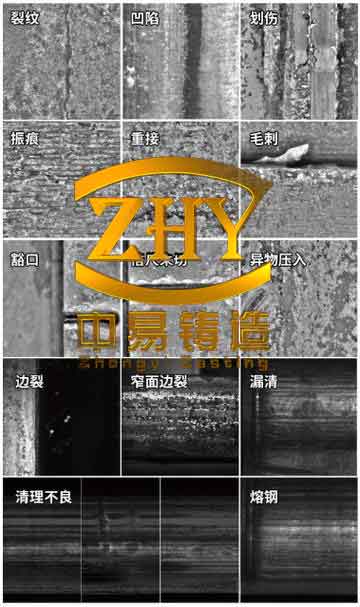
The image above illustrates several common sand casting defects that can arise in any sand casting process, including RCS. The visual identification and classification of such defects are essential for quality control.
Advanced Considerations for Reducing Sand Casting Defects
Beyond the basic remedies, I have investigated several theoretical aspects that influence the formation of sand casting defects. One important factor is the gas pressure inside the mold cavity during pouring. The rate of gas evolution from the RCS shell can be modeled by the following empirical equation:
$$ \dot{Q} = k \, A \, \exp\!\left(-\frac{E_a}{RT}\right) $$
where \( \dot{Q} \) is the gas evolution rate (mL/s), \( k \) is a constant, \( A \) is the surface area of the shell in contact with the metal, \( E_a \) is the activation energy for resin decomposition, \( R \) the gas constant, and \( T \) the temperature. To avoid gas porosity (a classic sand casting defect), the venting system must be designed so that the gas removal rate exceeds \( \dot{Q} \) before the metal skin solidifies. Using this model, I have derived a minimum vent area criterion:
$$ A_v > \frac{\dot{Q} \, \rho_{\text{metal}} \, \ln(1/(1-f_s))}{v_g \, t_{\text{solidification}}} $$
where \( A_v \) is the total vent cross‑sectional area, \( \rho_{\text{metal}} \) is the density, \( f_s \) is the fraction of solidified metal at the moment of maximum gas pressure, \( v_g \) is the gas velocity through the vents, and \( t_{\text{solidification}} \) is the solidification time of the casting skin. In practice, I ensure that the open riser area is at least 2% of the casting cross‑section, and that all core prints have vent grooves.
Another critical area is the control of sand expansion. The linear thermal expansion of silica sand can be expressed as:
$$ \Delta L / L_0 = \alpha_{\text{SiO}_2} \, \Delta T + \beta_{\text{phase}} $$
where \( \alpha_{\text{SiO}_2} \) is the coefficient of thermal expansion (about 14×10⁻⁶ /°C for quartz below 573°C, but the α→β quartz transition at 573°C causes a sudden volume increase of about 0.8%). This abrupt expansion is the main cause of veining sand casting defects. By using reclaimed sand (which has already undergone the phase change) and by adding iron oxide, the expansion is reduced. The addition of iron oxide (Fe₂O₃) is particularly effective because it reacts with the silica to form a low‑melting fayalite (2FeO·SiO₂) that fills cracks and reduces metal penetration.
Future Directions for Eliminating Sand Casting Defects in Larger Valves
Currently, the RCS process is limited to steel valves up to 6 inches because the shell loses strength quickly at high temperatures, and the mold cost becomes prohibitive for larger parts. I am collaborating with resin manufacturers to develop a new generation of RCS with higher hot strength and slower degradation. A promising approach is to incorporate nanofillers into the phenolic resin coating, which can increase the heat distortion temperature and prolong the life of the shell. Preliminary experiments show that adding 2% nano‑silica to the resin reduces the hot deformation by 30% and increases the time to shell collapse by 40%. This would allow the production of 8‑inch and even 10‑inch valve castings with the same low sand casting defects rate.
In addition, I am exploring the combination of RCS with a thin ceramic coating applied by dipping. This coating acts as a barrier to both gas and metal penetration, further reducing the risk of sand casting defects such as burn‑on and veining. The coating is made of a zircon‑based slurry with a binder, and it is applied after the shell is fully cured. The coating thickness is 0.2–0.5 mm and it dries in air. Trials with 6‑inch gate valves have shown that the coating essentially eliminates all surface‑related sand casting defects.
Conclusion
Through systematic investigation and practical experience, I have demonstrated that resin coated sand is a highly effective molding material for producing steel valve castings in the 2–6 inch range, provided that proper attention is given to pattern design, shell parameters, and defect‑specific countermeasures. The three most troublesome sand casting defects – gas porosity, veining, and shrinkage – can be controlled by core venting, sand expansion reduction, and increased feeding modulus ratios, respectively. The continuous improvement of RCS properties, combined with advanced modeling and coating technologies, will enable the application of this process to larger castings while maintaining low defect rates. By sharing these insights, I hope to help other foundries reduce their sand casting defects and improve the quality and efficiency of their operations.