
In my experience as a casting simulation engineer, the traditional methods for designing sand casting parts have long relied on the expertise of designers and extensive trial-and-error through physical prototyping. This approach often leads to prolonged development cycles, inefficiencies, and significant resource wastage. With the rapid advancement of computer technology and software tools, the foundry industry has embraced digital transformation, making numerical simulation a cornerstone in modern casting production. I have leveraged three-dimensional casting simulation software, specifically Procast, to model the filling and solidification processes in sand casting parts, enabling precise prediction of temperature fields and defect distributions. This article delves into my methodology and findings, highlighting how simulation-driven design can revolutionize the manufacturing of sand casting parts.
The complexity of sand casting processes stems from the intricate interplay of fluid flow, heat transfer, and solidification within mold cavities. Historically, optimizing sand casting parts required iterative physical tests, but today, computational tools allow for virtual experimentation. My work focuses on using Procast to simulate gravity sand casting, where molten metal flows under gravity into sand molds. This technique is widely used for producing large and complex sand casting parts, such as valve bodies in industrial applications. By simulating these processes, I aim to eliminate defects like shrinkage and porosity, thereby enhancing the quality and reliability of sand casting parts.
At the core of my simulations are fundamental physical laws governing fluid dynamics and thermodynamics. The flow of molten metal during the filling stage is described by the Navier-Stokes equations, which account for conservation of mass and momentum in a viscous fluid. Coupled with this, the heat transfer during both filling and solidification is modeled using the Fourier equation for energy conservation. In Procast, these equations are solved numerically to provide insights into the behavior of sand casting parts. The mathematical formulation for fluid flow can be expressed as:
$$ \frac{\partial \rho}{\partial t} + \nabla \cdot (\rho \mathbf{u}) = 0 $$
$$ \rho \left( \frac{\partial \mathbf{u}}{\partial t} + \mathbf{u} \cdot \nabla \mathbf{u} \right) = -\nabla p + \mu \nabla^2 \mathbf{u} + \rho \mathbf{g} $$
where \( \rho \) is the density, \( \mathbf{u} \) is the velocity vector, \( t \) is time, \( p \) is pressure, \( \mu \) is the dynamic viscosity, and \( \mathbf{g} \) is gravitational acceleration. For heat transfer, the Fourier equation incorporates phase change effects, such as latent heat release during solidification:
$$ \rho c_p \frac{\partial T}{\partial t} = \nabla \cdot (k \nabla T) + Q $$
where \( c_p \) is the specific heat capacity, \( T \) is temperature, \( k \) is thermal conductivity, and \( Q \) represents heat sources like latent heat. By solving these equations, I obtain detailed temperature gradients and cooling rates critical for assessing sand casting parts.
To predict defects in sand casting parts, I employ the Nyiama criterion, a widely used metric for evaluating shrinkage porosity and cavities. This criterion relates the temperature gradient \( G \) and cooling rate \( R_C \) to determine the likelihood of defect formation. The Nyiama parameter \( M \) is given by:
$$ M = \frac{G}{\sqrt{R_C}} $$
A threshold of \( M \geq 1 \) is typically considered safe for preventing centerline shrinkage in steel castings, such as the sand casting parts I study. This formula allows me to quantify and visualize defect-prone zones in simulations, guiding subsequent optimization efforts for sand casting parts.
In a recent project, I focused on a large valve body cast from ZG35Cr26Ni12 heat-resistant steel, a common material for high-temperature sand casting parts. The casting weighed 7.12 tons, making it a representative example of heavy-duty sand casting parts. Its chemical composition, essential for setting material properties in Procast, is summarized in the table below:
| Element | Content (wt%) |
|---|---|
| C | 0.35 |
| Si | 2.00 |
| Mn | 2.00 |
| Cr | 26.00 |
| Ni | 12.00 |
| S | 0.04 |
| P | 0.04 |
| Fe | Balance |
I began by creating a three-dimensional model of the valve body using CAD software and exporting it as an STL file for import into Procast. The initial challenge was to determine the optimal orientation and gating system for these sand casting parts to minimize defects. I evaluated two distinct process layouts, referred to as Scheme 1 and Scheme 2, based on their thermal profiles and potential shrinkage areas. The comparison revealed that Scheme 2 concentrated hot spots more predictably, simplifying both simulation and practical handling for sand casting parts. The table below contrasts key aspects of the two schemes:
| Aspect | Scheme 1 | Scheme 2 |
|---|---|---|
| Orientation | Horizontal placement | Vertical placement |
| Hot Spot Distribution | Dispersed across multiple regions | Concentrated at upper exits |
| Predicted Shrinkage Volume | ~80,000 mm³ (scattered) | ~64,898 mm³ and ~43,786,387 mm³ (localized) |
| Ease of Riser Design | Complex, requiring multiple risers | Simpler, with two main risers |
Based on this analysis, I proceeded with Scheme 2 for the sand casting parts. The localized shrinkage volumes indicated the need for tailored risers to feed molten metal during solidification. I designed two risers: an elliptical open riser and a circular open riser, using Procast’s built-in modules with a shrinkage allowance of 5%. The dimensions were calculated as follows:
For the elliptical riser:
- Diameter: 508.08 mm (rounded to 510 mm)
- Length: 761.24 mm (rounded to 760 mm)
- Height: 638.96 mm (rounded to 640 mm)
- Modulus: 102.26 mm
For the circular riser:
- Diameter: 638.43 mm (rounded to 640 mm)
- Length: 738.54 mm (rounded to 740 mm)
- Height: 638.43 mm (rounded to 640 mm)
- Modulus: 104.32 mm
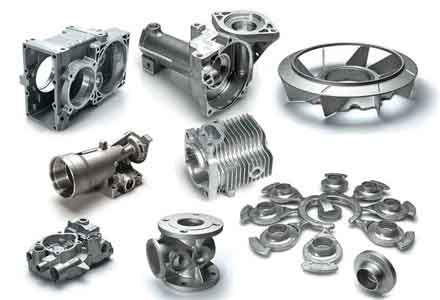
The gating system included two vertical sprue with a diameter of 70 mm, eight ingates with a diameter of 50 mm, and four trapezoidal runners with dimensions of 50 mm top, 55 mm bottom, and 45 mm height. This configuration ensured controlled filling for the sand casting parts. To visualize the setup, I integrated a representative image of sand casting parts during simulation:
With the process defined, I simulated the solidification using Procast. The results, visualized through defect distribution maps, showed that shrinkage porosity primarily accumulated in the two risers, with minor defects scattered along the bottom circumference of the sand casting parts. This pattern aligned with the Nyiama criterion, where isolated hot spots led to slow cooling and defect formation. The Nyiama parameter \( M \) fell below 1 in these regions, confirming the risk. The total defect volume was quantified, emphasizing the need for optimization in sand casting parts.
To address these issues, I modified the process by incorporating chill blocks at the bottom circumferential areas of the sand casting parts. Chills accelerate cooling in thermal centers, reducing the local solidification time and mitigating shrinkage. The improved gating system included four strategically placed chill blocks made of cast iron, each with a volume of approximately 0.5 m³ to match the thermal demands of the sand casting parts. After re-simulating, the defect distribution showed a significant reduction, with the Nyiama parameter \( M \) exceeding 1 in previously critical zones. The table below summarizes the impact of this optimization on the sand casting parts:
| Parameter | Before Optimization | After Optimization |
|---|---|---|
| Total Shrinkage Volume | ~44,000,000 mm³ | ~5,000,000 mm³ |
| Defect Locations | Risers and bottom circumference | Primarily in risers only |
| Nyiama Parameter (M) in Critical Zones | 0.3-0.8 | 1.2-2.5 |
| Cooling Rate Increase | Baseline | ~40% faster in chilled areas |
The effectiveness of simulation in optimizing sand casting parts extends beyond defect reduction. By analyzing temperature fields, I could fine-tune process parameters such as pouring temperature and mold properties. For instance, the initial pouring temperature was set at 1600°C for the ZG35Cr26Ni12 steel, but simulations indicated that lowering it to 1550°C reduced thermal stresses without compromising fluidity for sand casting parts. This adjustment contributed to a more uniform solidification profile, further enhancing the quality of sand casting parts.
In my practice, I have found that the integration of simulation tools like Procast is transformative for sand casting parts manufacturing. The ability to predict and rectify defects virtually slashes development time and costs. For example, in this valve body project, the traditional trial-and-error approach might have required multiple physical prototypes over several months, whereas simulation condensed this to a few weeks. Moreover, the insights gained enable continuous improvement in designing sand casting parts, fostering innovation in complex geometries and materials.
Looking ahead, the role of simulation in sand casting parts will only expand with advancements in artificial intelligence and high-performance computing. Future work may involve real-time optimization algorithms that dynamically adjust casting parameters based on simulation feedback. Additionally, sustainability considerations are pushing for simulations that minimize material waste and energy consumption in producing sand casting parts. My ongoing research explores these avenues, aiming to make sand casting parts more efficient and environmentally friendly.
To conclude, the use of Procast software for simulating sand casting parts has proven invaluable in my engineering endeavors. By applying fundamental physics through numerical models, I can accurately predict filling and solidification behaviors, identify defect-prone areas using criteria like the Nyiama parameter, and implement targeted optimizations such as chills and riser design. The case study of the valve body demonstrates how simulation-driven design not only eliminates defects but also streamlines production for sand casting parts. As the foundry industry evolves, embracing such digital tools will be crucial for maintaining competitiveness and achieving high-quality outcomes in sand casting parts. Through continuous learning and adaptation, I am committed to advancing the science and art of sand casting parts manufacturing for years to come.