
In the realm of advanced manufacturing, the lost wax investment casting process has long been revered for its ability to produce components with exceptional dimensional accuracy, fine surface finish, and complex geometries that are often unattainable through other manufacturing methods. As a research and development engineer deeply involved in pushing the boundaries of this technique, I have witnessed firsthand the evolving challenges. The industry’s relentless drive towards larger, thinner-walled, and more integrated castings has placed unprecedented demands on the process, particularly in addressing solidification defects. One of the most persistent and critical issues in lost wax investment casting is the formation of shrinkage porosity and cavities at thermal hotspots, or “hot spots,” within a casting. These are regions where the geometry—such as intersecting sections, bosses, or ribs—causes a localized delay in solidification, leading to defective structures. Traditionally, the solution within lost wax investment casting has been to employ elaborate gating and risering systems designed to feed these hot spots. However, this approach often results in massive feed systems, drastically reduced yield (often below 50%), significant material waste, and immense technical difficulty in shell fabrication and pouring. It became clear that a paradigm shift was necessary. Through extensive experimentation and process innovation, our team has successfully developed and implemented a novel technique: the strategic placement of engineered “chilling irons” or “chills” within the ceramic shell of a lost wax investment casting to eliminate hot spot defects without the need for cumbersome feeding systems.
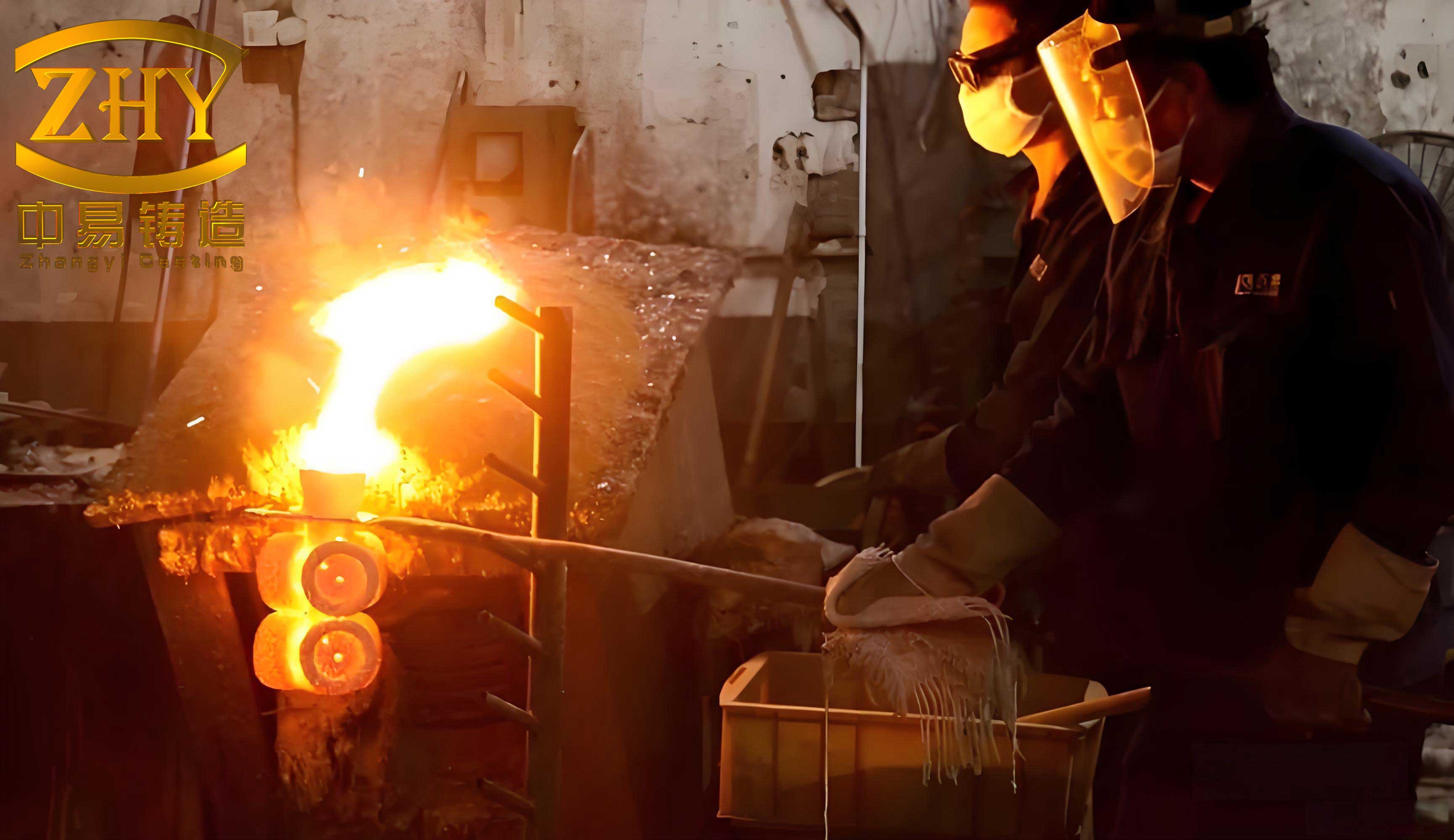
The fundamental principle of lost wax investment casting, also known simply as investment casting, involves creating a wax or polymer pattern, assembling it into a cluster, coating it with successive layers of refractory ceramic to build a shell, dewaxing, firing the shell at high temperatures, and finally pouring molten metal. This process is celebrated for its precision. However, the very complexity it can capture often introduces thermal management challenges. In sand casting, the use of external or internal chills—metallic inserts with high thermal conductivity and heat capacity—is a well-established method for promoting directional solidification and eliminating shrinkage in hot spots. The chill acts as a heat sink, rapidly extracting thermal energy and accelerating solidification in its vicinity, thus forcing the solidification front to move towards the riser. The efficacy of a chill can be conceptually described by its ability to modify the local solidification time, which is a function of the thermal diffusivity of the mold and metal. The basic heat extraction can be modeled using Fourier’s law:
$$ q = -k \nabla T $$
where \( q \) is the heat flux vector, \( k \) is the thermal conductivity of the chill material, and \( \nabla T \) is the temperature gradient. A simple approximation for the solidification time of a region influenced by a chill can be derived from Chvorinov’s rule, modified to account for the chilling effect:
$$ t_s = C \left( \frac{V}{A} \right)^n \cdot f(\alpha_{chill}, \alpha_{shell}) $$
Here, \( t_s \) is the solidification time, \( V \) is the volume of the casting section, \( A \) is its surface area, \( C \) and \( n \) are constants dependent on the alloy and mold material, and \( f(\alpha_{chill}, \alpha_{shell}) \) is a function that reduces the time based on the enhanced thermal diffusivity \( \alpha \) provided by the chill relative to the ceramic shell.
Directly transferring this sand casting technique to lost wax investment casting was historically considered impractical. The core obstacle is the shell firing stage. In lost wax investment casting, the ceramic shell must be fired at temperatures typically ranging from 950°C to 1100°C to achieve sufficient strength and remove residual volatiles. A standard steel chill placed inside the shell would undergo severe oxidation during this prolonged high-temperature exposure. The resulting oxide scale could flake off during metal pouring, becoming entrapped in the casting as non-metallic inclusions, severely compromising mechanical properties and integrity. Using high-temperature resistant alloys like stainless steel for the chills is not a viable solution either, as they would fuse with the casting steel, become extremely difficult to machine out, could not be reused, and would significantly increase cost. Therefore, for decades, the lost wax investment casting industry largely avoided internal chills, resorting to the inefficient and wasteful practice of oversized gating.
Our breakthrough was the development and application of a proprietary refractory coating specifically designed for chilling irons used in the lost wax investment casting process. This coating serves a dual purpose: it acts as a barrier layer, preventing oxidation of the chill during the high-temperature shell firing, and it physically separates the chill from the molten metal during pouring, preventing any metallurgical interaction or contamination. The key properties of this water-based coating are summarized in the table below:
| Property | Value or Description |
|---|---|
| Type | Water-based viscous colloidal liquid |
| Service Temperature Range | 850°C – 1300°C |
| Density | 1.9 – 2.0 g/cm³ |
| Coverage Capacity | 1.0 – 2.0 m² per kilogram |
| Recommended Coating Method | Dip coating |
| Number of Coats | 1 – 2 layers |
| Resulting Coating Thickness | 0.3 – 0.8 mm |
The application process is straightforward. The machined chills, typically made from low-carbon steel for optimal thermal properties and cost-effectiveness, are dipped into the coating slurry, allowed to drain, and then dried. This creates a uniform, adherent ceramic layer that survives the shell firing intact. The coating’s thermal properties are engineered to be sufficiently insulating to prevent premature melting of the adjacent wax during shell building but conductive enough not to severely impede the chill’s ultimate function during metal solidification. The effectiveness of this barrier can be assessed by considering the oxidation kinetics. The parabolic rate constant for iron oxidation at high temperature is given by:
$$ \frac{dx}{dt} = \frac{k_p}{x} $$
where \( x \) is the oxide thickness and \( k_p \) is the parabolic rate constant. The coating effectively reduces \( k_p \) to near zero for the protected chill surface by limiting oxygen diffusion.
The integration of coated chills necessitates a modified and rigorous process flow for lost wax investment casting. The following table outlines the comprehensive sequence, highlighting steps specific to the chilling iron technology.
| Process Step Number | Step Description | Key Considerations for Chilling Iron Process |
|---|---|---|
| 1 | Part Drawing Analysis | Identify potential hot spots for chill placement. |
| 2 | Process Design | Determine chill location, size, shape, and fixation method. |
| 3 | Pattern Die Design | Incorporate features to locate and secure chills within the wax assembly. |
| 4 | Pattern Die Manufacturing & Correction | Ensure precision of chill-locating features. |
| 5 | Wax Pattern Injection | Standard lost wax investment casting practice. |
| 6 | Wax Pattern Assembly & Gating | Wax patterns are assembled with gating systems. Chills are not yet added. |
| 7 | Chill Manufacturing | Machine chills to specified geometry from low-carbon steel. |
| 8 | Chill Surface Preparation | Cleaning to ensure good coating adhesion. |
| 9 | Chill Coating Application | Dip coating with proprietary refractory coating. |
| 10 | Chill Coating Drying/Curing | Air drying or low-temperature baking. |
| 11 | Wax Pattern & Chill Assembly | Coated chills are manually or semi-automatically positioned and fixed into the wax cluster at designated hot spots. |
| 12 | Shell Building (Stuccoing) | Standard lost wax investment casting shell building process embeds the coated chills within the ceramic layers. |
| 13 | Dewaxing (Autoclave or Flash Fire) | Wax is removed; coating on chill remains intact. |
| 14 | Shell Firing | Shell is fired at 1000-1100°C; coating protects chill from oxidation. |
| 15 | Metal Melting & Pouring | Alloy is melted, refined, and poured into the preheated shell. |
| 16 | Knock-out, Shell Removal & Chill Recovery | After solidification, the shell is mechanically removed. Chills, now loose, are recovered, cleaned of residual coating, and prepared for reuse. |
| 17 | Cut-off (Gating Removal) | Castings are separated from the simplified gating system. |
| 18 | Heat Treatment | As required by the alloy specification. |
| 19 | Finishing & Inspection | Final cleaning, non-destructive testing, and dimensional inspection. |
The success of this methodology hinges on several interconnected technical factors beyond just the coating. The chill’s design is critical. Its geometry, volume, and surface area must be calculated to provide the exact degree of cooling required to shift the thermal center from the hot spot to a feedable area. We often use dimensionless analysis like the Chilling Modulus, which compares the chill’s cooling capacity to the thermal mass of the hot spot:
$$ M_c = \frac{(V \rho C_p)_{chill}}{(V \rho C_p)_{hotspot}} $$
where \( \rho \) is density and \( C_p \) is specific heat capacity. For thin-walled castings with protruding features, a successful design often uses chill dimensions that match the contour of the hot spot to ensure uniform heat extraction. Furthermore, the method of embedding the chill in the wax pattern is crucial. It must be secure enough to withstand the slurry dipping and stuccoing forces during shell building but not so rigid as to cause shell cracking during thermal expansion mismatch. We typically use small wax connectors or adhesive points that melt out during dewaxing.
A compelling demonstration of this technology’s efficacy was its application to a large, thin-walled conical pipe casting. The component featured a major diameter with a wall thickness of less than 4mm and six equally spaced mounting lugs on its outer circumference. These lugs represented pronounced thermal hot spots. Manufacturing this part via forging or machining was prohibitively expensive and technically challenging, making lost wax investment casting the preferred route. However, conventional lost wax investment casting would require an extremely complex and heavy gating/risering system to feed these six isolated hot spots, resulting in a yield likely below 30%. We designed a experiment where three of the six lugs had coated low-carbon steel chills placed directly behind them in the wax assembly, while the other three lugs relied only on the simplified gating system. The results were unequivocal, as summarized below:
| Lug Number | Chill Presence | Post-Casting Inspection Result | Radiographic Inspection Finding |
|---|---|---|---|
| 1 | Yes (Coated Chill) | Sound, dense microstructure | No shrinkage defects detected |
| 2 | Yes (Coated Chill) | Sound, dense microstructure | No shrinkage defects detected |
| 3 | Yes (Coated Chill) | Sound, dense microstructure | No shrinkage defects detected |
| 4 | No | Visible surface shrinkage and internal porosity | Shrinkage cavity level 4 per ASTM E155 |
| 5 | No | Visible surface shrinkage and internal porosity | Shrinkage cavity level 5 per ASTM E155 |
| 6 | No | Subsurface shrinkage | Shrinkage cavity level 3 per ASTM E155 |
This controlled experiment within the lost wax investment casting process provided irrefutable evidence that the coated chilling iron effectively suppressed shrinkage formation. Metallographic analysis of the chilled sections revealed a significantly finer grain structure compared to the unchilled sections, attributable to the higher undercooling and nucleation rate induced by the rapid heat extraction. The Hall-Petch relationship, $$ \sigma_y = \sigma_0 + k_y d^{-1/2} $$, where \( \sigma_y \) is yield strength, \( \sigma_0 \) and \( k_y \) are constants, and \( d \) is the average grain diameter, suggests this grain refinement also enhances mechanical properties. The successful implementation for this conical pipe enabled its serial production via lost wax investment casting, achieving a yield exceeding 70% and reducing unit cost by over 40% compared to the traditional riser-based approach.
The implications and advantages of this chilling iron technology for lost wax investment casting are profound and multi-faceted. Firstly, it fundamentally simplifies gating design. Complex bottom or step gating systems, which are traditionally used in lost wax investment casting for large thin-wall castings to ensure smooth filling, often create large thermal gradients and make feeding of upper sections ineffective. With chills controlling solidification at hot spots, the gating system can be optimized primarily for smooth filling and slag trapping, not for long-range feeding. This leads to a dramatic increase in casting yield, often doubling it from 30-40% to 60-75%. The material and energy savings are substantial. Secondly, the technology extends the capability envelope of the lost wax investment casting process. It enables the production of castings previously deemed too risky or impossible due to isolated heavy sections in an otherwise thin structure. This includes large frames, housings, and structural components in aerospace, power generation, and high-performance automotive sectors. Thirdly, the process is highly adaptable. While our primary focus has been on steel and alloy steel castings, the principle is universally applicable. The coating formulation can be tailored for different firing temperatures, making the technology suitable for lost wax investment casting of aluminum, copper, titanium, and cobalt-based superalloys. The chilling effect can be modeled for different alloys using the Fourier number, \( Fo = \frac{\alpha t}{L^2} \), which characterizes transient heat conduction, where \( \alpha \) is thermal diffusivity, \( t \) is time, and \( L \) is a characteristic length.
From a practical implementation standpoint, the technology requires minimal capital investment. It integrates seamlessly into existing lost wax investment casting foundry workflows. The key additions are the coating preparation station and possibly a small CNC or manual lathe for chill machining. The chills themselves are reusable assets; after knockout, they are cleaned, inspected, recoated, and returned to inventory. Our economic analysis for a series of high-strength aluminum alloy components for electric locomotive applications, produced via this enhanced lost wax investment casting method, demonstrated a net saving of approximately 6.87 million currency units annually, primarily from improved yield, reduced machining, and the enablement of casting complex parts that were previously fabricated from multiple pieces.
In conclusion, the integration of protected chilling irons represents a significant technological advancement in the field of lost wax investment casting. It addresses a long-standing thermal management deficiency by borrowing and innovating upon a concept from sand casting. The core innovation—a simple yet robust refractory coating—solves the historical showstopper of chill oxidation. This technology empowers foundries to produce larger, thinner, and more complex castings with higher integrity and significantly lower cost. It reinforces the position of lost wax investment casting as a premier net-shape manufacturing process for critical components. Future work will focus on further optimizing chill design through advanced solidification simulation software, developing automated chill insertion systems, and formulating next-generation coatings with even better thermal and barrier properties for more demanding lost wax investment casting applications in extreme environments.