
In my extensive experience with foundry processes, the adoption of sand faced permanent iron molding, often referred to as iron mold sand lining, has revolutionized the production of thin-section grey iron casting components. This technique combines the durability of metal molds with the flexibility of sand linings, offering superior dimensional accuracy and surface finish. Particularly for grey iron casting parts with intricate geometries and thin walls, this method addresses common issues like cold shuts, misruns, and white iron formation. The demand for high-volume production of such castings, such as machine bases or enclosures, necessitates a robust and efficient process. Here, I will delve into the nuances of this technology, emphasizing its application to grey iron casting through detailed design parameters, operational insights, and empirical data, all aimed at optimizing production outcomes.
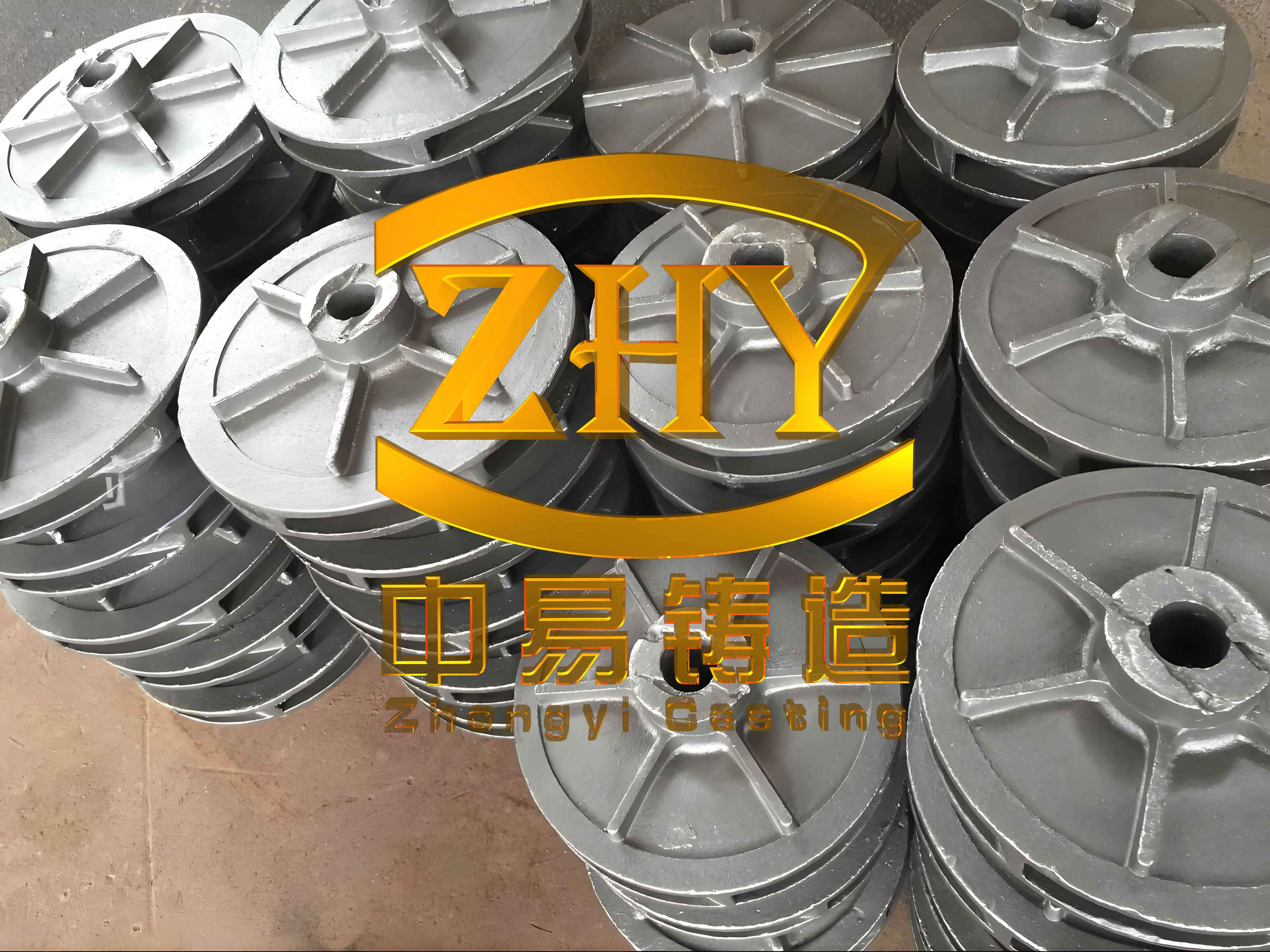
The fundamental principle behind sand faced permanent iron molding involves creating a thin sand layer on the interior surfaces of a reusable iron mold. This sand lining, typically resin-bonded, provides the necessary refractoriness and surface detail, while the iron mold ensures rapid heat dissipation and consistent mold geometry. For grey iron casting, which inherently has lower fluidity compared to ductile iron, this setup poses unique challenges. The rapid cooling in the mold can exacerbate defects in thin sections, making process control critical. In my practice, I have observed that successful implementation hinges on meticulous design—balancing thermal management, gating systems, and sand properties—to achieve sound castings with minimal scrap rates.
When designing for thin-wall grey iron casting using this method, several complexities arise. First, the part geometry, such as a shell-like structure with uniform wall thicknesses as low as 2-3 mm, limits mold parting options. Often, the entire cavity must be placed in a single mold half, increasing the adhesion forces during pattern withdrawal. Since the sand hardens before demolding, as in no-bake systems, the release process becomes tricky. Second, the poor fluidity of grey iron, coupled with the high thermal conductivity of the iron mold, accelerates the cooling of the molten metal front. This can lead to incomplete filling in areas like windows or thin edges, resulting in cold shuts or misruns. Moreover, the risk of white iron formation due to rapid solidification is heightened, compromising the material’s machinability and performance. Third, internal cores or mold sections can restrain the contraction of the grey iron casting during cooling, inducing thermal stresses and potential cold cracks. These factors collectively demand a tailored approach to ensure defect-free production.
To overcome these hurdles, I have developed a set of key design parameters and operational strategies. The gating system is paramount; I recommend a semi-closed design to promote rapid filling. The cross-sectional area ratios can be expressed as: $$ F_{\text{直}} : F_{\text{E横}} : F_{\text{E内}} = 1.2 : 1.5 : 1 $$ where \( F_{\text{直}} \) is the sprue area, \( F_{\text{E横}} \) is the runner area, and \( F_{\text{E内}} \) is the ingate area. This ratio ensures a controlled flow with minimal turbulence, essential for grey iron casting thin sections. Increasing the number of ingates also helps distribute metal evenly. Additionally, venting is crucial to prevent gas entrapment. The pressure drop during filling can be modeled using Darcy’s law for porous media: $$ \Delta P = \frac{\mu L v}{k} $$ where \( \Delta P \) is the pressure drop, \( \mu \) is the dynamic viscosity of the gas, \( L \) is the sand layer thickness, \( v \) is the gas velocity, and \( k \) is the permeability of the sand. Proper vents reduce back-pressure, facilitating smoother metal flow.
The sand layer thickness and iron mold thickness are adjustable parameters that significantly influence thermal behavior. For grey iron casting, I typically specify a sand lining thickness of 5–20 mm and an iron mold thickness of 10–25 mm. Thicker sand layers reduce the effective cooling rate by acting as an insulator, while thinner iron molds decrease the overall thermal mass. This balance can be quantified using the Fourier number for transient heat conduction: $$ Fo = \frac{\alpha t}{L^2} $$ where \( \alpha \) is the thermal diffusivity, \( t \) is time, and \( L \) is the characteristic length (e.g., sand thickness). A higher \( Fo \) indicates faster heat penetration, so adjusting \( L \) allows control over solidification rates. Below is a table summarizing these design parameters for optimal grey iron casting production.
| Parameter | Recommended Range for Grey Iron Casting | Influence on Process |
|---|---|---|
| Sand Lining Thickness | 5–20 mm | Reduces cooling rate, improves surface finish |
| Iron Mold Thickness | 10–25 mm | Decreases thermal mass, enhances mold life |
| Gating Ratio (Sprue:Runner:Ingate) | 1.2:1.5:1 | Ensures rapid, laminar filling |
| Pouring Temperature | ≥1320°C | Compensates for fluidity loss in grey iron |
| Sand Grain Size | Fine (AFS 70–100) | Increases surface smoothness, reduces flow resistance |
| Mold Venting Area | 0.5–1% of mold volume | Prevents gas defects, eases metal flow |
In production, operational practices are equally vital. I emphasize the use of high-quality release agents—sprayed or brushed onto patterns—to mitigate adhesion during demolding. For complex grey iron casting shapes, I often apply a thin coat of mold release paste on deep draws. Timing is critical; demolding should occur soon after sand curing to leverage residual plasticity, followed by post-curing if needed. Pouring conditions must be optimized: hot mold practice, where molds are preheated to 100–200°C, combined with elevated pouring temperatures above 1320°C, minimizes premature freezing. The pouring time for a typical thin-wall grey iron casting can be estimated from fluid dynamics: $$ t_{\text{pour}} = \frac{V}{A \sqrt{2gH}} $$ where \( V \) is the mold cavity volume, \( A \) is the ingate area, \( g \) is gravity, and \( H \) is the metallostatic head. Keeping this under 10 seconds, as in my setups, ensures complete filling. Early shakeout, within 5–10 minutes post-pouring, reduces restraint on the contracting grey iron casting, preventing cracks.
The benefits of this approach for grey iron casting are manifold. In high-volume runs, productivity soars; with multi-cavity molds, output can exceed 40 pieces per hour. Dimensional consistency meets tight tolerances—often within GB6414-86 CT8 grade—eliminating extensive machining. Surface finishes achieve near-net-shape quality, with sharp edges and minimal cleaning. Economically, material savings are substantial; for instance, part weight reduction from 9 kg to 7.02 kg per casting translates to lower material and energy costs per unit. The process also boasts a high yield, with casting yield (pouring weight to part weight) reaching 89%, and scrap rates below 2%. The iron-to-sand ratio, a measure of resource efficiency, can be as low as 1:1, outperforming conventional sand molding. Below, a table contrasts key performance indicators between traditional sand casting and sand faced permanent iron molding for grey iron casting.
| Performance Indicator | Traditional Sand Casting | Sand Faced Permanent Iron Molding |
|---|---|---|
| Casting Yield | 70–75% | 85–90% |
| Scrap Rate | 5–10% | 1–3% |
| Surface Roughness (Ra) | 12.5–25 μm | 6.3–12.5 μm |
| Dimensional Tolerance | ±0.8–1.2 mm | ±0.3–0.5 mm |
| Production Rate (pieces/hour) | 10–20 | 30–50 |
| Energy Consumption per Casting | High | Low (due to reuse) |
Thermal analysis further underscores the advantages. The solidification time for a grey iron casting in this system can be approximated using Chvorinov’s rule: $$ t_s = B \left( \frac{V}{A} \right)^n $$ where \( t_s \) is solidification time, \( B \) is a mold constant, \( V/A \) is the volume-to-surface-area ratio, and \( n \) is an exponent (typically ~2). For thin sections, the low \( V/A \) leads to short \( t_s \), but the sand lining moderates this by increasing the effective mold constant \( B \). This control prevents undercooling and promotes gray iron formation over white iron. In practice, I monitor cooling curves using thermocouples, ensuring the critical temperature range for grey iron casting—around 1150–950°C—is traversed without excessive gradient. The heat flux \( q \) from the casting to the mold can be derived: $$ q = h (T_{\text{cast}} – T_{\text{mold}}) $$ where \( h \) is the interfacial heat transfer coefficient, influenced by sand roughness and contact pressure. Optimizing \( h \) through sand composition—such as using fine-grained silica sand with phenolic resin—enhances thermal uniformity.
Another critical aspect is sand formulation. For grey iron casting, I prefer sands with high thermal stability and low gas generation. A typical mix includes 90–95% silica sand, 1–2% resin binder (e.g., furan or phenolic), and 0.5–1% catalyst. The sand’s compactability affects the lining density; I aim for a permeability number of 80–120 to allow gas escape while retaining strength. The curing reaction follows Arrhenius kinetics: $$ k = A e^{-E_a/(RT)} $$ where \( k \) is the rate constant, \( A \) is the pre-exponential factor, \( E_a \) is activation energy, \( R \) is the gas constant, and \( T \) is temperature. Controlling mold temperature during lining ensures proper cure, vital for pattern release. Additionally, sand reclamation is feasible, with up to 90% reuse rates, making the process sustainable for continuous grey iron casting production.
In terms of mold design, I employ modular iron molds with built-in cooling channels or vents. For a typical thin-wall grey iron casting like a machine base, the mold may be split horizontally or vertically, depending on part geometry. Finite element analysis (FEA) aids in predicting thermal stresses. The stress \( \sigma \) induced during cooling can be expressed as: $$ \sigma = E \alpha \Delta T $$ where \( E \) is Young’s modulus, \( \alpha \) is the coefficient of thermal expansion, and \( \Delta T \) is the temperature difference. Minimizing \( \Delta T \) through uniform sand thickness reduces residual stresses. I often design molds with adjustable sand lining pockets, allowing thickness variations from 5 mm in thick sections to 20 mm in thin areas, tailored for each grey iron casting project.
Quality assurance involves non-destructive testing and statistical process control. For grey iron casting, hardness and microstructure are key. The correlation between cooling rate and graphite morphology can be modeled: $$ \lambda = C \cdot t_s^{-m} $$ where \( \lambda \) is the graphite flake length, \( C \) and \( m \) are material constants, and \( t_s \) is solidification time. Slower cooling (achieved via thicker sand) promotes longer flakes, improving machinability. In production, I sample castings regularly to verify Brinell hardness (180–220 HB for HT200) and pearlite content. Defect analysis tools, like Pareto charts, help identify root causes—e.g., improper venting leading to gas holes in grey iron casting—enabling continuous improvement.
Looking broader, this technology aligns with lean manufacturing principles. The reduced floor space—under 200 m² for a full line—and minimal sand handling lower operational costs. For grey iron casting batches exceeding 10,000 pieces monthly, as in automotive or machinery sectors, the payback period for mold investment is short, often less than a year. Environmental benefits include lower emissions due to reduced melting volumes and sand waste. In my implementations, I have integrated automated systems for mold coating, sand shooting, and shakeout, further boosting consistency for grey iron casting outputs.
To summarize, sand faced permanent iron molding is a versatile and efficient method for producing high-quality thin-wall grey iron casting components. By integrating tailored design parameters, precise operational controls, and robust material choices, it addresses the inherent challenges of grey iron fluidity and rapid cooling. The result is a process that delivers dimensional accuracy, excellent surface finish, and economic savings, making it ideal for mass production. As foundries strive for competitiveness, adopting such advanced techniques for grey iron casting will be pivotal in meeting the demands of modern industry.