
In my extensive work with wear-resistant alloys, I have consistently encountered the challenge of producing large, complex sand casting parts that are both dimensionally precise and free from critical defects. High-chromium white irons, such as KmTBCr26, are exemplary materials for applications involving severe abrasion and moderate impact, commonly found in mining, mineral processing, and dredging equipment. Their superior performance stems from a microstructure dominated by hard chromium carbides embedded in a supportive metallic matrix. However, this very advantage introduces significant complexities during the solidification and cooling stages of sand casting. The task of manufacturing a large, thin-walled four-way pipe—a critical sand casting part for slurry handling in dredgers—became a focal point for investigating and solving a persistent cracking issue that led to the scrapping of initial productions. This article details my first-person analysis and the systematic engineering approach taken to rectify this problem, fundamentally improving the yield for such demanding sand casting parts.
The initial manufacturing attempt for two units of the four-way pipe employed a traditional CO2-sodium silicate sand molding process. This method is often favored for its rapid production cycle and good dimensional accuracy for large molds. The design required uniform wall thickness, smooth internal passages, and a high degree of geometric consistency to ensure optimal hydrodynamic flow and erosion resistance. Despite careful handling during knockout at temperatures below 100°C, both castings exhibited severe cracking at identical locations—specifically at the internal junctions (corners) where the pipe branches intersect. The fracture morphology, showing coarse, oxidized grains, was a clear indicator that the cracks formed at high temperatures during the later stages of solidification or early cooling, well before knockout. This recurrent failure mode pointed not to a random operational error but to a fundamental incompatibility between the material’s behavior, the component’s geometry, and the properties of the molding sand. Eliminating this defect required a holistic review of the entire sand casting process for these specific sand casting parts.
Root Cause Analysis of Thermal Cracking
Thermal cracking in castings is seldom attributable to a single factor. It is typically the result of tensile stresses developed during contraction exceeding the material’s cohesive strength in a vulnerable temperature range. For these high-chromium iron sand casting parts, I identified three interdependent primary causes.
1. Intrinsic Material Properties and Solidification Characteristics
The high-chromium iron’s composition directly dictates its solidification path and mechanical properties at elevated temperatures. These alloys have a relatively wide freezing range. The critical temperature range for hot tearing susceptibility ($T_{HTS}$) lies between the coherency temperature (where a solid network forms) and the solidus temperature. A wider freezing range often correlates with a broader $T_{HTS}$, prolonging the period during which the partially solid skeleton is weak and susceptible to strain from contraction.
$$ T_{range} = T_{liquidus} – T_{solidus} $$
$$ \text{Where a larger } T_{range} \text{ often increases hot tear propensity.} $$
For a typical KmTBCr26, $T_{liquidus}$ is approximately 1280°C and $T_{solidus}$ is around 1210°C, giving a $T_{range}$ of about 70°C. During this interval, the developing solid network undergoes significant linear contraction. If this contraction is restrained, tensile stresses ($\sigma_t$) build up. The material’s hot strength ($S_h$) in this mushy state is low, and the presence of segregated low-melting-point constituents at grain boundaries further reduces it. A hot tear initiates when:
$$ \sigma_t > S_h $$
This fundamental relationship was central to the failure of our initial sand casting parts.
2. Geometric Design and Stress Concentration
The four-way pipe, while seemingly symmetric, features junctions where differing pipe diameters and intersection angles create natural thermal masses or “hot spots.” Even with nominally uniform wall thickness, these junctions cool slower than the surrounding walls and straight sections. This creates thermal gradients, leading to differential contraction. Furthermore, the sharp internal corners (even with fillets) act as potent stress concentrators. The stress concentration factor ($K_t$) at such geometric discontinuities can significantly amplify the nominal tensile stress.
$$ \sigma_{max} = K_t \cdot \sigma_{nominal} $$
The combined effect of delayed solidification at the junction (creating a weak spot) and the geometric stress concentration creates a perfect locus for crack initiation. The fact that both prototype sand casting parts cracked at the exact same internal corners confirmed this as a primary failure point.
3. Mold and Core Restraint: The Role of Sand System
The CO2-sodium silicate sand process produces molds and cores with high initial strength and good surface stability. However, a significant drawback for casting alloys with high contraction is its poor “collapsibility” or “yield” at elevated temperatures. While the sand’s silicate binder breaks down upon heating, the core—especially a large, bulky one forming the complex internal passage of the four-way pipe—does not yield uniformly. The outer layers may partially disintegrate, but the inner core remains rigid, acting as a hard, unyielding obstacle to the contracting casting.
The restraining force ($F_r$) imposed by the core can be conceptually related to the core’s high-temperature strength and its thermal expansion mismatch with the metal. Although the initial process included placing loose, unbonded fillers (like wood chips or coke) in the core’s center to improve yield, as shown in the initial schematic, it proved insufficient. The overall restraint was too high for the high-contraction, high-chromium iron during its vulnerable solid-state cooling phase. The sand casting part was essentially being pulled apart by its own core.
| Root Cause Category | Key Mechanism | Effect on Casting |
|---|---|---|
| Material Properties | Wide freezing range, low hot strength, grain boundary segregation. | Creates a prolonged period of low strength during contraction. |
| Component Geometry | Junction hot spots, sharp internal corners (stress raisers). | Creates localized weakness and amplifies tensile stresses. |
| Mold/Core Material | Poor high-temperature collapsibility of CO2-silicate sand. | Provides excessive mechanical restraint to natural contraction. |
Implemented Solutions and Process Optimization
Addressing this multi-faceted problem required simultaneous interventions on the material, the design, and the process to shift the balance from $\sigma_t > S_h$ to $\sigma_t < S_h$ at the critical junctions.
1. Enhancing the Alloy’s Intrinsic Resistance to Cracking
Beyond the standard rare-earth silicon ferroalloy inoculant used for graphite suppression and carbide modification, I introduced a proprietary multi-component compound modifier containing controlled amounts of Aluminum (Al) and Magnesium (Mg), among other elements. The purpose was two-fold:
Grain Refinement: Al and other elements act as potent nuclei for the austenitic matrix. A finer grain structure increases the total grain boundary area, distributing any imposed strain more evenly. This can be conceptually linked to the Hall-Petch relationship, where yield strength ($\sigma_y$) increases with decreasing grain size ($d$):
$$ \sigma_y = \sigma_0 + \frac{k_y}{\sqrt{d}} $$
While this exact formula applies to room-temperature strength, the principle holds at high temperatures—a finer structure generally offers more resistance to crack propagation.
Microstructure Purification: The compound modifier enhances the scavenging (gettering) of oxygen and sulfur, reducing the formation of brittle, low-melting-point oxide and sulfide films at grain boundaries. This directly improves the grain boundary cohesion strength ($S_h$) in the critical temperature range.
2. Modifying Casting Geometry to Mitigate Stress
Without altering the functional envelope of the final sand casting part, I designed and incorporated “contraction ribs” or “cracking prevention ribs” at the high-stress internal junctions. These are thin, connecting webs of metal added to the pattern at the problem corners. Their function is dual:
Mechanical Reinforcement: The rib solidifies and gains strength before the thicker junction hot spot. As the junction later contracts, the rib, already strong, carries a portion of the tensile load, effectively reducing the stress ($\sigma_{nominal}$) on the junction itself.
Thermal Regulation: The rib acts as an additional heat sink, accelerating the cooling of the hot spot, thereby reducing the thermal gradient and the differential contraction strain. The dimensions of these ribs are critical; they must be thick enough to function but not so thick as to create a new, worse hot spot. An empirical rule often used is a rib thickness of 0.6 to 0.8 times the adjacent wall thickness.
3. Revolutionizing Core Design for Superior Yield
This was the most crucial process change. Instead of relying on a central cavity of loose filler within a solid CO2-sand core, I reformulated the core sand mixture itself. A significant proportion (approximately 30-40% by volume) of a specially designed “yield-enhancing additive” was uniformly blended into the silicate sand before blowing and gassing the core. This additive is a composite of organic materials (e.g., polystyrene beads, cereal) and lightweight inorganic materials that combust, vaporize, or compress readily upon heating.
The result is a core with a homogeneous, compromised internal structure. Its room-temperature and handling strength remain adequate due to the silicate binder, but its elevated-temperature strength ($\sigma_{core}(T)$) drops dramatically. This drastically increases the core’s overall yield ($Y$), which can be thought of as its compliance under the thermal strain of the contracting sand casting part.
$$ Y \propto \frac{1}{\sigma_{core}(T)} $$
With a higher $Y$, the restraining force $F_r$ is minimized, allowing the casting to shrink more freely. The improvement in yield was quantitatively estimated to be between 25% and 40% compared to the original core design.
| Solution Area | Specific Action | Intended Effect & Mechanism |
|---|---|---|
| Alloy Enhancement | Addition of multi-component compound modifier (Al-Mg based). | Refines grain size, purifies grain boundaries; increases high-temperature cohesive strength ($S_h$). |
| Design Modification | Strategic placement of contraction ribs at internal junctions. | Reduces effective stress ($\sigma_t$) on hot spots by load-sharing and accelerated cooling. |
| Process Innovation | Homogeneous incorporation of yield-enhancing additives into core sand. | Dramatically improves core collapsibility (increases $Y$), minimizing restraint force ($F_r$). |
Results and Industrial Validation
The implementation of this integrated three-pronged strategy was completely successful. Subsequent production runs of the high-chromium iron four-way pipe were carried out using the modified alloy, the updated pattern with contraction ribs, and the new core-making formulation.
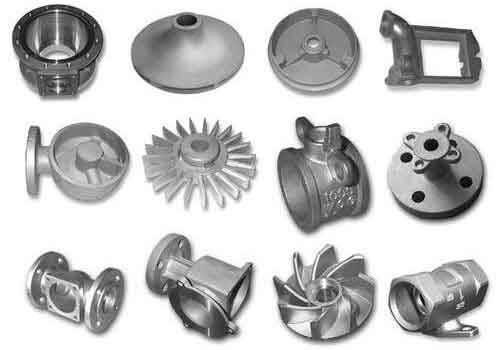
The image above illustrates the outcome: a flawless, crack-free sand casting part after knockout and initial cleaning. The critical junction areas, previously the site of catastrophic failure, were now sound and integral. This confirmed that the thermal cracking defect had been decisively eliminated. The successful casting of these complex, thin-walled sand casting parts validated the theoretical analysis and demonstrated a robust, reproducible process. The yield for this challenging product category improved from 0% in the first trial to nearly 100% in controlled production, delivering significant economic and reliability benefits.
Conclusion and Broader Implications
This investigation underscores that resolving critical defects in advanced sand casting parts, particularly those made from high-contraction alloys like high-chromium iron, requires a systems engineering approach. Thermal cracking is a synergistic failure mode where material properties, component geometry, and process mechanics interact.
- Holistic Diagnosis is Key: One must move beyond symptomatic fixes. A concurrent examination of the alloy’s solidification physics, the component’s thermal and stress profiles, and the mold/core’s mechanical interaction is essential to identify all contributing factors.
- Balanced Interventions are Effective: The solution involved strengthening the casting’s weak point (material and design ribs) while simultaneously reducing the driving force for failure (core restraint). This balanced approach is more reliable than relying on a single change.
- Process Knowledge is Critical: Deep understanding of the sand binder system’s high-temperature behavior allowed for its targeted modification. The shift from a heterogeneous loose-filler method to a homogeneous core-sand reformulation was a breakthrough that can be applied to other restrained sand casting parts.
The methodologies developed—from advanced inoculation and strategic geometric reinforcement to the engineering of high-yield sand cores—have now been codified into standard practice for similar large, thin-walled, high-chromium iron sand casting parts. This case stands as a testament to the fact that through rigorous analysis and innovative process adaptation, even the most persistent casting defects can be overcome, enabling the reliable production of high-performance industrial components.