
As a practitioner in the field of precision casting, I have extensively worked with the lost wax investment casting process, particularly for medium-sized bearing supports. This technique, also known as investment casting, has revolutionized the manufacturing of complex components, offering superior surface finish and dimensional accuracy compared to traditional sand casting. In this article, I will delve into the intricacies of lost wax investment casting for medium-sized bearing supports, highlighting the key challenges and presenting detailed solutions based on my experience. The lost wax investment casting method is pivotal in industries requiring high-performance parts, and its application to medium-sized supports involves unique hurdles that demand innovative approaches. Throughout this discussion, I will emphasize the term “lost wax investment casting” to underscore its centrality in modern manufacturing.
The lost wax investment casting process begins with the creation of a wax pattern, which is then coated with ceramic material to form a shell. After dewaxing, the shell is fired and filled with molten metal. For medium-sized bearing supports, which typically range from 10 kg to 100 kg in weight, this process must be meticulously controlled to avoid defects such as shrinkage porosity, distortion, and inclusions. My focus here is on a specific case involving a medium-sized bearing support with a ring-like structure, where the wall thickness varies from 10 mm to 20 mm. This component, used in extrusion equipment, requires high mechanical properties, and the lost wax investment casting technique is employed to meet these demands. The transition from sand casting to lost wax investment casting has brought significant advantages, including reduced machining needs and enhanced material utilization, but it also introduces complexities that I will analyze in depth.
In the lost wax investment casting of medium-sized bearing supports, the casting design plays a crucial role. The part in question features eight screw holes that are not cast but machined later, leading to a minimum wall thickness of 10 mm. This design aspect is beneficial for the lost wax investment casting process, as it helps maintain structural integrity. However, the maximum wall thickness of 20 mm poses a risk of shrinkage defects, particularly in thicker sections. To address this, the gating and risering system must be optimized. The solidification behavior in lost wax investment casting can be modeled using Chvorinov’s rule, which states that the solidification time \( t \) is proportional to the square of the volume-to-surface area ratio: $$ t = B \left( \frac{V}{A} \right)^2 $$ where \( B \) is a constant dependent on the mold material and casting conditions. For medium-sized supports, this formula guides the design of feeders to ensure directional solidification. The challenge lies in balancing the gating system to minimize shrinkage while maximizing yield, a critical factor in lost wax investment casting economics.
| Challenge | Description | Impact on Process |
|---|---|---|
| Shrinkage Porosity | Occurs in thick sections (e.g., 20 mm walls) due to inadequate feeding during solidification. | Reduces mechanical properties and part integrity; common in lost wax investment casting for heavy components. |
| Shell Strength Issues | The ceramic shell must withstand high temperatures and metallostatic pressure during pouring. | Weak shells can lead to mold cracking or metal penetration, compromising the lost wax investment casting quality. |
| Low Process Yield | Difficulty in optimizing gating and risering to achieve high material utilization. | Increases cost and waste in lost wax investment casting, especially for medium-sized parts. |
| Material Selection | Choosing appropriate wax and ceramic materials for patterns and shells. | Affects surface finish and dimensional accuracy in lost wax investment casting. |
| Thermal Management | Controlling cooling rates to prevent thermal stresses and distortion. | Critical for maintaining tolerances in lost wax investment casting of complex geometries. |
One of the primary challenges in lost wax investment casting for medium-sized bearing supports is ensuring effective feeding to combat shrinkage. The component’s ring shape exacerbates this issue, as heat concentration in thick areas leads to late solidification. In my practice, I have found that using a combination of open and blind risers can mitigate this. The feeding efficiency \( \eta \) can be expressed as: $$ \eta = \frac{V_f}{V_c} \times 100\% $$ where \( V_f \) is the volume of feed metal provided by risers and \( V_c \) is the volume of the casting. For lost wax investment casting, achieving a high \( \eta \) is essential to reduce shrinkage defects. Additionally, the gating design must facilitate rapid filling to avoid cold shuts, which is particularly important in lost wax investment casting due to the intricate shell structures. The use of top-gating systems, as implemented in my case, allows for better temperature control and feeding, but it requires careful simulation and experimentation.
Another significant aspect of lost wax investment casting is the selection of materials for the wax pattern and ceramic shell. For medium-sized supports, the pattern material must balance ease of molding with dimensional stability. I typically use a blend of natural and synthetic waxes to achieve the desired properties. The shell-building process involves multiple layers of ceramic slurry, with the first layers containing fine refractories like zircon flour for surface finish, and subsequent layers using coarser materials like mullite for strength. The shell’s thermal conductivity \( k \) influences the cooling rate, and its optimization is key in lost wax investment casting. The heat transfer during solidification can be described by Fourier’s law: $$ q = -k \nabla T $$ where \( q \) is the heat flux and \( \nabla T \) is the temperature gradient. In lost wax investment casting, a lower \( k \) can help reduce thermal shocks, but it may also prolong solidification, increasing shrinkage risks.
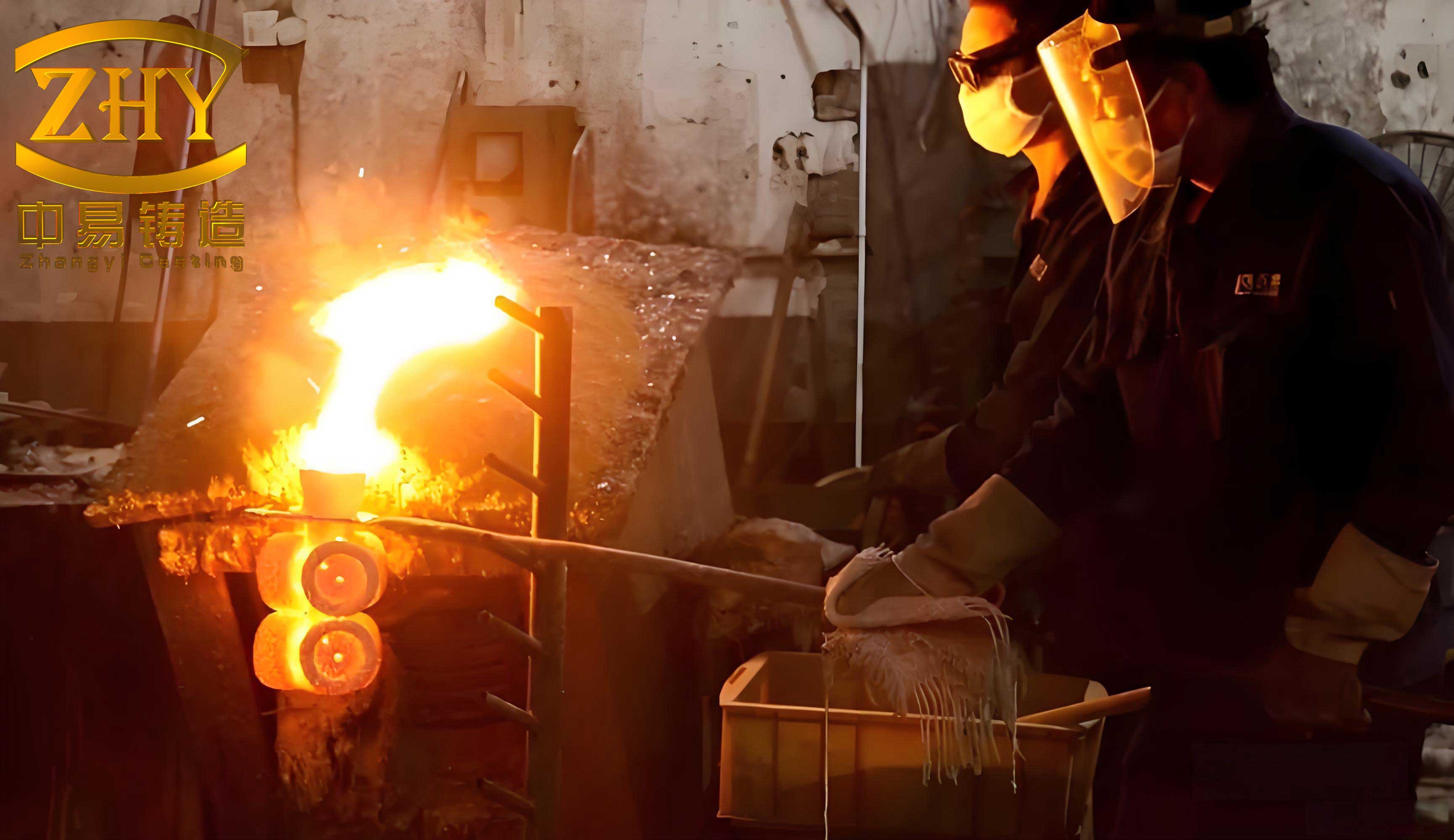
The image above illustrates a typical precision investment casting, showcasing the intricate details achievable through lost wax investment casting. This visual representation underscores the capability of the process to produce complex medium-sized components like bearing supports with high accuracy. In my work, such precision is paramount, and the lost wax investment casting method enables the creation of parts that require minimal post-processing. The ceramic shell visible in similar setups highlights the robustness needed for medium-sized castings, where shell integrity directly impacts the final quality. Lost wax investment casting, as demonstrated here, combines art and science to deliver superior results.
Moving to the solutions for the challenges in lost wax investment casting, I have developed a comprehensive approach that addresses each issue systematically. For shrinkage porosity, the implementation of a tailored risering system is crucial. In the case of the medium-sized bearing support, I designed a top-gating system with two open risers, one of which also serves as a sprue. This design promotes directional solidification from the thin sections toward the risers, effectively feeding the thick areas. The modulus method, a common tool in lost wax investment casting, helps determine riser sizes. The modulus \( M \) is defined as the volume-to-surface area ratio: $$ M = \frac{V}{A} $$ For a riser to effectively feed a casting section, its modulus should be greater than that of the section. In practice, I use a safety factor of 1.2, so \( M_r > 1.2 M_c \), where \( M_r \) is the riser modulus and \( M_c \) is the casting modulus. This ensures adequate feeding in lost wax investment casting processes.
| Challenge | Solution | Implementation Details |
|---|---|---|
| Shrinkage Porosity | Optimized risering with open and blind risers | Use top-gating with two open risers; apply modulus method for sizing; ensure directional solidification in lost wax investment casting. |
| Shell Strength Issues | Multi-layer ceramic shell with reinforcement | Apply zircon flour for face layers and mullite for backup layers; add wire mesh reinforcement; control drying times in lost wax investment casting. |
| Low Process Yield | Gating system simulation and redesign | Utilize CAD/CAE software to simulate flow and solidification; aim for yield > 60% in lost wax investment casting. |
| Material Selection | Use of aluminum alloy for pattern dies | Select YL12 aluminum for light weight and machinability; balance cost and performance for lost wax investment casting patterns. |
| Thermal Management | Controlled cooling and pouring parameters | Maintain pouring temperature at 1530–1540°C for ZG45 steel; use graded heating for shell baking in lost wax investment casting. |
For shell strength in lost wax investment casting, I recommend a multi-layer approach with specific materials. The face coat consists of silica sol bonded zircon flour, which provides a smooth surface and high refractoriness. The backup layers use silica sol with mullite flour to enhance strength and permeability. To further bolster the shell, I incorporate a wire mesh reinforcement after the third backup layer. This mesh, typically made of 1.5 mm diameter steel wire, is wound around the shell and embedded in subsequent layers. The shell’s overall strength \( \sigma_s \) can be approximated by a composite model: $$ \sigma_s = V_f \sigma_f + V_m \sigma_m $$ where \( V_f \) and \( V_m \) are the volume fractions of the filler and matrix, and \( \sigma_f \) and \( \sigma_m \) are their respective strengths. In lost wax investment casting, this reinforcement prevents cracking during dewaxing and pouring, especially for medium-sized supports where metallostatic pressures are high.
The choice of pattern die material is another critical factor in lost wax investment casting. For medium-sized bearing supports, the pattern die must be durable yet lightweight to facilitate handling. While steel dies offer excellent surface finish, they are heavy and costly. In my experience, using YL12 aluminum alloy for the die strikes a balance. Although the cavity surface may be slightly rougher than steel, the weight reduction (from about 100 kg to 30 kg) improves operability. Since lost wax investment casting produces surfaces finer than sand casting, this compromise is acceptable. The pattern’s dimensional accuracy is ensured by precise machining, and the wax injection parameters are optimized to replicate details. The wax pattern volume \( V_w \) is critical for calculating the overall material usage in lost wax investment casting, and it relates to the casting volume \( V_c \) by the pattern expansion factor \( \alpha \): $$ V_w = \alpha V_c $$ where \( \alpha \) typically ranges from 1.05 to 1.10, accounting for shrinkage and machining allowances.
In the shell-making phase of lost wax investment casting, I adhere to a rigorous protocol. After assembling the wax patterns, they are cleaned with a degreasing agent to remove contaminants. The dipping process involves sequential coatings: two face coats with zircon slurry and five backup coats with mullite slurry. Each coat is dried under controlled humidity and temperature. The inclusion of a wire mesh in the fourth layer, as mentioned, enhances shell integrity. Dewaxing is performed in an autoclave at 120–140°C for up to one hour, ensuring complete wax removal without shell damage. This step is vital in lost wax investment casting to prevent shell cracking due to thermal expansion. The dried shell is then baked in a gas-fired furnace, with a gradual temperature ramp to avoid thermal shock. The baking curve can be described by: $$ T(t) = T_0 + \beta t $$ for the initial heating, followed by a soak at 950–980°C. Here, \( T_0 \) is the ambient temperature, and \( \beta \) is the heating rate, which I set at 5°C/min for medium-sized shells in lost wax investment casting.
Melting and pouring are pivotal stages in lost wax investment casting. For medium-sized bearing supports made of ZG45 steel, I use a 250 kg medium-frequency induction furnace with an acid lining. The charge comprises 60% new material and 40% returns to maintain chemistry. Deoxidation is carried out in three stages: pre-deoxidation with ferromanganese, diffusion deoxidation with rare earth metals, and final deoxidation with aluminum chips. This sequence minimizes gas porosity, a common defect in lost wax investment casting. The deoxidation efficiency \( \epsilon \) can be modeled as: $$ \epsilon = 1 – \frac{C_f}{C_i} $$ where \( C_i \) and \( C_f \) are the initial and final oxygen concentrations, respectively. Aiming for high \( \epsilon \) ensures sound castings. The pouring temperature is maintained at 1530–1540°C, with a superheat of 60–70°C above the liquidus temperature of ZG45 (1460–1467°C). The pouring speed is high to promote rapid filling, and the pour height is kept at 15–20 mm to reduce turbulence. After pouring, the casting is cooled in sand for at least three hours to avoid cracking due to residual stresses.
The economic aspect of lost wax investment casting cannot be overlooked. For medium-sized supports, the process yield \( Y \) is defined as the ratio of casting weight to total metal poured: $$ Y = \frac{W_c}{W_t} \times 100\% $$ where \( W_c \) is the casting weight and \( W_t \) is the total weight including gating and risers. Through optimization, I have achieved yields of up to 65% for similar components, which is favorable for lost wax investment casting compared to sand casting. The use of simulation software allows for iterative design improvements, reducing trial-and-error costs. Additionally, the lost wax investment casting process minimizes machining, saving on post-processing expenses. The overall cost per part \( C \) can be estimated by: $$ C = C_m + C_l + C_e $$ where \( C_m \) is material cost, \( C_l \) is labor cost, and \( C_e \) is energy cost. For medium-sized bearing supports, lost wax investment casting offers a competitive edge due to its efficiency and precision.
In conclusion, the lost wax investment casting process for medium-sized bearing supports presents distinct challenges, but with systematic solutions, it can yield high-quality components. From addressing shrinkage through optimized risering to enhancing shell strength with reinforced ceramics, each step requires careful consideration. The lost wax investment casting technique leverages advanced materials and controlled parameters to achieve dimensional accuracy and mechanical properties. As I have detailed, the integration of engineering principles like modulus calculations and thermal management is essential. The lost wax investment casting method continues to evolve, offering opportunities for innovation in manufacturing. By sharing these insights, I hope to contribute to the broader adoption and refinement of lost wax investment casting for medium-sized and other critical parts.
Reflecting on my experience, the lost wax investment casting process is a testament to the synergy between traditional craftsmanship and modern technology. The ability to produce complex geometries with minimal waste makes it indispensable for industries ranging from aerospace to automotive. For medium-sized bearing supports, the challenges are manageable through continuous improvement and adaptation. The lost wax investment casting community thrives on collaboration, and I encourage further research into areas like additive manufacturing for pattern production and advanced ceramics for shells. As we push the boundaries of lost wax investment casting, the potential for even greater efficiencies and capabilities becomes apparent. This journey in lost wax investment casting is both demanding and rewarding, and I am committed to advancing its practice for future generations.