
Within the modern automotive industry, the imperatives of reducing energy consumption, enhancing safety, and meeting stringent environmental protection standards have become core evaluation criteria. One of the most effective strategies to address these challenges is vehicle lightweighting, achieved through structural optimization and the adoption of lighter materials, without compromising performance or economic viability. As a key drivetrain component, the transmission housing presents a significant opportunity for weight reduction. In our production experience, we transitioned from gray iron to aluminum alloy for transmission housings, employing the lost foam casting process to realize this goal. This shift necessitated a deep understanding of the fundamental differences in how the lost foam casting process must be applied to these two distinct material families. Based on extensive production practice, this article details the significant variances in the lost foam casting process for gray iron and aluminum alloy, focusing on material behavior, process parameters, and necessary equipment adaptations.
Our facility operates dedicated lines for both materials. The gray iron lost foam line has an annual capacity of 35,000 tons, producing castings from 15 kg to 110 kg. The aluminum lost foam line produces over 6,000 tons annually of castings ranging from 10 kg to 45 kg. The core material properties driving the process differences are summarized below:
| Property | Gray Iron (HT200) | Aluminum Alloy (ZL101A) |
|---|---|---|
| Density (g/cm³) | ~7.2 | ~2.68 |
| Tensile Strength (MPa) | ~200 | ~250 |
| Hardness (HB) | 170-241 | 80-100 |
| Typical Pouring Temperature | 1400°C – 1450°C | 700°C – 750°C |
This vast difference in pouring temperature, nearly 700°C, is the primary factor dictating the divergent paths of the lost foam casting process for these alloys. The thermal decomposition behavior of the expandable polystyrene (EPS) foam and the requirements for the mold system change dramatically.
1. Pattern Production and Assembly
1.1 Raw Bead Material and Pre-expansion
For gray iron, which experiences extreme temperatures, either standard EPS or co-polymer beads (often containing MMA) can be used. The co-polymer tends to leave less carbonaceous residue. For aluminum, standard EPS is perfectly adequate and preferred due to its lower gas generation at lower temperatures. The target pre-expansion density also differs subtly but importantly to control pattern density and subsequent gas evolution.
| Process Step | Gray Iron Process | Aluminum Alloy Process |
|---|---|---|
| Bead Material | EPS or Co-polymer | EPS |
| Pre-expansion Density | 18 – 24 g/L | 20 – 25 g/L |
| Key Consideration | Managing high-volume gas evolution at high temperature. | Managing liquid EPS decomposition products and pattern rigidity. |
The pre-expansion density ($\rho_{pre}$) is critical for final pattern quality and is calculated from the bulk density of the pre-expanded beads. Consistency here is paramount for both processes. The relationship between bead size, pre-expansion conditions, and final cavity fill is complex, but can be conceptually summarized by a filling efficiency factor ($\eta_f$):
$$ \eta_f = \frac{V_{filled}}{V_{cavity}} \propto \frac{1}{\rho_{pre}} \cdot f(P_{steam}, t_{fusion}) $$
where a lower $\rho_{pre}$ requires excellent steam pressure ($P_{steam}$) and fusion time ($t_{fusion}$) control to achieve complete, uniform cavity filling and bonding.
1.2 Pattern Molding and Shrinkage Allowance
The pattern’s dimensional change is a combination of foam shrinkage upon cooling and the metal’s solidification shrinkage. For thin-walled parts like transmission housings, the effective pattern shrinkage allowance differs.
- Aluminum Alloy (EPS): Free shrinkage 1.8%-2.0%; Restricted shrinkage 1.6%-1.9%.
- Gray Iron (EPS): Free shrinkage 0.9%-1.2%; Restricted shrinkage 0.6%-1.0%.
This difference directly impacts tooling design. Achieving uniform density throughout the pattern is more critical for aluminum, as non-uniformities can lead to localized variations in liquid EPS formation and drainage during the lost foam casting process.
1.3 Pattern Assembly and Adhesive
The choice of adhesive is crucial. Cold-setting adhesives (e.g., two-part urea formaldehyde) have a high melt temperature. In aluminum casting, they may not fully liquefy, leaving solid inclusions in the casting. They also shrink upon curing, potentially creating thin sections at joints. Hot-melt adhesives, with their low melt temperature, rapid setting, and minimal shrinkage, are far more suitable for aluminum lost foam casting. For gray iron, either can be used, but hot-melt is preferred for automation and consistency.
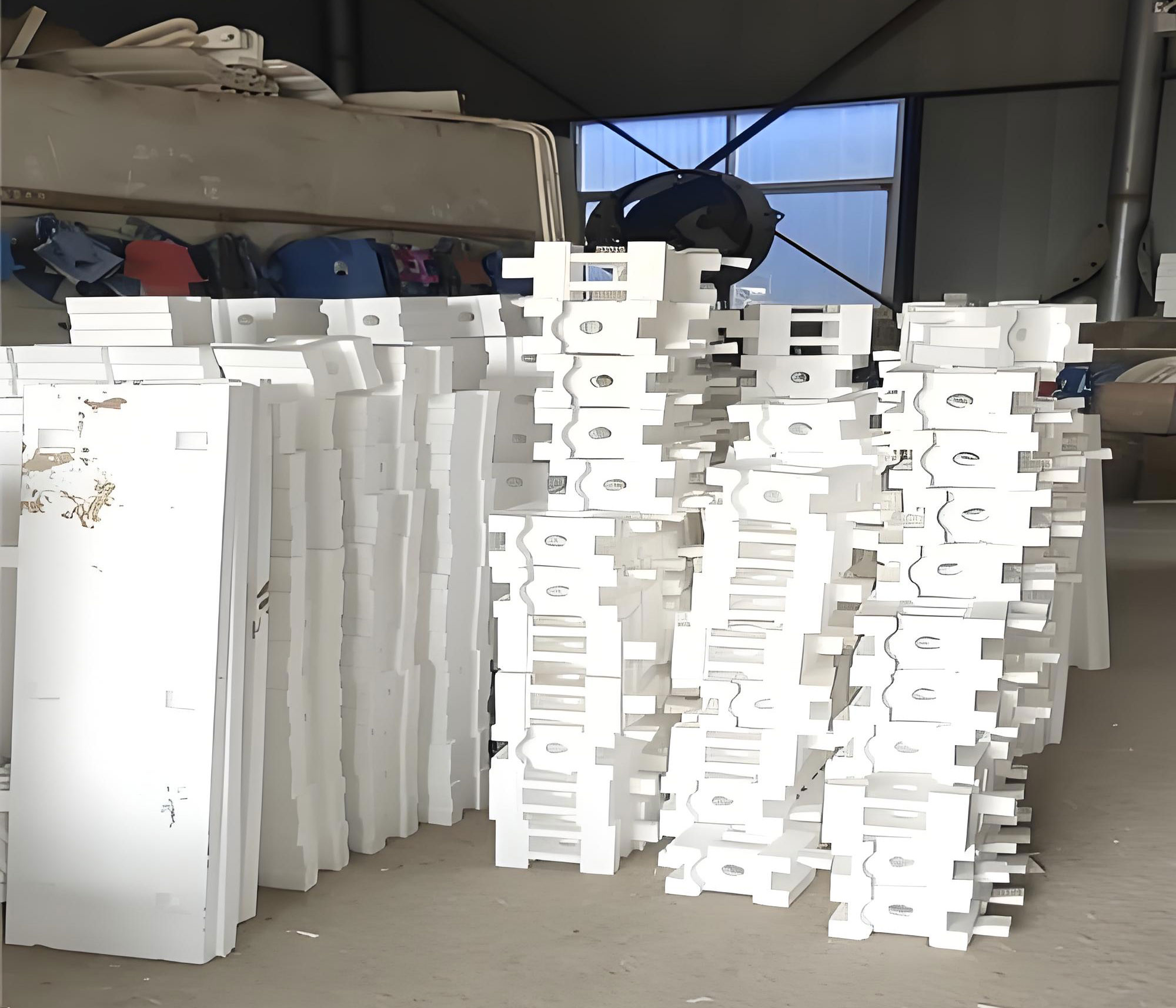
1.4 Gating System Design
Both systems typically use bottom gating for a calm fill. However, the design philosophy differs due to metal characteristics.
| Aspect | Gray Iron | Aluminum Alloy |
|---|---|---|
| Gating Type | Choked (Pressurized) or Semi-choked. | Open (Non-pressurized) or Semi-open. |
| Runner Function | Primarily for delivery and flow control. | Delivery, flow control, and significant feeding/solidification control. |
| Feature | Lower pouring pressure head. | Larger cross-section in main runner, higher pressure head (by 100-200 mm). |
The larger runner for aluminum is necessary due to its higher volumetric shrinkage ($\beta_{Al} > \beta_{Fe}$), requiring it to act as a feeding source. The required modulus ($M$) of the runner must satisfy:
$$ M_{runner} \geq M_{casting} \cdot f_{feeding} $$
where $f_{feeding}$ is a factor accounting for the efficiency of feeding in the lost foam casting process, which is different from conventional sand casting.
2. Coating Application and Mold Preparation
2.1 Coating Function and Formulation
This is one of the most critical differentiators. The coating must manage the decomposition products of the foam.
- Gray Iron: At ~1450°C, EPS decomposes primarily into gaseous products (styrene, hydrogen, etc.). The coating must have high permeability to allow these gases to escape through the sand mold under vacuum. It also needs high refractoriness and strength.
- Aluminum Alloy: At ~720°C, EPS melts and pyrolyzes into viscous liquid hydrocarbons. The coating must have lower permeability to allow pressure buildup that pushes the liquid into the coating layer (absorption). It must have excellent adsorptivity. High permeability would allow air ingress, potentially oxidizing the liquid front.
Consequently, coating thickness and application differ vastly. Gray iron coatings are often applied twice via dipping to achieve a thickness of 0.5-1.0 mm. Aluminum coatings are applied once, targeting a thinner, more uniform layer of 0.2-0.5 mm. Achieving this uniformity often necessitates automated dipping and draining/leveling systems.
The coating’s gas permeability ($K_{coat}$) can be conceptually modeled for the two processes:
$$ \text{Gray Iron: } K_{coat}^{GI} \gg K_{coat}^{Al} $$
$$ \text{Aluminum: } K_{coat}^{Al} \text{ is low, but } A_{ads}^{Al} \text{ (adsorption capacity) is high.} $$
Commercially available, specialized coatings are strongly recommended for aluminum, while gray iron coatings can sometimes be produced in-house.
2.2 Sand Mold Preparation
While both use dry, unbonded silica sand, the grain size and mold stabilization method differ.
| Parameter | Gray Iron Process | Aluminum Alloy Process |
|---|---|---|
| Sand Grain Size | Coarser (30-50 mesh). | Finer (50-100 mesh). |
| Mold Stabilization | Mandatory use of vacuum (“negative pressure stabilization”). | Can use weight (top pressure) or sand overburden; vacuum often not used or used at very low level. |
| Vacuum Level | High: -0.03 MPa to -0.05 MPa. | Low or None: 0 MPa to -0.01 MPa. |
The vacuum in gray iron casting serves to: 1) extract large volumes of gas, 2) stabilize the mold, and 3) draw metal into the mold. For aluminum, the main function, if used, is mild stabilization. The sand itself requires periodic reclamation by thermal calcination (~800°C) to remove condensed pyrolysis products, especially critical after casting aluminum.
3. Metal Melting, Pouring, and Post-Processing
3.1 Melting and Metal Treatment
Gray iron is commonly melted in medium-frequency induction furnaces, which are efficient and provide good superheat control (melting ~1480°C). Aluminum melting is typically done in gas-fired reverberatory or centralized furnaces (melting ~750-780°C), followed by a much more elaborate treatment process.
| Aspect | Gray Iron | Aluminum Alloy |
|---|---|---|
| Melting Unit | Medium-Frequency Induction Furnace. | Gas-Fired Central Melting/Holding Furnace. |
| Key Treatments | Carburization, Silicon adjustment, Inoculation. | Degassing (Rotary, Lance), Fluxing, Grain Refining, Modification. |
| Liquid State Handling | Relatively simple; focus on temperature & chemistry. | Complex; must minimize turbulence to prevent oxide entrainment and hydrogen pickup. |
The reaction kinetics for inoculation in iron ($\text{FeSi} \rightarrow \text{Graphite Nuclei}$) and modification in aluminum ($\text{Na/Sr} + \text{Si} \rightarrow \text{Modified Eutectic}$) are both time-sensitive, but the “windows” and mechanisms are completely different, impacting the logistics of the lost foam casting process.
3.2 Pouring Practice
The pouring parameters are fundamentally different and must be tightly controlled.
$$ \text{Pouring Temperature: } T_{pour}^{GI} \approx 1400^\circ\text{C}, \quad T_{pour}^{Al} \approx 720^\circ\text{C} $$
$$ \text{Vacuum Application: } P_{vac}^{GI} \approx -0.04 \text{ MPa}, \quad P_{vac}^{Al} \approx 0 \text{ MPa} $$
Pouring speed is critical for both. For aluminum, a slow, steady pour is essential to allow the liquid EPS front to be properly managed by the coating. Automated pouring systems, such as robotic pourers, are highly beneficial for aluminum to eliminate human variability in pour rate—a factor less critical but still important for gray iron.
3.3 Casting Cleaning and Finishing
Post-casting operations also reflect the material’s properties.
- De-gating: Gray iron runners are knocked off with a hammer. Aluminum runners are typically cut using a band saw or circular saw with a non-ferrous blade to avoid tearing.
- Shot Blasting: Gray iron uses larger, harder media (e.g., 1.5 mm steel shot). Aluminum requires softer, non-ferrous media (e.g., 0.6-0.8 mm stainless steel shot) to avoid peening and surface damage.
- Grinding: Gray iron uses abrasive grinding wheels. Aluminum typically uses abrasive flap discs or sanding pads to avoid embedding abrasive particles.
3.4 Heat Treatment
This is a major differentiator. Most lost foam aluminum castings (e.g., ZL101A) require a full T6 heat treatment (solutionizing, quenching, artificial aging) to achieve the specified mechanical properties. Gray iron castings, on the other hand, often do not require any stress-relief annealing, as the lost foam process itself generates lower residual stresses compared to conventional green sand casting—a benefit attributed to the cushioning effect of the decomposing foam. The stress reduction ($\Delta \sigma$) can be approximated as a function of the foam’s thermal buffer effect:
$$ \Delta \sigma \propto \int_{T_{room}}^{T_{pour}} E(T) \cdot \alpha(T) \cdot \left(1 – \frac{\partial u_{foam}}{\partial t}\right) dT $$
where $\frac{\partial u_{foam}}{\partial t}$ represents the energy sink rate of the decomposing foam, reducing the thermal gradient.
4. Integrated Process Comparison and Conclusion
The following table synthesizes the key differences across the entire lost foam casting process chain:
| Process Stage | Gray Iron Lost Foam Casting | Aluminum Alloy Lost Foam Casting | Underlying Principle |
|---|---|---|---|
| Pattern Material | EPS or Co-polymer | EPS | High-temp gas evolution vs. low-temp liquid formation. |
| Pattern Assembly | Hot-melt or Cold glue | Hot-melt Adhesive (Essential) | Need for complete liquefaction/evaporation of adhesive. |
| Coating Function | High Permeability, Gas Venting | Low Permeability, Liquid Adsorption | Managing gaseous vs. liquid decomposition products. |
| Mold Stabilization | High Vacuum Essential (-0.04 MPa) | Low/No Vacuum, Weight or Sand Pressure | Gas evacuation vs. mold rigidity for liquid metal front support. |
| Pouring Atmosphere | Under Significant Vacuum | Atmospheric or Slight Vacuum | Preventing mold collapse & gas evacuation vs. preventing air aspiration. |
| Metallurgical Focus | Inoculation, Carbide Control | Degassing, Grain Refinement, Modification | Graphite formation vs. Oxide/Hydrogen and Si eutectic control. |
| Post-Casting | Often no heat treatment | T6 Heat Treatment Required | As-cast ferritic/pearlitic matrix vs. precipitation hardening. |
In conclusion, the lost foam casting process is a versatile technology applicable to both ferrous and non-ferrous alloys. However, treating it as a single, uniform process is a significant oversight. The production of aluminum alloy castings via lost foam is not merely a direct translation of gray iron parameters to a lower temperature. It is, in essence, a different process with distinct physics at its core—centered on managing a liquid foam decomposition front rather than a gaseous one. Success demands tailored approaches in every step: from foam density and adhesive selection, through the specific formulation and application of the coating, to the mold filling dynamics and post-casting treatments. Equipment choices must reflect these needs, with greater emphasis on precision in pattern making, coating control, and automated pouring for aluminum. Therefore, when implementing or optimizing a lost foam casting process, the material-specific roadmap must be followed diligently to achieve high-quality, sound castings for either material family.