
In my years of working with lost foam castings, I have accumulated substantial experience in identifying and mitigating the various defects that plague aluminum alloy components produced by this method. The lost foam casting process, also known as dry sand evaporative pattern casting, offers remarkable advantages in dimensional accuracy, design flexibility, and environmental friendliness. However, the unique physical and chemical phenomena occurring during mold filling and solidification introduce a set of defect mechanisms that differ significantly from conventional sand casting. In this article, I share my systematic analysis of common defects in lost foam castings and the preventive measures I have validated through production practice.
The core challenge in lost foam castings lies in the dynamic interaction between the advancing liquid metal front and the vaporizing foam pattern. As the molten aluminum enters the mold, it must first decompose the polymeric foam through thermal radiation and conduction. The gaseous products generated at the metal–foam interface create an irregular gap layer whose thickness is critical. If the gap becomes too large, the sand mold may collapse locally or globally; if it is too small, the evolved gases cannot escape, leading to subsurface porosity. The gap size δ can be approximated by the balance between the heat flux from the metal and the decomposition rate of the foam:
$$ \delta \approx \frac{k_f (T_{metal} – T_{decomp})}{\rho_f \, L_f \, v_{fill}} $$
where kf is the thermal conductivity of the foam, Tmetal is the pouring temperature, Tdecomp is the decomposition temperature, ρf is the foam density, Lf is the latent heat of vaporization, and vfill is the filling velocity. This simplified model underscores why controlling foam density, pouring temperature, and vacuum level is so essential in lost foam castings.
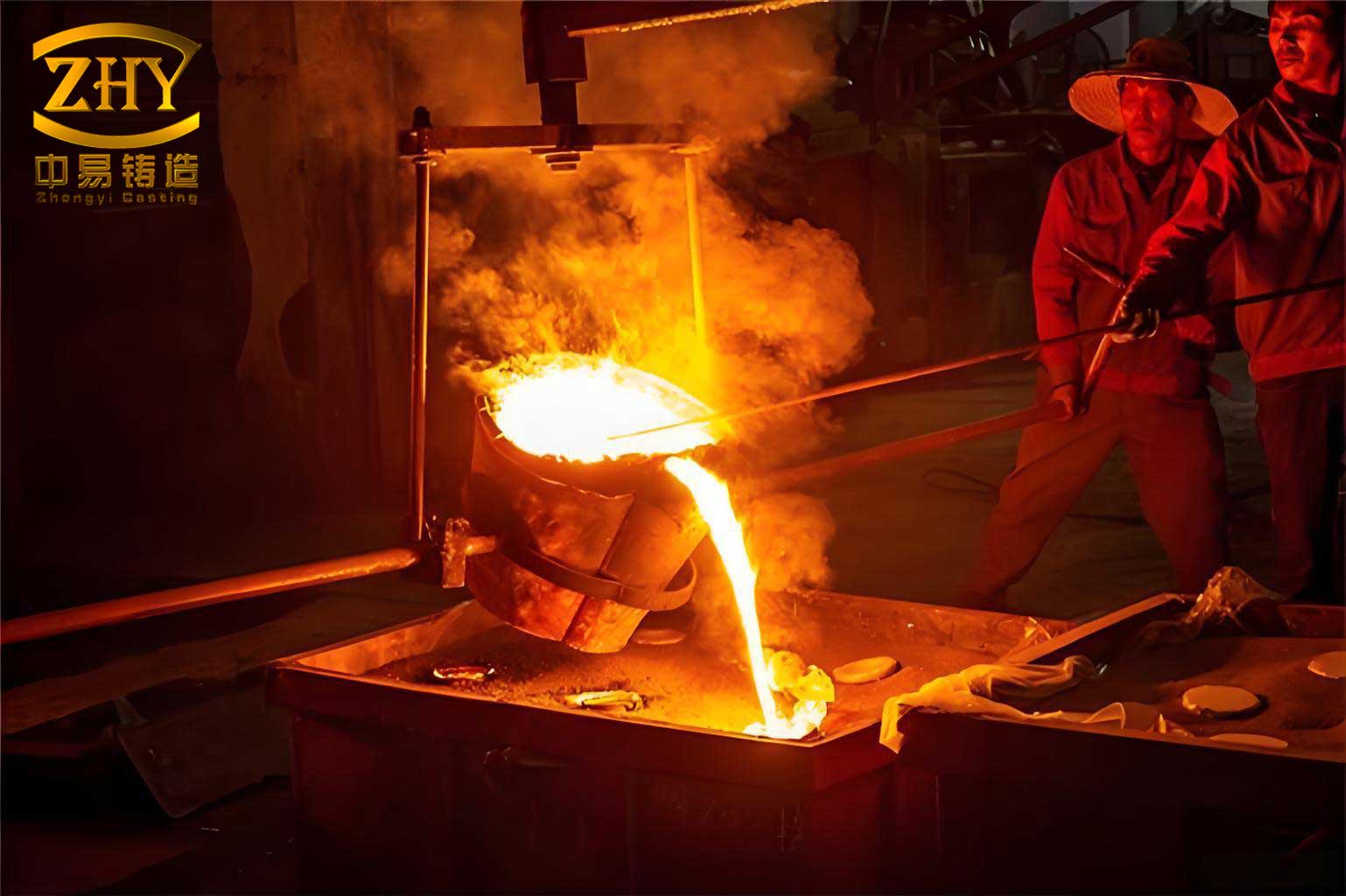
Through my work with lost foam castings of aluminum alloys (such as A356, A357, and A390), I have encountered seven major defect categories. Below I analyze each defect’s root causes and present the preventive actions I have found effective, accompanied by summary tables for quick reference.
1. Incomplete Filling and Deformation
Incomplete filling (also called misrun) and deformation are frequently observed in lost foam castings when the foam pattern becomes distorted during molding or when the mold collapses during pouring. I have traced these failures to several factors:
- Excessive vibration amplitude during sand compaction, causing the foam pattern to bend or break.
- Insufficient foam pattern strength, often due to low density or poor bead fusion.
- Unstable vacuum pressure during pouring, leading to a sudden gap expansion and sand collapse.
- Interruption of the pouring stream (break in metal flow), which creates a temporary pressure drop in the mold.
- Large-scale damage to the plastic sealing film covering the sand surface, causing a rapid loss of vacuum.
My preventive measures focus on optimizing the pattern density and vacuum parameters. The foam density ρf should be maintained between 0.016 and 0.028 g/cm³, with higher values for thicker sections. The vacuum level must be regulated using a modulating valve to keep fluctuations within ±2 kPa. Table 1 summarizes the causes and remedies.
| Cause | Preventive Measure |
|---|---|
| Excessive vibration amplitude | Select amplitude based on pattern geometry; typical 0.3–0.6 mm |
| Low pattern strength | Adjust foam density to 0.016–0.028 g/cm³; ensure complete pre‑expansion |
| Unstable vacuum pressure | Use vacuum regulator; maintain –0.04 to –0.06 MPa during pouring |
| Pouring interruption | Train operators to pour continuously with adequate pouring temperature |
| Sealing film damage | Increase sand cover thickness above film to at least 50 mm |
2. Surface Pinholes and Gas Porosity
Aluminum is highly reactive with oxygen and moisture. In lost foam castings, hydrogen and oxygen can be absorbed from the atmosphere, mold coatings, or even the foam decomposition products. When the dissolved gas cannot escape before solidification, it forms pinholes or larger gas pores, often just below the casting surface. I have found the hydrogen content in the melt to be a primary culprit:
$$ [H]_{melt} = K \sqrt{p_{H_2}} \, e^{-\frac{\Delta H}{RT}} $$
where K is the equilibrium constant, pH₂ is the partial pressure of hydrogen, ΔH is the heat of solution, and T is the melt temperature. To minimize gas absorption, I implement strict degassing protocols and design the gating system to avoid turbulent flow that entrains air. The key factors and my countermeasures are listed in Table 2.
| Cause | Preventive Measure |
|---|---|
| High hydrogen content in melt | Use rotary degassing with N₂ or Ar; hold temperature 700–730°C |
| Poor gating design (turbulent filling) | Adopt closed gating system; minimize filling time |
| Moisture from coatings or foam | Dry coated pattern at 50–60°C for ≥8 h; use low‑gas binder |
| Insufficient coating permeability | Control coating thickness (0.6–1.0 mm); use coarse refractory filler |
| Inadequate degassing of charge materials | Preheat all tools and alloy ingots to 150°C before melting |
3. Slag Inclusions (Non‑Metallic Inclusions)
Slag or dross inclusions in lost foam castings arise from two sources: (a) oxide films and refractory particles entrained during melting and pouring, and (b) unburned carbonaceous residues from incomplete foam decomposition. In one particularly challenging lot of lost foam castings, I traced the black inclusions to a foam pattern with high residual volatiles. After switching to a low‑volatile foam material and increasing the pouring temperature by 20°C, the defect rate dropped by 60%.
Table 3 lists the common causes and my corrective actions.
| Cause | Preventive Measure |
|---|---|
| Oxide films from melt handling | Skim slag regularly; use ceramic foam filters in gating |
| Unburned foam residue | Select foam with low volatile content (<10%); increase pouring temperature by 10–20°C |
| Too heavy gating system (excess foam) | Use hollow or thin‑wall risers; reduce gating weight by 30% |
| Inadequate coating permeability | Increase coating porosity; add wood flour to the coating |
| Vacuum drop during pouring | Stabilize negative pressure at –0.05 ± 0.005 MPa |
4. Sand Inclusions, Burn‑On, and Metal Penetration
Sand inclusions occur when molding sand enters the liquid metal. Burn‑on describes a mechanical mixture of metal and sand, while metal penetration refers to fine metallic globules that break through the coating and solidify in the sand. In my experience with lost foam castings, these defects are intimately linked to coating integrity and sand properties. The critical coating strength σc must withstand the ferrostatic pressure:
$$ \sigma_c > \frac{\rho_{Al} g h}{2} $$
where ρAl is the density of molten aluminum (≈2.4 g/cm³), g is gravity, and h is the metal head height. If the coating cracks or detaches, the sand is exposed to the melt. I summarise the causes and remedies in Table 4.
| Cause | Preventive Measure |
|---|---|
| Coating detachment at gating corners | Design large radius corners (R ≥ 5 mm); avoid sharp edges |
| Low coating strength or excessive thickness | Control coating thickness 0.6–1.0 mm; use quick‑drying repair paste |
| Coarse or angular sand grains | Limit angular sand to <20%; use AFS 45–55 for small castings |
| Non‑uniform sand compaction | Fill sand in layers ≤300 mm; vibrate with amplitude 0.3–0.5 mm |
| Vacuum instability | Install vacuum accumulator; monitor pressure continuously |
| Excessive pouring temperature | Pour at 700–740°C for Al‑Si alloys; reduce if burn‑on appears |
5. Cold Shuts (Cold Laps)
Cold shuts in lost foam castings appear as seams where two metal streams fail to fuse completely. Besides the classical causes (low pouring temperature, interrupted flow, poor gating), I have identified a phenomenon unique to the lost foam process: when the vacuum is too high, the foam near the coating decomposes faster than the interior, causing the metal to advance preferentially along the cavity wall. The wall‑hugging stream solidifies quickly, and the bulk metal arriving later cannot remelt it, resulting in a lap or “double skin.” The critical vacuum pressure Pvac should satisfy:
$$ P_{vac} = P_{atm} – \Delta P_{sand} – \Delta P_{gap} $$
where ΔPsand is the pressure drop through the sand bed and ΔPgap is the drop across the decomposition gap. I adjust the vacuum to balance the decomposition rate with the filling speed. Table 5 shows the analysis.
| Cause | Preventive Measure |
|---|---|
| Low pouring temperature | Pour at 720–760°C (depending on section thickness) |
| Pouring interruption | Ensure continuous stream; use bottom‑pour ladle |
| Turbulent filling from poor gating | Use unidirectional, bottom‑fill gating; avoid abrupt cross‑section changes |
| Excessively high vacuum | Reduce vacuum to –0.04 to –0.05 MPa; monitor filling pattern |
| Slow filling speed | Increase pouring rate; use larger sprue area |
6. Wrinkles (Surface Ripples / “Orange Peel”)
Wrinkles on the casting surface are a characteristic defect of lost foam castings when the foam decomposition is incomplete or sluggish. The residual liquid phase of the foam condenses on the metal surface and, combined with solid carbon, creates a wrinkled texture. Through systematic trials on lost foam castings of thin‑wall housings, I discovered that the foam density and sand permeability dominate this defect. The critical foam decomposition rate Rdecomp must exceed the metal filling rate Rfill:
$$ R_{decomp} = \frac{\dot{Q}}{\rho_f L_f} > R_{fill} $$
where Q̇ is the heat flux from the metal. If Rdecomp is too low, the foam melts rather than vaporizes, forming a liquid film that wrinkles. My preventive actions are in Table 6.
| Cause | Preventive Measure |
|---|---|
| Low vacuum level | Increase vacuum to –0.055 to –0.065 MPa |
| Poor coating permeability | Add 5–10% wood flour to coating; reduce coating thickness |
| High foam density | Reduce foam density to lower limit (0.016 g/cm³ for thin walls) |
| Fine sand or high fines content in sand | Use AFS 35–45 sand; screen out fines (<5% through 200 mesh) |
| Inadequate gating design (slow fill) | Increase gating cross‑section; use multiple ingates |
7. Shrinkage Porosity and Cavities
Shrinkage defects in lost foam castings are more pronounced than in conventional sand casting because the foam decomposition absorbs heat, lowering the melt’s local temperature and diminishing the feeding efficiency of risers. Furthermore, lost foam castings typically have no open risers through which hot metal can be top‑poured. I have addressed this by redesigning the gating system to act as a directional solidification feeder. The volumetric shrinkage Vs can be estimated from the solidification interval:
$$ V_s = \beta_{Al} (T_{liq} – T_{sol}) V_{casting} $$
where βAl is the volumetric contraction coefficient (≈6.5×10⁻⁵/°C for Al‑Si alloys). To compensate, I ensure that the last‑to‑solidify sections are connected to a sufficient metal reservoir via a properly sized riser. Table 7 summarises my approach.
| Cause | Preventive Measure |
|---|---|
| Insufficient riser volume or no riser | Add insulated or exothermic riser sleeves; riser volume ≥ 20% of casting |
| Low pouring temperature causing early solidification | Pour at upper temperature range (740–760°C) |
| Poor directional solidification | Place risers near heavy sections; use chills to accelerate cooling of thin sections |
| Foam decomposition absorbing too much heat | Reduce foam density; apply insulating coating on riser necks |
| Gating system not feeding properly | Size ingates to allow reverse‑flow feeding; keep ingates thick |
Concluding Remarks
Throughout my career dedicated to lost foam castings, I have learned that defect prevention requires a holistic approach—integrating foam pattern quality, coating formulation, sand properties, vacuum control, and melt treatment. The tables I have provided encapsulate the most common pitfalls and the practical remedies I have developed. Each foundry may need to adjust parameters based on its own equipment and alloy, but the underlying physics of lost foam castings remains universal. By systematically controlling the foam decomposition gap, vacuum stability, coating permeability, and thermal feeding, one can produce sound aluminum alloy castings with minimal defects. I hope that my experience, distilled here, will help fellow engineers reduce scrap rates and improve the reliability of lost foam castings in their own production environments.