
The pursuit of internal soundness and superior surface quality in complex casting parts represents a fundamental challenge in modern foundry engineering. This challenge is magnified in components with significant variations in wall thickness, large planar surfaces, and isolated thermal masses. Such geometries disrupt ideal solidification patterns, creating focal points for shrinkage porosity, micro-shrinkage, and surface defects like sand inclusions. The development of a robust casting process, therefore, hinges on a meticulously designed and optimized gating and feeding system. The following discourse synthesizes a specific case study into a broader, first-principles methodology for achieving high yields and reliable production of demanding casting parts.
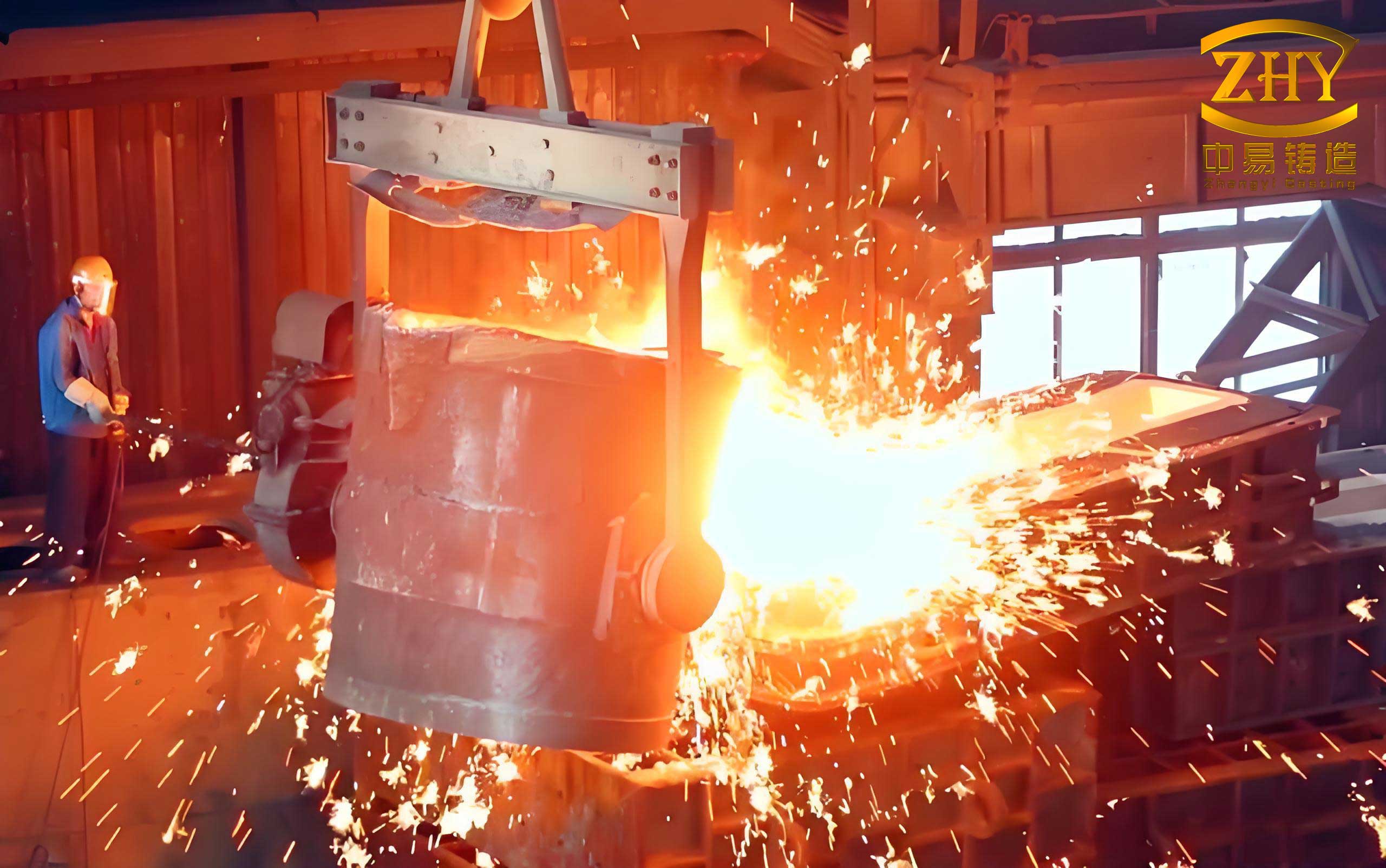
Foundational Challenges in Producing Complex Casting Parts
Casting parts such as engine flywheels, housings, and frames often possess non-uniform sections. The primary defects encountered stem from two interrelated phenomena: volumetric shrinkage during the liquid-to-solid phase change, and turbulent mold filling. For a typical ferrous alloy, the total volumetric shrinkage can be approximated as the sum of liquid contraction, solidification contraction, and solid-state contraction. The solidification shrinkage, which is most critical for feeding, can be modeled as:
$$V_{shrinkage} = \beta \cdot V_{casting}$$
where $V_{shrinkage}$ is the volume of shrinkage cavity, $\beta$ is the solidification shrinkage factor (approximately 4-6% for gray and ductile iron), and $V_{casting}$ is the volume of the casting part. In non-uniform casting parts, this shrinkage is not distributed evenly but concentrates at the last-to-freeze locations, or “hot spots.” Simultaneously, high velocity or turbulent metal entry can erode the mold sand, leading to sand inclusion defects on the casting surface, particularly on large upward-facing planes. The interaction of these factors dictates that the process design must achieve both controlled, tranquil filling and directional solidification toward designed feeding sources.
| Common Defect in Casting Parts | Primary Cause | Relevant Casting Feature |
|---|---|---|
| Macro-shrinkage Cavity | Insufficient feed metal volume or premature freezing of feed path | Heavy sections, junction points |
| Micro-shrinkage (Porosity) | Inability to feed interdendritic regions; gas precipitation | Medium-thick sections, areas between chills and risers |
| Sand Inclusions/Erosion | High metal velocity, turbulent flow, impingement on mold walls | Large flat surfaces, areas near ingates |
| Slag Entrapment | Poor gating system design failing to trap slag | All areas, but often in upper sections |
Systematic Gating System Design for Sound Casting Parts
The gating system is the hydraulic network that delivers molten metal from the pouring basin to the mold cavity. Its design principles are paramount for the quality of the final casting parts. For heavy, flat casting parts, a bottom-gated, pressurized system is often preferred to promote a calm, upward-filling wavefront. A key design parameter is the choke area, typically at the sprue base or ingates, which controls the initial flow rate. The flow velocity $v$ at the choke can be estimated using Bernoulli’s principle applied to a running system:
$$v = C_d \sqrt{2gh}$$
where $C_d$ is a discharge coefficient (≈0.8 for sand casting), $g$ is gravity, and $h$ is the effective metallostatic head. To prevent mold erosion, this velocity should be kept below a critical threshold, often around 0.5-0.8 m/s for green sand molds. For large casting parts, achieving this requires multiple, well-distributed ingates to reduce the flow rate per gate. A strategic approach involves designing a tapered distribution runner with a progressively reducing cross-section. This helps maintain flow velocity and prevents premature freezing in the runner while distributing metal to multiple points. The relationship between sections in an open (non-pressurized) system is often given by the ratios of sprue exit : runner : ingate areas. A conservative, slag-trapping design uses a ratio like 1 : 1.5 : 2, ensuring the runner remains full to float slag. For pressurized systems (e.g., 1 : 0.8 : 1.2), the ingates act as the choke, providing a slight back-pressure to fill the runner quickly.
| Gating Design Feature | Mathematical / Design Principle | Benefit for Casting Parts |
|---|---|---|
| Choke Area ($A_c$) | $A_c = \frac{W}{\rho \cdot t \cdot C_d \sqrt{2gh}}$ W=pouring weight, ρ=density, t=desired fill time |
Controls fill time and initial velocity to prevent turbulence. |
| Runner Tapering | $A_{runner, exit} = A_{runner, entrance} – n \cdot A_{ingate}$ n = number of ingates fed up to that point |
Maintains velocity, prevents slag entrainment, ensures simultaneous filling. |
| Ingate Distribution | Number of ingates $n \propto \frac{Perimeter_{casting}}{K}$ K is an empirical spacing factor (e.g., 150-250 mm) |
Distributes heat, reduces localized heating, promotes uniform temperature field. |
| Ingate Connection | Attached at the bottom of the cavity with a slight dam or step. | Minimizes erosion at impact point, promotes bottom-up filling. |
Augmenting Solidification Control: Risers, Chills, and Aids
While the gating system controls filling, managing solidification is the task of the feeding system. The goal is to establish a clear temperature gradient, directing solidification from the extremities of the casting part toward the risers. The fundamental requirement for a riser to feed a section of a casting part is summarized by Chvorinov’s Rule and the feeding distance concepts. The modulus (Volume/Surface Area ratio) of the riser ($M_r$) must be greater than the modulus of the casting section it feeds ($M_c$), typically by a factor of 1.1 to 1.2 for plain risers:
$$M_r = \frac{V_r}{A_r} > 1.2 \cdot M_c$$
For complex casting parts with isolated hot spots far from riser locations, exothermic or insulating riser sleeves can extend feeding power. However, a more effective and economical solution is often the use of internal or external chills. Chills are high-heat-capacity materials (e.g., iron, copper, graphite) placed in the mold adjacent to the casting part. They act as local heat sinks, accelerating solidification at strategic locations to prevent shrinkage and to extend the effective feeding range of a riser. The required mass of a chill $m_{chill}$ can be approximated by equating the heat to be removed from the casting section with the heat absorbed by the chill:
$$m_{metal} \cdot c_{p,metal} \cdot (T_{pour} – T_{solidus}) \cdot f \approx m_{chill} \cdot c_{p,chill} \cdot (T_{chill,final} – T_{chill,initial})$$
where $f$ is an empirical factor accounting for the interface resistance and latent heat. For ductile iron casting parts, which exhibit a significant graphite expansion phase, the use of chills must be balanced carefully with the mold rigidity to avoid enlargement of the mold cavity.
| Feeding/Auxiliary Method | Mechanism | Application in Casting Parts | Key Consideration |
|---|---|---|---|
| Top Riser (Open) | Gravity feeding, highest pressure head. | Heavy top sections of casting parts. | Large contact area with atmosphere, high heat loss. |
| Side Riser (Blind) | Feed from side, often used with exothermic sleeves. | Heavy sections not accessible from top. | Requires a slag trap system in the runner. |
| Exothermic Riser Sleeve | Chemical reaction generates heat, delaying solidification. | Extending feeding range, reducing riser size for critical casting parts. | Cost, reaction gases must vent. |
| External Chill | Conductive heat extraction from casting surface. | Creating directional solidification toward a riser; eliminating hot spots. | Surface finish at chill contact; chill must be clean and dry. |
| Internal Chill | Chill is placed within cavity and fuses into casting part. | Feeding deep, inaccessible hot spots in thick casting parts. | Must be of compatible or soluble material; fusion integrity. |
The Critical Role of Numerical Simulation in Optimizing Processes for Casting Parts
Empirical design provides a starting point, but the non-linear interactions of fluid flow, heat transfer, and phase change in complex casting parts make definitive prediction difficult. Numerical simulation (Computational Foundry or CAE) has become an indispensable tool. It allows for virtual prototyping of the entire process before any metal is poured. The core of these simulations solves the governing equations of fluid dynamics and heat transfer, often incorporating specialized models for solidification and shrinkage prediction.
The filling simulation solves the Navier-Stokes equations with a free surface (e.g., Volume of Fluid method) to visualize the flow pattern, velocity magnitudes, and potential for air entrapment or surface turbulence. This directly informs gating design modifications to achieve the desired “plug flow” filling for delicate casting parts. The subsequent solidification and stress analysis solves the heat transfer equation with a source term for latent heat release:
$$\rho c_p \frac{\partial T}{\partial t} = \nabla \cdot (k \nabla T) + \rho L \frac{\partial f_s}{\partial t}$$
where $\rho$ is density, $c_p$ is specific heat, $k$ is thermal conductivity, $T$ is temperature, $t$ is time, $L$ is latent heat, and $f_s$ is solid fraction. Post-processing of these results generates “Niyama criterion” maps or similar indicators, which predict the location of micro-porosity based on local thermal gradients $G$ and solidification rates $R$. Regions with a low Niyama value $N_i$ are prone to shrinkage porosity:
$$N_i = \frac{G}{\sqrt{R}}$$
By iteratively adjusting riser sizes, chill placements, and gating designs in the simulation environment, a foundry engineer can converge on an optimal process that guarantees soundness for the casting part with minimal yield loss and trial costs.
From Case Study to Generalized Methodology for Casting Parts
The optimization of a specific flywheel casting part elucidates a universal, multi-stage methodology applicable to a wide range of challenging casting parts.
Stage 1: Geometrical and Thermal Analysis. Calculate the modulus ($M=V/A$) for all sections of the casting part. Identify regions with high modulus (potential hot spots) and map the thermal nodes. For the flywheel, this clearly showed the hub and the rim junction as critical areas.
Stage 2: Initial Process Concept. Define parting line, pouring position (often placing large flats down to avoid slag), and the number of casting parts per mold. Select a gating philosophy (e.g., bottom-gated with a tapered runner). Determine approximate riser sizes using the modulus method and place them on the main hot spots. Identify areas unsuitable for riser placement (like large flat surfaces or distant junctions) as candidates for chills.
Stage 3: Numerical Simulation and Iterative Refinement.
- Initial Run: Simulate the initial design. The flywheel case showed sequential filling from one ingate, leading to localized overheating.
- Gating Optimization: Redesign to achieve simultaneous, balanced filling. This involved implementing a properly tapered runner and increasing the number of symmetrically placed ingates. The fill velocity should be verified to be below the erosion threshold (e.g., <0.7 m/s).
- Feeding System Optimization: Analyze solidification patterns and shrinkage predictions. Adjust riser neck sizes to ensure they remain open longer than the casting section. Introduce chills at isolated hot spots (like the flywheel hub) and at the end of feeding zones to extend riser effectiveness. For the flywheel, replacing a central insulating riser with a chill proved more effective.
- Process Window Validation: Run sensitivity analyses on key parameters like pouring temperature (e.g., 1380-1400°C for ductile iron) and alloy chemistry (controlling carbon equivalent for fluidity and inoculation for graphite morphology).
Stage 4: Production Validation and Control. The finalized digital process is translated into tooling. Initial pours are rigorously inspected via non-destructive testing (NDT) and sectioning to validate simulation predictions. For consistent quality of serial production casting parts, key process parameters (melting practice, metal composition, pouring temperature/time, mold properties) must be strictly controlled and monitored via statistical process control (SPC) charts.
| Optimization Stage | Key Action | Quantitative Goal / Metric | Impact on Casting Parts |
|---|---|---|---|
| 1. Geometrical Analysis | Modulus ($M$) calculation, hot spot identification. | $M_{hotspot} / M_{avg\_wall}$ > 1.5 | Pinpoints critical feeding regions. |
| 2. Initial Gating Design | Determine choke area, runner layout, ingate number. | Fill time $t_f$: 15-40 s; Ingate velocity $v_i$ < 0.8 m/s. | Ensures calm, controlled filling. |
| 3.a Filling Simulation | Analyze flow pattern, velocity field. | Eliminate “waterfall” effects; achieve uniform front advance. | Prevents sand erosion and oxide film entrainment. |
| 3.b Solidification Simulation | Analyze thermal gradients, Niyama criterion. | $N_i$ > 1 (℃1/2 min1/2/mm) in all casting body areas. | Predicts and eliminates shrinkage porosity. |
| 3.c System Refinement | Adjust riser/chill placement, ingate sizing. | Solidification path clearly directed to risers. | Ensures internal soundness of casting parts. |
| 4. Production & Control | Implement SPC on melt chemistry, temp, fill time. | Cpk > 1.33 for all critical process parameters. | Guarantees consistent quality across all production casting parts. |
Conclusion and Economic Implications
The systematic design and optimization of gating and feeding systems is not merely a technical exercise but a critical business imperative for producing high-integrity casting parts. A holistic approach that integrates sound hydraulic principles, controlled solidification via risers and chills, and predictive numerical simulation leads to first-pass success. The economic benefits are substantial: increased yield (reduced riser metal and scrap), reduced reliance on expensive feeding aids, lower machining costs due to fewer defects, and shorter development lead times. The generalized methodology outlined—from thermal analysis to simulation-driven refinement and controlled production—provides a robust framework. By adhering to this structured process, foundries can reliably and economically produce a vast array of complex, high-quality casting parts, from automotive components like flywheels and engine blocks to heavy machinery parts, ensuring they meet the stringent demands of modern engineering applications.
The entire process can be summarized as a continuous improvement loop aimed at maximizing the quality and yield of casting parts:
$$O_{final} = A_{initial} + \sum_{i=1}^{n} (R_i \times S_i)$$
where $O_{final}$ is the optimized process, $A_{initial}$ is the initial empirical design, $R_i$ represents the $i$-th round of refinement based on simulation results $S_i$. The objective function is to minimize the total cost $C_{total}$ of producing sound casting parts:
$$C_{total} = C_{metal} \cdot Y^{-1} + C_{scrap} + C_{machining\_rework} + C_{development}$$
where $Y$ is the casting yield. An optimized process directly increases $Y$ and reduces all other cost components, making the production of high-performance casting parts both technically viable and economically advantageous.