
In the field of industrial grinding, the quest for more durable and efficient grinding media has been a persistent challenge. Traditionally, high-manganese steel has been widely used for grinding balls in ball mills. However, this material relies on work-hardening under high-impact conditions to achieve its wear resistance. In typical ball mill operations, where grinding involves more rolling and low-impact collisions, high-manganese steel often fails to form a sufficient hardened surface layer, thus not realizing its full耐磨 potential. This limitation prompted the exploration of alternative materials, leading to the development of high-chromium white cast iron. During the 1970s, international advancements, such as those by companies in the United States, introduced high-chromium white cast iron for industrial applications. By the late 1970s, domestic research initiatives began focusing on this material, but widespread adoption was hindered by issues like high breakage rates. Our research team embarked on a project to overcome these challenges, culminating in successful trials and the establishment of production capabilities. This article delves into the comprehensive development process, from composition design to industrial application, emphasizing the superior properties of high-chromium white cast iron.
The core objective was to create a grinding ball material that combines excellent wear resistance with adequate impact toughness. White cast iron, characterized by its high carbide content, inherently offers remarkable abrasion resistance, but its brittleness can lead to fracture under repetitive冲击. By optimizing the alloy composition and heat treatment, we aimed to enhance the toughness of high-chromium white cast iron while retaining its耐磨 attributes. The following sections detail our methodology, findings, and practical outcomes, supported by technical data, formulas, and tables.
Experimental Conditions and Process Flow
Our investigations began with small-scale trials using a 50 kg induction furnace, followed by industrial-scale tests conducted in a 150 kg medium-frequency induction furnace. Heat treatment was performed using muffle furnaces and box-type electric furnaces. For molding, we employed a sand mixture composed of calcium-based bentonite (6-8%), coal powder (4-5%), moisture (4.5-5.5%), and the remainder being 50-100 mesh quartz sand. Raw materials included high-carbon ferrochromium, ferromolybdenum, ferromanganese, ferrosilicon, electrolytic copper, pig iron, and scrap steel. The overall process flow adhered to a streamlined sequence: melting → pouring → finishing → heat treatment → storage. This systematic approach ensured consistency and reproducibility in producing high-chromium white cast iron components.
To illustrate a key stage in the process, consider the casting operation where molten white cast iron is poured into molds. Proper temperature control and pouring speed are critical to avoid defects and achieve the desired microstructure. The image below provides a visual reference for such a casting setup, highlighting the industrial context of manufacturing white cast iron parts.
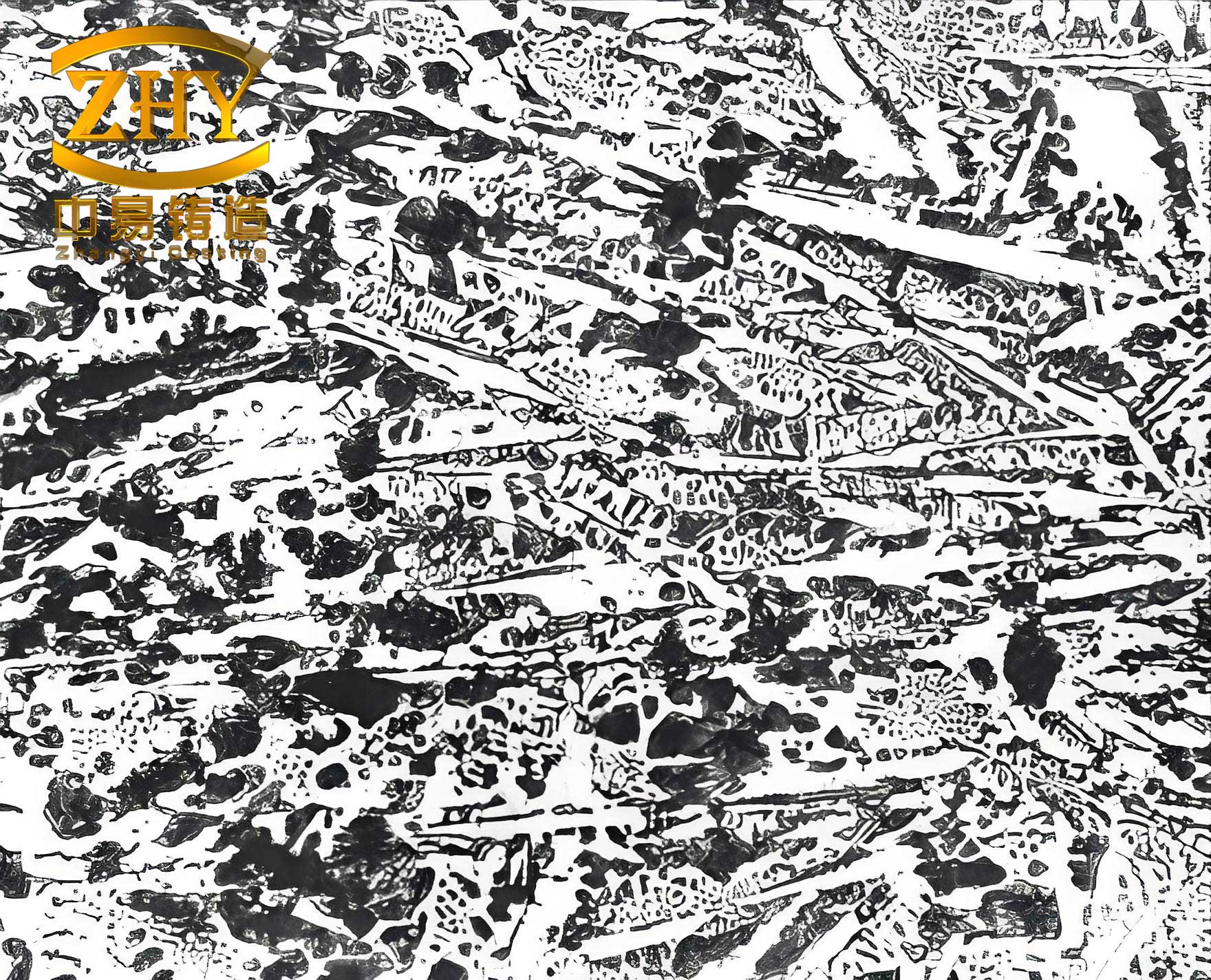
This step is pivotal, as the quality of the as-cast structure directly influences subsequent heat treatment and final properties. Ensuring optimal parameters during melting and pouring is essential for minimizing inclusions and promoting a uniform distribution of carbides in the white cast iron matrix.
Composition Design Principles
The performance of grinding balls in ball mills is governed by a balance between impact resistance and abrasive wear. Grinding balls are subjected to both冲击 forces from falling and碾磨 actions from rolling, leading to high-stress abrasive wear. Therefore, the material must exhibit not only high hardness but also sufficient toughness to withstand cyclic loading. Our composition design for high-chromium white cast iron was guided by metallurgical principles aimed at optimizing carbide morphology and matrix strength.
Carbon (C): Carbon is a crucial element for enhancing wear resistance in white cast iron. It combines with chromium to form hard carbides such as M7C3 and M23C6, which significantly increase the material’s hardness. However, excessive carbon leads to the formation of coarse primary carbides in hypereutectic compositions, which can act as stress concentrators and reduce impact toughness. The relationship between carbon content and toughness can be approximated by the following empirical formula, highlighting the trade-off:
$$ \alpha_k \approx \alpha_0 – k_C \cdot (C\% – C_0)^2 $$
where $\alpha_k$ is the impact toughness, $\alpha_0$ and $C_0$ are constants, and $k_C$ is a coefficient dependent on other alloying elements. To prevent brittle fracture, we limited the carbon content to below 3.0%, ensuring a near-eutectic or slightly hypoeutectic structure that avoids large primary carbides.
Chromium (Cr): Chromium is the primary alloying element in high-chromium white cast iron, serving multiple functions. It promotes the formation of M7C3 carbides, which are harder and more beneficial for wear resistance than cementite (Fe3C). Moreover, chromium increases the hardenability of the matrix and improves corrosion resistance. A critical aspect is the Cr/C ratio, which influences the type of carbides. To ensure the predominance of M7C3 carbides, the chromium content must satisfy:
$$ \text{Cr\%} \geq 12 \times \text{C\%} – 1.5 $$
For our design, chromium was maintained above 12%, typically in the range of 12-18%, to achieve a microstructure dominated by eutectic M7C3 carbides with a desirable morphology.
Molybdenum (Mo) and Copper (Cu): These elements are added to enhance hardenability and strength. Molybdenum, particularly when combined with chromium, contributes to secondary hardening during tempering and inhibits pearlite formation. Copper acts similarly, improving toughness and suppressing pearlite. However, due to cost considerations, their contents were controlled at low levels. The combined effect on hardenability can be expressed using a multiplying factor analogous to the ideal critical diameter in steel:
$$ D_I = f(\text{Cr}, \text{Mo}, \text{Cu}, \ldots) $$
where $D_I$ represents the depth of hardening. We limited molybdenum to below 1.5% and copper to below 1.0% to balance performance and economics.
Other Elements: Silicon and manganese were adjusted for deoxidation and to influence matrix transformation characteristics. Silicon helps in inhibiting carbide graphitization, while manganese stabilizes austenite. Their contents were kept moderate to avoid adverse effects on toughness.
Based on these principles, the designed chemical composition for our high-chromium white cast iron grinding balls is summarized in Table 1. This composition aims to achieve an optimal blend of carbide hardness and matrix toughness, crucial for durable grinding media.
| Element | C | Cr | Mo | Cu | Si | Mn | P | S |
|---|---|---|---|---|---|---|---|---|
| Range | 2.6-3.0 | 12-18 | 0.5-1.5 | 0.5-1.0 | 0.5-1.2 | 0.5-1.5 | <0.05 | <0.05 |
This composition ensures that the white cast iron microstructure consists of hard carbides embedded in a tough matrix, tailored to withstand the demands of grinding operations.
Melting and Casting Practices
Melting was carried out in a 150 kg medium-frequency induction furnace, which provided efficient heating and good control over alloy homogeneity. The process involved charging raw materials sequentially, with ferroalloys added after initial melting to minimize oxidation. Once the molten white cast iron reached a temperature of approximately 1500°C, it was tapped into a ladle. To protect against oxidation and slag inclusion, the ladle was covered with charcoal or草木灰 (replaced by proprietary flux in our process). After a brief镇静 period of several minutes to allow slag separation and temperature uniformity, the metal was poured at temperatures between 1380°C and 1420°C. Pouring speed was carefully regulated—initially fast to fill the mold quickly, then slowed to minimize turbulence—and the sprue was promptly topped up to ensure sound feeding.
The casting molds were made using green sand with the composition specified earlier. This sand mixture provided adequate permeability and collapsibility, reducing the risk of hot tearing in the white cast iron castings. After solidification, the grinding balls were extracted, cleaned, and inspected for surface defects. Any fins or irregularities were removed through grinding or shot blasting to prepare the balls for heat treatment.
Heat Treatment Strategy
Heat treatment is a critical step in optimizing the microstructure and mechanical properties of high-chromium white cast iron. Conventionally, such white cast iron is subjected to a quenching and tempering process to obtain a martensitic matrix, which offers high hardness. However, martensite can be brittle, increasing the risk of fracture under impact. To address the prevalent issue of breakage in grinding balls, we devised an alternative heat treatment aimed at producing an austenitic matrix. Austenite, being more ductile, can absorb impact energy better and slow crack propagation. The resistance to crack growth in austenite compared to martensite can be described by the stress intensity factor:
$$ K_{IC}(\text{Austenite}) > K_{IC}(\text{Martensite}) $$
where $K_{IC}$ is the fracture toughness. Thus, for grinding balls where impact resistance is paramount, an austenitic matrix is advantageous.
Our heat treatment protocol involved the following steps: After casting, the balls were removed from the molds at high temperature (above 800°C) and immediately transferred to a box furnace for isothermal holding. They were held at 950°C for 4-6 hours, depending on ball diameter (typically 1 hour per 25 mm of section thickness), followed by air cooling. This treatment resulted in a microstructure consisting of austenite + eutectic carbides (M7C3). No subsequent tempering was performed, as the goal was to retain stable austenite. The absence of martensitic transformation reduces internal stresses and enhances toughness. The process can be summarized by the time-temperature profile:
$$ T(t) = 950^\circ\text{C} \quad \text{for} \quad t \in [0, t_h] $$
where $t_h$ is the holding time. This approach not only improved impact resistance but also saved energy compared to traditional quenching and tempering cycles.
Mechanical Properties and Microstructural Analysis
The mechanical properties of the heat-treated high-chromium white cast iron were evaluated through standard tests. Impact toughness was measured using unnotched Charpy specimens, hardness was assessed with a Rockwell or Brinell tester, and bending strength was determined via three-point bending tests. The results, averaged from multiple batches, are presented in Table 2. These properties underscore the balanced performance achievable with optimized white cast iron.
| Property | Impact Toughness (J/cm²) | Bending Strength (MPa) | Hardness (HRC) |
|---|---|---|---|
| Value | 8-12 | 800-1000 | 56-62 |
The relationship between chromium content and key mechanical properties is particularly instructive. As chromium increases, hardness rises slightly due to enhanced carbide volume, but impact toughness declines more significantly. This trend can be modeled using regression equations derived from our data. For hardness (HRC) as a function of chromium content (Cr%):
$$ \text{HRC} = 50 + 0.5 \times (\text{Cr}\%) – 0.02 \times (\text{Cr}\%)^2 $$
For impact toughness ($\alpha_k$ in J/cm²):
$$ \alpha_k = 15 – 0.8 \times (\text{Cr}\%) + 0.03 \times (\text{Cr}\%)^2 $$
These formulas highlight the diminishing returns of high chromium on hardness and the pronounced detriment to toughness. Therefore, our composition range of 12-18% Cr represents a compromise that maximizes overall performance in white cast iron grinding balls.
Microstructurally, the material exhibits a network of eutectic carbides embedded in an austenitic matrix. The carbides, primarily of the M7C3 type, appear as discontinuous rods or blades rather than continuous networks, which is beneficial for toughness. This morphology is achieved through controlled solidification and heat treatment. The volume fraction of carbides ($V_c$) can be estimated from the composition using the lever rule approximation for the Fe-Cr-C system:
$$ V_c \approx \frac{\text{C\%} – C_{\alpha}}{C_{carb} – C_{\alpha}} $$
where $C_{\alpha}$ is the carbon solubility in austenite (about 0.1%) and $C_{carb}$ is the carbon content in M7C3 (approximately 6.7%). For our composition, $V_c$ ranges from 20% to 30%, contributing significantly to wear resistance.
Field Trials and Performance Evaluation
To validate the practical efficacy of our high-chromium white cast iron grinding balls, we conducted field trials in several cement plants. The balls were installed in ball mills of varying sizes and operated under normal production conditions. Key metrics monitored included grinding ball consumption per ton of cement produced, breakage rate, and any changes in mill throughput. The results, compiled from multiple trials, are summarized in Table 3. These data demonstrate the superior performance of white cast iron grinding balls compared to conventional high-manganese steel balls.
| Plant | Mill Specification | Operation Time (hours) | Cement Output (tons) | Specific Consumption (g/ton cement) | Breakage Rate (%) | Increase in Throughput (%) |
|---|---|---|---|---|---|---|
| A | φ1.5×5.7 m | 2000 | 15,000 | 80 | 0.1 | 5 |
| B | φ1.83×6.4 m | 2500 | 22,000 | 75 | 0.08 | 7 |
| C | φ2.2×6.5 m | 3000 | 30,000 | 70 | 0.05 | 10 |
The specific consumption of white cast iron balls was reduced by over 50% compared to traditional steel balls, translating to substantial cost savings. For instance, based on plant data, using high-chromium white cast iron grinding balls can lower the cost per ton of cement by approximately 0.5 to 1.0 currency units, depending on local factors. Moreover, the low breakage rate (below 0.1% in most cases) confirms the success of our approach in enhancing toughness. Additionally, some plants reported an increase in mill throughput, likely due to the improved grinding efficiency and reduced downtime for ball replacement.
Extended Technical Discussion
To further elucidate the advantages of high-chromium white cast iron, it is instructive to delve into the wear mechanisms and microstructural stability. In grinding applications, abrasive wear predominates, where hard particles or surfaces remove material through micro-cutting and fatigue. The wear resistance of white cast iron is primarily governed by the carbide phase. The hardness of M7C3 carbides can exceed 1500 HV, significantly higher than that of typical abrasive minerals (e.g., silica at ~1000 HV). Thus, the carbides act as barriers to abrasion, protecting the matrix. The wear rate ($W$) can be modeled using the Archard equation adapted for composite materials:
$$ W = k \cdot \frac{P}{H_{eff}} $$
where $k$ is a wear coefficient, $P$ is the applied pressure, and $H_{eff}$ is the effective hardness of the composite. For white cast iron, $H_{eff}$ can be approximated by a rule of mixtures:
$$ H_{eff} = V_c \cdot H_c + (1 – V_c) \cdot H_m $$
with $H_c$ and $H_m$ being the hardness of carbides and matrix, respectively. Our composition yields $H_{eff}$ values around 600-700 HV, explaining the low wear rates observed.
Regarding impact toughness, the austenitic matrix plays a crucial role. Austenite can undergo strain-induced transformation to martensite under severe deformation, a phenomenon known as transformation-induced plasticity (TRIP). This can enhance toughness by dissipating energy. The stability of austenite in our white cast iron is influenced by the alloy content and heat treatment. The Ms (martensite start) temperature can be estimated using an empirical formula:
$$ M_s (^\circ\text{C}) = 539 – 423 \cdot \text{C\%} – 30.4 \cdot \text{Mn\%} – 17.7 \cdot \text{Ni\%} – 12.1 \cdot \text{Cr\%} – 7.5 \cdot \text{Mo\%} $$
For our composition, $M_s$ is below room temperature, ensuring austenite retention after heat treatment. This metastable austenite contributes to crack blunting and improved fracture resistance.
Another aspect is the effect of carbide morphology on mechanical properties. Through controlled solidification, we promoted the formation of isolated or semi-continuous carbides rather than a fully connected network. This reduces the crack propagation path along carbide interfaces. The mean free path in the matrix ($\lambda_m$) is a key parameter, given by:
$$ \lambda_m = \frac{1 – V_c}{N_L} $$
where $N_L$ is the number of carbide intersections per unit length. A larger $\lambda_m$ enhances ductility. Our processing conditions yielded $\lambda_m$ values in the range of 10-20 µm, conducive to good toughness in white cast iron.
Furthermore, the economic and environmental benefits of using high-chromium white cast iron grinding balls are noteworthy. The extended service life reduces the frequency of ball replacement, lowering labor costs and mill downtime. Additionally, the energy savings from our simplified heat treatment contribute to a smaller carbon footprint. When considering the entire lifecycle, white cast iron grinding balls offer a sustainable solution for the mining and cement industries.
Conclusion
In summary, the development of high-chromium white cast iron grinding balls represents a significant advancement in grinding media technology. Through meticulous composition design, optimized melting and casting practices, and an innovative heat treatment that yields an austenitic matrix, we have achieved a material that combines exceptional wear resistance with satisfactory impact toughness. Field trials have confirmed that these white cast iron balls outperform traditional high-manganese steel balls, reducing specific consumption by over 50% and maintaining breakage rates below 0.1%. The technical insights gained, from carbide morphology control to fracture mechanics, underscore the versatility and potential of white cast iron in demanding applications. As industries continue to seek efficiency and cost reduction, high-chromium white cast iron stands out as a robust and reliable choice for grinding operations, paving the way for wider adoption and further innovations in material science.
The success of this project highlights the importance of holistic approaches in materials engineering, where composition, processing, and microstructure are intricately linked. Future work may explore further alloy modifications or advanced heat treatments to push the boundaries of white cast iron performance. Nonetheless, the current成果 provide a solid foundation for the widespread use of high-chromium white cast iron in grinding and beyond, cementing its role as a cornerstone of modern耐磨 materials.