
In the field of metal casting, particularly for automotive components, slag holes represent a pervasive and detrimental defect that significantly compromises the mechanical properties of cast parts. These defects act as stress concentrators, increasing notch sensitivity and leading to reduced fatigue life and failure under load. As nodular cast iron, also known as ductile iron, is a critical material for high-strength, durable parts such as crankshafts, brake calipers, and structural elements, addressing slag hole formation is paramount for enhancing product quality and manufacturing efficiency. This study focuses on investigating and optimizing the casting process for nodular cast iron to mitigate slag hole defects, combining practical foundry techniques with computational fluid dynamics simulations. We explore two primary avenues: enhancing molten metal purity through slag removal practices and optimizing the gating system design to minimize slag entrainment. The goal is to develop a robust methodology that can be applied in industrial sand casting operations to reduce defect rates and improve the reliability of nodular cast iron components.
Slag holes in nodular cast iron typically originate from non-metallic inclusions, such as oxides, sulfides, and slag particles, that are entrained in the molten metal during melting, treatment, or pouring. These inclusions have densities generally lower than that of the iron melt, causing them to float to the surface; however, turbulent flow during mold filling can trap them within the casting, resulting in subsurface or surface defects. The formation of slag is influenced by several factors, including the purity of charge materials, melting conditions, treatment processes (like spheroidization and inoculation), and the design of the gating and running system. Previous research has highlighted various strategies, such as improving charge material quality, employing effective slag removal agents, and designing gating systems that promote laminar flow and slag trapping. For instance, studies have shown that semi-closed gating systems with choke areas can effectively reduce slag entrainment, while excessive turbulence in runners can exacerbate defect formation. In this work, we build upon these insights by systematically evaluating slag removal efficiency and gating geometry modifications specifically for nodular cast iron castings.
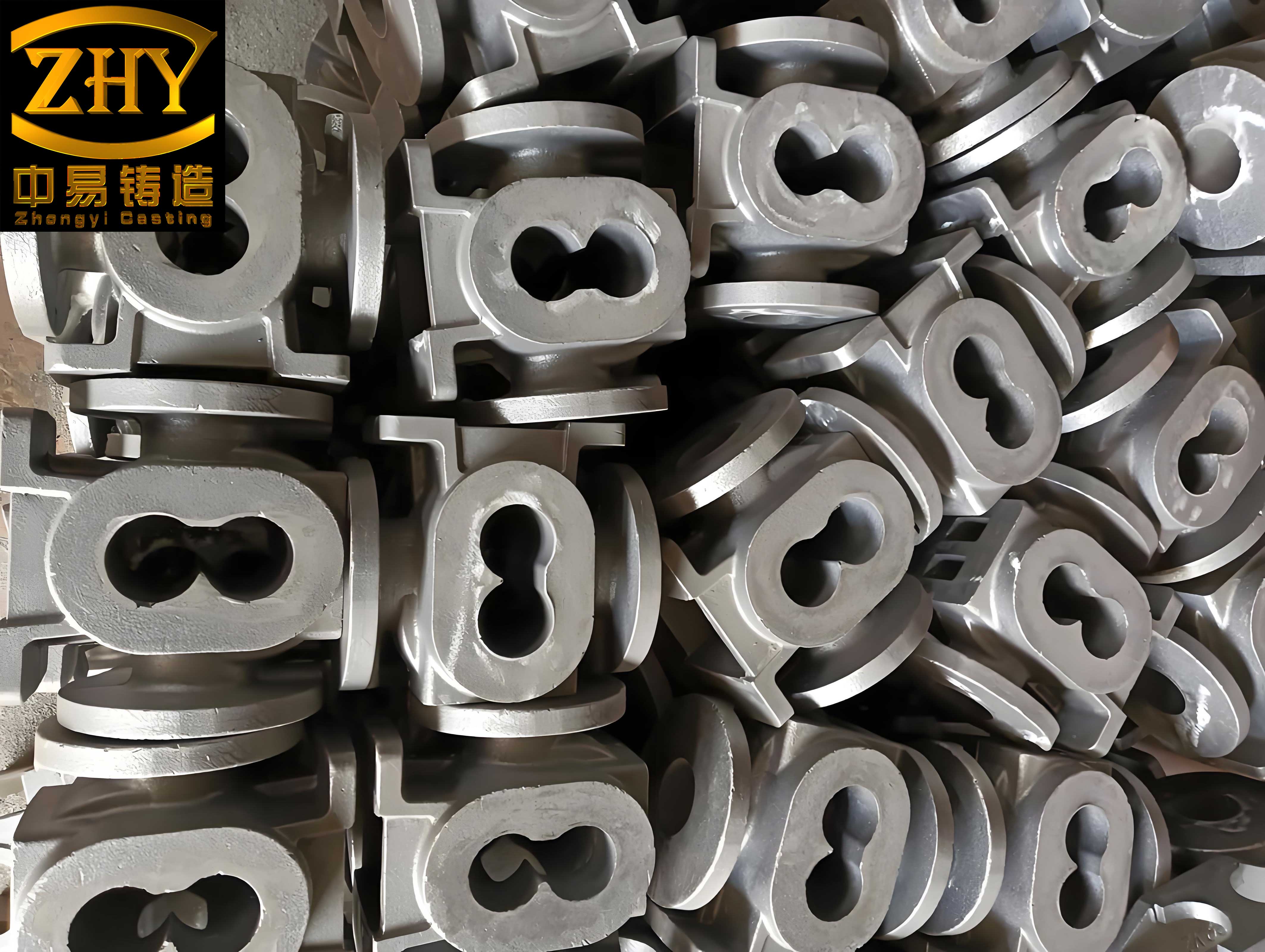
The base material for this investigation is nodular cast iron, produced using a charge consisting of pig iron, steel scrap, and returns. The chemical composition is adjusted through alloying additions to meet standard specifications for automotive-grade nodular cast iron. The target composition, as verified by spectroscopy, is presented in Table 1. The spheroidizing treatment employs a magnesium-ferrosilicon alloy with rare earth elements, while inoculation is carried out using a silicon-based inoculant containing calcium, barium, and other elements to promote graphite nodule formation and improve metallurgical quality.
| Element | C | Si | Mn | P | S | Mg | Cr | Cu | Fe |
|---|---|---|---|---|---|---|---|---|---|
| Content | 3.6-3.9 | 2.2-2.6 | 0.2-0.4 | <0.05 | <0.02 | 0.03-0.05 | <0.1 | 0.4-0.6 | Bal. |
The melting process is conducted in a medium-frequency induction furnace, with the superheating temperature maintained between 1520°C and 1560°C to ensure proper fluidity and treatment response. After melting, the molten nodular cast iron undergoes spheroidization and inoculation in a transfer ladle. The casting process employs green sand molds with vertically parted patterns, typical for high-volume production of automotive parts. To assess slag hole formation, we cast test specimens resembling small brake components and steering knuckles, which are prone to such defects due to their geometry and filling characteristics.
The first aspect of our improvement strategy focuses on enhancing molten metal purity through slag removal. During melting, slag forms on the surface of the nodular cast iron bath due to oxidation of alloying elements and the reaction of fluxes with impurities. We implement a systematic slag-off practice using a commercial slag coagulant that aggregates the slag particles, making them easier to remove. The efficiency of this practice is quantified by measuring the surface coverage of slag after each slag-off operation. The process involves skimming the slag from the furnace bath and, subsequently, from the treatment ladle after tapping. The results are summarized in Table 2, which shows the relationship between the number of slag-off operations and the residual slag coverage. The data indicate that two to three slag-off cycles during melting achieve optimal reduction in slag content without excessively increasing processing time or cost. After tapping, a single slag-off operation in the ladle is generally sufficient for most applications, though additional cycles can be employed for high-integrity castings.
| Number of Slag-Off Operations | Slag Coverage on Melt Surface (%) | Observations |
|---|---|---|
| 1 | 60-70 | Substantial slag remains; insufficient for quality casting. |
| 2 | 30-40 | Significant improvement; meets basic quality threshold. |
| 3 | 15-20 | Low slag content; suitable for most engineering applications. |
| 4 | 8-10 | Very clean melt; used for critical components only. |
The second aspect involves optimizing the gating system to prevent residual slag from entering the mold cavity. The gating design principles for nodular cast iron must balance slag trapping with minimal turbulence to avoid mold erosion and gas entrapment. We investigate several gating configurations, including a standard unpressurized system, a semi-pressurized system, and a fully pressurized system, with modifications such as slag traps, runner extensions, and choke areas. The primary design criterion is to achieve a flow condition that minimizes the velocity of the molten nodular cast iron at the ingate, thereby reducing kinetic energy that can entrain slag. The flow behavior can be described using Bernoulli’s equation for incompressible fluids, modified for foundry applications:
$$ P_1 + \frac{1}{2} \rho v_1^2 + \rho g h_1 = P_2 + \frac{1}{2} \rho v_2^2 + \rho g h_2 + \Delta P_{loss} $$
where \( P \) is pressure, \( \rho \) is the density of nodular cast iron (approximately \( 7.1 \times 10^3 \, \text{kg/m}^3 \)), \( v \) is flow velocity, \( g \) is gravitational acceleration, \( h \) is height, and \( \Delta P_{loss} \) accounts for frictional losses in the gating channels. For effective slag separation, the design should promote a low \( v \) in the runners, allowing buoyant forces to float slag to the top. The upward velocity of slag particles can be estimated using Stokes’ law for small spherical inclusions:
$$ v_b = \frac{2 (\rho_m – \rho_s) g r^2}{9 \eta} $$
Here, \( v_b \) is the terminal rising velocity, \( \rho_m \) is the density of molten nodular cast iron, \( \rho_s \) is the density of slag (typically \( 2.5 \times 10^3 \, \text{kg/m}^3 \)), \( r \) is the radius of the slag particle, and \( \eta \) is the dynamic viscosity of the melt (approximately \( 5.5 \times 10^{-3} \, \text{Pa·s} \) at 1500°C). To ensure slag removal, the residence time of the metal in the runner must be sufficient for particles to rise to a trapping zone. This requires a runner with a large cross-sectional area or a horizontal extension that acts as a settling chamber.
We employ computational simulation using AnyCasting software to analyze the mold filling sequence and slag particle trajectories. The simulation model incorporates the actual geometry of the test casting and gating system, with material properties set for nodular cast iron. The initial condition assumes a uniform distribution of slag particles with diameters ranging from 0.1 mm to 1 mm. The results for a conventional gating system show that during the early stage of filling, slag is carried directly into the casting cavity due to high momentum. However, when a slag trap (e.g., a well or expanded runner) is incorporated at the base of the sprue, the initial metal stream is decelerated, and slag particles are captured. Furthermore, we implement a “swallowtail” junction at the sprue-runner connection, which creates a vortex that directs floating slag into a dead zone, preventing it from entering the ingates. The efficiency of this design is evaluated by counting the number of slag particles that reach the casting cavity in the simulation.
The experimental validation involves producing castings with different gating designs and measuring the slag hole defect rate after shot blasting and visual inspection. Defect rate is defined as the percentage of castings showing visible slag holes on critical surfaces. Table 3 summarizes the results for three gating configurations: Design A (conventional unpressurized), Design B (semi-pressurized with a swallowtail junction), and Design C (semi-pressurized with swallowtail and an additional slag collecting pocket at the runner end). Each design is tested with 200 castings, and the pouring parameters are kept constant: pouring temperature of 1450°C, pouring time of 9 seconds, and a pouring cup height of 150 mm. The data clearly demonstrate that Design C yields the lowest defect rate, underscoring the importance of combined slag trapping features.
| Gating Design | Description | Defect Rate (%) | Remarks |
|---|---|---|---|
| Design A | Conventional unpressurized system with straight sprue and runner | 19.8 | High turbulence; poor slag separation. |
| Design B | Semi-pressurized system with swallowtail sprue-runner junction | 8.5 | Improved slag trapping; some residual defects. |
| Design C | Semi-pressurized system with swallowtail junction and runner slag pocket | 4.7 | Optimal design; minimal slag entrainment. |
Another critical parameter is the cross-sectional area ratio between the sprue and the runner. This ratio influences the pressure and velocity profile in the gating system. For nodular cast iron, a semi-pressurized system often works best, where the sprue base area is smaller than the total runner area but larger than the ingate area. We define the area ratio \( R \) as:
$$ R = \frac{A_{\text{sprue base}}}{A_{\text{runner total}}} $$
where \( A_{\text{sprue base}} \) is the cross-sectional area at the bottom of the sprue, and \( A_{\text{runner total}} \) is the sum of cross-sectional areas of all runner channels. A series of experiments are conducted with \( R \) values ranging from 0.4 to 1.2, while keeping other parameters constant. The defect rate is measured for each \( R \) value, and the results are plotted in Figure 4. The data reveal a parabolic relationship, with a minimum defect rate at \( R = 0.8 \). This optimal ratio provides a balance: it reduces the metal velocity sufficiently to allow slag flotation while maintaining enough pressure to ensure complete mold filling within the desired time window (8-10 seconds). At lower \( R \) values, the velocity is too high, causing excessive turbulence and slag entrainment. At higher \( R \) values, the reduced velocity may lead to mistruns or cold shuts, and the prolonged exposure to air can promote reoxidation, generating new slag in situ.
The relationship between defect rate \( D \) and area ratio \( R \) can be modeled empirically using a quadratic equation derived from the experimental data:
$$ D(R) = \alpha R^2 + \beta R + \gamma $$
where \( \alpha \), \( \beta \), and \( \gamma \) are constants specific to the nodular cast iron composition and mold configuration. For our setup, the best-fit parameters are \( \alpha = 25.3 \), \( \beta = -40.5 \), and \( \gamma = 21.7 \), yielding a minimum at \( R = 0.8 \) as calculated from \( dD/dR = 0 \). This mathematical model aids in predicting defect rates for similar casting geometries without extensive trial runs.
In addition to gating design, the pouring practice itself plays a crucial role. We maintain a consistent pouring speed of approximately 1000 mm/s at the sprue entrance, controlled by using a tapered pouring cup. The filling pattern is monitored via simulation to ensure that the metal front advances smoothly without jetting or splashing. For nodular cast iron, which has a tendency to form dross if exposed to air, a continuous pour without interruption is essential. Any disruption can create a fresh oxide layer that may break off and become entrapped as slag.
The interaction between slag removal efficiency and gating design is synergistic. Even with excellent slag-off practices, some fine inclusions remain in the molten nodular cast iron; hence, the gating system must act as a final filter. Conversely, a well-designed gating system can tolerate a slightly higher initial slag load. To quantify this interaction, we conduct a factorial experiment with two factors: slag-off level (low: one furnace slag-off; high: three furnace slag-offs plus ladle slag-off) and gating design (Design A vs. Design C). The response variable is the defect rate. The results, analyzed using ANOVA, show that both factors have significant effects (p < 0.01), but the gating design has a larger effect size, explaining about 65% of the variance in defect rates. This underscores that while metal purity is important, gating optimization is often more impactful for reducing slag holes in nodular cast iron castings.
Microstructural examination of castings with and without slag holes provides further insight. Samples are sectioned, polished, and examined under a scanning electron microscope (SEM) equipped with energy-dispersive X-ray spectroscopy (EDS). The slag inclusions in defective areas consist primarily of complex oxides of silicon, magnesium, and calcium, along with traces of sulfur. These correspond to reaction products from spheroidization and inoculation of nodular cast iron. In sound castings produced with the optimized process, such inclusions are largely absent from the matrix, confirming the effectiveness of the combined approach.
The economic implications of reducing slag hole defects are substantial for foundries producing nodular cast iron components. Lower defect rates translate directly into higher yield, reduced rework and scrap, and improved customer satisfaction. The implementation of the recommended practices—specifically, two to three slag-off cycles during melting and a semi-pressurized gating system with a swallowtail junction, runner slag pocket, and an area ratio \( R = 0.8 \)—requires minimal capital investment but offers significant returns. Furthermore, the use of simulation software like AnyCasting allows for virtual prototyping, reducing the time and cost associated with physical trials.
In conclusion, this study demonstrates a comprehensive methodology for mitigating slag hole defects in nodular cast iron castings. Through systematic slag removal and gating system optimization, we achieve a substantial reduction in defect rates, from nearly 20% to below 5%. The key findings are: (1) Slag-off operations during melting should be performed two to three times to achieve a slag coverage below 30%; a single ladle slag-off after tapping is generally adequate. (2) The gating system for nodular cast iron should incorporate features such as a swallowtail sprue-runner junction and a slag collection pocket to trap inclusions. (3) The cross-sectional area ratio between sprue and runner should be optimized around 0.8 for semi-pressurized systems to balance flow velocity and slag separation. (4) Computational simulation is a valuable tool for predicting slag entrainment and validating gating designs prior to production. These recommendations, grounded in experimental data and theoretical analysis, provide a practical framework for enhancing the quality and reliability of nodular cast iron components in automotive and other high-performance applications.