
In my extensive experience within the piston ring industry, I have closely studied the evolution and application of various casting technologies for ductile cast iron components. Over the past fifteen years, ductile cast iron piston rings have become indispensable in engines for agricultural machinery, automobiles, and motorcycles, owing to their exceptional mechanical properties such as high strength, wear resistance, and good machinability. This article, from my first-person perspective, delves into the primary casting methods employed internationally for ductile cast iron piston rings, comparing them with domestic practices and offering a detailed evaluation. The focus will be on technical insights, incorporating tables and formulas to elucidate key aspects, while consistently emphasizing the critical role of ductile cast iron in these processes.
The fundamental appeal of ductile cast iron lies in its unique microstructure, characterized by spheroidal graphite nodules embedded in a ferritic or pearlitic matrix. This structure is achieved through precise metallurgical control during casting. The quality of the final ductile cast iron product is heavily influenced by the casting process, which governs solidification behavior, defect formation, and dimensional accuracy. Therefore, selecting an appropriate casting method is paramount for manufacturers aiming to optimize performance and cost-efficiency.
Globally, several advanced casting techniques have been developed specifically for ductile cast iron piston rings. My observations, based on visits and technical exchanges, indicate that Germany, Japan, and Russia are at the forefront of this technology. Each method has distinct characteristics, advantages, and challenges related to the processing of ductile cast iron.
In Germany, the pioneering work in ductile cast iron piston ring casting is well-recognized. The double-piece elliptical casting process, introduced decades ago, remains a cornerstone. This method involves casting two rings together in an elliptical mold configuration, which enhances material yield and reduces thermal stresses. The process typically employs semi-automatic or automatic molding machines with square sand boxes. The key to its success with ductile cast iron is the controlled cooling rate, which can be approximated by the solidification time formula:
$$ t_s = k \cdot V^{2/3} $$
Here, \( t_s \) represents the solidification time, \( k \) is a constant dependent on the mold material and ductile cast iron properties, and \( V \) is the volume of the casting. This relation underscores how geometry affects the solidification of ductile cast iron, impacting graphite nodule formation and mechanical integrity.
Building upon this, a more advanced four-piece elliptical short-sleeve casting process was later developed. This method increases productivity by casting four rings in a taller mold using the same automated equipment. It significantly reduces sand consumption and cleaning efforts for ductile cast iron castings. However, it necessitates efficient slicing machinery to separate the rings, adding a layer of complexity to the post-casting workflow for ductile cast iron components.
In Japan, companies have adeptly integrated both German-inspired double-piece casting and indigenous cylindrical elliptical casting. The cylindrical process utilizes vertical parting flaskless molding lines, such as the Koyo SM-50V, which enable very high production rates suitable for large-volume orders of ductile cast iron rings. This method casts multiple rings in a sleeve form, which are subsequently sliced. The cooling dynamics here are critical; the cooling rate \( \dot{T} \) directly influences the nodule count \( N \) in the ductile cast iron, as described by:
$$ N = C \cdot \dot{T}^m $$
where \( C \) and \( m \) are material-specific constants. Faster cooling in these tight molds can lead to finer graphite structures, potentially enhancing the properties of the ductile cast iron, though it may also introduce risks of internal stresses.
The Russian approach, particularly at the Volga Auto Plant, involved importing Japanese-style cylindrical casting technology. Their innovation lies in the slicing equipment, which is notably simpler and more efficient, addressing a major bottleneck in high-volume production of ductile cast iron piston rings.
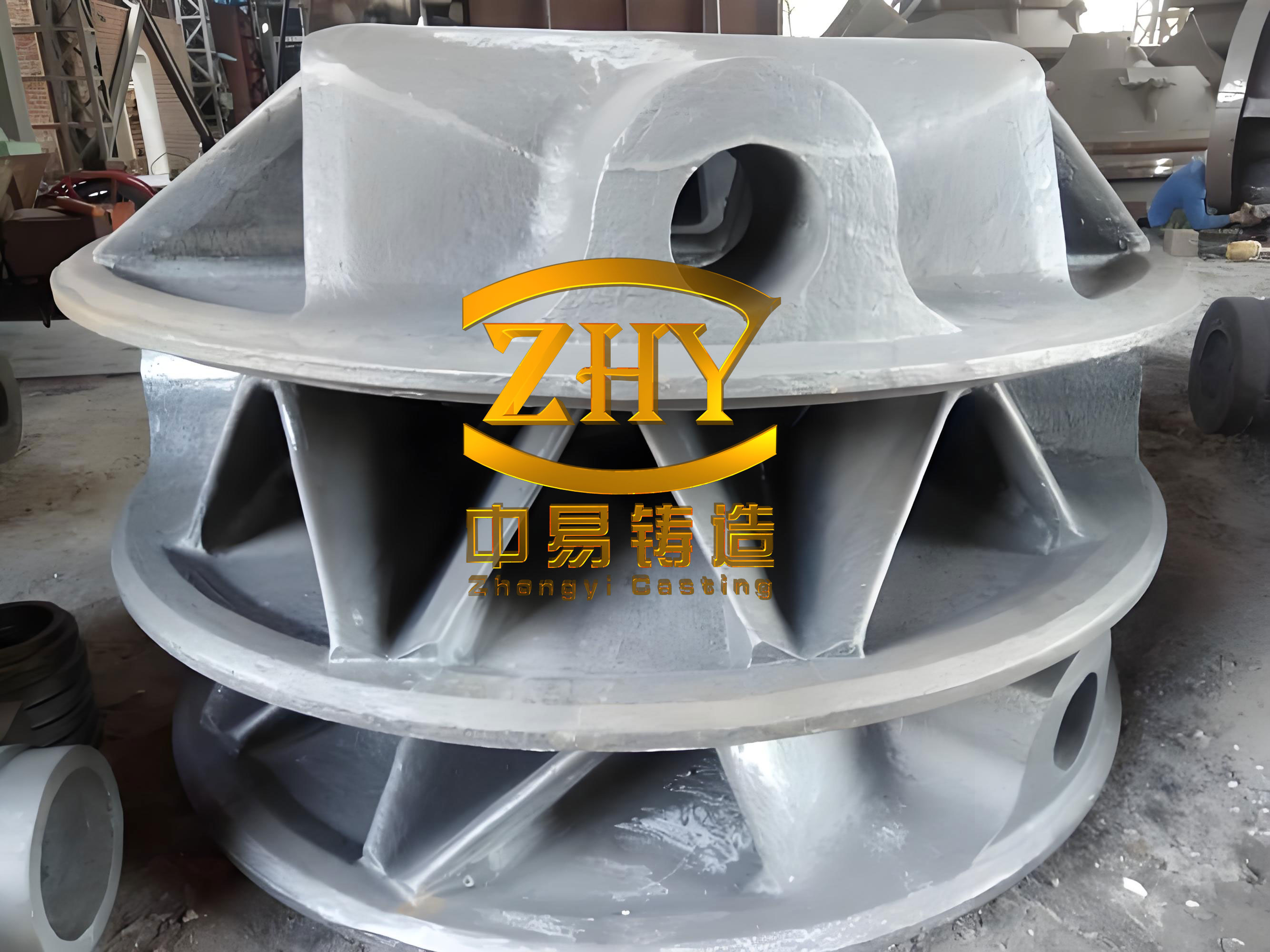
As illustrated, the casting of ductile iron involves intricate mold designs and precise thermal management to achieve the desired microstructure and minimize defects in the final ductile cast iron product.
In contrast, domestic production of ductile cast iron piston rings has largely adopted the double-piece casting process, with limited use of single-piece and lost foam casting (EPC) for specific applications like motorcycle rings. However, these alternative methods often struggle with economic efficiency or defect control when processing ductile cast iron.
To systematically compare these diverse methods for ductile cast iron, I have compiled several tables. Table 1 outlines the fundamental characteristics of each casting process.
| Process Method | Molding Equipment | Key Process Features for Ductile Cast Iron | Typical Application Scope |
|---|---|---|---|
| Double-piece Elliptical Casting | Semi-automatic/Automatic molding machines with square sand boxes | Excellent adaptability to various ring diameters; good control over solidification shrinkage; relatively simple post-casting slicing. | Widely used for automotive and diesel engine ductile cast iron rings. |
| Four-piece Elliptical Short-sleeve Casting | Automatic molding machines (same as double-piece) | Higher rings per mold; reduced sand use and cleaning; requires precise slicing technology to handle ductile cast iron’s toughness. | High-volume production of ductile cast iron rings, replacing double-piece in some lines. |
| Cylindrical Elliptical Casting | Vertical parting flaskless molding lines (e.g., Koyo SM-50V) | Extremely high molding efficiency; consistent mold quality; demands specialized high-speed slicing machines for ductile cast iron. | Mass production of specific, high-demand ductile cast iron ring sizes. |
| Single-piece Elliptical Casting | Basic molding machines | Simple mold design but requires large risers for feeding, leading to very low metal yield for ductile cast iron. | Limited to small-diameter rings (e.g., motorcycles) where volume is low. |
| Lost Foam Casting (EPC) | Foam pattern-based molding systems | Process simplicity and good dimensional accuracy, but prone to shrinkage porosity in ductile cast iron if not carefully controlled. | Primarily for niche applications like certain motorcycle ductile cast iron rings. |
Economic and quality metrics are crucial for evaluating these processes. A vital parameter is the metal yield ratio \( Y \), which significantly impacts the cost-effectiveness of producing ductile cast iron parts:
$$ Y = \frac{W_{\text{usable rings}}}{W_{\text{total molten metal}}} \times 100\% $$
For ductile cast iron, this yield varies dramatically. Single-piece casting might have \( Y \approx 10-15\% \), while double-piece and advanced multi-piece methods can achieve \( Y > 50\% \). Table 2 provides a comparative analysis of efficiency and cost.
| Process Method | Typical Metal Yield for Ductile Cast Iron (%) | Estimated Production Rate (Rings per Hour) | Relative Capital and Operational Cost | Common Defects in Ductile Cast Iron |
|---|---|---|---|---|
| Double-piece Elliptical | 50 – 65 | Moderate to High (e.g., 500-1000) | Low to Medium | Minor centerline shrinkage, minimal porosity. |
| Four-piece Elliptical | 60 – 72 | High (e.g., 800-1500) | Medium (slicing machine investment) | Potential center porosity if slicing allowance is insufficient. |
| Cylindrical Elliptical | 65 – 78 | Very High (e.g., 1500-3000+) | High (due to molding and slicing lines) | Surface cracks from rapid cooling, internal stresses. |
| Single-piece Elliptical | 10 – 15 | Low (e.g., 100-300) | Low (equipment) but High (material waste) | Significant shrinkage porosity near risers. |
| Lost Foam Casting | 40 – 55 | Moderate (e.g., 300-600) | Low to Medium | Shrinkage cavities, gas inclusions. |
The metallurgy of ductile cast iron is intrinsically linked to casting success. The nodularization process, typically via magnesium treatment, is fundamental. The reaction can be simplified as:
$$ \text{Mg} + \text{FeS} \rightarrow \text{MgS} + \text{Fe} $$
Effective control of residual magnesium \( [\text{Mg}]_{\text{res}} \) (usually 0.03-0.06%) is vital to ensure proper spheroidal graphite formation in the ductile cast iron and avoid undesirable carbides. Furthermore, inoculation practices influence the final nodule count. The efficiency of inoculation \( \eta_{\text{inoc}} \) can be conceptualized as:
$$ \eta_{\text{inoc}} = \frac{N_{\text{achieved}}}{N_{\text{potential}}} $$
where \( N_{\text{achieved}} \) is the measured nodule count per unit area, a key quality indicator for ductile cast iron.
The chemical composition of the ductile cast iron must be tailored for each casting process to optimize fluidity, shrinkage behavior, and final properties. Table 3 presents typical compositional ranges.
| Element | Target Range for Double/ Four-piece Ductile Cast Iron (%) | Target Range for Cylindrical Ductile Cast Iron (%) | Primary Role in Ductile Cast Iron |
|---|---|---|---|
| Carbon (C) | 3.5 – 3.9 | 3.4 – 3.8 | Promotes graphite formation, enhances castability. |
| Silicon (Si) | 2.1 – 2.6 | 2.3 – 2.8 | Strong graphitizer, increases fluidity and ferrite content. |
| Magnesium (Mg) | 0.035 – 0.050 | 0.040 – 0.060 | Essential for spheroidal graphite nodule formation. |
| Manganese (Mn) | 0.15 – 0.35 | 0.10 – 0.25 | Increases strength and hardenability but can segregate. |
| Phosphorus (P) | < 0.04 | < 0.03 | Kept low to prevent embrittlement in ductile cast iron. |
| Copper (Cu) – optional | 0.3 – 0.8 | 0.4 – 1.0 | Improves pearlite formation, strength, and corrosion resistance. |
Thermal management during casting is another critical domain. The cooling rate affects the matrix structure of the ductile cast iron. The Fourier number \( Fo \), a dimensionless parameter for heat conduction, helps in analyzing this:
$$ Fo = \frac{\alpha \cdot t}{L^2} $$
Here, \( \alpha \) is the thermal diffusivity of the ductile cast iron or mold, \( t \) is time, and \( L \) is a characteristic length (e.g., ring wall thickness). A higher \( Fo \) indicates a more uniform temperature field, which is desirable for consistent microstructure in ductile cast iron.
Residual stresses induced during the cooling of ductile cast iron castings can affect dimensional stability and fatigue life. These stresses \( \sigma_{\text{res}} \) arise from thermal gradients and can be estimated by:
$$ \sigma_{\text{res}} \approx E \cdot \alpha_{\text{th}} \cdot \Delta T_{\text{eff}} $$
where \( E \) is Young’s modulus of the ductile cast iron, \( \alpha_{\text{th}} \) is its coefficient of thermal expansion, and \( \Delta T_{\text{eff}} \) is an effective temperature difference during constrained cooling. Process optimization aims to minimize \( \Delta T_{\text{eff}} \) to reduce these stresses in ductile cast iron components.
From a quality assurance standpoint, non-destructive testing is essential. Ultrasonic testing, for instance, relies on the sound velocity \( v \) in the ductile cast iron, which correlates with its density \( \rho \) and dynamic elastic modulus \( E_d \):
$$ v = \sqrt{\frac{E_d}{\rho}} $$
Variations in \( v \) can indicate the presence of discontinuities like shrinkage or slag inclusions within the ductile cast iron casting, providing a critical quality check.
Looking at productivity holistically, Overall Equipment Effectiveness (OEE) is a valuable metric for casting lines dedicated to ductile cast iron. OEE is the product of Availability (A), Performance (P), and Quality (Q) rates:
$$ \text{OEE} = A \times P \times Q $$
For a ductile cast iron piston ring line, improving OEE involves reducing downtime (A), increasing the actual output rate versus theoretical maximum (P), and minimizing scrap and rework (Q). Advanced processes like cylindrical casting can achieve high P but may require excellent maintenance (A) and slicing precision (Q) to realize their full potential for ductile cast iron production.
In my evaluation, the double-piece process for ductile cast iron offers an excellent balance of simplicity, flexibility, and cost, making it a robust choice for diverse product ranges. The four-piece and cylindrical processes represent the next evolution, delivering superior productivity for high-volume ductile cast iron rings but demanding greater upfront investment and technical mastery, particularly in slicing technology. The single-piece and EPC methods, while serving niche markets, have inherent limitations in metal yield and defect control for ductile cast iron that hinder their broader adoption.
The future development of casting technologies for ductile cast iron piston rings will likely focus on further automation, integration of real-time process monitoring, and advanced simulation tools. Computational modeling of fluid flow, solidification, and stress evolution can predict defects and optimize gating and cooling designs specifically for ductile cast iron. Moreover, developing more efficient and versatile slicing machinery is a prerequisite for wider adoption of high-productivity multi-cast methods for ductile cast iron.
In conclusion, the landscape of casting technologies for ductile cast iron piston rings is rich and varied. International practices provide valuable blueprints, but successful implementation requires deep understanding of the underlying material science of ductile cast iron and careful adaptation to local manufacturing conditions. As the demand for high-performance, cost-effective engine components grows, continuous innovation in the casting of ductile cast iron will remain a critical driver for the industry’s progress. My firsthand experience confirms that a methodical approach, combining proven techniques with targeted advancements, is the key to excelling in the production of superior ductile cast iron piston rings.