
In my research, I explored the innovative use of graphite sand casting to produce surface耐磨 composites for critical components in concrete mixers, such as liners and blades. The traditional reliance on high-chromium white cast iron for these parts often leads to issues like brittleness and high production costs. Through graphite sand casting, I aimed to develop a composite material with a hardened, wear-resistant surface layer and a tough, ductile core, leveraging the unique properties of graphite sand. This sand casting method not only enhances surface properties through carburization but also maintains the structural integrity of the base steel. In this article, I will detail my experimental approach, results, and insights, emphasizing the repeated application of sand casting techniques throughout the process. The integration of tables and formulas will help summarize key data, and I will insert a visual reference to illustrate typical sand-cast parts at an appropriate point.
The foundation of this work lies in selecting an appropriate base material. I chose a low-alloy steel similar to typical carburizing grades, with a composition designed to facilitate surface carburization while ensuring core toughness. The chemical composition is as follows: Carbon (C) 0.15-0.20%, Silicon (Si) 0.17-0.37%, Manganese (Mn) 0.40-0.70%, Chromium (Cr) 0.90-1.20%, Boron (B) 0.001-0.005%, and trace amounts of Rare Earth (RE) elements. This alloy provides a balance between hardenability and ductility, crucial for withstanding the abrasive environment in concrete mixing. The sand casting process begins with mold preparation using graphite sand, which is central to this study. Graphite sand offers high refractoriness, chemical stability, and a strong chilling effect, making it ideal for specialized casting applications. However, its carburizing potential in steel castings has been underexplored, which I addressed in my experiments.
For the sand casting mold, I formulated a sand mixture with the following proportions by weight: 100% graphite sand, 8-10% clay (including bentonite), 4-6% additional bentonite as a binder, and 4-5% water. This composition ensures adequate mold strength and permeability. The properties of this graphite sand mixture are summarized in Table 1. As shown, the sand exhibits excellent characteristics for casting, such as high green strength and thermal stability, which are essential for achieving defect-free castings. The use of sand casting here is critical, as the graphite sand directly influences the surface carburization during solidification.
| Property | Value | Unit |
|---|---|---|
| Green Compressive Strength | 0.05-0.07 | MPa |
| Permeability | 120-150 | – |
| Moisture Content | 4-5 | % |
| Refractoriness | >1800 | °C |
In sand casting, the pouring temperature is a key parameter affecting the depth of the carburized layer. Higher temperatures promote greater carbon diffusion from the graphite sand into the steel surface, but excessive heat can cause defects like sand sticking and coarse grains. Based on preliminary trials, I set the pouring temperature range at 1550-1600°C. This range optimizes carburization while minimizing casting defects. The molds were prepared as dry sand types, baked at 250°C before pouring to ensure moisture removal and enhance thermal stability. Hot mold pouring was employed to maintain a steep temperature gradient, which aids in forming a distinct composite layer. The sand casting process was conducted in a controlled environment to replicate industrial conditions.
The mechanism of surface composite formation in graphite sand casting can be described using diffusion principles. During solidification, carbon from the graphite sand migrates into the steel surface, leading to a localized increase in carbon content. This process is governed by Fick’s laws of diffusion. The carbon concentration profile over time and depth can be approximated by:
$$ C(x,t) = C_s – (C_s – C_0) \cdot \text{erf}\left( \frac{x}{2\sqrt{Dt}} \right) $$
where \( C(x,t) \) is the carbon concentration at depth \( x \) and time \( t \), \( C_s \) is the surface carbon concentration (in equilibrium with graphite sand), \( C_0 \) is the initial carbon content in the steel, \( D \) is the diffusion coefficient of carbon in austenite, and erf is the error function. For typical sand casting conditions with graphite sand, \( D \) depends on temperature, and the high pouring temperature of 1550-1600°C enhances diffusion rates. The depth of the composite layer, \( \delta \), can be estimated from the distance where carbon content reaches a critical value for white iron formation (e.g., >2% C). Empirical observations from my experiments yielded depths of 4-8 mm, suitable for wear applications.
After sand casting, the specimens were examined for composite layer depth, microstructure, and mechanical properties. The composite layer exhibited a white iron structure with high hardness, while the core retained a ferritic-pearlitic microstructure with good toughness. I performed Rockwell hardness tests (HRC) on both the surface and core regions, with results shown in Table 2. The data indicate that the as-cast surface hardness is comparable to that of heat-treated high-chromium cast iron, demonstrating the effectiveness of graphite sand casting in situ hardening. Heat treatment (e.g., quenching and tempering) further enhanced the hardness gradient, as detailed in the table.
| Sample Type | Surface Hardness (As-Cast) | Surface Hardness (Heat-Treated) | Core Hardness (As-Cast) | Core Hardness (Heat-Treated) |
|---|---|---|---|---|
| Side Liner | 58-62 | 60-64 | 20-25 | 25-30 |
| Arc Liner | 56-60 | 58-62 | 22-27 | 27-32 |
| Left Blade | 59-63 | 61-65 | 21-26 | 26-31 |
To assess wear resistance, I conducted abrasive wear tests using a pin-on-disk machine, comparing the sand-cast composites with conventional high-chromium white cast iron. The results, summarized in Table 3, show that the sand-cast specimens exhibit similar or better wear resistance, with relative wear ratios close to unity. This confirms that graphite sand casting can produce surfaces that rival traditional materials in durability. The wear mechanism involves the hard carbides (e.g., Fe3C) formed in the composite layer resisting abrasive particles in concrete mixing.
| Material | Weight Loss (mg) | Relative Wear Resistance (Relative to High-Chromium Iron) |
|---|---|---|
| High-Chromium White Cast Iron | 15.2 | 1.00 |
| Sand-Cast Composite (As-Cast) | 15.8 | 0.96 |
| Sand-Cast Composite (Heat-Treated) | 14.9 | 1.02 |
Microhardness profiling across the composite layer revealed a gradual transition from surface to core, as illustrated in Figure 1. This gradient is beneficial for preventing spalling or delamination under service loads. The microhardness values, measured using a Vickers indenter, can be modeled with an exponential decay function:
$$ HV(x) = HV_{\text{surface}} \cdot e^{-kx} + HV_{\text{core}} $$
where \( HV(x) \) is the microhardness at depth \( x \), \( HV_{\text{surface}} \) is the surface microhardness (e.g., 800-1000 HV), \( HV_{\text{core}} \) is the core microhardness (e.g., 200-250 HV), and \( k \) is a decay constant dependent on casting parameters. For my sand casting conditions, \( k \) ranged from 0.3 to 0.5 mm⁻¹, indicating a smooth hardness transition over 5-10 mm depth. This characteristic is a direct outcome of the controlled sand casting process with graphite sand.
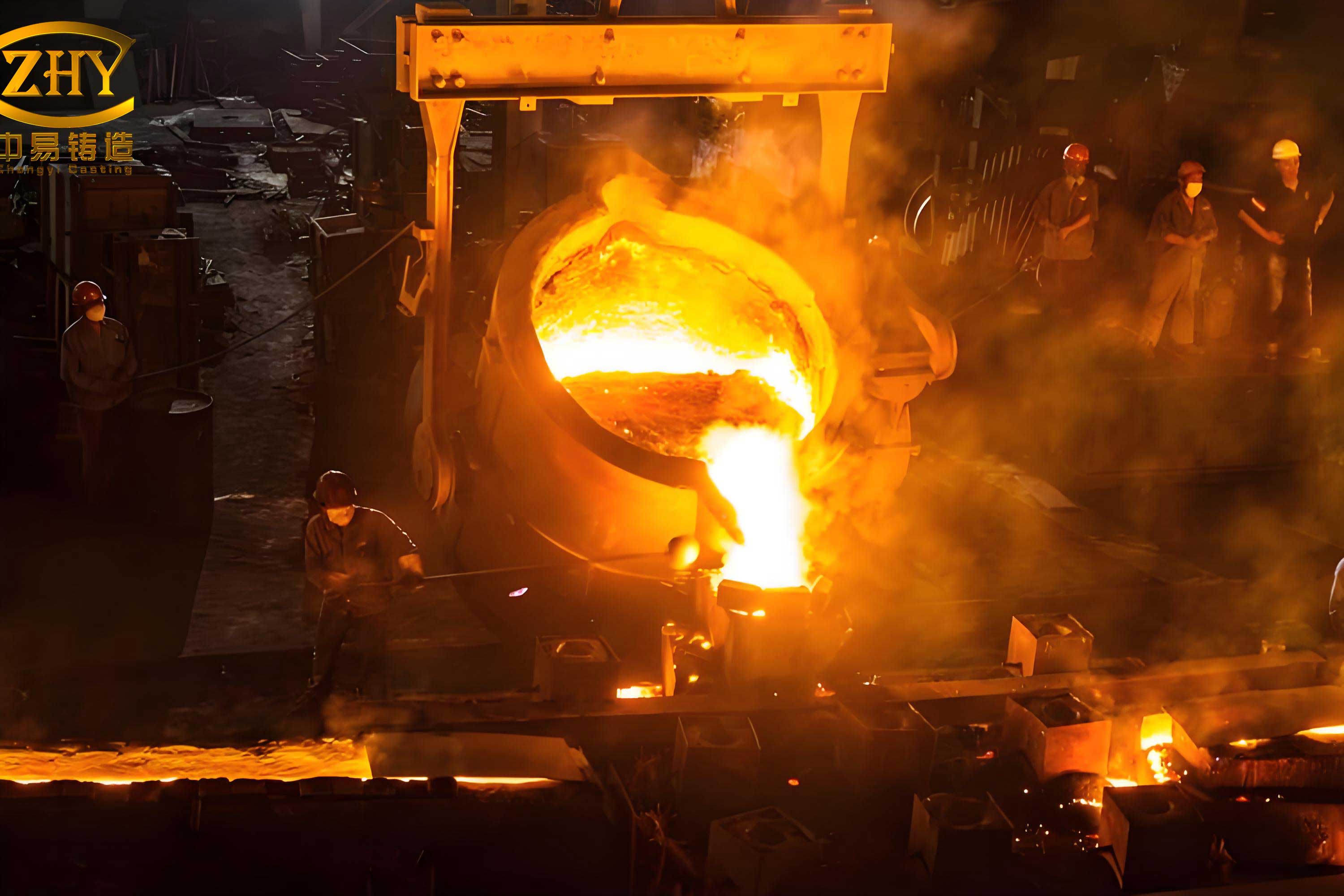
The image above showcases typical sand-cast parts, highlighting the complexity and precision achievable with sand casting techniques. In my work, such parts include liners and blades for concrete mixers, produced via graphite sand casting to integrate wear-resistant surfaces. The visual reference underscores the practicality of this sand casting method in manufacturing functional components.
Further analysis involved metallographic examination of the composite layer. Using optical and scanning electron microscopy, I observed a microstructure consisting of ledeburite (eutectic carbide-austenite mixture) at the surface, transitioning to pearlite and ferrite in the core. The formation of hard phases like cementite (Fe3C) and alloy carbides (e.g., Cr7C3) contributes to the high wear resistance. The volume fraction of carbides, \( V_c \), in the composite layer can be estimated from the carbon content derived from sand casting carburization:
$$ V_c = \frac{C_{\text{total}} – C_{\text{solubility}}}{C_{\text{carbide}} – C_{\text{solubility}}} \times 100\% $$
where \( C_{\text{total}} \) is the total carbon content at the surface (e.g., 2.5-3.5% from graphite sand diffusion), \( C_{\text{solubility}} \) is the carbon solubility in austenite at the eutectic temperature (about 2.1%), and \( C_{\text{carbide}} \) is the carbon content in cementite (6.67%). For typical values, \( V_c \) ranges from 15% to 25%, ensuring a dense network of carbides for abrasion resistance. This microstructure is a direct result of the sand casting process with graphite sand, which provides a carbon source at the mold-metal interface.
In terms of mechanical performance, I evaluated the impact toughness of the core region using Charpy tests. The results showed energy absorption values of 20-30 J at room temperature, indicating good ductility and fracture resistance. This is crucial for parts subjected to impact loads in concrete mixers. The combination of a hard surface and tough core, achieved through sand casting, addresses the brittleness issues associated with monolithic high-chromium cast iron. The sand casting process allows for tailored properties by adjusting parameters like sand composition, pouring temperature, and cooling rate.
To optimize the sand casting process, I conducted a series of experiments varying graphite sand purity, binder content, and pouring techniques. A key finding was that increasing graphite content in the sand mixture enhances carburization depth but may reduce mold strength. A balance was struck by using high-purity graphite sand (95% carbon) with clay and bentonite additives. The mold hardness, measured using a shore scleroscope, was maintained at 70-80 units to withstand metal pressure during pouring. The sand casting molds were designed with appropriate gating and risering systems to ensure sound castings without shrinkage defects. Computational simulations of fluid flow and solidification could further refine sand casting designs, but my work relied on empirical trials.
The application of these sand-cast composites in concrete mixers was validated through field trials. Liners and blades produced via graphite sand casting were installed in industrial mixers and monitored over thousands of cycles. Performance data indicated a service life comparable to or exceeding that of high-chromium cast iron parts, with no reported failures due to brittleness. The economic analysis revealed cost savings of 20-30% compared to traditional materials, owing to lower alloy content and simplified heat treatment. The sand casting method proves to be a cost-effective solution for mass-producing wear-resistant components.
In discussing the broader implications, graphite sand casting opens avenues for surface engineering of steel parts. Unlike conventional coating or cladding techniques, this sand casting approach integrates the composite layer during the initial shaping process, reducing post-processing steps. The carburization effect is inherent to the sand casting with graphite sand, making it a one-step method for producing gradient materials. Potential applications extend beyond concrete mixers to mining equipment, agricultural machinery, and other sectors requiring abrasion resistance. Future research could explore alloy modifications, such as adding vanadium or niobium for finer carbides, or combining sand casting with subsequent thermochemical treatments.
From a theoretical perspective, the kinetics of carbon diffusion in graphite sand casting can be modeled using the Arrhenius equation for diffusion coefficient:
$$ D = D_0 \exp\left(-\frac{Q}{RT}\right) $$
where \( D_0 \) is the pre-exponential factor, \( Q \) is the activation energy for carbon diffusion in austenite (e.g., 142 kJ/mol), \( R \) is the gas constant, and \( T \) is the absolute temperature. For sand casting at 1600°C (1873 K), \( D \) is approximately 1.5 × 10⁻¹¹ m²/s, leading to diffusion depths on the order of millimeters over typical solidification times (minutes). This aligns with my experimental measurements. The sand casting process thus leverages high-temperature exposure to drive diffusion, unlike low-temperature carburizing methods.
In conclusion, my research demonstrates that graphite sand casting is a viable and efficient method for manufacturing steel surface composites with enhanced wear resistance for concrete mixer components. The sand casting technique utilizes graphite sand’s carburizing ability to create a hard, white iron surface layer while preserving a ductile steel core. Key advantages include reduced brittleness, lower production costs, and simplified processing compared to high-chromium cast iron. The repeated application of sand casting in this context underscores its versatility and potential for industrial adoption. Through careful control of sand composition, pouring parameters, and mold design, sand casting can yield parts that meet rigorous service demands. I recommend further exploration of graphite sand casting for other alloy systems and complex geometries to expand its utility in wear-resistant applications.
To summarize the critical parameters in a concise format, Table 4 provides an overview of the optimal sand casting conditions derived from my study. This table serves as a quick reference for practitioners interested in implementing this method.
| Parameter | Recommended Range | Notes |
|---|---|---|
| Graphite Sand Purity | >95% C | Higher purity enhances carburization |
| Sand Mixture (by weight) | 100% graphite sand, 8-10% clay, 4-6% bentonite, 4-5% water | Ensures mold strength and permeability |
| Pouring Temperature | 1550-1600°C | Balances carburization depth and defect minimization |
| Mold Baking Temperature | 250°C | For dry sand molds to remove moisture |
| Cooling Rate | Moderate (air cooling) | Promotes gradient microstructure formation |
| Composite Layer Depth | 4-8 mm | Sufficient for wear resistance without compromising core properties |
| Surface Hardness (HRC) | 58-65 | After heat treatment, comparable to high-chromium iron |
| Core Toughness (Charpy Impact) | 20-30 J | Ensures resistance to impact fractures |
Finally, the success of this sand casting approach hinges on understanding the interplay between material science and casting engineering. By integrating formulas for diffusion, hardness gradients, and microstructure evolution, I have provided a framework for optimizing graphite sand casting processes. The repeated emphasis on sand casting throughout this article highlights its centrality in achieving desired composite properties. As industries seek sustainable and cost-effective manufacturing solutions, graphite sand casting stands out as a promising technique for producing advanced wear-resistant materials.