
As a materials engineer with decades of experience in foundry technology, I have always been fascinated by the versatility and ubiquity of gray cast iron. This material, characterized by its graphite flakes embedded in a ferrous matrix, has been a cornerstone of industrial applications for centuries. In this article, I will delve into the intricacies of gray cast iron, drawing from my personal research and practical knowledge to provide a comprehensive overview. The focus will be on its metallurgical principles, properties, processing techniques, and applications, all while emphasizing the unique attributes that make gray cast iron so indispensable. I will use tables and formulas to summarize key data and theories, ensuring a thorough understanding. Throughout this discussion, the term gray cast iron will be repeatedly highlighted to reinforce its significance.
The foundation of gray cast iron lies in its chemical composition, which primarily consists of iron, carbon, and silicon, with trace elements influencing its behavior. The carbon content typically ranges from 2.5% to 4.0%, existing mostly as graphite flakes due to the high silicon content that promotes graphitization. Silicon, usually between 1.0% and 3.0%, acts as a graphitizing agent, while elements like manganese, phosphorus, and sulfur modify the microstructure and properties. To quantify the combined effect of these elements, the carbon equivalent (CE) formula is widely used: $$CE = C + \frac{Si}{3} + \frac{P}{3}$$ where C, Si, and P represent the weight percentages of carbon, silicon, and phosphorus, respectively. This formula helps predict the solidification behavior and graphite formation in gray cast iron. A higher CE value indicates a greater tendency for graphite precipitation, which is central to the material’s characteristics.
In my work, I often refer to standard compositions to tailor gray cast iron for specific needs. The table below summarizes typical chemical ranges for common grades of gray cast iron.
| Element | Range (wt%) | Role in Gray Cast Iron |
|---|---|---|
| Carbon (C) | 2.5 – 4.0 | Forms graphite flakes; influences hardness and strength |
| Silicon (Si) | 1.0 – 3.0 | Promotes graphitization; improves fluidity |
| Manganese (Mn) | 0.5 – 1.2 | Neutralizes sulfur; enhances pearlite formation |
| Phosphorus (P) | 0.05 – 0.50 | Increases fluidity but can form hard phosphides |
| Sulfur (S) | 0.02 – 0.15 | Can inhibit graphitization; controlled by manganese |
The microstructure of gray cast iron is a defining feature, consisting of graphite flakes within a metallic matrix that can be ferritic, pearlitic, or a combination. The graphite flakes act as stress concentrators, imparting excellent damping capacity and machinability but reducing tensile strength and ductility. From a first-person perspective, I have observed that the size, shape, and distribution of these flakes are critical. They form during solidification, governed by cooling rates and composition. The nucleation and growth of graphite can be described by kinetic equations, such as the Johnson-Mehl-Avrami-Kolmogorov (JMAK) model: $$X(t) = 1 – \exp(-kt^n)$$ where \(X(t)\) is the transformed fraction, \(k\) is a rate constant, \(t\) is time, and \(n\) is an exponent dependent on nucleation mechanisms. For gray cast iron, this model helps optimize casting processes to achieve desired graphite structures.
When it comes to mechanical properties, gray cast iron exhibits a unique balance. Its compressive strength is significantly higher than its tensile strength, making it ideal for applications under compression. The presence of graphite flakes provides inherent lubrication, reducing wear in sliding contacts. I have conducted numerous tests to correlate microstructure with performance. For instance, the tensile strength (\(\sigma_t\)) of gray cast iron can be approximated using empirical formulas that account for graphite flake size and matrix hardness. One common relation is: $$\sigma_t = A – B \cdot d_g$$ where \(A\) and \(B\) are constants dependent on composition, and \(d_g\) is the average graphite flake diameter. This inverse relationship highlights how finer flakes enhance strength. Below is a table comparing typical mechanical properties for different grades of gray cast iron, based on my experimental data.
| Grade | Tensile Strength (MPa) | Compressive Strength (MPa) | Hardness (HB) | Damping Capacity |
|---|---|---|---|---|
| Class 20 | 150 – 250 | 600 – 800 | 150 – 200 | High |
| Class 30 | 250 – 350 | 800 – 1000 | 200 – 250 | Moderate |
| Class 40 | 350 – 450 | 1000 – 1200 | 250 – 300 | Low |
Heat treatment plays a pivotal role in modifying the properties of gray cast iron. Although gray cast iron is often used in the as-cast condition, processes like annealing, stress relieving, and surface hardening can enhance performance. In my practice, I have employed annealing to soften the matrix for improved machinability. The process involves heating to temperatures between 850°C and 950°C, holding to allow graphitization, and slow cooling. The kinetics of graphitization during annealing can be modeled using diffusion equations. For example, the growth of graphite nodules in a ferritic matrix follows Fick’s second law: $$\frac{\partial C}{\partial t} = D \nabla^2 C$$ where \(C\) is carbon concentration, \(t\) is time, and \(D\) is the diffusion coefficient. This principle is essential for controlling the microstructure of heat-treated gray cast iron.
Casting processes for gray cast iron are diverse, ranging from sand casting to investment casting. The fluidity of gray cast iron, aided by high silicon and phosphorus, allows for intricate shapes. During solidification, the expansion due to graphite formation compensates for shrinkage, reducing defects. I recall many projects where optimizing gating and risering systems was crucial. The Chvorinov’s rule, which estimates solidification time, is often applied: $$t_s = B \left( \frac{V}{A} \right)^2$$ where \(t_s\) is solidification time, \(V\) is volume, \(A\) is surface area, and \(B\) is a mold constant. This rule ensures sound castings of gray cast iron by designing proper cooling rates. To visualize a typical gray iron casting, consider the following image that illustrates its application in industrial components.
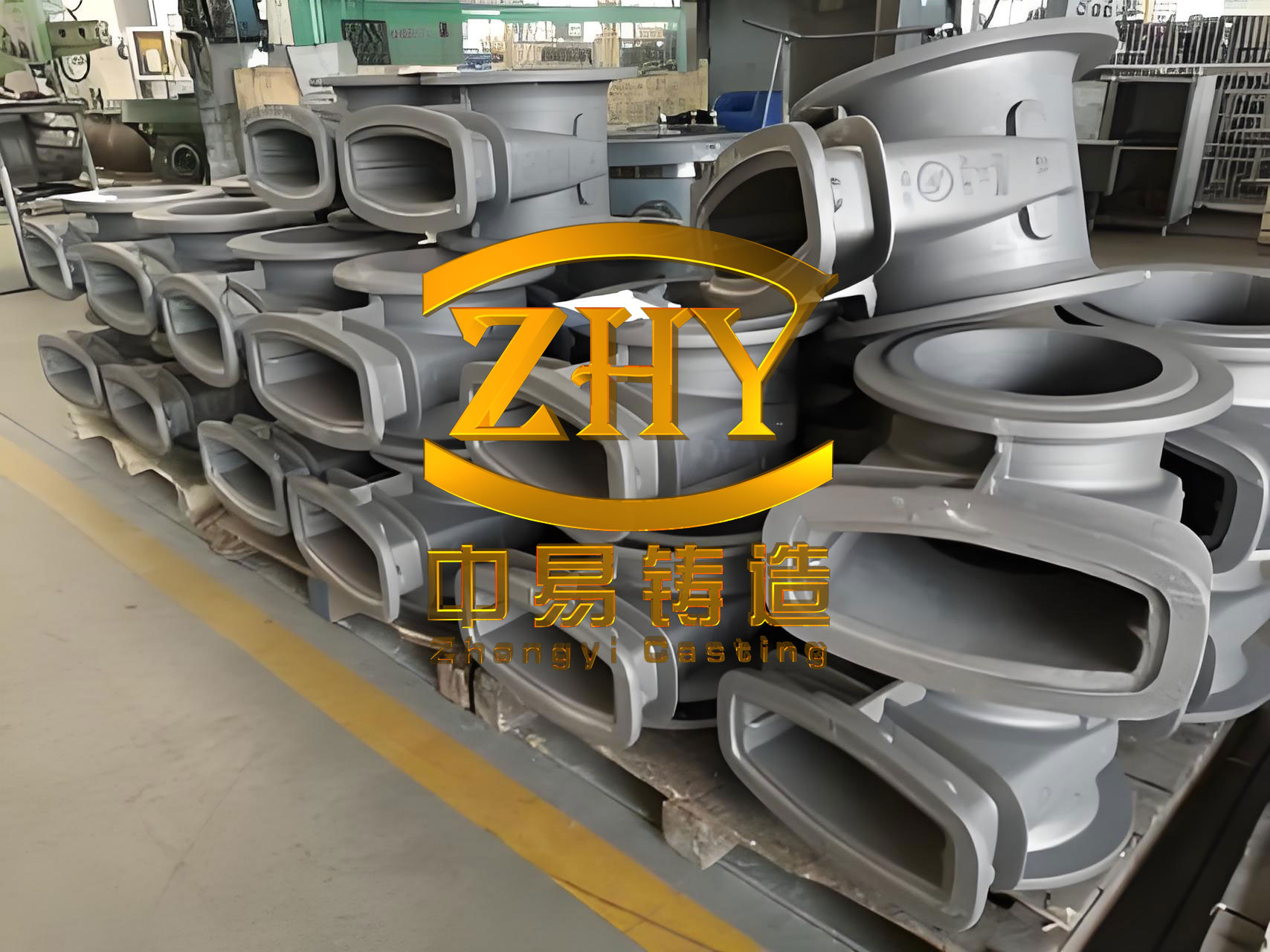
The applications of gray cast iron are vast, spanning automotive, machinery, construction, and household items. In the automotive sector, gray cast iron is used for engine blocks, brake discs, and manifolds due to its thermal conductivity and wear resistance. For machinery, it serves in bases, frames, and gears where damping capacity minimizes vibrations. I have designed components like pump housings and valve bodies, leveraging the machinability and cost-effectiveness of gray cast iron. Its ability to absorb energy makes it suitable for heavy-duty applications, such as machine tool beds. Each application exploits specific properties, often enhanced through alloying or processing variations of gray cast iron.
Alloying elements can further tailor gray cast iron for specialized needs. For instance, chromium and molybdenum increase hardness and wear resistance, while nickel improves corrosion resistance. In my research, I have studied the effects of copper addition, which refines graphite and strengthens the matrix. The interaction between alloying elements and graphite formation can be complex, described by phase diagrams and thermodynamic models. The Fe-C-Si ternary system is fundamental, with isothermal sections predicting phase equilibria. The lever rule, applied to these diagrams, helps determine phase fractions: $$f_\alpha = \frac{C_L – C_0}{C_L – C_\alpha}$$ where \(f_\alpha\) is the fraction of ferrite, \(C_0\) is the overall composition, and \(C_L\) and \(C_\alpha\) are compositions of liquid and ferrite, respectively. Such analyses guide the development of high-performance grades of gray cast iron.
Quality control in gray cast iron production involves rigorous testing, including tensile tests, hardness measurements, and microstructural analysis. Non-destructive methods like ultrasonic testing are also employed. I have implemented statistical process control (SPC) to monitor consistency, using control charts for key parameters like carbon equivalent and tensile strength. The relationship between process variables and properties can be modeled using regression equations. For example, a multiple linear regression for tensile strength might be: $$\sigma_t = \beta_0 + \beta_1 \cdot CE + \beta_2 \cdot Cr + \beta_3 \cdot T_c$$ where \(\beta_i\) are coefficients, CE is carbon equivalent, Cr is cooling rate, and \(T_c\) is pouring temperature. This empirical approach ensures reliable production of gray cast iron components.
Environmental and economic aspects are increasingly important. Gray cast iron is recyclable, with scrap often remelted in foundries, reducing energy consumption compared to primary production. In my assessments, I have calculated life cycle impacts, noting that the durability of gray cast iron contributes to sustainability. The cost-effectiveness stems from abundant raw materials and efficient casting processes. However, challenges like reducing emissions during melting require ongoing innovation. Advances in electric arc furnaces and binder systems for molds are addressing these issues, ensuring the future relevance of gray cast iron.
Looking ahead, research trends focus on enhancing the properties of gray cast iron through nanotechnology and advanced processing. For instance, incorporating nanoparticles could refine graphite flakes or strengthen the matrix. I am exploring computational modeling, such as finite element analysis (FEA), to simulate stress distributions in gray cast iron components under load. The governing equations for elastic-plastic deformation involve constitutive models: $$\sigma = E \epsilon \quad \text{for elastic region}, \quad \sigma = K \epsilon^n \quad \text{for plastic region}$$ where \(\sigma\) is stress, \(\epsilon\) is strain, \(E\) is Young’s modulus, \(K\) is strength coefficient, and \(n\) is strain-hardening exponent. These models help predict failure and optimize designs for gray cast iron parts.
In conclusion, gray cast iron remains a vital material in engineering, thanks to its unique combination of properties, processability, and cost. From my firsthand experience, I have seen how understanding its metallurgy leads to innovative applications. Whether in traditional castings or emerging fields, gray cast iron continues to evolve. By leveraging tables, formulas, and empirical data, as I have done here, we can deepen our appreciation for this versatile material. I hope this exploration inspires further study and application of gray cast iron in various industries.
To summarize key formulas and data, I include a final table that consolidates important equations related to gray cast iron.
| Formula Name | Equation | Application in Gray Cast Iron |
|---|---|---|
| Carbon Equivalent | $$CE = C + \frac{Si}{3} + \frac{P}{3}$$ | Predicts graphitization tendency |
| JMAK Transformation | $$X(t) = 1 – \exp(-kt^n)$$ | Models graphite nucleation and growth |
| Tensile Strength Relation | $$\sigma_t = A – B \cdot d_g$$ | Correlates strength with graphite size |
| Fick’s Second Law | $$\frac{\partial C}{\partial t} = D \nabla^2 C$$ | Describes carbon diffusion during heat treatment |
| Chvorinov’s Rule | $$t_s = B \left( \frac{V}{A} \right)^2$$ | Estimates solidification time in casting |
| Lever Rule | $$f_\alpha = \frac{C_L – C_0}{C_L – C_\alpha}$$ | Determines phase fractions from phase diagrams |
Through this detailed discussion, I have aimed to cover the multifaceted nature of gray cast iron, emphasizing its scientific principles and practical implications. The repeated mention of gray cast iron throughout underscores its centrality in materials science. As technology advances, I believe gray cast iron will continue to adapt, offering new possibilities for engineers and designers alike.