
In the production of high manganese steel casting, the density and integrity of the cast components are critical factors that directly impact their wear resistance and service life. As a key material in applications requiring high durability, such as mining and construction equipment, high manganese steel casting must be free from defects like shrinkage cavities and porosity, particularly in areas subjected to intense wear. To address this, we have collaborated with academic institutions to develop a specialized solidification simulation software tailored for high manganese steel casting. This software enables us to optimize the casting process design through precise temperature field analysis, ensuring superior performance in real-world conditions.
The development of this simulation tool was driven by the need to enhance the quality of high manganese steel casting. The software comprises three main modules: pre-processing, simulation computation, and post-processing. In the pre-processing module, we handle tasks such as 3D model visualization of the high manganese steel casting, including rotation, scaling, translation, material selection, and light rendering. We employ an STL-based solid model for automatic mesh generation, which divides the casting model into discrete elements for accurate analysis. The simulation computation module takes the pre-processed data and incorporates various parameters to simulate the temperature field during the solidification of high manganese steel casting. Finally, the post-processing module visually displays the results, showing the temperature distribution at different stages of solidification, which helps identify potential defects early in the design phase.
To illustrate the application of this software, we focused on a specific high manganese steel casting component—a jaw plate or similar wear part. The material used is ZGMn13-1, a common grade in high manganese steel casting, with key thermal properties summarized in the tables below. The liquidus temperature is 1400°C, the solidus temperature is 1350°C, and the latent heat of solidification is 277 J/g. The density varies from 7.930 g/cm³ at room temperature to 7.050 g/cm³ at 1460°C. The specific heat capacity and thermal conductivity of ZGMn13-1 across different temperature ranges are detailed in Table 1 and Table 2, respectively. These parameters are essential for accurate simulation of high manganese steel casting processes.
| Temperature Range / °C | Specific Heat Capacity / J·(g·°C)⁻¹ |
|---|---|
| 50–100 | 0.519 |
| 150–200 | 0.569 |
| 350–400 | 0.607 |
| 550–600 | 0.703 |
| 750–800 | 0.650 |
| 950–1000 | 0.674 |
| 1200 | 0.837 |
| Temperature / °C | Thermal Conductivity / J·(cm·s·°C)⁻¹ |
|---|---|
| 0 | 0.12979 |
| 200 | 0.16329 |
| 400 | 0.19259 |
| 600 | 0.21771 |
| 800 | 0.23446 |
| 1000 | 0.25539 |
In addition to the high manganese steel casting material itself, the mold materials play a crucial role in the solidification process. For lost foam casting, which is commonly used in high manganese steel casting, we employ silica sand as the molding medium. The density of silica sand is 1.73 g/cm³, and its specific heat capacity and thermal conductivity vary with temperature. The specific heat capacity is given by the following equations, where T is in Kelvin (K):
For T ≤ 846 K:
$$ c = 0.782 + 5.71 \times 10^{-4} T – \frac{1.88 \times 10^{4}}{T^{2}} $$
For T > 846 K:
$$ c = 1.00 + 1.35 \times 10^{-4} T $$
The thermal conductivity of silica sand is described by:
$$ \lambda = 6.04 \times 10^{-3} – 7.67 \times 10^{-6} T + 7.95 \times 10^{-9} T^{2} $$
For traditional sand casting methods in high manganese steel casting, we use water glass sand, specifically magnesia olivine sand, with a density of 1.83 g/cm³. The specific heat capacity and thermal conductivity are defined as:
$$ c = 1.02 + 1.94 \times 10^{-4} T – \frac{2.36 \times 10^{4}}{T^{2}} $$
$$ \lambda = 7.13 \times 10^{-3} + 3.49 \times 10^{-2} T $$
Chills, often made of gray iron, are incorporated in high manganese steel casting to control solidification rates. The density of gray iron is 7.0 g/cm³, and its thermal properties are summarized in Table 3. These chills help in directing heat flow, reducing the risk of defects in critical areas of high manganese steel casting.
| Temperature / K | Specific Heat Capacity / J·(g·K)⁻¹ | Thermal Conductivity / J·(cm·s·K)⁻¹ |
|---|---|---|
| 293 | 0.536 | 0.654 |
| 473 | 0.561 | 0.520 |
| 673 | 0.586 | 0.395 |
| 1073 | 0.793 | 0.300 |
| 1273 | 0.723 | 0.223 |
Using the developed software, we simulated the solidification temperature field for a high manganese steel casting component, such as a jaw plate, without considering the thermal effects of the gating system. The 3D model was created using SolidWorks and exported as an STL file for analysis. The simulation results at various solidification times revealed that the outer regions near the mold cavity solidify first, while the last areas to solidify are typically the thicker sections, especially near internal features like ears. This insight is vital for optimizing the high manganese steel casting process to prevent defects.
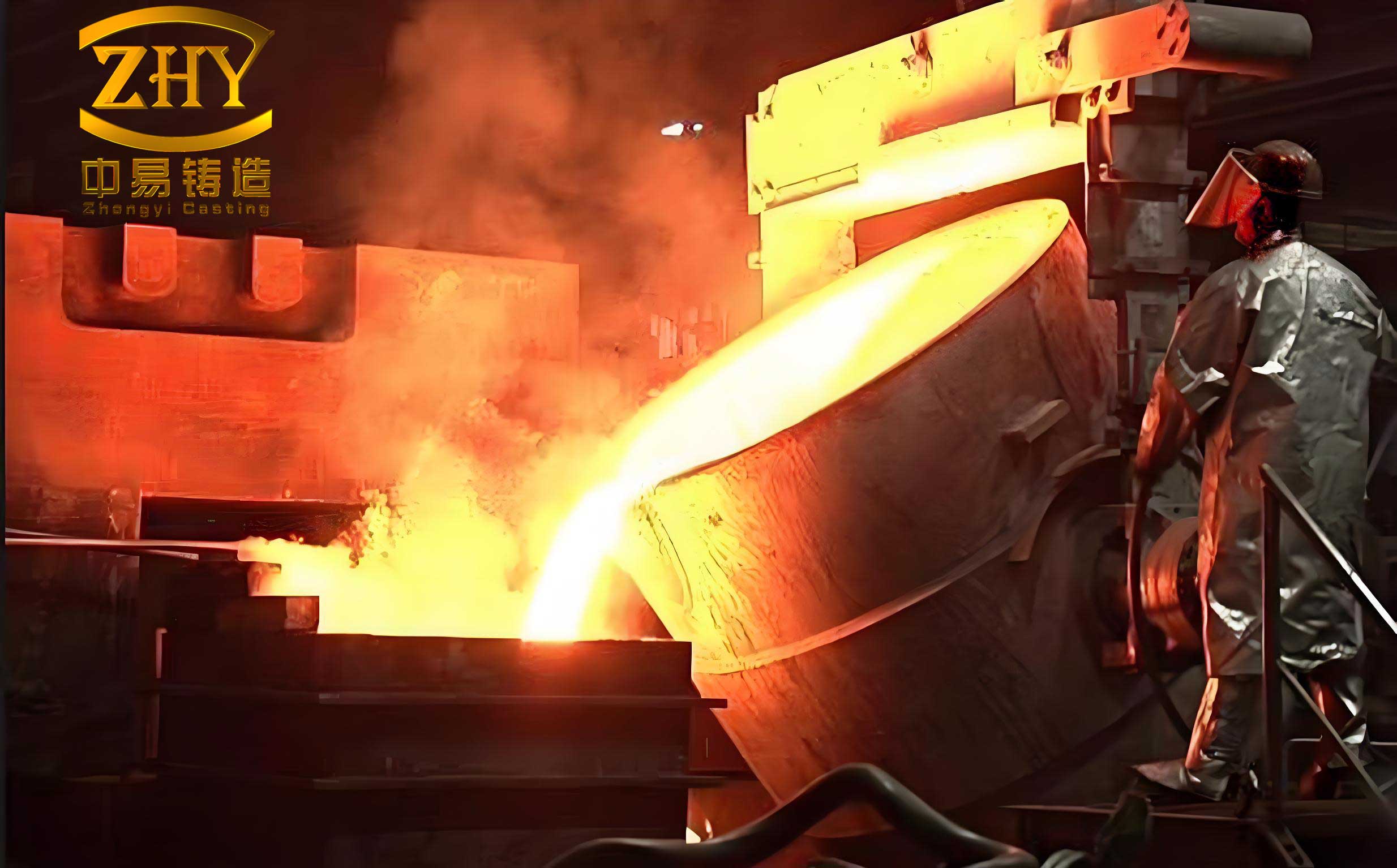
The application of this advanced control method has significantly improved the production of high manganese steel casting. By leveraging solidification simulation, we can design casting processes that minimize shrinkage and porosity, leading to enhanced wear resistance. For instance, in practical applications, high manganese steel casting components produced with this approach have demonstrated extended service life in abrasive environments. Comparative studies show that optimized high manganese steel casting can achieve up to 100% improvement in longevity compared to conventional methods, underscoring the importance of precise thermal management.
Furthermore, the integration of digital technologies in high manganese steel casting allows for continuous refinement. We have optimized parameters such as pouring temperature, cooling rates, and chill placement based on simulation feedback. This not only improves the microstructure of high manganese steel casting, resulting in a purer and denser matrix, but also enhances safety and reliability in operation. The economic benefits are substantial, as evidenced by case studies where high manganese steel casting parts outperformed alternatives in terms of cost-effectiveness and durability.
In conclusion, the casting process plays a pivotal role in determining the wear resistance of high manganese steel casting. Through the development and application of solidification simulation software, we have achieved greater control over the production of high manganese steel casting, leading to fewer defects and superior performance. The use of detailed thermal property data, combined with advanced modeling techniques, enables us to push the boundaries of high manganese steel casting quality. As we continue to innovate, high manganese steel casting will remain a cornerstone in industries demanding high wear resistance, driven by data-driven process optimizations.