
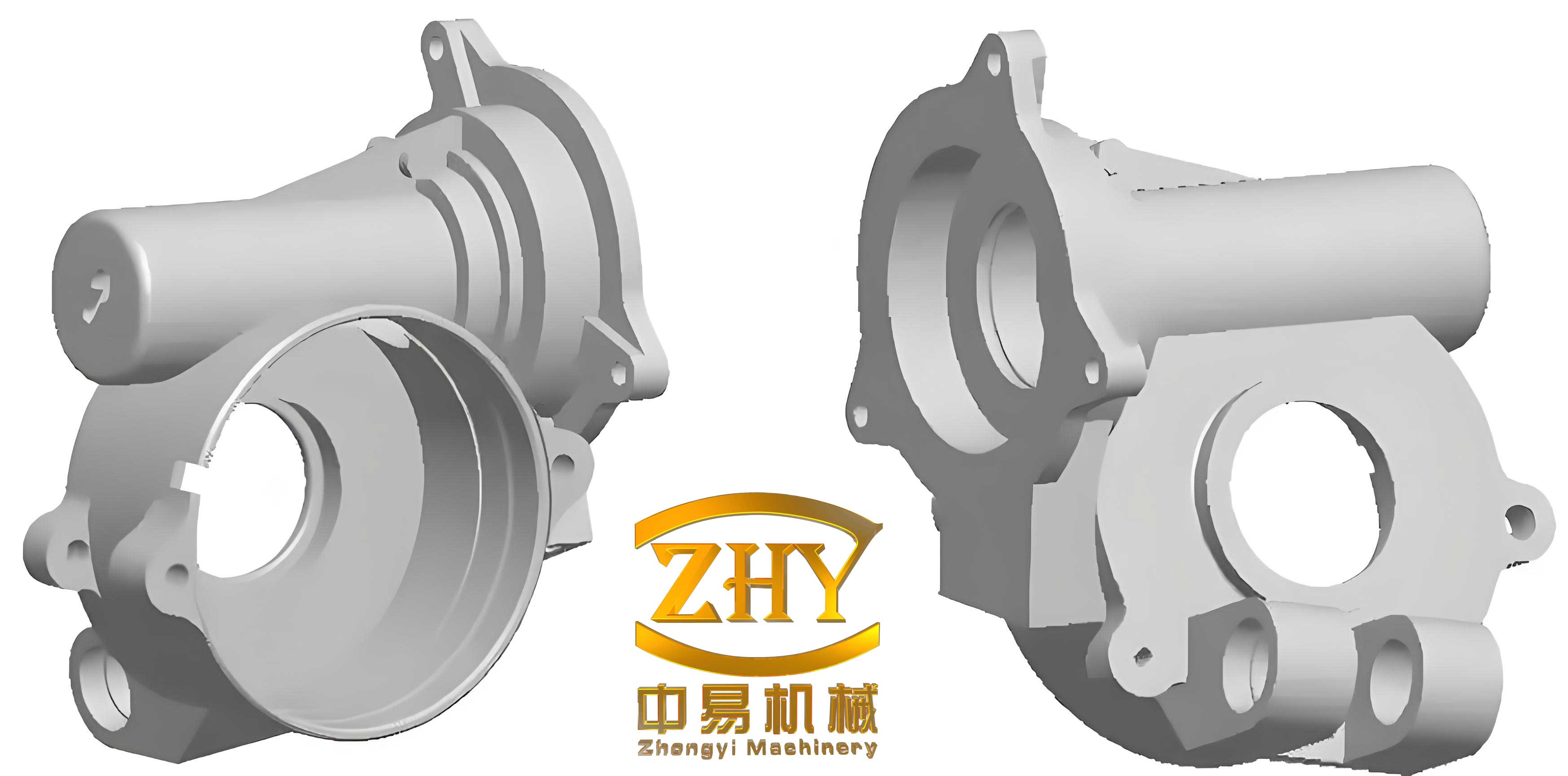
In my extensive experience with advanced casting techniques, the lost foam process has proven to be a transformative method for producing complex shell castings, such as automotive gearbox housings. Since its inception in the mid-20th century, lost foam casting has gained prominence due to its ability to yield precise dimensions, smooth surfaces, cost-effectiveness, and improved working conditions. For shell castings like gearboxes, which require intricate geometries and high structural integrity, this process offers distinct advantages over traditional methods. In this article, I will delve into the detailed工艺 parameters, common defects, and innovative solutions based on practical applications, emphasizing the critical role of proper design and control. Throughout, I will highlight key aspects of shell castings production, using tables and formulas to summarize data and principles.
The foundation of successful lost foam casting for shell castings lies in the浇注 system design. Unlike conventional casting, where core placement constraints dictate浇注 placement, lost foam allows greater freedom, but this necessitates careful analysis to avoid defects. Initially, I explored two浇注 systems for gearbox shell castings. The first was a阶梯式 system, where metal enters from both top and bottom gates. However, this led to cold shuts and wrinkle-like defects on the shell castings surfaces, as the two metal streams converged at cooler regions, trapping decomposed foam residues. The second system, a底注式 design, proved more effective. Here, two内浇道 connect to the internal bottom of the shell castings, reducing浇注 time and minimizing冲刷 force on the coating. This setup directs metal flow to converge at the shell castings’ end, where a冒口 is placed for slag collection. The comparison below summarizes the two approaches:
| 浇注 System Type | 内浇道 Location | Advantages | Disadvantages | Suitability for Shell Castings |
|---|---|---|---|---|
| Stepped (Top and Bottom) | Top and bottom of shell castings | Potential for even filling | High risk of cold shuts and carbon defects | Low |
| Bottom-Gated | Internal bottom of shell castings | Reduced冲刷, better slag control, shorter浇注 time | Requires precise positioning | High |
To optimize the底注式 system, I consider fluid dynamics principles. The metal flow rate \( Q \) can be expressed using the Bernoulli equation adapted for lost foam:
$$ Q = A \sqrt{\frac{2gH}{\xi}} $$
where \( A \) is the cross-sectional area of the内浇道, \( g \) is gravitational acceleration, \( H \) is the metallostatic head, and \( \xi \) is a loss coefficient accounting for foam decomposition. For shell castings, maintaining \( Q \) within 10-15 seconds per piece ensures proper foam gasification without defects.
Beyond the浇注 system, other工艺 parameters are crucial for high-quality shell castings. The sand selection involves using silica sand with an AFS fineness of 25-30, permeability of 13.5–16.5 cm²/Pa·min, and严格控制 temperature and moisture. The coating process employs a water-based涂料, applied manually in two layers and dried at 50±5°C for 15–20 hours. For molding, a rain-style sand filling method is used in 1200 mm × 1000 mm × 900 mm boxes, often with multiple shell castings per box. Vibration compaction on a 3D table with amplitude 0.5–1.0 mm and frequency 40–80 Hz ensures dense sand packing. Melting is done in a 3-ton medium-frequency furnace, with raw materials like pig iron, ferrosilicon, ferromanganese, scrap steel, and returns. The metal is tapped at 1520°C and poured at 1420–1480°C, following a slow-fast-slow sequence to prevent反喷. Key parameters are summarized below:
| Parameter Category | Specific Value/Range | Impact on Shell Castings |
|---|---|---|
| Sand Properties | AFS 25-30, permeability 13.5-16.5 cm²/Pa·min, moisture ≤3%, temperature ≤45°C | Ensures proper gas evacuation and mold stability |
| Coating Process | Two-layer manual application, drying at 50±5°C for 15-20 h | Prevents metal penetration and improves surface finish |
| Vibration Compaction | Amplitude 0.5-1.0 mm, frequency 40-80 Hz | Enhances sand density around shell castings |
| Melting and Pouring | Tapping at 1520°C, pouring at 1420-1480°C, slow-fast-slow rhythm | Minimizes defects like反喷 and cold shuts |
| Vacuum Pressure | -55 to -40 kPa | Aids in removing decomposition gases |
The relationship between pouring temperature \( T_p \) and foam decomposition rate \( R_d \) is critical for shell castings. I model it as:
$$ R_d = k e^{-\frac{E_a}{RT_p}} $$
where \( k \) is a pre-exponential factor, \( E_a \) is the activation energy for foam pyrolysis, \( R \) is the gas constant, and \( T_p \) is in Kelvin. Higher \( T_p \) accelerates decomposition but risks excessive gas generation, so balancing this with浇注 speed is key.
Common defects in lost foam casting of shell castings require targeted solutions. The first issue is pattern deformation, which occurs during coating, handling, or vibration due to the large, complex geometry of shell castings. I evaluated three reinforcement methods. The first used a steel frame around the pattern, but it caused bonding issues and清理 difficulties. The second involved gluing foam strips to weak areas, but this wasted metal and complicated cleaning. The third, using bamboo strips glued to low-strength zones before coating, proved most effective. This approach分散 stress and maintains dimensional accuracy for shell castings without interfering with metal flow. The effectiveness can be quantified by the deformation reduction factor \( \delta \):
$$ \delta = \frac{D_0 – D_r}{D_0} \times 100\% $$
where \( D_0 \) is initial deformation without reinforcement, and \( D_r \) is with bamboo strips. In practice, \( \delta \) exceeds 80% for gearbox shell castings.
The second major defect is burn-on or粘砂, where metal penetrates the coating into sand, often at hot spots or corners of shell castings. Causes include coating cracking, insufficient sand compaction, inadequate drying, low vacuum, improper浇注 location, high pouring temperature, or weak涂料. To address this, I developed a method where a specially formulated self-curing resin sand (labeled Type I) is spread inside the coated and dried pattern, with thicker layers in corners and dead zones. This barrier enhances耐火度 and prevents metal penetration. The resin sand’s performance can be expressed by its耐火度 index \( I_r \):
$$ I_r = \frac{T_m – T_d}{\sigma_c} $$
where \( T_m \) is the metal temperature, \( T_d \) is the decomposition temperature of the resin sand, and \( \sigma_c \) is the coating strength. For Type I sand, \( I_r > 5 \) ensures minimal粘砂 in shell castings.
The third defect, carbon defects, is unique to lost foam casting and accounts for about 50% of issues in shell castings. It manifests as black inclusions on surfaces, resulting from incomplete foam pyrolysis when metal advance outpaces gasification. Factors influencing this include pattern material, pouring parameters,浇注 system design, chemistry, sand permeability, and vacuum. For shell castings, I recommend using EPS foam with carbon content \( w(C) = 92\% \), but additives like benzoquinone can promote decomposition. Pouring temperature should be 30–80°C higher than in sand casting, at 1420–1480°C, with浇注 time of 10–15 seconds. The浇注 system should be底注式 with a top冒口. Chemical composition should minimize碳 content, and vacuum maintained at -55 to -40 kPa. The carbon defect risk \( R_c \) can be modeled as:
$$ R_c = \frac{w(C) \cdot V_f}{P \cdot T_p \cdot \phi} $$
where \( w(C) \) is pattern carbon content, \( V_f \) is浇注 speed, \( P \) is vacuum pressure, \( T_p \) is pouring temperature, and \( \phi \) is sand permeability. Lower \( R_c \) values below 0.1 indicate reduced defects in shell castings.
To further elaborate on process control, I integrate statistical methods. For instance, the interaction between振动 parameters and sand density \( \rho_s \) affects shell castings quality. The optimal density can be derived from:
$$ \rho_s = \rho_0 \left(1 + \alpha A^2 f\right) $$
where \( \rho_0 \) is initial sand density, \( \alpha \) is a material constant, \( A \) is amplitude, and \( f \) is frequency. For shell castings, \( \rho_s \) should exceed 1.6 g/cm³ to prevent metal penetration. Additionally, the coating thickness \( t_c \) plays a role in insulating the shell castings. I recommend \( t_c \) between 0.5–1.0 mm, calculated as:
$$ t_c = \frac{m_c}{\rho_c A_s} $$
where \( m_c \) is coating mass, \( \rho_c \) is coating density, and \( A_s \) is shell castings surface area.
In terms of metallurgy, the mechanical properties of shell castings are paramount. For gearbox housings, the required tensile strength is >200 MPa, with graphite morphology (A+B type) ≥70% and pearlite ≥95%. Achieving this involves careful control of cooling rates and inoculation. The cooling rate \( \dot{T} \) influences microstructure:
$$ \dot{T} = \frac{T_p – T_s}{t_c} $$
where \( T_s \) is sand temperature, and \( t_c \) is solidification time. For pearlite formation in shell castings, \( \dot{T} \) should be 10–20°C/min. Inoculation practices can be optimized using a fading time model:
$$ C_e = C_0 e^{-\lambda t} $$
where \( C_e \) is effective inoculant concentration, \( C_0 \) is initial concentration, \( \lambda \) is fading coefficient, and \( t \) is time after inoculation. Regular monitoring ensures consistent quality in shell castings.
The production outcomes validate these approaches. Shell castings produced via the optimized lost foam process exhibit tensile strengths exceeding 200 MPa, with microstructures meeting specifications. The graphite distribution and pearlite content are controlled through precise工艺 parameters, ensuring durability and performance in automotive applications. Below is a summary of key performance metrics for shell castings:
| Property | Target Value | Achieved Range | Method of Assurance |
|---|---|---|---|
| Tensile Strength | >200 MPa | 210-230 MPa | Controlled cooling and inoculation |
| Graphite (A+B Type) | ≥70% | 75-85% | Proper foam decomposition and浇注 design |
| Pearlite Content | ≥95% | 96-98% | Optimized cooling rates and chemistry |
Looking beyond individual defects, systemic process integration is essential for shell castings. The lost foam line must coordinate sand handling, coating, molding, melting, and浇注. I emphasize the importance of operator training to avoid human errors, such as improper vibration or pouring sequences. Each step should follow standardized procedure cards, with real-time monitoring of parameters like temperature and vacuum. For shell castings, this holistic approach reduces scrap rates and enhances consistency.
In conclusion, the lost foam casting process for gearbox shell castings demands meticulous attention to浇注 design,工艺 parameters, and defect mitigation. Through innovations like bamboo reinforcement and resin sand layers, along with optimized temperature and vacuum controls, high-quality shell castings can be reliably produced. The use of tables and formulas helps encapsulate complex relationships, aiding in process refinement. As the automotive industry evolves, continued advancements in lost foam technology will further improve the efficiency and quality of shell castings, solidifying this method’s role in modern manufacturing.