
In the development of advanced casting techniques for automotive safety components, the vacuum wheel rim stands out as a critical part in commercial and engineering vehicles. This component, typically made from spheroidal graphite iron, demands high dimensional accuracy, superior surface finish, and excellent mechanical properties to ensure行车 safety and durability. Based on extensive research and practical experience, I have explored the lost foam casting process as a viable solution for producing these complex thin-walled structures. The inherent challenges of traditional casting methods, such as sand molding or resin sand processes, often lead to issues like wall thickness variation, poor surface quality, and increased production costs due to additional coring and machining steps. Through this work, I aim to detail the systematic development of a lost foam casting process tailored for spheroidal graphite iron vacuum wheel rims, emphasizing process optimization, quality enhancement, and cost reduction.
The vacuum wheel rim casting, with an average wall thickness of 10–15 mm and a mass of approximately 60 kg, features a peripheral annular groove and multiple vent holes and mounting holes on the web. This geometry makes it a “small-modulus, large-contour” thin-walled casting, where conventional two-part mold casting struggles due to the undercut groove requiring complex sand cores. Such cores can introduce defects like misalignment, leading to uneven wall thickness—a critical safety concern. Therefore, I determined that the lost foam casting process offers distinct advantages: it eliminates the need for external cores, allows for near-net-shape casting of holes, and improves overall quality through vacuum-assisted filling. This process involves creating an expendable polystyrene (EPS) foam pattern, coating it with refractory material, embedding it in unbonded sand under vibration and vacuum, and pouring molten metal to replace the pattern. The key benefits include enhanced surface finish, precise wall thickness control, and reduced machining, all while leveraging the properties of spheroidal graphite iron for high ductility and strength.
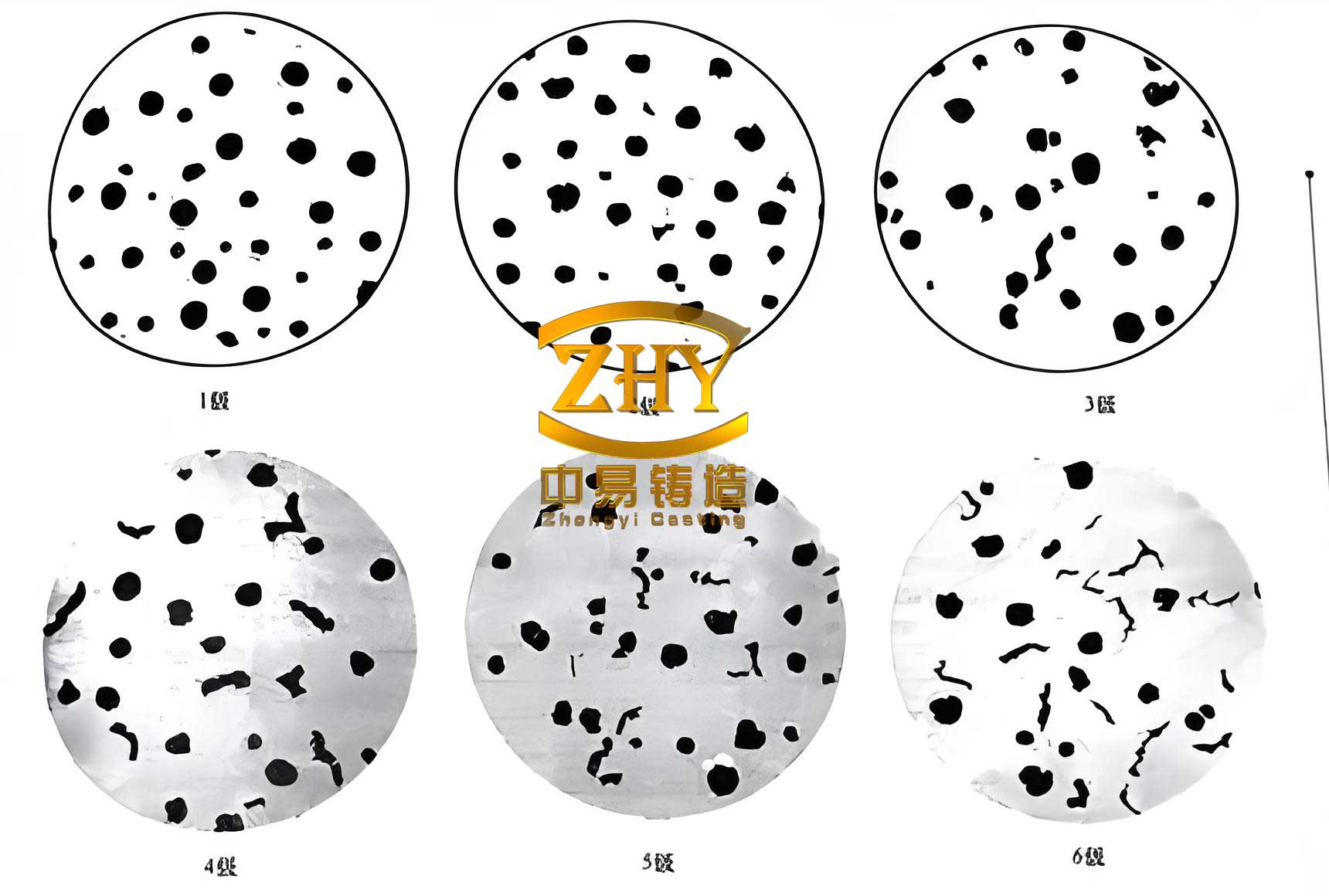
To implement this process, I first analyzed the castability of the vacuum wheel rim design. The material specification QT450-15, a grade of spheroidal graphite iron with minimum tensile strength of 450 MPa and 15% elongation, requires careful control of microstructure to achieve the desired mechanical properties. In lost foam casting, the decomposition of the EPS pattern during pouring can influence the metal flow and solidification, potentially affecting graphite nodularity and matrix structure. Thus, process parameters must be optimized to ensure the integrity of the spheroidal graphite iron. I designed the process to cast the vent holes and valve stem hole directly to final dimensions, eliminating machining steps, while the bolt mounting holes were cast as near-net shapes to minimize machining allowance. This approach not only reduces cost but also improves production efficiency, aligning with the goal of sustainable manufacturing.
The development proceeded through several stages, starting with EPS foam pattern production. Instead of machining from EPS boards, I opted for molded EPS foam patterns to ensure consistency and reduce deformation risks. The pattern density was set at 26–32 g/L to balance strength and gas evolution during pouring. Higher density patterns resist distortion better, especially in the wide轮缘 area where sagging can occur. To prevent deformation, I reinforced the pattern with cross-shaped glass fiber strips bonded at the open rim side before coating. The pattern included all critical features: vent holes, valve stem hole, and pre-formed bolt holes. After molding, any surface imperfections were corrected using patching compounds to ensure a smooth finish.
Next, the assembly of the gating and feeding system was crucial for successful casting. I designed a top-gating system with multiple ingates to ensure uniform filling and minimize turbulence. The gating ratio was calculated to achieve a controlled flow rate, reducing the risk of entrapped gases or slag inclusion. The system included 6–8 risers placed at the top to act as reservoirs for feeding shrinkage during solidification. The overall pattern cluster was assembled by bonding these components using hot-melt adhesive, ensuring robust connections that withstand coating and handling. This step is critical for maintaining dimensional accuracy in the final spheroidal graphite iron casting.
The coating process involved dipping and brushing a water-based quartz sand refractory coating onto the pattern cluster. The coating serves multiple functions: it provides a barrier between the pattern and sand, enhances surface finish, and facilitates the removal of decomposition products. I applied two coats, each dried naturally or at temperatures below 55°C for 8–10 hours to avoid pattern distortion. The coating thickness was controlled to approximately 0.5–1.0 mm, as measured by a thickness gauge. Proper drying is essential to prevent cracks or blisters that could defect the casting. After coating, the pattern cluster was ready for molding in unbonded sand.
For molding, I used zircon sand or similar high-refractoriness aggregates to fill the flask. The sand was vibrated in three dimensions to ensure tight packing around the pattern, especially in intricate areas like the annular groove and holes. Vacuum was applied at 0.04–0.06 MPa during pouring to enhance mold rigidity and improve metal flow. The vacuum-assisted filling helps overcome the limitations of thin-walled sections by increasing the pressure differential, which promotes complete cavity filling and reduces porosity. The solidification of spheroidal graphite iron in such conditions benefits from rapid cooling, leading to a finer microstructure and improved mechanical properties.
To quantify the process parameters, I have summarized key data in the following tables. These tables provide a comprehensive overview of the lost foam casting process for spheroidal graphite iron vacuum wheel rims.
| Parameter | Value | Unit |
|---|---|---|
| Material Grade | QT450-15 (Spheroidal Graphite Iron) | – |
| Cast Weight | 60 | kg |
| Average Wall Thickness | 10–15 | mm |
| Outer Diameter | Approx. 500 | mm |
| Peripheral Groove Depth | 8–10 | mm |
| Number of Vent Holes | 8–12 | – |
| Process Step | Parameter | Value/Range | Remarks |
|---|---|---|---|
| EPS Pattern | Density | 26–32 g/L | Higher density reduces deformation |
| Pattern Reinforcement | Reinforcement Type | Glass Fiber Strips | Cross-shaped at rim opening |
| Coating | Type | Water-based Quartz Sand | Two coats applied |
| Drying | Temperature | <55°C | 8–10 hours per coat |
| Molding Sand | Type | Zircon Sand or宝珠砂 | Unbonded, high refractoriness |
| Vibration | Frequency | 50–60 Hz | 3D vibration for compaction |
| Vacuum Level | Pressure | 0.04–0.06 MPa | Applied during pouring and solidification |
| Pouring Temperature | Iron Temperature | 1380–1420°C | For spheroidal graphite iron |
| Pouring Time | Duration | 15–25 seconds | Depends on gating design |
| Solidification Time | In-mold Time | 2–2.5 hours | Before shakeout |
The pouring of spheroidal graphite iron requires precise temperature control to maintain nodular graphite formation. I used a ladle treatment with magnesium ferrosilicon alloy for spheroidization and inoculation to ensure graphite spheroidization. The pouring temperature was maintained between 1380°C and 1420°C to balance fluidity and minimal gas pickup. During pouring, the vacuum吸附 effect enhances the filling ability, which can be described by the Bernoulli principle modified for porous media flow. The pressure difference ΔP between the mold cavity and atmosphere drives the metal flow, given by:
$$ \Delta P = P_{\text{atm}} – P_{\text{vacuum}} $$
where \( P_{\text{vacuum}} \) is the reduced pressure in the mold, typically 0.04–0.06 MPa below atmospheric. This ΔP increases the effective head pressure, improving the filling of thin sections. The fluid flow velocity v can be approximated using Darcy’s law for flow through the coating layer:
$$ v = \frac{K}{\mu} \frac{\Delta P}{L} $$
where K is the permeability of the coating, μ is the dynamic viscosity of molten spheroidal graphite iron, and L is the thickness of the coating. This relation highlights the importance of coating properties in lost foam casting.
After pouring, the solidification process determines the internal soundness of the casting. For spheroidal graphite iron, the cooling rate affects graphite nodule count and matrix structure. I analyzed the solidification using Chvorinov’s rule to estimate the solidification time t:
$$ t = B \left( \frac{V}{A} \right)^2 $$
where V is the volume of the casting, A is the surface area, and B is the mold constant dependent on sand properties and vacuum conditions. For thin-walled sections like the wheel rim, the V/A ratio is small, leading to rapid solidification. This rapid cooling favors fine graphite nodules and a pearlite-ferrite matrix, enhancing the mechanical properties of spheroidal graphite iron. To further control solidification, I placed chills strategically near thick sections to promote directional solidification and minimize shrinkage porosity.
The results from production trials confirmed the effectiveness of the lost foam process. Castings exhibited excellent surface quality with no visible defects like cold shuts or misruns, thanks to the vacuum-assisted filling. Dimensional inspections showed that the wall thickness variation was within ±0.5 mm, meeting the stringent requirements for safety components. The vent holes and valve stem hole were cast to final dimensions, eliminating machining needs, while the bolt holes required only minimal finishing. Mechanical testing revealed that the spheroidal graphite iron castings achieved the specified properties of QT450-15, as summarized in Table 3.
| Property | Target (QT450-15) | Measured Average | Unit |
|---|---|---|---|
| Tensile Strength | ≥450 | 460–480 | MPa |
| Yield Strength | ≥310 | 320–340 | MPa |
| Elongation | ≥15 | 16–18 | % |
| Hardness (Brinell) | 160–210 | 170–190 | HB |
| Graphite Nodularity | ≥80% | 85–90% | – |
| Nodule Count | 100–150/mm² | 120–140/mm² | nodules/mm² |
Microstructural analysis showed well-formed spheroidal graphite in a ferritic-pearlitic matrix, consistent with the grade requirements. The absence of slag inclusions or gas pores attested to the efficient removal of pattern decomposition products through the coating and vacuum system. The process also demonstrated economic benefits: by casting holes to near-net shape, machining costs were reduced by approximately 30%, and cleaning time was cut by 40% compared to traditional sand casting methods. Furthermore, the use of unbonded sand allows for nearly 100% reclamation, contributing to environmental sustainability.
To optimize the process further, I conducted sensitivity analyses on key parameters. For instance, the EPS pattern density influences the gas generation rate during pouring, which can be modeled using the Arrhenius equation for polymer decomposition:
$$ k = A e^{-E_a/(RT)} $$
where k is the decomposition rate constant, A is the pre-exponential factor, \( E_a \) is the activation energy, R is the gas constant, and T is the temperature. Higher pattern density slows decomposition, reducing the risk of gas defects in the spheroidal graphite iron casting. Similarly, the coating thickness affects heat transfer; too thick a coating can insulate and slow cooling, while too thin may lead to metal penetration. I found an optimal coating thickness of 0.8 mm through iterative trials.
Another critical aspect is the gating design to minimize turbulence. I used Bernoulli’s equation to estimate the flow velocity at the ingates:
$$ \frac{P_1}{\rho g} + \frac{v_1^2}{2g} + z_1 = \frac{P_2}{\rho g} + \frac{v_2^2}{2g} + z_2 $$
where P is pressure, ρ is density of spheroidal graphite iron, v is velocity, g is gravity, and z is height. By designing the gating system to maintain a constant pressure head, I ensured smooth filling without excessive velocity that could cause erosion or entrainment. The multiple ingates distributed the flow evenly, reducing thermal gradients and promoting uniform solidification.
In conclusion, the lost foam casting process developed for spheroidal graphite iron vacuum wheel rims offers significant advantages over conventional methods. It enhances dimensional accuracy, surface finish, and mechanical properties while reducing costs and environmental impact. The successful production of these castings demonstrates the viability of this approach for complex thin-walled components. Future work could focus on integrating real-time monitoring and advanced simulation tools to further refine the process for other spheroidal graphite iron applications. The key takeaway is that lost foam casting, when properly engineered, can unlock new possibilities in the manufacturing of high-performance spheroidal graphite iron parts, contributing to safer and more efficient transportation systems.
Throughout this development, the importance of material science cannot be overstated. Spheroidal graphite iron, with its unique combination of strength and ductility, is ideal for safety-critical castings. By leveraging the lost foam process, we can fully exploit these properties, ensuring reliable performance in demanding applications. The tables and formulas presented here provide a framework for practitioners to adapt this process, emphasizing the iterative nature of foundry innovation. As casting technologies evolve, continued exploration of processes like lost foam will drive advancements in the production of spheroidal graphite iron components, meeting the ever-growing demands of modern industry.