
In my extensive experience with ductile iron casting, particularly for large and complex components like cylinder heads, I have consistently faced the challenge of shrinkage porosity. This defect not only compromises the structural integrity of the castings but also leads to significant scrap rates, especially in parts subjected to high thermal and mechanical loads. The cylinder head, a critical engine component, must exhibit exceptional strength, thermal resistance, and most importantly, pressure tightness to pass rigorous hydrostatic and pneumatic tests. The journey to solve persistent shrinkage issues in a large ductile iron cylinder head, with a weight of approximately 240 kg and intricate geometry involving thin sections as low as 9 mm and heavy masses up to 196 mm, was a profound learning experience. This article details the systematic approach, from problem identification through simulation to practical process optimization, all aimed at enhancing the quality and yield of ductile iron castings.
The initial production process for this large ductile iron casting employed a two-cavity mold with an open gating system designed for bottom pouring. Chills were strategically placed in heavy sections like the valve guide holes, injector holes, and main bolt holes, while insulated risers were positioned on the top. Despite these measures, the results were disappointing. Out of 60 castings produced, a staggering 80% were rejected due to shrinkage porosity, primarily localized around the valve guide holes, injector holes, and, most critically, the oblique oil channels which led to leakage during pressure testing. This high rejection rate underscored the urgent need for a deeper understanding and a more effective solution for defects in ductile iron casting.
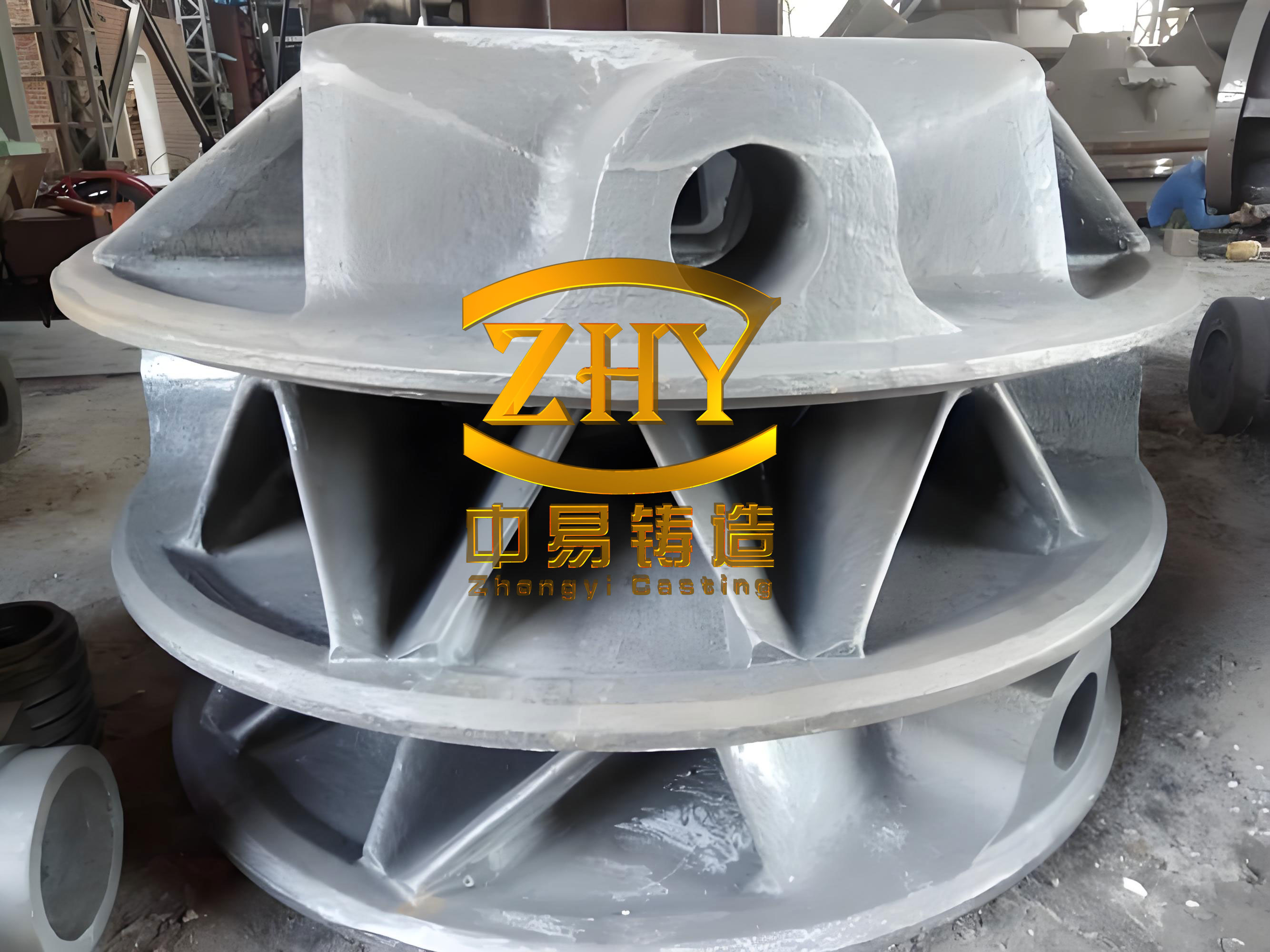
The fundamental issue lies in the solidification behavior of ductile iron. Unlike white iron or steel, ductile iron undergoes a mushy or pasty solidification. It has a wide eutectic freezing range, leading to a broad solid-liquid region. During this stage, a dense network of dendrites forms, impeding the flow of liquid metal and making feeding exceptionally difficult. This inherent characteristic is a primary reason for the pronounced tendency towards shrinkage porosity in ductile iron casting. The propensity for shrinkage is governed by a complex interplay of factors, which can be summarized by the following relationship:
$$ Shrinkage Tendency (S) \\propto \\frac{(\\Delta T_{eutectic}) \\cdot (V_{liquid})}{(G \\cdot R \\cdot \\eta_{feed})} $$
Where $\\Delta T_{eutectic}$ is the eutectic temperature range, $V_{liquid}$ is the volume of liquid contraction, $G$ is the temperature gradient, $R$ is the solidification rate, and $\\eta_{feed}$ is the feeding efficiency from risers and internal mechanisms. A larger $\\Delta T_{eutectic}$ and $V_{liquid}$, coupled with a low $G$, $R$, and $\\eta_{feed}$, drastically increase shrinkage risk. The key process variables influencing these parameters are pouring temperature, chemical composition (especially carbon equivalent), the design of the feeding system (risers and chills), and mold rigidity.
To diagnose the specific problem, I utilized MAGMA simulation software. The initial simulation of the original process clearly predicted a high probability of shrinkage porosity in the regions around the valve guide holes and the oblique oil channels, which matched perfectly with the actual defect locations found in machined and sectioned castings. This virtual analysis was crucial. It revealed two major flaws in the original ductile iron casting process. First, the insulated risers were poorly designed. With a diameter of 100 mm and a height of 130 mm, and a 20 mm neck, they were simply too small. Furthermore, the riser sleeves were made from manually compacted air-set sand, resulting in low rigidity. Consequently, the risers solidified before the critical hot spots in the casting, failing to provide feed metal and even creating a reverse suction effect, drawing liquid from the casting. Second, the chill design around the valve guide holes was insufficient to create the necessary directional solidification towards a proper feed source.
The core of the solution involved a multi-faceted optimization of the ductile iron casting process. The strategy focused on manipulating the thermal gradients and solidification sequence to ensure soundness in the problematic zones.
1. Optimization of Feeding and Cooling Aids
The first step was to redesign the feeding system. The riser dimensions were significantly increased to Φ140 mm in diameter and 170 mm in height. More importantly, the riser neck was reduced to 14 mm and a pre-formed, high-rigidity shell mold (like a coated sand sleeve) was adopted for the riser base. This combination ensured the riser remained liquid longer than the casting hot spots and provided an efficient feeding path, drastically improving $\\eta_{feed}$.
Simultaneously, the chill strategy was revolutionized. For the valve guide holes, instead of conventional block chills, thin-walled cylindrical chill sleeves were introduced. These were non-enclosed sleeves, approximately 1 mm thick, 45 mm in diameter, and 80 mm long. Their function was to rapidly extract heat from the periphery of the hole, shifting the thermal center and the last point to solidify inwards. Since these areas are subsequently machined out to form the final guide bore, any minor residual porosity would be removed, eliminating the leakage path. The thermal effect can be conceptually modeled by enhancing the local heat transfer coefficient (h):
$$ \\frac{dQ}{dt} = h \\cdot A \\cdot (T_{casting} – T_{chill}) $$
Where $dQ/dt$ is the heat extraction rate, $A$ is the contact area, and the chill sleeve maximizes $h$ and $A$ for its geometry. For the oblique oil channel, a massive conformal chill was added, matching the contour of the heavy section (96 mm × 87 mm × 45 mm). This chill acted as a powerful heat sink, accelerating solidification in that region and altering the local temperature field to promote directional solidification towards the enhanced riser.
The table below summarizes the key changes made to the feeding and cooling system:
| Component | Original Design | Optimized Design | Primary Function |
|---|---|---|---|
| Top Riser | Φ100 mm × 130 mm, 20 mm neck, manual sand base | Φ140 mm × 170 mm, 14 mm neck, pre-formed shell base | Provide adequate liquid metal reservoir and efficient feed path |
| Valve Guide Chill | Standard block chill | Thin-walled cylindrical sleeve (Φ45×80×1mm) | Shift thermal center inwards, enabling machining removal of shrinkage |
| Oblique Oil Channel Chill | None | Conformal chill (96×87×45 mm) | Create steep thermal gradient, accelerate local solidification |
Simulation of the revised ductile iron casting process showed a remarkable improvement. The shrinkage tendency around the valve guide holes was virtually eliminated, and the risk in the oblique oil channel area was substantially reduced. Physical sectioning of trial castings confirmed these simulation results, validating the effectiveness of the thermal management strategy.
2. Precise Control of Pouring Temperature
Pouring temperature ($T_{pour}$) is a critical lever in controlling shrinkage in ductile iron casting. An excessively high $T_{pour}$ increases the total liquid contraction volume ($V_{liquid}$), requiring more feed metal and raising shrinkage risk. Conversely, a very low $T_{pour}$ can impair fluidity, hinder the feeding ability of risers (especially in bottom-gated systems), and promote other defects like mistruns and slag entrapment. The goal is to find the “thermal equilibrium point” where fluidity is sufficient for complete mold filling and effective feeding, while minimizing liquid contraction.
Through a series of simulations holding other variables constant, I analyzed the impact of varying $T_{pour}$. The original process used a range of 1365–1375°C. The simulation studies indicated that a lower temperature range would be beneficial for this specific ductile iron casting geometry. The optimized range was established at 1345–1355°C. This reduction decreased the liquid contraction demand while maintaining adequate superheat for proper fluidity and feeding from the now-more-efficient riser system. The relationship can be thought of as optimizing the following factor in the shrinkage tendency equation:
$$ V_{liquid} \\propto \\beta \\cdot (T_{pour} – T_{liquidus}) $$
Where $\\beta$ is the coefficient of liquid thermal contraction. By lowering $T_{pour}$, we directly reduce $V_{liquid}$, thereby lowering the shrinkage tendency $S$.
3. Strategic Adjustment of Carbon Equivalent
The chemical composition, particularly the Carbon Equivalent (CE), is perhaps the most influential factor in determining the soundness of a ductile iron casting. Carbon Equivalent defines the position of the iron’s composition relative to the eutectic point in the Fe-C-Si system. It is calculated as:
$$ CE = \\%C + \\frac{1}{3}(\\%Si + \\%P) $$
A higher CE promotes more graphite precipitation during solidification. The expansion associated with this graphite formation can counteract the shrinkage from liquid and solidification contraction, providing a “self-feeding” effect. However, this is only effective if the mold has sufficient rigidity to contain the expansion. If the mold walls yield or the feeding system is still open, the expansion pressure is dissipated without compensating for shrinkage. Furthermore, an excessively high CE can lead to graphite flotation in heavy sections.
The original composition for this ductile iron casting had a CE of 4.7–4.8%. Simulation studies and theoretical analysis suggested this was too high for the given mold system and geometry. The high CE likely caused significant early primary graphite precipitation, reducing the amount of expansion available during the critical late stages of eutectic solidification. The expansion was occurring too early, potentially while the riser system was still an open channel.
The CE was strategically lowered to a range of 4.25–4.4%. This shift had several beneficial effects for this ductile iron casting process:
- Delayed Graphite Expansion: Lowering CE moves the composition to the right of the eutectic point, reducing primary graphite. The majority of graphite precipitation now occurs later, during the eutectic reaction, and crucially, after the feeding system (riser necks) has sealed off due to solidification.
- Contained Self-Feeding: With the feeding paths closed, the expansive force of the graphite formation is contained within the isolated liquid pockets in the casting itself. This internal pressure effectively compensates for micro-shrinkage, dramatically reducing the propensity for porosity, especially in isolated hot spots like the oblique oil channels.
- Improved Graphite Morphology: A lower CE generally results in a finer and more uniform distribution of graphite nodules, contributing to better mechanical properties.
The interplay between CE, mold rigidity, and shrinkage can be conceptualized by a modified feeding criterion:
$$ V_{shrink} = V_{liquid} + V_{phase} – V_{graphite\\,expansion} $$
Where $V_{shrink}$ is the net shrinkage volume needing external feed, $V_{liquid}$ is thermal contraction, $V_{phase}$ is contraction from austenite formation, and $V_{graphite\\,expansion}$ is the expansion from graphite precipitation. By optimizing CE and ensuring mold rigidity (through good sand compaction and use of stiff mold/cores), we maximize $V_{graphite\\,expansion}$ and minimize $V_{shrink}$, often to zero or even a positive volume change, leading to sound castings.
The following table contrasts the key process parameters before and after optimization:
| Parameter | Original Process | Optimized Process | Impact on Shrinkage |
|---|---|---|---|
| Riser Design | Small, weak neck, low-rigidity base | Larger, optimized neck, high-rigidity shell base | Greatly improved external feeding efficiency ($\\eta_{feed}$ ↑) |
| Chill Strategy | Standard blocks in key areas | Cylindrical sleeves + conformal chills | Enhanced thermal gradients ($G$ ↑), controlled solidification sequence |
| Pouring Temperature | 1365–1375°C | 1345–1355°C | Reduced liquid contraction volume ($V_{liquid}$ ↓) |
| Carbon Equivalent (CE) | 4.7–4.8% | 4.25–4.4% | Optimized timing/containment of graphite self-feeding ($V_{graphite\\,expansion}$ utilization ↑) |
Production Validation and Results
The combined optimizations were implemented in production. The results were transformative. From the initial scrap rate of 80% due to shrinkage, the rejection rate plummeted to approximately 20% in the subsequent batch of 80 castings. All internal scrap from machining-related shrinkage was eliminated. The remaining leaks, primarily from the oblique oil channels, represented a focused area for further improvement. This dramatic improvement proved that the systematic, simulation-guided approach to optimizing the ductile iron casting process was not only valid but highly effective. It provided a reliable framework for tackling similar challenges in other complex ductile iron castings.
The journey to perfect this ductile iron casting process didn’t end there. The residual leakage from the oblique oil channels pointed to the need for even more aggressive local cooling or a change in the solidification mode in that specific heavy section. Literature and experience suggest that elements like tellurium (Te) can be highly effective. Tellurium is a powerful chilling agent; even in minute amounts added via a coating applied to the mold surface in the specific area, it can drastically increase the cooling rate, forcing a whiter, more directional solidification in that zone. The intense chill promotes a skin-forming solidification mode rather than a mushy one, thereby reducing shrinkage porosity. The next step in the evolution of this ductile iron casting process involves trials with tellurium-based coatings or the possible introduction of internal chills in the core for the oblique oil channel to achieve definitive soundness.
Conclusion and Broader Implications
The successful resolution of shrinkage porosity in this large ductile iron cylinder head offers several key insights for the foundry industry dealing with similar challenges in ductile iron casting:
1. Synergistic Process Design is Crucial: There is no single silver bullet. The solution lay in the careful integration of riser design, chill application, pouring temperature, and chemical composition. Each element interacts with the others. For instance, the lower CE’s self-feeding benefit is fully realized only with adequate mold rigidity and a properly timed solidification sequence aided by chills.
2. Simulation is an Indispensable Tool: Numerical simulation software like MAGMA provides unparalleled insight into the solidification process. It allows for rapid, cost-effective testing of multiple “what-if” scenarios, pinpointing defect-prone areas and validating proposed solutions before committing to expensive production trials. It transforms ductile iron casting process development from an art based on experience into a more predictable science.
3. The Critical Role of Carbon Equivalent Management: CE is not just a specification for mechanical properties; it is a powerful process control parameter for soundness. Selecting the appropriate CE for a specific casting geometry and mold system is essential. A lower CE, strategically chosen, can enhance the utilization of graphite expansion for internal feeding, provided the mold system is designed to contain that pressure.
4. Innovative Chill Design: Moving beyond simple block chills to engineered solutions like thin sleeves or conformal chills can provide precise control over local solidification. The use of a chill sleeve to intentionally shift the shrinkage to a machinable area is a brilliant example of designing the process in harmony with the final machining operations.
5. The “Thermal Equilibrium” Pouring Temperature: Pouring temperature must be optimized for each specific ductile iron casting. It represents a balance between fluidity/feeding and contraction volume. Foundries should use simulation and controlled experiments to establish this optimal range for their critical castings.
The formula for success in producing sound, high-integrity ductile iron castings, therefore, can be encapsulated as:
$$ Soundness = f(\\text{Simulation}, \\text{Optimized CE}, \\text{Precise Thermal Management}, \\text{Rigid Mold System}) $$
This case study underscores that persistent defects in ductile iron casting, such as shrinkage porosity, are not insurmountable. Through a methodical approach combining advanced simulation, fundamental understanding of metallurgy and solidification, and innovative engineering of the casting process itself, remarkable improvements in quality and yield are achievable. The lessons learned here are directly applicable to a wide range of heavy-section and complex geometry ductile iron castings, pushing the boundaries of what is possible with this versatile and critical engineering material. The continuous pursuit of perfection in ductile iron casting processes remains a cornerstone of advanced manufacturing for the automotive, marine, and heavy machinery industries.