
The pursuit of low-carbon economies, characterized by minimal consumption, emission, and pollution, fundamentally hinges on enhancing energy utilization efficiency. The manufacturing sector is a significant contributor to global carbon emissions, accounting for approximately 38% of the total. Within this sector, sand casting—a foundational process for producing metal components—is notably energy-intensive and polluting, with a lamentably low overall energy utilization rate of only around 17%. This presents a substantial opportunity for energy conservation and emission reduction. Therefore, moving towards low-carbon and cleaner sand casting production necessitates a critical evaluation of the utilization efficiency of energy, materials, and emissions. This article proposes a comprehensive carbon efficiency model and evaluation method specifically for the sand casting process, providing a scientific basis for targeted节能减排 activities within foundries.
The sand casting process involves transforming raw materials into final castings through a series of interconnected stages, consuming energy and resources while generating emissions at each step. Merely comparing the total carbon emissions of different processes or production lines fails to capture the intricate relationship between emissions and actual production performance, such as output rate, equipment utilization, and production cycle time. To address this, we define Sand Casting Carbon Efficiency (SCCE) as the integrated capability of the sand casting production process to minimize carbon emissions while maximizing production efficiency, considering factors like production capacity, equipment status, resource input, and environmental impact.
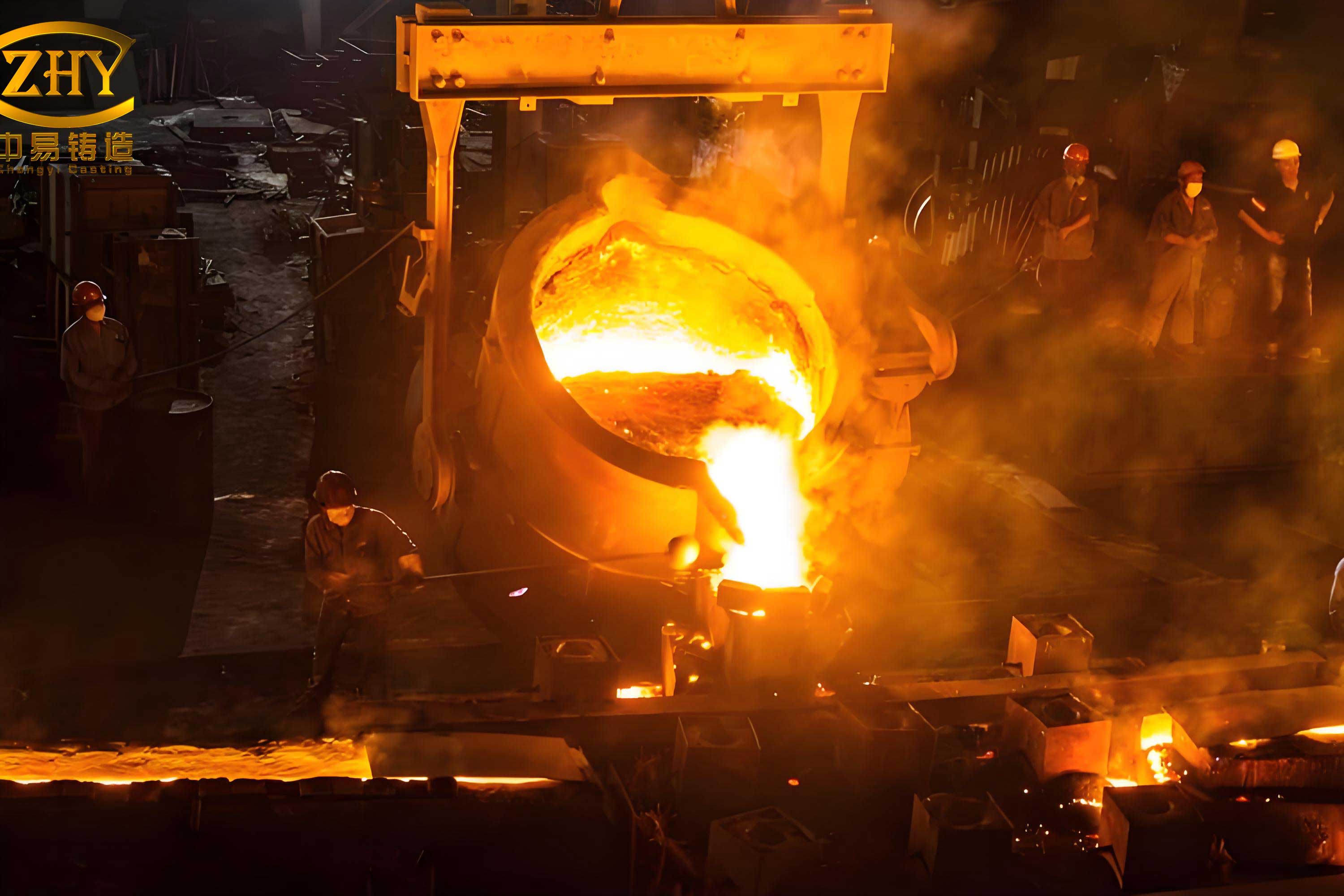
To quantify this, we first need a robust model for calculating carbon emissions from the sand casting process. The process can be decomposed into fundamental carbon-generating units or “Process Carbon Sources,” which fall into two main categories: Equipment Carbon Sources and Non-Equipment Carbon Sources.
Equipment Carbon Sources include emissions from equipment in idle/standby mode (Pause Carbon Source) and under operational load (Load Carbon Source). Their emissions depend primarily on power ratings and operational time.
$$C_{PC} = P_o \cdot t \cdot E_e$$
$$C_{LC} = (P_o + \mu \cdot m_e \cdot P_w) \cdot t \cdot E_e$$
Where \(C_{PC}\) is the Pause Carbon Source emission, \(C_{LC}\) is the Load Carbon Source emission, \(P_o\) is the idle/standby power (kW), \(t\) is the operating time (hours), \(E_e\) is the carbon emission factor of electricity (kg CO₂-eq/kWh), \(P_w\) is the additional power per unit load weight (kW/kg), \(\mu\) is the equipment power loss coefficient, and \(m_e\) is the mass of the load (kg).
Non-Equipment Carbon Sources encompass emissions from material consumption, direct energy consumption (like natural gas), and the treatment of waste/unwanted by-products.
$$C_{MC} = \sum_{i=1}^{n} \sum_{k=1}^{i} (ES_k \cdot U_i) \cdot E_e$$
$$C_{EC} = \sum_{i=1}^{n} V_i \cdot E_i$$
$$C_{UC} = \sum_{i=1}^{n} \sum_{k=1}^{i} (ES_k \cdot Q_i \cdot \phi_i) \cdot E_e$$
Where \(C_{MC}\) is the Material Consumption Carbon Source emission, \(C_{EC}\) is the direct Energy Consumption Carbon Source emission, \(C_{UC}\) is the Unwanted (waste) Carbon Source emission, \(U_i\) is the quantity of the i-th material consumed, \(ES_k\) is the electricity consumed at the k-th processing stage for material/waste, \(V_i\) is the quantity of the i-th direct energy source consumed, \(E_i\) is its carbon emission factor, \(Q_i\) is the quantity of the i-th waste generated, and \(\phi_i\) is its treatment difficulty coefficient.
The total carbon emission for a sand casting process \(C_{pro}\) is the sum of all these sources:
$$C_{pro} = C_{eq} + C_{neq} = (C_{PC} + C_{LC}) + (C_{MC} + C_{EC} + C_{UC})$$
Based on this emission model and our definition, the Sand Casting Carbon Efficiency (SCCE) is constructed as a four-dimensional vector, each dimension capturing a specific relationship between emissions and a key production performance indicator:
$$SCCE = \{ SCCE_{cp},\ SCCE_{eq},\ SCCE_{e},\ SCCE_{t} \}$$
1. Production Capacity Carbon Efficiency (SCCEcp)
This dimension evaluates the carbon emissions per unit of production output. It is defined as the ratio of total process carbon emissions to the production capacity.
$$SCCE_{cp} = \frac{C_{eq} + C_{neq}}{CP} = \frac{(C_{PC}+C_{LC}) + (C_{MC}+C_{EC}+C_{UC})}{CP}$$
The Production Capacity (\(CP\)) is a critical measure. For sand casting, it can be expressed as the number of molds produced per unit time for high-volume small castings, or as the tonnage of castings produced per unit time for other production modes. Its calculation must account for the hierarchical organization of the production process (e.g., workstation, cell, line, shop floor). The capacity at a given level \(k\) can be calculated using methods like rated time, summation, or bottleneck analysis, depending on the production structure. A generalized formula considering equipment (\(CP_{eq}\)), personnel (\(CP_{pr}\)), and hierarchical capacities is:
$$CP = G \cdot \sum_{k=1}^{K} (CP_{eq_k} + CP_{pr_k} + CP_{t_k} + CP_{s_k} + CP_{r_k})$$
Where \(G\) is the conversion factor (e.g., number of molds or tonnage of castings). Therefore, the full model becomes:
$$SCCE_{cp} = \frac{(C_{PC}+C_{LC}) + (C_{MC}+C_{EC}+C_{UC})}{G \cdot \sum_{k=1}^{K} (CP_{eq_k} + CP_{pr_k} + CP_{t_k} + CP_{s_k} + CP_{r_k})}$$
2. Equipment Utilization Carbon Efficiency (SCCEeq)
This dimension focuses on the efficiency of equipment-related emissions. It is defined as the ratio of total equipment carbon source emissions to the Overall Equipment Effectiveness (OEE).
$$SCCE_{eq} = \frac{\sum_{i=1}^{n} (C^i_{PC} + C^i_{LC})}{EP_{eq}}$$
Here, \(EP_{eq}\) represents the comprehensive equipment production efficiency, often measured as OEE, which is the product of Availability, Performance, and Quality rates.
$$EP_{eq} = \sum_{i=1}^{n} \eta_{eq} \cdot TR_i \cdot DR_i \cdot PR_i = \sum_{i=1}^{n} \eta_{eq} \cdot \frac{N_{q_i}}{t_{a_i}} \cdot t_{op_i} \cdot C_{dr_i}$$
Where \(TR\) is Time Utilization Rate, \(DR\) is Performance Rate, \(PR\) is Quality Rate, \(N_q\) is quantity of qualified products, \(t_a\) is total available time, \(t_{op}\) is operating time, \(C_{dr}\) is design rate/capacity, and \(\eta_{eq}\) is equipment cycling utilization factor. Thus, the model is:
$$SCCE_{eq} = \frac{\sum_{i=1}^{n} (C^i_{PC} + C^i_{LC})}{\sum_{i=1}^{n} \eta_{eq} \cdot \frac{N_{q_i}}{t_{a_i}} \cdot t_{op_i} \cdot C_{dr_i}}$$
3. Energy Consumption Carbon Efficiency (SCCEe)
This dimension assesses the proportion of total emissions that originate directly from energy use (both electrical via equipment and direct fuels). It is defined as the ratio of energy-related carbon emissions to the total process carbon emissions.
$$SCCE_{e} = \frac{\sum_{i=1}^{n} (C^i_{LC} + C^i_{PC} + C^i_{EC})}{C_{pro}}$$
A lower value indicates a greater relative contribution from non-energy sources like material processing, highlighting different leverage points for emission reduction in sand castings.
4. Production Cycle Carbon Efficiency (SCCEt)
This dimension evaluates the carbon emission intensity over time. It is defined as the total carbon emissions per unit of production cycle time.
$$SCCE_{t} = \frac{\sum_{i=1}^{n} (C^i_{LC} + C^i_{PC} + C^i_{MC} + C^i_{EC} + C^i_{UC})}{\sum_{j=1}^{m} \Delta_j}$$
Where \(\Delta_j\) is the duration of the j-th production cycle. This metric is crucial for understanding the temporal density of emissions in sand casting operations.
Comprehensive Evaluation Using Grey Relational Analysis
To compare and rank different sand casting production lines or process routes based on their multi-dimensional carbon efficiency profile, a comprehensive evaluation method is needed. Grey Relational Analysis (GRA) is suitable for multi-attribute decision-making with limited information. The steps are as follows:
1. Define the Decision Matrix: For \(m\) alternative sand casting lines and the four SCCE indicators, form the matrix \(CM = [cm_j(k)]_{m \times 4}\), where \(cm_j(k)\) is the value of the \(k\)-th indicator for the \(j\)-th line.
2. Determine the Ideal Sequence: Construct an ideal reference sequence \(PCM\) by selecting the optimal value for each indicator (e.g., minimum for SCCE values as they represent emission intensity) from the alternatives.
3. Normalize the Data: Normalize the decision matrix to eliminate scale effects. For cost-type indicators like SCCE (lower is better), use:
$$v_j(k) = \frac{cm_j(k_{min})}{cm_j(k)}$$
This yields the normalized matrix \(V\).
4. Calculate Grey Relational Coefficient: Compute the coefficient \(\psi_j(k)\) between the normalized value of alternative \(j\) on indicator \(k\) and the ideal value \(v_0(k)\).
$$\psi_j(k) = \frac{\min_j \min_k |v_0(k) – v_j(k)| + \xi \max_j \max_k |v_0(k) – v_j(k)|}{|v_0(k) – v_j(k)| + \xi \max_j \max_k |v_0(k) – v_j(k)|}$$
Where \(\xi\) is the distinguishing coefficient, usually set to 0.5.
5. Compute Weighted Grey Relational Grade: Determine the weight vector \(W = \{w_1, w_2, w_3, w_4\}\) for the four SCCE dimensions (e.g., using methods like AHP or Entropy weight). The comprehensive Grey Relational Grade \(\gamma_j\) for each sand casting line is:
$$\gamma_j = \sum_{k=1}^{4} \psi_j(k) \cdot w_k$$
The alternatives are then ranked based on \(\gamma_j\), with a higher grade indicating better overall carbon efficiency.
Case Study: Application to Molding Lines
To illustrate the model, consider four different molding line configurations in a foundry producing small, high-volume sand castings. The lines vary in their level of automation and process technology (e.g., manual vs. automatic molding, different sand mixing systems).
Step 1: Carbon Emission Calculation
Based on process parameters, activity times, and consumption data, the carbon emissions from each Process Carbon Source for producing a batch of 20 molds are calculated using the models in Section 2.
| Line ID | Process Description | \(C_{PC}\) (kg CO₂-eq) | \(C_{LC}\) (kg CO₂-eq) | \(C_{MC}\) (kg CO₂-eq) | \(C_{EC}\) (kg CO₂-eq) | \(C_{UC}\) (kg CO₂-eq) | \(C_{pro}\) (kg CO₂-eq) |
|---|---|---|---|---|---|---|---|
| L1 | Manual-intensive, machine-assisted | 7.2 | 10.5 | 95.0 | 3.1 | 4.8 | 120.6 |
| L2 | Machine-based, self-setting sand | 6.1 | 12.0 | 85.0 | 2.1 | 2.7 | 107.9 |
| L3 | Integrated semi-automated line | 5.7 | 11.0 | 89.0 | 1.7 | 2.4 | 109.8 |
| L4 | Automated line with high-pressure | 7.0 | 15.0 | 93.0 | 2.9 | 3.6 | 121.5 |
Step 2: Calculate Four-Dimensional SCCE
Using production data (cycle time, equipment efficiency, output), the four carbon efficiency dimensions are calculated for each line.
| Carbon Efficiency Dimension | L1 | L2 | L3 | L4 |
|---|---|---|---|---|
| \(SCCE_{cp}\) (kg CO₂-eq / mold) | 2.010 | 1.285 | 1.373 | 1.519 |
| \(SCCE_{eq}\) (kg CO₂-eq / OEE unit) | 29.50 | 20.84 | 20.12 | 27.85 |
| \(SCCE_{e}\) (ratio) | 0.172 | 0.187 | 0.168 | 0.205 |
| \(SCCE_{t}\) (kg CO₂-eq / hour) | 180.9 | 226.6 | 219.6 | 243.0 |
Step 3: Grey Relational Analysis Evaluation
1. Construct the normalized decision matrix \(V\), using the minimum value for each SCCE indicator as the ideal (since lower is better).
2. Assume equal weights for simplicity: \(W = \{0.25, 0.25, 0.25, 0.25\}\).
3. Calculate the Grey Relational Coefficient \(\psi_j(k)\) for each line and indicator.
4. Compute the comprehensive Grey Relational Grade \(\gamma_j\).
| Line ID | \(\gamma_j\) (Grey Relational Grade) | Rank |
|---|---|---|
| L1 | 0.4527 | 4 |
| L2 | 0.7592 | 2 |
| L3 | 0.8446 | 1 |
| L4 | 0.5760 | 3 |
Discussion and Conclusion
The case study yields insightful results. While Line L4 has the highest total carbon emissions (\(C_{pro} = 121.5\) kg CO₂-eq), it does not rank as the worst in overall carbon efficiency. Conversely, Line L3, despite having higher total emissions than Line L2, achieves the highest overall Grey Relational Grade (\(\gamma_3 = 0.8446\)). This outcome underscores the critical importance of a multi-dimensional assessment. Line L3’s superiority stems from its balanced performance across all four SCCE dimensions—particularly strong equipment utilization and energy consumption efficiency—which compensates for its slightly higher total emissions compared to L2.
The proposed modeling and evaluation framework provides a nuanced and actionable tool for foundries. The four-dimensional Sand Casting Carbon Efficiency model moves beyond simple carbon accounting by explicitly linking emissions to core operational metrics: production output, equipment effectiveness, energy mix, and cycle time. The application of Grey Relational Analysis allows for a holistic comparison of different sand casting process routes, identifying not just the “least emitting” line, but the most carbon-efficient one when all production factors are considered. This enables managers and engineers to make informed decisions on process improvement, technology investment, and operational adjustments, ultimately guiding the sand casting industry towards more sustainable and competitive production. Future work could integrate dynamic production data streams and explore optimization algorithms to not only evaluate but also actively suggest pathways for improving carbon efficiency in real-time sand casting operations.