
In the field of mechanical engineering, support components play a critical role in sustaining axial compressive forces, particularly in applications such as injection molding machines. These parts, often manufactured from nodular cast iron, must exhibit high integrity to prevent failures due to defects like shrinkage porosity, cold shuts, and cracks. Traditional casting design relies heavily on empirical knowledge, which can lead to prolonged trial-and-error cycles, increased costs, and inconsistent quality. To address these challenges, I have employed numerical simulation software, specifically ProCAST, to analyze and optimize the casting process for a nodular cast iron support. This approach allows for a detailed evaluation of gating systems, riser design, and solidification patterns before physical prototyping, thereby enhancing efficiency and reliability.
Nodular cast iron, also known as ductile iron, is favored for its excellent mechanical properties, including high strength, ductility, and wear resistance. The material’s graphite spheroids, formed through magnesium or cerium treatment, contribute to its toughness and ability to withstand dynamic loads. However, the casting of nodular cast iron presents unique challenges, such as a pronounced tendency for shrinkage defects due to its solidification characteristics. This necessitates precise control over process parameters to ensure sound castings. In this study, I focus on a support component with complex geometry, where optimizing the casting method is essential to meet technical requirements of defect-free surfaces and internal soundness.
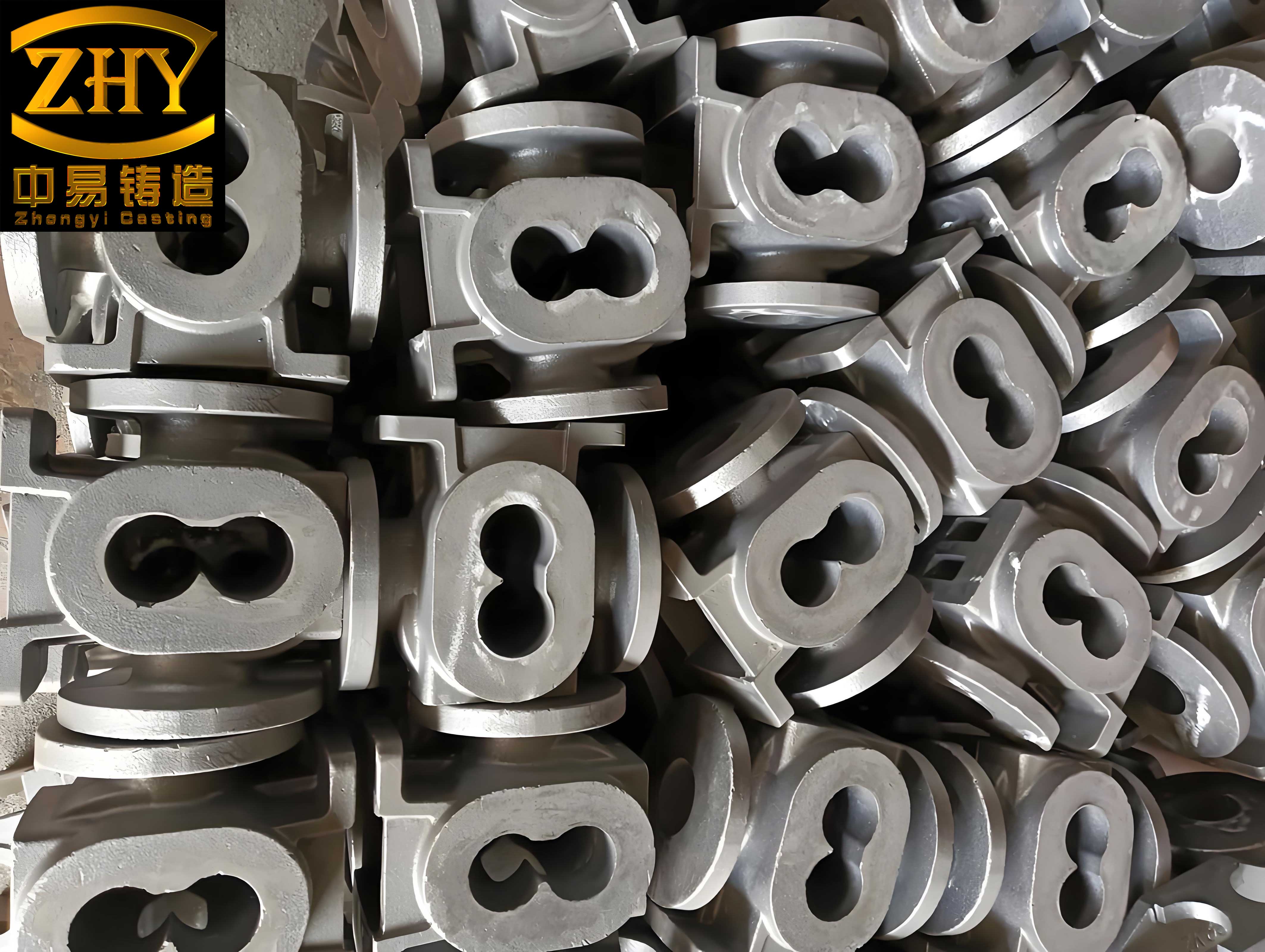
The support casting, with overall dimensions of 650 mm × 340.5 mm × 589 mm and a weight of 174.8 kg, features a multifaceted structure. It comprises a front flange, connecting side walls, and a rear base, each with varying wall thicknesses ranging from 34 mm to 116 mm. Such disparities in section thickness create thermal gradients during solidification, leading to potential hot spots and defect formation. The material specification is QT500-7 nodular cast iron, which requires a carbon equivalent near the eutectic point to promote graphite nucleation and minimize shrinkage. Key chemical composition ranges for this grade of nodular cast iron are summarized in Table 1.
| Element | Content Range |
|---|---|
| Carbon (C) | 3.55–3.85 |
| Silicon (Si) | 2.34–2.86 |
| Manganese (Mn) | <0.50 |
| Sulfur (S) | ≤0.02 |
| Phosphorus (P) | ≤0.05 |
| Magnesium (Mg) | 0.04–0.06 |
| Rare Earth (RE) | 0.03–0.05 |
Silicon in nodular cast iron enhances graphitization and ferrite strengthening, while manganese stabilizes pearlite but must be controlled to avoid inverse chill effects. Low sulfur and phosphorus levels are crucial to reduce shrinkage propensity and cold cracking. The addition of magnesium and rare earth elements facilitates nodular graphite formation but requires careful balancing to prevent slag inclusions. For the support casting, I selected a resin sand molding process due to its good collapsibility and surface finish, with core assemblies made from zircon sand to improve dimensional accuracy.
Initial casting method design involved a horizontal parting plane with two-box molding to simplify pattern withdrawal. A four-cavity layout was adopted to maximize productivity, using a bottom-gated, pressurized gating system to ensure rapid and tranquil filling. The gating dimensions were calculated based on empirical formulas, with a total pouring weight of 1,169 kg and a pouring time of 35 seconds. The cross-sectional areas of the gating elements are detailed in Table 2.
| Gating Element | Cross-Sectional Area (cm²) | Dimensions (mm) |
|---|---|---|
| Sprue | 50.3 | Diameter: 90 (top), 80 (bottom) |
| Runner | 24 | Rectangular: 36 × 54 |
| Ingates (8 total) | 44.8 | Rectangular: varies per ingate |
The filling behavior of nodular cast iron is critical to avoid surface defects. The initial design aimed to minimize turbulence, but numerical simulation was necessary to verify its efficacy. I utilized ProCAST, a finite element-based software, to model the coupled phenomena of fluid flow, heat transfer, and solidification. The simulation setup involved discretizing the geometry into 780,986 tetrahedral elements, ensuring sufficient resolution for accurate defect prediction. Boundary conditions included interfacial heat transfer coefficients, with values set as 500 W/(m²·K) for cast-sand interfaces and 2,000 W/(m²·K) for cast-chill interfaces. The pouring temperature was 1,350°C, and the mold initial temperature was 20°C, reflecting typical foundry conditions for nodular cast iron.
Mathematically, the solidification process of nodular cast iron can be described by the heat conduction equation with phase change:
$$ \rho C_p \frac{\partial T}{\partial t} = \nabla \cdot (k \nabla T) + L \frac{\partial f_s}{\partial t} $$
where \( \rho \) is density, \( C_p \) is specific heat, \( T \) is temperature, \( t \) is time, \( k \) is thermal conductivity, \( L \) is latent heat, and \( f_s \) is solid fraction. ProCAST solves this equation numerically to predict temperature fields and solidification sequences. For nodular cast iron, the latent heat release during graphite precipitation significantly influences cooling rates and defect formation.
Simulation results for the initial method revealed several issues. Filling was平稳 and complete within 32.9 seconds, with no cold shuts or misruns. However, solidification analysis indicated severe shrinkage defects in the rear base and front flange bosses, where isolated liquid pockets formed due to unfavorable thermal gradients. The defect severity was quantified using the normalized porosity criterion, with values exceeding 80% in critical regions. This aligns with the inherent characteristics of nodular cast iron, where graphite expansion during eutectic solidification can compensate for shrinkage, but only if feeding paths remain open. The initial design lacked adequate risers, leading to premature freezing of thin sections and blockage of liquid metal supply to thicker zones.
To optimize the process, I modified the method by incorporating insulating risers and strategic chill placements. Riser design followed the modulus method, ensuring sufficient feed metal volume. For nodular cast iron, risers must account for both shrinkage compensation and graphite expansion effects. The riser dimensions were calculated using:
$$ M_r = 1.2 M_c $$
where \( M_r \) is the riser modulus and \( M_c \) is the casting modulus, derived from volume-to-surface area ratios. The optimized riser was an insulated neck-type open riser with dimensions: diameter 120 mm, height 256 mm, neck width 80 mm, and neck height 36 mm. Chills were placed in regions with high thermal mass to accelerate cooling and eliminate hot spots. Table 3 summarizes the optimization measures.
| Component | Optimization Action | Purpose |
|---|---|---|
| Front Flange | Add insulating riser on boss | Direct feeding to prevent shrinkage |
| Rear Base | Place chills (50 mm thick) on bottom and sides | Enhance cooling to reduce solidification time |
| Transition Zones | Add chills (30 mm thick) adjacent to hot spots | Control thermal gradients and improve feeding |
| U-Shaped Slot | Use conformal chill (60 mm thick) | Eliminate isolated liquid regions |
Re-simulation with the optimized method showed significant improvement. The temperature distribution during solidification became more uniform, with a progressive directional solidification from the bottom to the top. Defect analysis indicated that shrinkage porosity was reduced to below 5% in all critical areas, meeting the technical requirements for nodular cast iron components. The casting yield, calculated as the ratio of casting weight to total poured weight, improved to approximately 65.4%, indicating efficient use of metal. The success of this optimization underscores the value of numerical simulation in designing robust processes for nodular cast iron.
Further analysis involved evaluating the effect of process parameters on defect formation. For nodular cast iron, key factors include pouring temperature, cooling rate, and carbon equivalent. I conducted parametric studies using ProCAST to establish optimal ranges. The relationship between shrinkage tendency and carbon equivalent (CE) can be expressed as:
$$ CE = C + \frac{Si + P}{3} $$
Higher CE values promote graphite formation but may increase shrinkage if not balanced with proper feeding. Simulation results validated that a CE around 4.3 to 4.5 minimized defects for this casting. Additionally, the cooling rate influences graphite nodule count and matrix structure, critical for mechanical properties of nodular cast iron. Table 4 presents simulation-based recommendations for process parameters.
| Parameter | Optimal Range | Impact on Defects |
|---|---|---|
| Pouring Temperature | 1,340–1,360°C | Lower temperatures reduce shrinkage but risk cold shuts |
| Mold Temperature | 20–30°C | Higher temperatures slow cooling, aiding feeding |
| Carbon Equivalent | 4.3–4.5 | Balances graphitization and shrinkage compensation |
| Solidification Time | 10,000–11,000 s | Longer times allow for better feeding in thick sections |
The use of chills in nodular cast iron casting is particularly effective due to their ability to modify local solidification rates. The chill effect can be quantified by the heat extraction capacity:
$$ Q = h_c A (T_c – T_m) $$
where \( Q \) is heat flux, \( h_c \) is interfacial heat transfer coefficient, \( A \) is contact area, \( T_c \) is chill temperature, and \( T_m \) is metal temperature. By adjusting chill thickness and placement, I achieved controlled solidification that prioritized feeding paths. This is essential for nodular cast iron, where late-stage graphite expansion can counteract shrinkage if the mold rigidity is sufficient.
In conclusion, the integration of ProCAST simulation into the casting process design for nodular cast iron components has proven highly effective. By analyzing filling patterns, thermal gradients, and defect formation, I optimized the gating and risering system to eliminate shrinkage porosity and other defects. The optimized method ensures directional solidification, adequate feeding, and high casting yield, all critical for producing sound nodular cast iron parts. This approach reduces reliance on trial-and-error, saving time and resources while improving quality consistency. Future work could explore advanced simulation of microstructure evolution in nodular cast iron to further enhance mechanical performance prediction.
Moreover, the principles applied here are transferable to other complex nodular cast iron castings. The ability to virtually test multiple design iterations allows for robust process development, especially for industries requiring high-integrity components. As foundries increasingly adopt digital tools, the synergy between simulation and practical expertise will drive innovations in nodular cast iron technology, enabling lighter, stronger, and more reliable castings. The continuous refinement of simulation parameters, such as material databases for nodular cast iron, will further enhance accuracy and foster sustainable manufacturing practices.
Throughout this study, the focus on nodular cast iron has highlighted its versatility and challenges. By leveraging numerical simulation, I have demonstrated that defect-free castings are achievable through systematic optimization. The methodologies described here provide a framework for foundry engineers to improve their processes, ensuring that nodular cast iron continues to be a material of choice for demanding applications. The combination of theoretical insights and practical simulations paves the way for advancements in casting science and technology.