
In the aluminum electrolysis industry, anode steel claws are essential consumables that play a critical role in conducting electricity within electrolytic cells. These components are typically assembled with aluminum guide rods via explosion-welded blocks, then inserted into anode carbon blocks and bonded through phosphoric iron casting to form an integrated anode system. To meet production demands, anode steel claws must operate reliably for over ten cycles on average, necessitating sufficient mechanical strength and excellent electrical conductivity. Beyond material compliance with standards like ZG230-450, key specifications include height deviations ≤2 mm, claw head dimension deviations ≤1 mm, and center spacing deviations ≤1 mm. Additionally, machined surfaces at explosion-welded ends require a roughness of 12.5μm, with castings being free from visible defects such as cracks, sand inclusions, slag, or porosity that could impair functionality.
Traditionally, many domestic enterprises have relied on water glass sand casting for producing anode steel claws. In this process, to enhance pouring quality, two-part horizontal molding with sand core positioning is often employed, followed by vertical pouring after mold assembly. However, due to inherent limitations of water glass sand casting, defects like mold misalignment at parting lines and surface burning-on are common, necessitating extensive post-casting cleaning. This results in prolonged production cycles, high costs, poor dimensional accuracy, and significant environmental pollution from manual grinding.
Our company addressed these challenges by adopting lost foam casting technology. In October 2000, we introduced the lost foam casting process, and in 2003, we integrated sand treatment equipment from a specialized manufacturer to establish a dedicated lost foam production line for steel claws. Over more than a decade of continuous improvement, we have successfully produced various claw types—including 3, 4, 6, and 8-claw designs—using lost foam casting, achieving notable economic and social benefits. This article, written from our firsthand perspective, details the optimization of a gating and riser integrated process for 4-claw steel claws, emphasizing the advantages of lost foam casting through expanded technical analysis, tables, and formulas.
Lost foam casting, also known as evaporative pattern casting, involves creating foam patterns that vaporize upon contact with molten metal, leaving a precise cavity in sand molds. This method minimizes traditional casting defects and enhances dimensional accuracy. In our experience, lost foam casting has revolutionized anode claw production by reducing cleanup efforts and improving material utilization. The key to success lies in meticulous pattern preparation, coating application, sand compaction, and controlled pouring parameters.
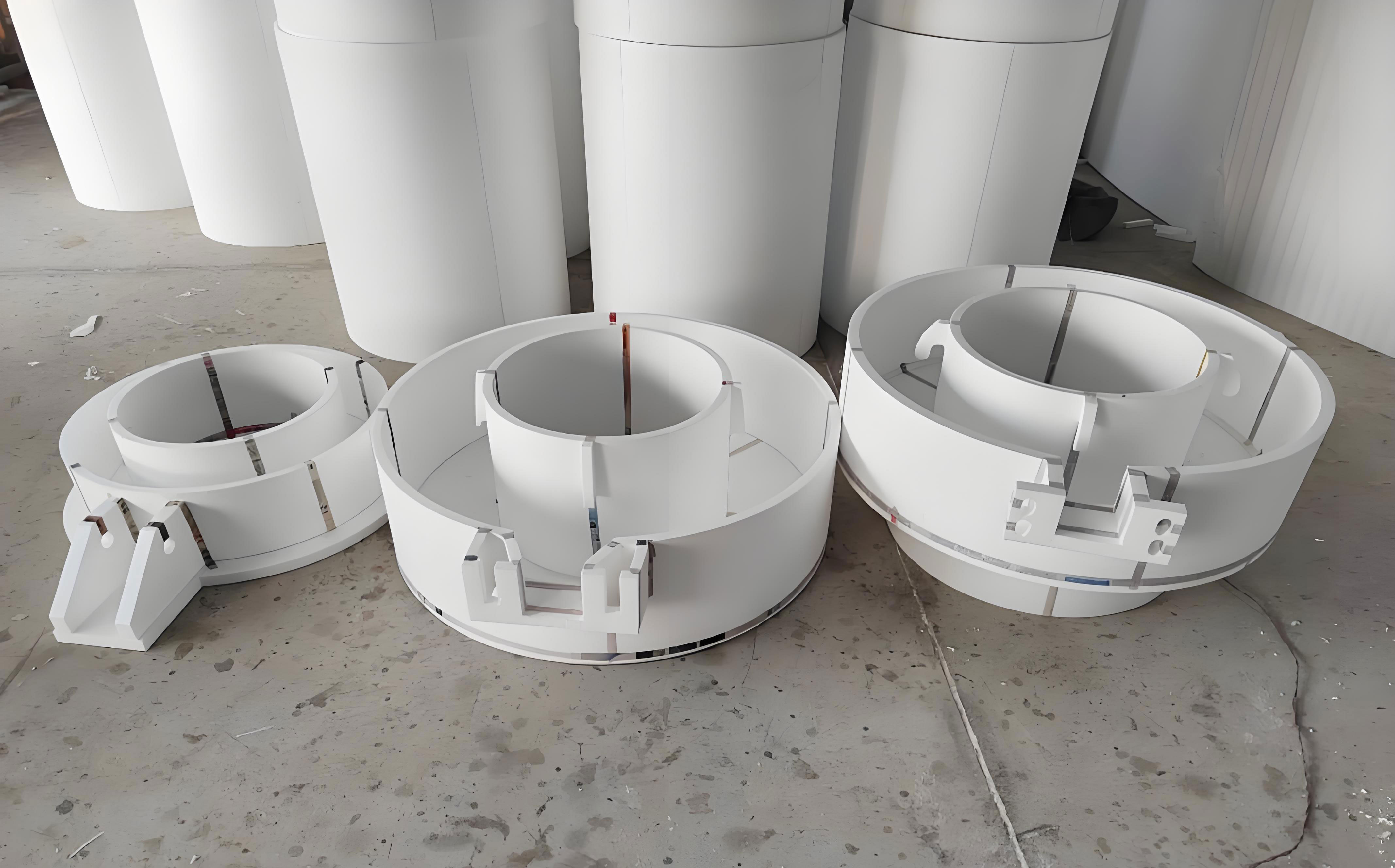
Initially, our lost foam casting process for steel claws involved creating two-part hollow foam patterns for the claw sections and spherical risers, which were then bonded into complete rings. The crossbeam was fabricated by manually cutting pre-formed foam boards, and all components were assembled using定位 fixtures. A bottom gating system was used, with ingates located at the pattern base to allow gradual upward decomposition of expandable polystyrene (EPS) during pouring. While this approach ensured stable filling with pyrolysis products floating atop the metal front, it presented drawbacks: carbon defects tended to accumulate on upper surfaces, gating paths were long increasing resistance, and assembly was complex. Additionally, extensive cutting was required for riser removal, and multiple machining surfaces lowered yield, raising costs.
To overcome these issues, we optimized the process by integrating gating and riser systems—a hallmark innovation in lost foam casting. As shown in the schematic, risers are positioned on the upper platform of the claw, with ingates opened 60 mm below the riser top, implementing a top-pouring system. Contrary to conventional wisdom that top-pouring may induce turbulence and slag entrapment, the EPS pattern’s vaporization buffers metal impact energy. In lost foam casting, the rapid filling and maintained temperature gradient—hotter metal above cooler regions—promote complete EPS gasification, favoring directional solidification and riser feeding. This integrated system simplifies pattern assembly, reduces sand box space usage, and cuts post-casting labor. For in-house applications, we even omit claw base machining and拉筋, accepting minor center spacing variations that don’t affect performance.
The benefits of this optimized lost foam casting process are quantifiable. Originally, yield was 66%, but with gating-riser integration, it increased to 80%, a 14% improvement. Machining allowances on claw faces dropped from 7 mm to 3 mm (or zero in some cases), reducing加工 costs. Moreover, riser cutting volume decreased significantly, saving gas consumption and labor hours. These gains underscore the efficiency of lost foam casting in industrial applications.
To validate the process, we conducted comprehensive production trials. Pattern making involved polystyrene foam boards cut with band saws and specialized templates for claws, while crossbeams and gating systems were shaped using electric hot-wire cutting guided by templates. Manual assembly with cold glue ensured precision. For coating, a water-based formulation—composed of 100% quartz powder, 3% white emulsion glue, 2% CMC, 2% Na-bentonite, and适量 water—was applied via dipping and brushing. Three layers achieved a thickness ≥3 mm, with drying at 40–60°C or ambient sun exposure.
In molding, we used Inner Mongolia Yimeng water-washed quartz sand with grain sizes of 0.850–0.212 mm (20–70 mesh). This sand provides uniform support to the coating layer, prevents metal penetration, and allows venting of decomposed gases. For casting, three pieces totaling ~260 kg were arranged in a 1,200 mm × 1,100 mm × 1,200 mm sandbox with a grid-like bottom抽气 system. Sand compactness was ensured through vibration, maintaining >130 mm sand cover around patterns. Pouring employed water glass sand pouring cups to maintain a封闭 system, preventing flow interruption. Vacuum pressure was controlled at 0.04–0.06 MPa; lower values risk mold collapse, while higher ones cause rough surfaces or burning-on.
The success of lost foam casting hinges on understanding underlying physics. For instance, metal flow during filling can be modeled using the Bernoulli equation for incompressible fluids:
$$P + \frac{1}{2}\rho v^2 + \rho gh = \text{constant}$$
where \(P\) is pressure, \(\rho\) is density, \(v\) is velocity, and \(h\) is height. In top-pouring lost foam casting, the EPS decomposition gas pressure alters this dynamics, reducing effective velocity and minimizing turbulence. Heat transfer during solidification follows Fourier’s law:
$$q = -k \nabla T$$
where \(q\) is heat flux, \(k\) is thermal conductivity, and \(\nabla T\) is temperature gradient. The maintained gradient in our integrated system enhances feeding efficiency.
To summarize improvements, consider the following table comparing key parameters between traditional and optimized lost foam casting processes:
| Parameter | Original Lost Foam Process | Optimized Gating-Riser Integrated Process |
|---|---|---|
| Yield (Productivity) | 66% | 80% |
| Machining Allowance (Claw Face) | 7 mm | 3 mm or none |
| Gating System Complexity | High (bottom gating, long paths) | Low (top gating, compact) |
| Post-Casting Cutting Labor | Extensive | Reduced by ~30% |
| Environmental Impact | Higher (more grinding) | Lower (less waste) |
Another critical aspect is the economic analysis of lost foam casting. The cost savings from reduced machining and higher yield can be expressed as:
$$\text{Cost Savings} = (Y_o – Y_n) \times C_m + (M_o – M_n) \times C_a$$
where \(Y_o\) and \(Y_n\) are old and new yields, \(C_m\) is material cost per unit, \(M_o\) and \(M_n\) are old and new machining allowances, and \(C_a\) is machining cost per mm. For our production scale, this translates to significant annual reductions.
Furthermore, lost foam casting minimizes defect rates. Common defects in traditional casting, such as porosity, can be mitigated by controlling foam density and decomposition. The EPS degradation kinetics follow an Arrhenius-type equation:
$$k = A e^{-E_a/(RT)}$$
where \(k\) is decomposition rate, \(A\) is pre-exponential factor, \(E_a\) is activation energy, \(R\) is gas constant, and \(T\) is temperature. By optimizing pouring temperature in lost foam casting, we ensure complete vaporization without residue.
In terms of social benefits, lost foam casting reduces airborne particles from grinding, aligning with green manufacturing trends. Our facility has reported a 40% drop in particulate emissions since adopting this method. Additionally, the precision of lost foam casting minimizes rework, enhancing worker safety and product consistency.
Looking ahead, we continue to refine lost foam casting for anode claws. Potential advancements include using advanced foam materials for better surface finish, automated pattern assembly robots, and real-time monitoring of pouring parameters via sensors. The integration of simulation software, such as computational fluid dynamics (CFD) models, could further optimize gating designs. For example, filling time \(t_f\) can be estimated as:
$$t_f = \frac{V}{A \cdot v}$$
where \(V\) is mold volume, \(A\) is ingate area, and \(v\) is average flow velocity. Adjusting these variables in lost foam casting simulations helps prevent defects like mistruns.
In conclusion, the gating-riser integrated system in lost foam casting represents a superior approach for manufacturing anode steel claws. It simplifies machining, boosts yield, and lowers costs while reducing environmental impact. Our experience confirms that lost foam casting, when meticulously applied, offers a robust solution for high-precision cast components in demanding industries. We advocate for broader adoption of lost foam casting techniques, as they embody efficiency and sustainability in modern foundry practices.