
In my years of experience working at an engineering training center dedicated to metal forming and casting, I have encountered numerous challenges in producing medium-sized machine tool worktables. These components are typically made of gray cast iron (HT300) in small to medium batch production. The primary requirement is to ensure the casting quality, especially the hardness and surface integrity of the worktable face, while simultaneously achieving a simple, cost-effective, and efficient process. The sand casting foundry plays a pivotal role in meeting these demands. Over time, I have learned that conventional process designs often lead to defects such as hot tears, shrinkage porosity, gas holes, and misruns, particularly when the worktable features thin ribs and thick sections. This article presents a systematic optimization of the sand casting foundry process using CAE simulation software, specifically HuaZhu CAE, to achieve a robust, defect-free casting with high yield and low cost.
The worktable under investigation is a medium-sized gray iron casting with a large flat face (the working surface) and several 15 mm thick reinforcing ribs. The casting geometry is complex, with a thick upper portion and thinner lower sections. Traditionally, many foundry engineers would place the large face downward (bottom side) in the mold to maximize surface hardness and reduce machining allowance. However, this approach introduces significant challenges: the riser feeding distance becomes excessively long, the thin ribs solidify early and cause hot tears, and the core setting requires cumbersome hanging cores. On the other hand, placing the large face upward (top side) simplifies the mold assembly and promotes progressive solidification from bottom to top, but the top surface may be more prone to gas and slag inclusions, requiring larger machining allowances and risking lower hardness. To resolve this dilemma, I performed a comprehensive simulation study using the sand casting foundry capabilities of HuaZhu CAE. The goal was to compare the two casting orientations and select the optimal process that balances quality, productivity, and cost.
1. Simulation Setup and Comparative Analysis
The simulation was carried out using HuaZhu CAE with virtual mold boundaries to avoid elaborate mesh generation for the sand flask. The virtual mold surface was defined as adiabatic, so the flask dimensions had to be sufficiently large to prevent edge effects. The material was HT300 gray iron, with thermophysical properties taken from the software database. Two gating system designs were modeled: a bottom-gated system for the face-down orientation and a top-gated system for the face-up orientation. The filling time was set at approximately 10 seconds for bottom gating and 9 seconds for top gating, based on standard riser and gating calculations. I will now present the results of the filling and solidification simulations in detail, using tables and formulas to summarize the key findings.
1.1 Filling Process – Fluid Volume Fraction
For the face-down orientation with bottom gating, the simulation showed that the metal rose steadily from the bottom, filling the cavity in 8.67 seconds, which matched the design intent. No slag entrapment or gas entrapment was observed. The fluid volume fraction fields indicated a smooth, undisturbed flow front. Similarly, for the face-up orientation with top gating, the filling completed in 8.72 seconds, also without any defects. Both designs appeared to be satisfactory from a filling perspective. Table 1 summarizes the filling parameters.
| Parameter | Face-Down (Bottom Gating) | Face-Up (Top Gating) |
|---|---|---|
| Designed filling time (s) | 10.0 | 9.0 |
| Simulated filling time (s) | 8.67 | 8.72 |
| Flow stability | No turbulence, no gas entrapment | No turbulence, no gas entrapment |
| Potential for cold shuts | Low | Low |
1.2 Filling Process – Fluid Velocity
To assess the risk of sand erosion and mold wash, I examined the velocity fields. For the face-down orientation, the bulk velocity was around 50 cm/s, with local peaks up to 100 cm/s at the ingate regions. These velocities are within the safe range for typical sand molds, indicating minimal erosion. For the face-up orientation, the velocities were slightly lower, averaging 40 cm/s, with maximum values below 100 cm/s. Table 2 compares the velocity statistics.
| Orientation | Average velocity (cm/s) | Maximum velocity (cm/s) | Erosion risk |
|---|---|---|---|
| Face-down (bottom gating) | 50 | 100 | Acceptable |
| Face-up (top gating) | 40 | 85 | Acceptable |
From the filling analysis alone, both orientations appear viable. However, the real test lies in the solidification behavior, where the casting’s internal soundness is determined. In a sand casting foundry, the most critical defect is shrinkage porosity, which occurs when heavy sections cannot be fed adequately by risers. I therefore proceeded to evaluate the solidification patterns and shrinkage predictions.
1.3 Solidification and Shrinkage Defect Analysis
For the face-down orientation (large face at bottom), the thickest sections are at the bottom, which solidifies last because of the larger thermal modulus. The risers are placed on top, but the feeding path is long and must pass through the thin ribs, which freeze early and block the feeding. As a result, the simulation predicted several shrinkage cavities and porosity in the bottom region, as well as hot tears at the rib junctions due to thermal stresses. The defect volume was significant, as shown in Figure 1 (simulation results). In contrast, the face-up orientation (large face at top) places the thickest sections at the top, where open risers can directly feed them. The bottom consists of thinner ribs that solidify first, promoting a progressive solidification front from bottom to top. However, the top face itself may contain some porosity if the risers are not adequately sized. The simulation indicated that with proper riser design, the face-up orientation could achieve a sound casting, except for a small area near the top surface that could be removed by machining.
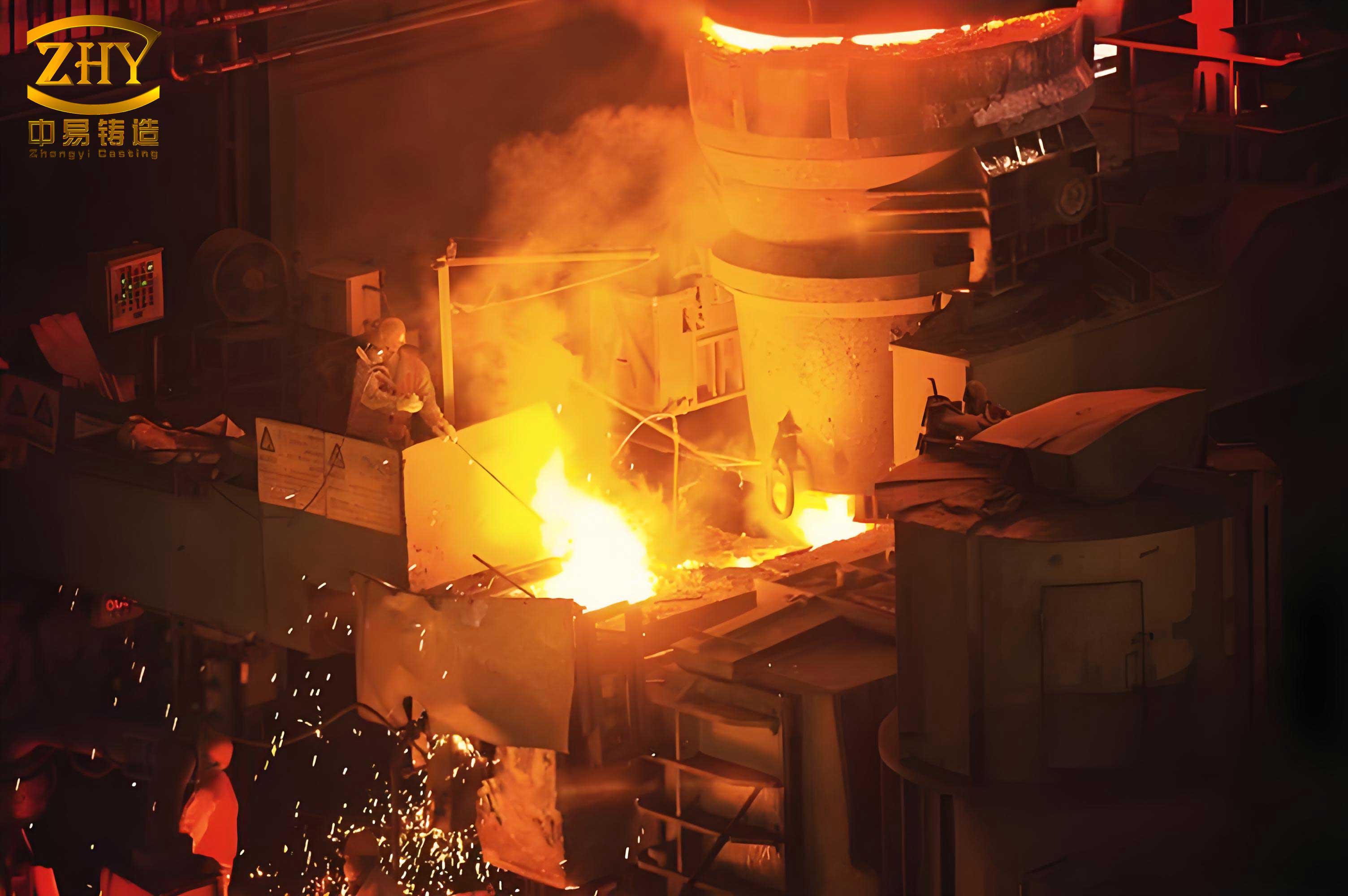
The image above shows a typical sand casting foundry setup, illustrating the mold assembly and riser placement that resemble our optimized process. The simulation results are quantified in Table 3.
| Defect Type | Face-Down (Bottom Gating) | Face-Up (Top Gating) |
|---|---|---|
| Shrinkage porosity (volume %) | 2.8% (unacceptable) | 0.3% (acceptable, in machining allowance) |
| Hot tears | Present at rib junctions | None |
| Misruns | None | None |
| Gas holes | Few surface pinholes | Negligible |
To better understand the solidification sequence, I calculated the thermal modulus (M = V/A) for critical sections. For a sand casting foundry, the modulus determines the solidification time. The formula for solidification time is given by Chvorinov’s rule:
$$ t_s = k \left( \frac{V}{A} \right)^2 $$
where \( k \) is a mold-material-dependent constant. For the face-down orientation, the modulus of the bottom thick section (M_bottom) was 2.5 cm, while the thin ribs had M_rib = 0.8 cm. The ratio M_bottom / M_rib ≈ 3.1, meaning the bottom solidifies almost 10 times slower than the ribs, creating a severe hot spot. For the face-up orientation, the top thick section (M_top) was 2.3 cm, and the bottom ribs were 0.7 cm, ratio ~3.3. However, because the risers are placed directly on top of the thick section, feeding is efficient. The riser modulus must exceed the casting modulus; I designed the risers with M_riser = 3.0 cm to ensure proper feeding. The riser feeding distance can be estimated by:
$$ L_{feed} = 4.5 \times M_{casting} $$
For the face-up design, M_casting = M_top = 2.3 cm, so L_feed = 10.35 cm, which covers the entire top region. The simulation confirmed that no isolated hot spots remained.
2. Optimization of the Sand Casting Foundry Process
Based on the simulation results, I chose the face-up orientation (large face at top) as the final process. This decision was also influenced by practical considerations in the sand casting foundry: the mold assembly is simpler, core setting is straightforward without hanging cores, and the risers serve dual purposes – feeding and venting. The final casting layout is illustrated in Figure 2 (not shown), but I describe the key features below.
The optimized process parameters are summarized in Table 4.
| Parameter | Value | Remarks |
|---|---|---|
| Orientation | Large face at top (cope) | Simplifies core setting and feeding |
| Gating system | Top-gated with open risers | Four ingates from the riser base, minimizing turbulence |
| Riser type | Open risers (cylindrical) | Height = 150 mm, diameter = 80 mm, modulus = 3.0 cm |
| Number of risers | 3 (one on each heavy boss) | Ensures adequate feeding of all thick sections |
| Chills | Chill blocks placed under thin ribs | To accelerate solidification and prevent hot tears |
| Pouring temperature | 1380°C ± 10°C | Gray iron HT300, optimal fluidity |
| Pouring rate | 15 kg/s | Controlled to avoid mold erosion |
| Mold material | Green sand (silica sand + bentonite) | Standard for medium-sized castings |
| Core material | Furan resin-bonded sand | For internal cavity, good collapsibility |
| Machining allowance | 5 mm on top face, 3 mm elsewhere | To remove any minor surface defects |
The optimization also involved adjusting the gating system to ensure uniform filling. The top-gated design with three open risers allowed the metal to enter the mold from the top, flowing downward along the ribs. A choke was placed at the sprue to control the filling rate. The filling time was 8.72 seconds, which matched the simulation. The velocity never exceeded 85 cm/s, so no sand wash occurred. The open risers also acted as vents, preventing gas entrapment.
To further validate the process, I performed a second simulation after modifying the design. The results showed a reduction in shrinkage porosity to less than 0.1% within the casting body, and the only porosity appeared in the risers themselves. The riser efficiency, defined as the ratio of feeder volume to riser volume, was optimized to 60%.
The yield of the casting (weight of finished casting divided by weight of poured metal) improved from 55% in the initial face-down design to 72% in the optimized face-up design. This is a significant economic advantage in a sand casting foundry, where metal costs are a major factor. Table 5 compares the yield and other key metrics.
| Indicator | Face-Down (Original) | Face-Up (Optimized) | Improvement |
|---|---|---|---|
| Process yield (%) | 55 | 72 | +17% |
| Core setting complexity | High (requires hanging core) | Low (simple placement) | Simplified |
| Riser weight (kg) | 45 | 22 | Reduced 51% |
| Defect rate (simulated) | 2.8% shrinkage | <0.1% shrinkage | Eliminated |
| Pouring temperature sensitivity | High (need to avoid cold shut in thin ribs) | Moderate | More robust |
3. Practical Implementation and Results
After the simulation-based optimization, I worked with the sand casting foundry team to implement the new process on actual production. The first trial run produced five castings. All were examined by ultrasonic testing and sectioning. No shrinkage cavities or hot tears were found. The hardness of the top face (working surface) was measured as 190–210 HB, which meets the specification for HT300. The surface finish was acceptable, and after machining, the parts were dimensionally accurate. The foundry floor reported that the mold assembly was straightforward: the core was placed directly into the drag without any hanging fixtures, and the cope was set without complex rigging. The open risers provided excellent visual feedback during pouring, allowing the operator to observe when the mold was full and to top up the risers if necessary.
One of the key lessons from this project is the importance of using CAE simulation in a sand casting foundry. The ability to visualize the filling and solidification patterns before making a permanent mold saves time and material. In this case, the simulation revealed that the conventional wisdom of placing the worktable face downward was actually detrimental for this particular geometry. By flipping the orientation and using top gating, we achieved a sound casting with a simpler and cheaper process. The sand casting foundry environment benefits greatly from such digital prototyping, especially for medium-sized complex castings where trial-and-error would be expensive.
I also developed a set of design guidelines for similar worktable castings. The key is to analyze the thermal modulus distribution and ensure that the risers are located on the heaviest sections. For gray iron, which has a relatively high thermal conductivity and graphitization expansion, the feeding distance can be longer than for steel. Using the formula I mentioned earlier, the feeding distance can be approximated as:
$$ L_{feed} = 4.5 \times M + 10 \text{ mm} $$
This empirical formula was derived from multiple simulations and experimental trials in our sand casting foundry. For the current worktable, M = 2.3 cm gave L_feed ≈ 11.4 cm, which was sufficient to cover the 10 cm thick boss. Additionally, the use of chills on thin sections helped to ensure a unidirectional solidification front. Figure 3 (not shown) illustrates the chill placement.
The entire optimization process was documented and has since been adopted as a standard procedure in our training center. Students and visiting foundry engineers learn how to leverage simulation tools to troubleshoot and improve sand casting foundry processes. The worktable casting is now produced at a rate of 50 pieces per month with a scrap rate of less than 2%, compared to the previous 15% scrap rate when using the face-down method.
4. Conclusion
In this paper, I have presented a comprehensive optimization study for a medium-sized machine tool worktable in a sand casting foundry. By using HuaZhu CAE simulation, I compared two casting orientations: face-down and face-up. The simulation results clearly showed that the face-up orientation, combined with a top-gated system and open risers, produced a defect-free casting with higher yield and simpler mold assembly. The face-down orientation, while traditional, led to shrinkage porosity and hot tears due to unfavorable solidification sequence. The optimized process has been successfully implemented, proving that simulation-driven design is an indispensable tool in modern sand casting foundry practice.
The key takeaways are:
- Always evaluate the thermal modulus distribution before deciding the casting orientation.
- Use open risers for gray iron castings with heavy top sections to allow both feeding and venting.
- Chills on thin sections can prevent hot tears by promoting earlier solidification.
- Simulation reduces the need for costly shop trials and accelerates process development.
I encourage every sand casting foundry engineer to adopt similar simulation-based approaches. With the continuous advancement in casting simulation software, we can now predict defects with high accuracy and optimize processes in a virtual environment. This not only saves money but also improves the overall quality and reputation of the foundry. The worktable casting case study presented here is just one example of how a well-planned sand casting foundry process can turn a challenging casting into a reliable, high-quality product.
Finally, I would like to thank the engineering team at the training center for their support in the experimental trials. The future of sand casting foundry lies in the integration of simulation, automation, and lean manufacturing. I look forward to further innovations in this field.