
In my extensive experience within foundry operations, lost foam casting has proven to be a transformative process for producing complex, near-net-shape components. As a process engineer, I have overseen the development of numerous castings, with a particular focus on intricate shell structures such as truck transmission housings. Compared to conventional sand casting, this method involves creating a foam replica of the desired part, coating it with refractory material, embedding it in unbonded sand, and then replacing the foam with molten metal during pouring. The advantages for producing robust and precise shell castings are significant: exceptional dimensional accuracy, immense design flexibility, excellent environmental cleanliness, and high production efficiency. However, the core challenge lies in the physics of the process itself. The metal front must progressively vaporize, liquefy, and displace the foam pattern, creating complex fluid dynamics and gas evolution that directly govern the final quality of the shell castings. Therefore, the meticulous design of the gating system is not merely a step but the cornerstone of process stability and part integrity in lost foam casting. This article synthesizes theoretical principles with hard-won practical knowledge, using the specific example of an HT250 truck transmission shell casting, to elaborate on the systematic design, calculation methodology, and optimization strategies for the gating system, providing a reliable framework for developing high-integrity shell castings.
Fundamental Principles of Gating System Design
The primary function of the gating system in lost foam casting transcends simple metal delivery. It serves as the critical control element for managing the interaction between the advancing metal and the decomposing foam pattern. For complex shell castings, its design must fulfill three interdependent functions:
- Stable Mold Filling: To promote laminar flow, minimizing turbulence that can entrain gaseous and liquid pyrolysis products into the metal, leading to defects in the thin walls of the shell castings.
- Pyrolysis Product Evacuation: To regulate the relative rates of metal flow and foam degradation, ensuring gases escape through the coating and preventing mold collapse or carbonaceous defects.
- Feeding and Thermal Gradient Control: To establish a favorable temperature gradient, often utilizing the gating system itself to enable directional solidification, which is crucial for pressure-tightness in shell castings.
The placement of the casting within the flask is the first and most critical decision. For shell castings like transmission housings, I prioritize vertical or slanted pouring positions. This avoids large horizontal upward-facing surfaces where pyrolysis residue can become trapped. Empirical data from our shop floor shows this simple orientation change can reduce carbon defect rates on the top surfaces of iron shell castings by over 30%. Furthermore, critical machined surfaces are positioned downward or laterally, relegating non-critical or readily cleanable surfaces to the top. This minimizes slag and shrinkage defects on functional areas. A frequently overlooked aspect is ensuring adequate dry sand compaction in deep pockets and blind holes of the shell castings; we mandate a compaction density of no less than 85% in these areas to prevent wall movement or collapse.
The choice of gating method is alloy-dependent and must be tailored to the specific geometry of the shell castings. The following table summarizes the approaches I have found most effective.
| Alloy Type | Recommended Gating Method | Rationale for Shell Castings |
|---|---|---|
| Gray Iron, Ductile Iron | Bottom or Side Gating | Minimizes turbulence and carbon pickup in thick sections; promotes cleaner metal in thin-wall regions of the shell. |
| Cast Steel | Top Gating with Open Risers | Addresses high feeding demand of thick sections; risers compensate for greater solidification shrinkage. |
| Aluminum Alloys | Bottom or Stepped Gating | Prevents oxide film entrainment and cold shuts in thin, expansive sections typical of aluminum shell castings. |
| Complex Thin-Wall Shell Castings | Vertical Slot Gating | Distributes metal quickly with minimal flow resistance across large, thin areas, reducing filling-related defects. |
Detailed Case Analysis: Truck Transmission Shell Casting
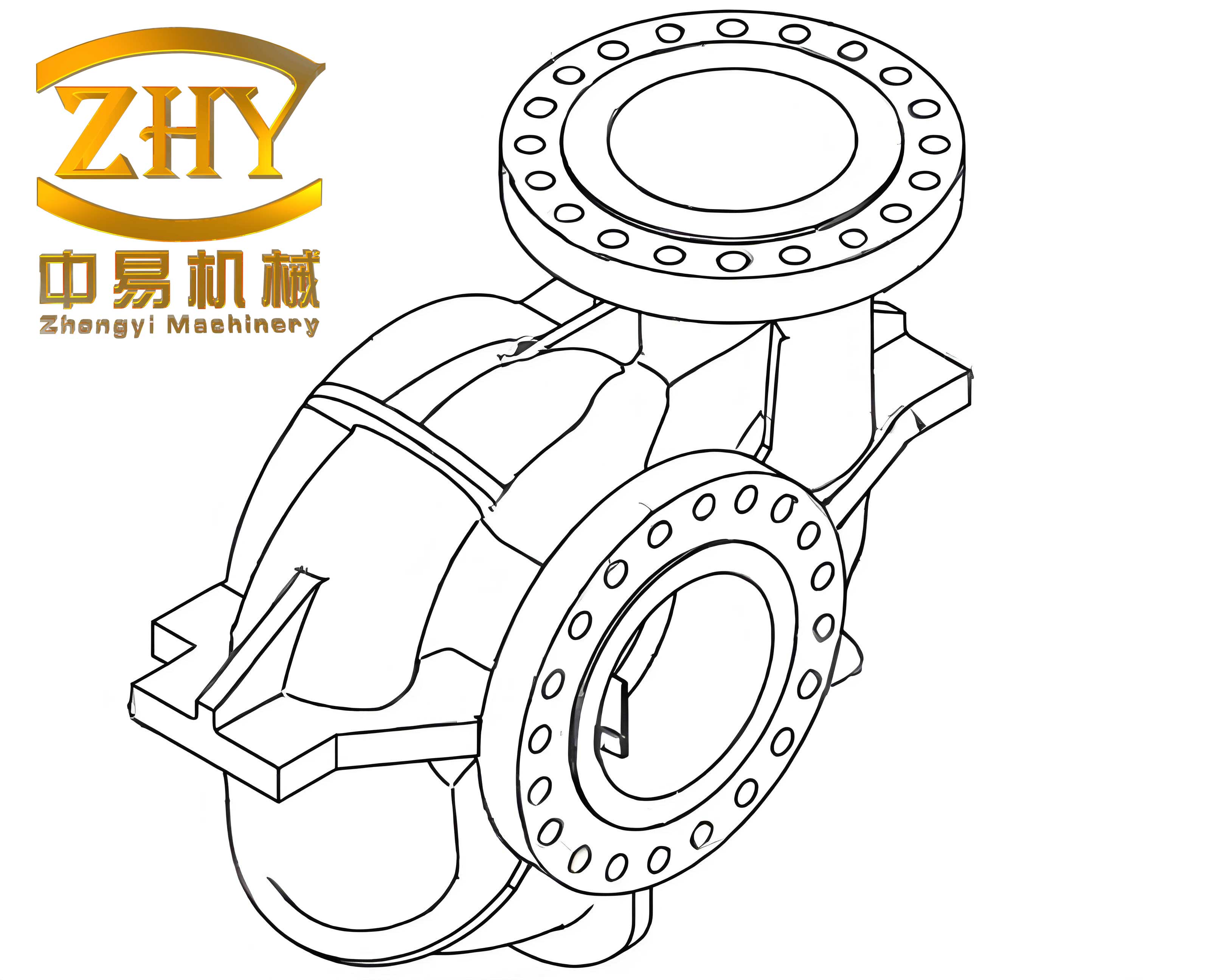
The development of a robust process for a specific shell casting best illustrates these principles. The component in question is a truck transmission housing, a quintessential example of a complex, thin-wall shell casting requiring high dimensional stability and pressure tightness.
Basic Process Parameters
The shell casting, with a material specification of HT250, has an envelope dimension of 463 mm x 500 mm x 350 mm and a nominal wall thickness of 8 mm. The casting weight is approximately 86 kg. We use expandable polystyrene (EPS) beads with a pre-expanded density of 22-23 kg/m³ for patternmaking. The coating is applied via dipping. The key pouring parameters are a temperature range of 1,460-1,510°C and a mold cavity pressure of -0.03 to -0.07 MPa (vacuum) during pouring. Production runs on a domestic lost foam molding line.
Determining Sprue Height and Casting Orientation
To facilitate uniform sand filling and compaction around this deep, shell-like structure, the pattern is oriented with its larger rear face upward, placed vertically in the flask. Given the significant height (463 mm) of this shell casting, a bottom-gating system is selected. This promotes calm, upward filling, allowing pyrolysis gases to escape ahead of the metal front and significantly reducing the risk of gas porosity in the upper sections of the shell. The ingates are located on a machined surface (Surface A) to allow for clean finishing after knock-off. The sprue height is calculated based on flask geometry: a bottom sand bed of 200 mm, the casting height of 463 mm, and a clearance of 50-150 mm from the sprue top to the flask lip for plastic film sealing. This results in a total sprue height of 680 mm.
Calculating Gating System Cross-Sectional Areas
There is no single universal formula for lost foam gating design, but the principles of hydraulics provide a solid foundation. I primarily reference and adapt the well-established Ozanic’s formula for sand casting, adjusting for the unique back-pressure and flow resistance presented by the vaporizing foam in shell castings. The formula calculates the choke area, which in a bottom-gated system is typically the total ingate area.
The fundamental equation is:
$$S_{choke} = \frac{m}{\rho \cdot t \cdot \mu \sqrt{2 g H_p}}$$
Where:
- $S_{choke}$ is the total choke area (m²).
- $m$ is the total mass of metal flowing through the choke (kg). This includes the casting and the gating system weight. For an 86 kg shell casting with an expected yield of ~85%, $m \approx 101$ kg.
- $\rho$ is the density of molten iron, taken as 7,000 kg/m³.
- $t$ is the mold filling time (s). We use an empirical relation adjusted for lost foam: $t = K \sqrt{m}$, where $K$ is 0.85 under vacuum conditions. Thus, $t = 0.85 \times \sqrt{101} \approx 8.54$ s.
- $\mu$ is the discharge coefficient, accounting for system friction. For a well-designed lost foam system, a value of 0.4-0.5 is appropriate. We use $\mu = 0.5$.
- $g$ is gravitational acceleration, 9.81 m/s².
- $H_p$ is the average metallostatic pressure head during filling (m). For a bottom-gated system: $H_p = H_0 – \frac{P}{2}$, where $H_0$ is the height from the sprue top to the casting top (0.463m + 0.22m = 0.683m) and $P$ is the casting height (0.463m). Therefore, $H_p = 0.683 – (0.463/2) = 0.452$ m.
Substituting these values:
$$S_{choke} = \frac{101}{7000 \times 8.54 \times 0.5 \times \sqrt{2 \times 9.81 \times 0.452}} \approx 1.1 \times 10^{-3} \, \text{m}^2 = 11 \, \text{cm}^2$$
We employ a pressurized system to maintain a full sprue and minimize air aspiration. For gray iron, a typical area ratio is: ΣIngate : ΣRunner : Sprue = 1 : 1.2 : 1.4.
- Total Ingate Area (ΣS_ingate): Target = 11 cm². We implement two ingates, each 70mm wide x 7mm thick = 4.9 cm². Total = 9.8 cm² (close to target, accounting for practical coating thickness).
- Runner Area (ΣS_runner): Target = 13.2 cm². A single runner with a trapezoidal cross-section of 65mm x 20mm provides 13 cm².
- Sprue Area (S_sprue): Target = 15.4 cm². A cylindrical sprue with a bottom diameter of 45mm provides an area of 15.9 cm². The top is flared to 80mm to match the pouring cup.
The simplicity of these shapes—cylindrical sprue, trapezoidal runner, flat ingates—is intentional for ease of pattern assembly and coating.
Design of Auxiliary Support Structures
Thin-wall shell castings are particularly susceptible to pattern distortion during handling, coating, and sand filling. To guarantee dimensional fidelity, we integrate reinforcement ribs directly into the pattern. For the large, flat top cover surface of this transmission shell, we designed and molded “two horizontal and one vertical” foam ribs to limit distortion during processing to under 2 mm. These ribs become part of the final metal casting and are removed during machining. For critical dimensions on the rear face, we use custom-cut glass fiber bars epoxied onto the pattern. These bars maintain precise distances during the process and burn out during pouring, leaving no residue. The choice between foam and fiber reinforcements depends on the required precision and post-cast cleaning effort.
| Process Variable | Typical Range for Iron Shell Castings | Primary Influence on Defects |
|---|---|---|
| Pattern Density (EPS) | 20-24 kg/m³ | Higher density increases gas load, risk of porosity/carbon defects. Lower density risks pattern weakness. |
| Coating Thickness | 0.8-1.2 mm | Thicker coatings improve surface finish but can hinder gas permeability, leading to blows. |
| Pouring Temperature | 1,450-1,520 °C | Lower temperature increases cold shuts/misruns. Higher temperature improves fluidity but increases shrinkage and metal-mold reaction. |
| Mold Vacuum | -0.04 to -0.07 MPa | Enhances mold strength, removes pyrolysis gases faster. Excess vacuum can increase penetration defects. |
Riser Design for Shell Castings
In bottom-gated systems, the last metal to fill is at the top of the casting. This area accumulates the highest concentration of foam pyrolysis products (liquid and gaseous), leading to a high risk of carbonaceous slag defects. While increasing pouring temperature and vacuum can mitigate this, the most robust solution is to employ a slag collector riser at the top of the shell casting. This riser serves a dual purpose: it collects the contaminated metal, and it acts as a thermal cap, promoting directional solidification toward the ingates and reducing isolated shrinkage in the upper casting walls. The design starts with solidification simulation to identify thermal centers. The riser diameter ($D_r$) is typically 1.5 to 2 times the local hot spot thickness ($T_h$) of the shell casting, and its height ($H_r$) is 1.2 to 2 times $D_r$.
$$ D_r \approx (1.5 \,\text{to}\, 2.0) \times T_h $$
$$ H_r \approx (1.2 \,\text{to}\, 2.0) \times D_r $$
For our housing, a hot spot of ~20mm led to a riser design of 40mm diameter and 70mm height, fabricated from low-density foam sheet to minimize gas generation.
Application of Ceramic Filters
A persistent quality issue with pressure-tight shell castings was micro-leakage. Scanning Electron Microscopy (SEM) and Energy-Dispersive X-ray Spectroscopy (EDS) analysis of defective areas revealed non-metallic inclusions rich in oxygen, silicon, and aluminum—elements traceable to ladle lining refractories and coating material. While improved slagging practices and ladle management helped, the definitive solution was integrating a ceramic foam filter into the gating system.
Based on the total metal mass of ~95 kg, we selected a round filter with a diameter of 60 mm and a pore density of 10 Pores Per Linear Inch (PPI). The sprue was redesigned with a bonding shelf, and the filter was securely sealed and mounted between the sprue and the runner using high-temperature adhesive tape. This positioning protects the filter from direct initial impact, extending its effective filtration life. The filter effectively traps macroscopic and microscopic inclusions, dramatically improving the metallurgical cleanliness and pressure integrity of the final shell castings.
| Common Defect | Typical Causes in Shell Castings | Corrective Actions via Gating/Rigging |
|---|---|---|
| Carbonaceous Slag (Folds) | Accumulation of foam pyrolysis products at metal front, especially with top-gating. | Use bottom/side gating; implement slag collector risers at casting top; optimize pouring temperature/vacuum. |
| Shrinkage Porosity | Inadequate feeding due to unfavorable thermal gradients. | Design gating to create directional solidification toward risers; use risers on isolated hot spots identified via simulation. |
| Inclusions (Non-Metallic) | Entrainment of coating, sand, or ladle slag. | Implement ceramic foam filters in the gating system; ensure stable, non-turbulent filling. |
| Pattern Distortion | Warping of thin-wall foam patterns during processing. | Incorporate foam or glass fiber reinforcement ribs into the pattern assembly. |
Conclusions and Synthesis
The successful production of high-quality shell castings via lost foam casting hinges on a scientifically guided yet pragmatically executed gating system design. For the truck transmission housing, the process involved: 1) strategic vertical orientation and bottom gating, 2) calculation of choke area using a modified Ozanic’s formula ($S_{choke} = m / (\rho t \mu \sqrt{2 g H_p})$), 3) implementation of a pressurized system with a 1:1.2:1.4 area ratio, 4) addition of foam and fiber reinforcement to combat distortion in thin sections, 5) placement of a slag-collecting riser at the metal’s terminal fill point, and 6) integration of a ceramic foam filter for inclusion control. This holistic approach, validated through both simulation and the stable production of tens of thousands of castings, underscores that effective design is an integration of fluid dynamics, heat transfer, and material science principles. Furthermore, embracing advancements like simulation software, ceramic filters, and specialized riser technologies is essential for pushing the quality boundaries of complex shell castings in lost foam foundries.