
As a foundational pillar of modern manufacturing, the production of high-quality sand casting parts remains a primary objective for foundries worldwide. The traditional sand casting process is renowned for its versatility, cost-effectiveness, and ability to produce complex geometries in a wide range of alloys, accounting for over 90% of all cast components. However, the relentless demands of contemporary industries—such as automotive, aerospace, and heavy machinery—require components with exceptional dimensional accuracy, superior surface finish, and near-zero internal defects. This pursuit of excellence has led to the development of advanced methodologies under the umbrella of Precision Sand Casting. In my exploration of this field, I focus on a particularly potent synergy: the integration of Rapid Prototyping Manufacturing (RPM) for pattern making and Transfer Coating Technology for mold surface enhancement. This combination represents a transformative approach to achieving near-net-shape, high-integrity sand casting parts.
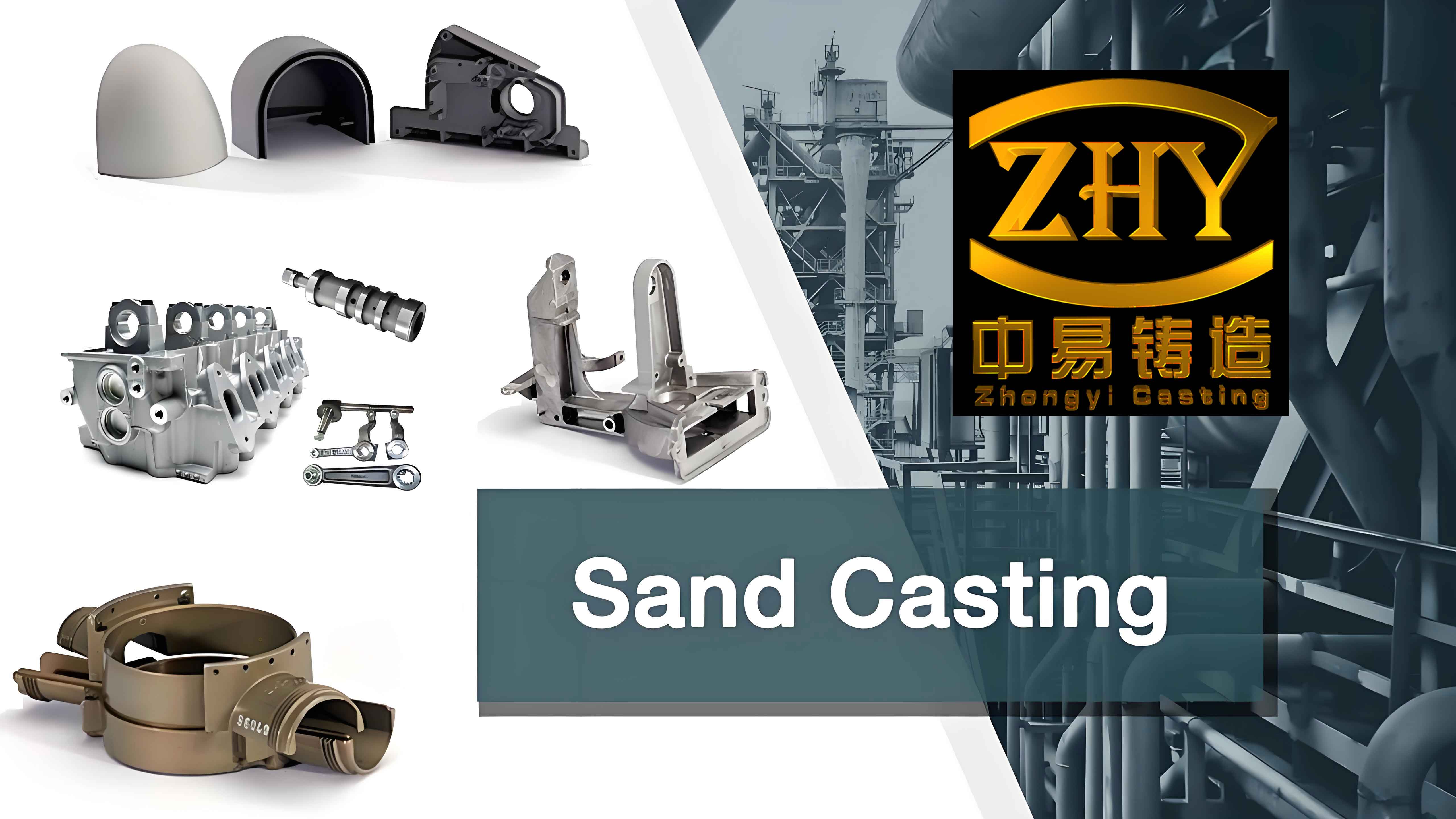
The core challenge in traditional sand casting lies in the replication fidelity from pattern to mold cavity. Wooden or metal patterns have limitations in complexity, lead time, and achievable surface detail. Furthermore, applying a refractory coating *after* molding can unevenly alter dimensions and introduce defects. Precision Sand Casting aims to overcome these hurdles by ensuring the mold cavity is an exact, high-fidelity negative of the intended part. This is where RPM and transfer coatings converge. RPM allows for the direct fabrication of accurate, complex patterns from CAD data, while transfer coating ensures this accuracy is perfectly imparted onto the mold surface without dimensional occupation. The result is the capability to mass-produce sand casting parts with characteristics approaching those of investment casting, but with the economic and scalability benefits of sand-based processes.
The Role of Rapid Prototyping Manufacturing (RPM)
My investigation into precision methods begins with the pattern source. RPM technologies have revolutionized the speed and flexibility of pattern production. These additive manufacturing techniques build three-dimensional patterns layer by layer directly from a digital model, eliminating the need for costly and time-consuming tooling for prototype or low-volume production runs. For creating patterns for sand casting parts, several RPM technologies are relevant, each with distinct advantages for dimensional accuracy and surface quality.
The fundamental principle underpinning all RPM techniques is additive layering, which can be conceptually described by the process of building a volume from discrete slices. If a digital model $M$ is sliced into layers of thickness $t$, the physical part $P$ is built by sequentially adding material for each layer $L_i$:
$$ P = \sum_{i=1}^{n} L_i $$
where $n$ is the total number of layers. The achievable accuracy of the final pattern is a function of layer thickness $t$ and the specific process’s ability to solidify or fuse material precisely within the bounds of each $L_i$.
For sand casting applications, the key RPM technologies and their characteristics are summarized below:
| RPM Technology | Primary Material | Key Advantages for Sand Casting | Limitations for Pattern Making |
|---|---|---|---|
| Stereolithography (SLA) | Photopolymer Resin | Excellent surface finish, high detail resolution. | Material can be brittle, may require supports. |
| Selective Laser Sintering (SLS) | Polymer Powder (Nylon, etc.) | Good strength, no support structures needed. | Porous surface, generally rougher finish than SLA. |
| Fused Deposition Modeling (FDM) | ABS, PLA Filaments | Robust patterns, low material cost, good dimensional stability. | Visible layer lines, staircase effect on curved surfaces. |
| Binder Jetting (e.g., for sand) | Foundry Sand + Binder | Direct production of sand molds/cores, high complexity. | Mold strength and surface finish may require post-processing. |
In my work, FDM-processed ABS patterns have proven highly effective. While the surface exhibits layer lines, they are typically fine enough to be successfully managed and replicated by the subsequent transfer coating process. The formula for the theoretical surface roughness $R_a$ of an FDM part, influenced by layer height $h$ and deposition angle $\theta$, can be approximated as:
$$ R_a \approx k \cdot \frac{h}{\sin(\theta)} $$
where $k$ is a process-dependent constant. By minimizing $h$, a smoother pattern surface is achieved, forming a better base for the coating.
Transfer Coating Technology: The Principle of Non-Occupancy
The second pillar of my precision approach is Transfer Coating Technology. Traditional mold coatings are brushed, sprayed, or dipped onto the cured sand mold. This “occupying” method inevitably alters the cavity dimensions—the coating thickness directly subtracts from the metal volume, affecting the final size of the sand casting parts. More critically, it can lead to runs, drips, uneven coverage, and poor replication of fine pattern details.
Transfer coating, or non-occupying coating, inverts this sequence. The refined refractory coating is first applied directly onto the pattern (or core box) surface. The molding sand (typically a chemically-bonded system like phenolic urethane or sodium silicate) is then packed around the coated pattern. Both the coating and the sand cure simultaneously under the constraint of the pattern. Upon demolding, the adhesion between the coating and the cured sand mold ($\sigma_{T-S}$) is engineered to be significantly greater than the adhesion between the coating and the pattern surface ($\sigma_{T-M}$). This ensures the coating cleanly and completely transfers from the pattern to the mold cavity surface.
The fundamental condition for successful transfer is:
$$ \sigma_{T-S} > \sigma_{T-M} $$
The coating thus becomes an integral, perfectly conformal skin on the mold wall. Since it sets in place *before* the sand is packed, it does not occupy the designed cavity space; it *defines* it. This results in a mold cavity that is a dimensionally precise inverse of the pattern, capturing even fine textures and details, directly leading to superior surface quality and dimensional accuracy in the final sand casting parts.
Deconstructing the Transfer Coating: Composition and Function
Developing a coating formulation that satisfies the transfer condition and performs under molten metal is critical. A transfer coating is a complex suspension with several key functional components, as outlined in the table below. The specific formulation must be tailored to the alloy being poured (e.g., cast iron, steel, aluminum) and the sand binder system used.
| Component Category | Primary Function | Common Examples | Key Considerations for Transfer |
|---|---|---|---|
| Refractory Filler | Provides thermal barrier, defines coating body. | Graphite, Zircon, Alumina, Chromite, Mullite. | Particle size distribution affects surface finish. Must be chemically inert to molten metal. |
| Liquid Carrier | Medium for suspension and application. | Water, Isopropanol, Ethanol. | Choice affects drying/curing speed. Alcohol carriers offer faster, “air-set” curing. |
| Binder System | Provides green strength and high-temperature integrity. | Latexes (e.g., acrylic), Resins (furan, phenolic), Silicates, Cellulosics. | Critical for achieving $\sigma_{T-S}$. Must cure compatibly with mold sand binder. |
| Suspension & Thixotropic Agents | Prevents settling, controls viscosity/flow. | Bentonite clay, Attapulgite, Fumed silica, Organic gums. | Ensures uniform application without sagging on vertical pattern surfaces. |
| Wetting & Adhesion Modifiers | Controls interface adhesion. | Surfactants, Silane coupling agents. | Delicately balances $\sigma_{T-M}$ to be low enough for clean release but sufficient for application. |
The performance of a coating can be modeled by considering its behavior as a non-Newtonian fluid. Its apparent viscosity $\eta$ during application often follows a shear-thinning power-law model:
$$ \eta = m \cdot \dot{\gamma}^{n-1} $$
where $\dot{\gamma}$ is the shear rate, $m$ is the consistency index, and $n$ is the power-law index ($n<1$ for shear-thinning). This property allows it to flow under the shear of spraying or brushing ($\text{high } \dot{\gamma}$) but immediately thicken to prevent sagging once applied ($\text{low } \dot{\gamma}$).
A generalized, example formulation for a water-based transfer coating suitable for gray iron sand casting parts might have the following composition by weight:
| Ingredient | Weight % | Function |
|---|---|---|
| Alumina Flour (325 mesh) | 60% | High-temperature refractory base |
| Flake Graphite | 15% | Provides lubrication and carbon layer for iron casting |
| Colloidal Silica (Binder) | 12% | Inorganic binder, cures by dehydration |
| Acrylic Latex Emulsion | 5% | Organic co-binder for green strength and flexibility |
| Sodium Bentonite | 2% | Suspension and thixotropic agent |
| Carboxymethyl Cellulose (CMC) | 0.3% | Water retention and viscosity control |
| Wetting Agent (Surfactant) | 0.2% | Ensures complete coverage of pattern surface |
| Water | Balance to 100% | Carrier liquid |
Integrated Process Workflow and Experimental Validation
The synergy of RPM and transfer coating is best illustrated through a defined process chain. I have systematically followed this workflow to produce precision sand casting parts, using a component like a brake drum as a case study. The process can be formalized in the following sequence:
1. CAD Model & Process Design: A 3D solid model of the final part is created. Critical machining allowances (minimized) and necessary draft angles (also minimized due to the excellent release from the transfer coating) are applied digitally to generate the pattern model. Gating and risering systems are designed concurrently using simulation software to ensure soundness.
2. RPM Pattern Fabrication: The digital pattern file is sent to an FDM system. An ABS plastic pattern is built with optimized parameters (minimal layer height, proper orientation) to achieve the best possible surface finish and dimensional accuracy.
3. Coating Preparation & Application: The transfer coating is prepared and its rheological properties (viscosity, density, thixotropy index) are measured. It is then applied uniformly onto the ABS pattern surface via careful spraying or brushing to achieve a consistent thickness, typically between 0.2mm and 0.5mm.
4. Molding with Coated Pattern: The coated pattern is placed in a molding flask. A fast-curing phenolic urethane no-bake sand is mixed and compacted around it. The resin binder in the sand and the binders in the coating cure simultaneously over a period of minutes.
5. Demolding & Coating Transfer: Once cured, the mold is opened. Due to the engineered adhesion balance ($\sigma_{T-S} > \sigma_{T-M}$), the coating releases cleanly from the ABS pattern and remains perfectly adhered to the sand mold surface, creating a smooth, precise cavity.
6. Casting & Finishing: The mold is assembled, poured with molten iron, cooled, and shaken out. The resulting casting requires minimal finishing, as the surface is smooth and dimensions are close to net shape.
The quantitative improvement can be significant. While traditional sand casting might achieve dimensional tolerances per ISO 8062 standard of CT12 to CT14 for a given dimension, the integrated precision process can consistently yield tolerances of CT8 to CT10. Surface roughness can improve from the typical $R_a = 12.5\text{–}25 \mu m$ range down to $R_a = 3.2\text{–}6.3 \mu m$, a substantial enhancement for sand casting parts.
Conclusion and Future Trajectory
The integration of Rapid Prototyping Manufacturing and Transfer Coating Technology presents a formidable and practical pathway to Precision Sand Casting. This methodology directly addresses the core challenges of dimensional control and surface finish in sand-based foundry processes. By utilizing RPM, complex and accurate patterns can be produced rapidly and without traditional tooling constraints. By employing transfer coating, the intrinsic accuracy of these patterns is faithfully and completely imparted to the mold cavity in a non-occupying manner, overcoming the drawbacks of conventional coating techniques.
The outcome is the ability to manufacture sand casting parts that compete with more expensive casting methods on quality, while retaining the material flexibility, scalability, and cost-effectiveness of sand casting. This is particularly valuable for the production of prototype series, complex cores, and low-to-medium volume runs of high-value components where tooling costs for die casting or investment casting are prohibitive.
Future advancements in this field lie in further optimizing the coating chemistry for even cleaner release and higher refractoriness, integrating in-situ curing methods (e.g., UV-curable coatings for use with transparent RPM patterns), and streamlining the entire digital thread from CAD to finished casting through automation. The continued evolution of binder jetting 3D printing for sand molds also offers a complementary direct digital approach, where the transfer coating principle could be adapted to enhance the surface of printed cores. Ultimately, the pursuit of precision in sand casting is an ongoing journey of innovation, relentlessly pushing the boundaries of what is possible for these most fundamental of manufactured components.