
In recent years, the application of 3D printing technology in sand casting has expanded significantly, driven by its flexibility, precision, and ability to accelerate product development cycles. This technology is now commonplace in industries such as diesel engine manufacturing and aerospace, where complex casting parts are often required for prototyping and low-volume production. Our project focused on leveraging rapid prototyping for the development of a large-size box-type casting part intended for a large-bore diesel engine. Since this casting part was solely for research purposes without mass production demands, it presented an ideal scenario for employing 3D printing processes. This article details our comprehensive approach, encompassing three-dimensional process design, CAE simulation analysis, rapid manufacturing of sand cores and molds, and the subsequent steps of casting assembly, pouring, and cleaning. Throughout this endeavor, we emphasized the integration of advanced digital tools to optimize the quality and efficiency of producing such intricate casting parts.
The foundation of our rapid prototyping methodology lies in meticulous three-dimensional process design. For the box-type casting part, with dimensions of 2100 mm in length, 2100 mm in width, and 550 mm in thickness, and a maximum wall thickness of 290 mm, we selected QT500-7 as the material—a high-strength alloy ductile iron known for its significant shrinkage tendencies. The internal cavity of this casting part was composed of two primary sand cores, labeled Core 1 and Core 2, which formed complex geometries essential for the diesel engine’s functionality. To achieve the desired accuracy, we adopted a single-piece production process using 3D additive manufacturing for sand cores and molds, targeting a casting tolerance grade of CT10. Machining allowances were designed according to MA-E level, with a primary allowance of 10 mm to accommodate subsequent finishing operations for these precision casting parts.
Determining the appropriate shrinkage rate was critical due to the material properties and structural constraints of the casting part. QT500-7, as a high-strength alloy iron, exhibits substantial solidification shrinkage, and the presence of thick, massive sand cores within the casting part increases resistance during contraction. After thorough analysis, we set the shrinkage rate at 0.8%. This value was derived from empirical data and material science principles, considering factors like thermal expansion and phase transformations during cooling. The relationship can be expressed through a simplified model for shrinkage in casting parts: $$ S = \alpha \cdot \Delta T + \beta \cdot C $$ where \( S \) is the total shrinkage rate, \( \alpha \) is the thermal contraction coefficient, \( \Delta T \) is the temperature drop during solidification, and \( \beta \) is a factor accounting for metallurgical shrinkage influenced by carbon content \( C \). For QT500-7, with its specific composition, we calibrated these parameters to arrive at the 0.8% value, ensuring dimensional accuracy in the final casting parts.
The gating and riser system design was tailored to the flat box structure of the casting part. We opted for a middle-pouring gating system with the parting plane positioned at the mid-thickness location. To ensure high-quality casting parts, a fast pouring approach was deemed necessary. The casting part’s mass \( m \) was 5600 kg, and the pouring time \( t \) was calculated using the empirical formula: $$ t = \sqrt[3]{m} + \sqrt{m} = \sqrt[3]{5600} + \sqrt{5600} \approx 92.6 \text{ seconds} $$ This formula accounts for the thermal dynamics and fluidity of molten iron when forming large casting parts. The choke cross-sectional area \( \sum A_{\text{choke}} \) was determined to regulate flow and minimize turbulence: $$ \sum A_{\text{choke}} = K \sqrt{m} = 1.55 \times \sqrt{5600} \approx 116 \text{ cm}^2 $$ Here, \( K \) is an empirical constant ranging from 1.1 to 2.0, where lower values are used for large, complex, and thin-walled casting parts, and higher values for small, thick-walled, and simple casting parts. Our design followed a partially choked open gating system, with sectional ratios set as \( F_{\text{vertical}}: F_{\text{horizontal}}: F_{\text{internal}} = 1.13: 1.0: 1.15 \). This configuration combines the advantages of both choked and open systems, facilitating slag trapping and smooth filling for defect-free casting parts.
To summarize key design parameters for the casting part, we compiled the following table, which highlights the integration of 3D printing constraints and traditional casting principles:
| Parameter | Value | Description |
|---|---|---|
| Dimensions | 2100 mm × 2100 mm × 550 mm | Overall size of the casting part |
| Max Wall Thickness | 290 mm | Critical for thermal management in casting parts |
| Material | QT500-7 | High-strength alloy ductile iron for durable casting parts |
| Shrinkage Rate | 0.8% | Optimized for material and geometry of casting parts |
| Casting Tolerance | CT10 | Precision level achievable with 3D printed molds for casting parts |
| Machining Allowance | 10 mm (MA-E level) | Standard for research-oriented casting parts |
| Pouring Time | 92.6 s | Calculated to ensure quality in large casting parts |
| Choke Area | 116 cm² | Designed to control flow dynamics in casting parts production |
Sand core and mold design was heavily influenced by the capabilities of rapid prototyping equipment. Due to size limitations of the 3D printers, the upper mold of the casting part was segmented into four sand cores, with weights of 2.3 t, 2.4 t, 0.5 t, and 0.7 t. Cores exceeding 2 t were equipped with lifting lugs and straps for safe handling and flipping. Vent holes and overflow risers were integrated into the upper mold sections to facilitate gas escape and excess metal flow, crucial for preventing defects in casting parts. The lower mold was divided into two sand cores, each weighing 1 t, with lifting holes on both top and sides. The internal cavity cores, Core 1 and Core 2, included features such as reinforcing columns to prevent fracture during assembly—later removed manually—and risers on Core 2 for feeding shrinkage. Vent channels were designed at core prints to ensure proper degassing. Given the manual core assembly and grinding box process, and to counteract mold wall movement in ductile iron casting parts, a buried box technique was employed.
CAE simulation analysis played a pivotal role in optimizing the design and preempting issues in casting parts. We utilized advanced software to simulate pouring, solidification, and potential defect formation. The simulations revealed that hot spots were predominantly located at thick sections, such as bolt hole areas in the corners and central oil passages of the casting part. These hot spots correlated with predicted shrinkage porosity sites. The simulation output, represented through temperature and solidification fraction plots, allowed us to identify critical areas requiring intervention. For instance, the thermal analysis indicated that unconventional risers or chills were necessary to address shrinkage in these regions. To enhance yield and cost-efficiency, we opted to use internal chills instead of risers for non-critical locations, a strategy validated by simulation results. The governing equation for heat transfer during solidification of casting parts can be expressed as: $$ \rho c_p \frac{\partial T}{\partial t} = \nabla \cdot (k \nabla T) + Q_{\text{latent}} $$ where \( \rho \) is density, \( c_p \) is specific heat, \( T \) is temperature, \( t \) is time, \( k \) is thermal conductivity, and \( Q_{\text{latent}} \) is the latent heat release during phase change. By solving this numerically, we predicted temperature gradients and optimized the placement of chills and risers for our casting parts.
The rapid prototyping of sand cores and molds was executed using binder jetting technology with silica sand as the primary material. This process offers high precision and is well-suited for complex casting parts. A detailed breakdown of the manufacturing approach is provided in the table below, emphasizing the adaptability of 3D printing for diverse mold components in producing casting parts:
| Component Name | Material | Manufacturing Method | Resin Content Range |
|---|---|---|---|
| Lower Mold 1 | Silica Sand | Additive Manufacturing with Pre-made Sand Blocks | 2.2%–2.5% |
| Lower Mold 2 | Silica Sand | Additive Manufacturing with Pre-made Sand Blocks | 2.2%–2.5% |
| Side Core | Silica Sand | Additive Manufacturing with Pre-made Sand Blocks | 2.2%–2.5% |
| Upper Mold 1 | Silica Sand | Additive Manufacturing with Pre-made Sand Blocks | 2.2%–2.5% |
| Upper Mold 2 | Silica Sand | Additive Manufacturing with Pre-made Sand Blocks | 2.2%–2.5% |
| Upper Mold 3 | Silica Sand | Additive Manufacturing with Pre-made Sand Blocks | 2.2%–2.5% |
| Upper Mold 4 | Silica Sand | Additive Manufacturing with Pre-made Sand Blocks | 2.2%–2.5% |
| Core 1 | Silica Sand | Additive Manufacturing with Pre-made Sand Blocks | 2.2%–2.5% |
| Core 2 | Silica Sand | Additive Manufacturing with Pre-made Sand Blocks | 2.2%–2.5% |
A 0.5 mm coating layer was incorporated into the sand core and mold designs, achieved by adjusting parameters in the rapid prototyping process. This coating enhances surface finish and reduces metal penetration in casting parts. After printing, the sand cores and molds were inspected for loose sand, and except for core print areas, they were coated with zircon flour-based paint and ignited for drying. This post-processing step is vital for ensuring the integrity and performance of molds used for high-quality casting parts.
The assembly, pouring, and cleaning phase involved meticulous preparation to realize the casting parts. For the lower molds, internal chills of specified dimensions—such as Ø48 mm × 240 mm, Ø20 mm × 340 mm, Ø34 mm × 242 mm, and Ø48 mm × 380 mm—were fixed in predetermined positions prior to coating. Similarly, Core 2 was coated and assembled with exothermic insulating risers, where the riser tops were vented, and gaps filled with self-setting sand to level with the core surface. After curing, excess sand was removed to maintain precision for the casting parts. The upper molds were treated likewise, with internal chills installed at designated spots. Core assembly began on a leveled and flat chassis, using lifting holes to position the lower molds, side cores, and internal cores sequentially. Reinforcing columns on Core 1 were ground off carefully, and uncoated product areas were retouched to prevent defects in the casting parts.
Using lifting lugs and alignment pins, the upper molds were placed onto the lower assembly. After cleaning, filters were inserted, and the remaining upper mold sections were positioned. Alignment blocks were added to secure the entire mold structure. To counteract mold wall movement—a common issue with ductile iron casting parts—the mold was bound with channel steel to the chassis and enclosed in a jacket box, with the cavity filled and compacted with self-setting sand. Vent core plugs and overflow riser cores were attached to ensure proper ventilation and prevent metal adhesion, facilitating easier cleaning of the casting parts. Additional weights were placed atop the mold to further suppress wall movement during pouring.
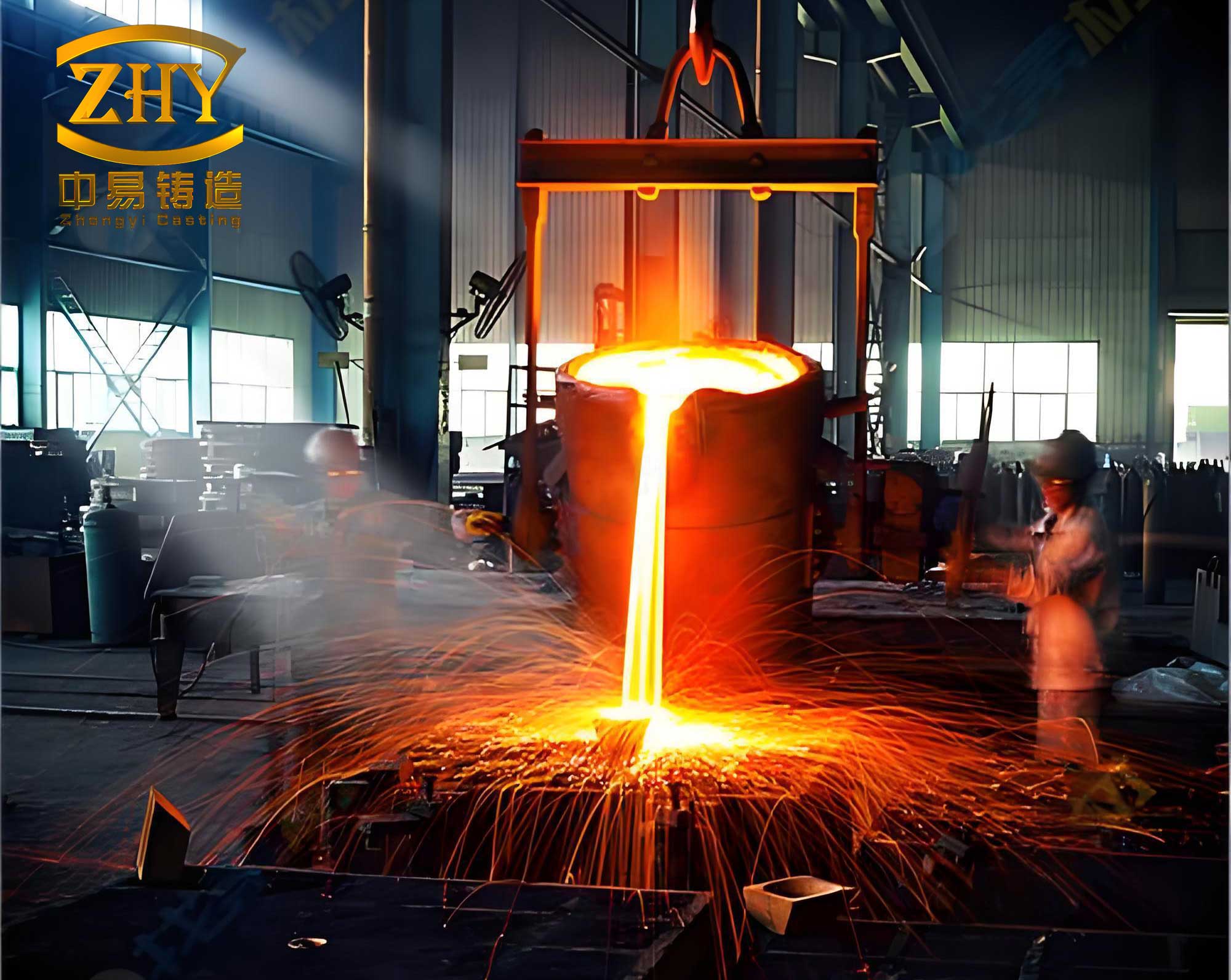
Pouring was conducted at a temperature of 1350°C, with a pouring time of approximately 90 seconds, aligning closely with simulation predictions. After a 72-hour cooling period, the mold was opened, and the casting part was rough-cleaned to remove gating and riser systems. Fine cleaning and shot blasting yielded the final毛坯件成品, or rough casting part. Inspection confirmed the absence of cold shuts, gas holes, or other defects, and machining verification showed no shrinkage porosity in critical threaded hole areas, demonstrating the success of our rapid prototyping approach for these large casting parts.
In conclusion, our project underscores the transformative potential of rapid prototyping for developing large-size casting parts. The process, encompassing 3D process design, CAE simulation, additive manufacturing of sand cores and molds, and traditional foundry steps, enabled a significant reduction in development time—by approximately 105 days compared to conventional mold-based methods—while saving on模具开支成本, or mold tooling costs. Moreover, 3D printing technology minimizes environmental pollution by reducing smoke and dust emissions, thereby lowering health risks associated with foundry operations. However, we identified several considerations specific to rapid prototyping for casting parts. First, the higher resin content in 3D printed sand cores and molds, necessary for strength, can increase gas generation, necessitating robust venting designs in both cores and mold cavities for casting parts. Second, dimensional deviations may arise due to cumulative errors in large-format 3D printing and the lack of dedicated assembly fixtures, highlighting the need for precision control in producing casting parts. Third, for large, thick-walled ductile iron casting parts, the use of chills (including internal chills) and exothermic risers requires careful design of assembly methods and appropriate clearance allowances. Lastly, while rapid prototyping is ideal for single-piece or small-batch validation of casting parts, its current material costs preclude widespread use in mass production, though it remains invaluable for research and prototyping stages. As technology advances, we anticipate broader adoption of these methods for efficient and sustainable manufacturing of complex casting parts.
To further elaborate on the technical aspects, we can delve into the mathematical modeling of shrinkage and thermal behavior in casting parts. For instance, the solidification time \( t_s \) for a section of a casting part can be estimated using Chvorinov’s rule: $$ t_s = B \left( \frac{V}{A} \right)^n $$ where \( V \) is the volume, \( A \) is the surface area, \( B \) is a mold constant, and \( n \) is an exponent typically around 2. This rule helps in designing risers for feeding casting parts effectively. Additionally, the pressure drop \( \Delta P \) in the gating system during pouring can be analyzed using Bernoulli’s principle modified for viscous flow: $$ \Delta P = \frac{1}{2} \rho v^2 + \rho g h + f \frac{L}{D} \frac{\rho v^2}{2} $$ where \( \rho \) is fluid density, \( v \) is velocity, \( g \) is gravity, \( h \) is height, \( f \) is friction factor, \( L \) is length, and \( D \) is diameter. Optimizing these parameters is crucial for minimizing turbulence and ensuring sound casting parts.
The integration of CAE simulation extends beyond defect prediction to optimizing the entire lifecycle of casting parts. We employed finite element analysis (FEA) to simulate stress distributions during solidification and cooling, which informed the placement of reinforcements and chills. The stress-strain relationship in casting parts during cooling can be expressed as: $$ \sigma = E \epsilon + \eta \dot{\epsilon} $$ where \( \sigma \) is stress, \( E \) is Young’s modulus, \( \epsilon \) is strain, \( \eta \) is viscosity, and \( \dot{\epsilon} \) is strain rate. This model aids in predicting residual stresses and distortions in casting parts, allowing for preemptive design adjustments. Furthermore, computational fluid dynamics (CFD) simulations were used to analyze mold filling patterns, ensuring uniform flow and reducing the risk of inclusions or cold shuts in casting parts.
In terms of material science, the selection of QT500-7 for our casting parts was based on its balance of strength and ductility, which is essential for diesel engine components. The microstructure evolution during solidification of such casting parts involves graphitization and matrix formation, governed by cooling rates and inoculation practices. The kinetics of graphite nodule formation can be described by: $$ N = N_0 \exp\left(-\frac{Q}{RT}\right) $$ where \( N \) is the nodule count, \( N_0 \) is a pre-exponential factor, \( Q \) is activation energy, \( R \) is the gas constant, and \( T \) is temperature. Controlling these parameters ensures the desired mechanical properties in casting parts.
From an environmental perspective, the adoption of 3D printing for casting parts aligns with sustainable manufacturing goals. Compared to traditional sand casting, which often involves disposable molds and higher energy consumption, additive manufacturing reduces waste through precise material deposition and reusability of sand in some systems. The energy efficiency of producing casting parts via 3D printing can be quantified using metrics like specific energy consumption (SEC): $$ \text{SEC} = \frac{E_{\text{total}}}{m_{\text{casting}}} $$ where \( E_{\text{total}} \) is the total energy input and \( m_{\text{casting}} \) is the mass of the casting part. Our assessments indicated a lower SEC for rapid prototyping in small batches, reinforcing its viability for research-oriented casting parts.
Looking ahead, advancements in 3D printing materials, such as hybrid sands or bio-based binders, could further enhance the sustainability and performance of molds for casting parts. Additionally, the integration of artificial intelligence (AI) with CAE tools promises to automate design optimization, reducing trial-and-error in developing complex casting parts. As we continue to refine these processes, the synergy between digital technologies and traditional foundry practices will undoubtedly propel the innovation and efficiency of manufacturing casting parts across industries.
In summary, our experience with rapid prototyping for large-size casting parts demonstrates a holistic approach that combines digital design, simulation, additive manufacturing, and meticulous craftsmanship. By addressing challenges such as gas porosity, dimensional accuracy, and material costs, we have established a framework for successfully producing high-quality casting parts for research and development. The lessons learned underscore the importance of interdisciplinary collaboration and continuous improvement in the realm of advanced casting technologies.