
In the field of industrial wear-resistant materials, the demand for high-performance white cast iron components has been steadily increasing, particularly in severe abrasion environments such as mining and slurry pumping applications. Traditional hypoeutectic and eutectic high chromium white cast iron, while offering decent wear resistance, often fall short in extreme conditions where service life is critically short, leading to frequent replacements and significant operational costs. This study addresses the urgent need for developing a superior white cast iron material that combines high hardness with adequate toughness, specifically targeting the production of slurry pump components. Our goal was to design an over hypereutectic high chromium white cast iron, designated as K63, with carbon content ranging from 4.60% to 4.70% and chromium content from 37.50% to 39.00%, aiming for a hardness of ≥63.0 HRC and impact toughness of Ak ≥ 4.0 J/cm². Through meticulous optimization of chemical composition, strengthening and toughening strategies, modification treatment using a proprietary KX-9 refiner, and tailored heat treatment processes, we successfully achieved these targets, enabling the mass production of 12/10 type slurry pump parts with a field service life 3–4 times longer than that of the reference A05 white cast iron.
The development of high-chromium white cast iron has historically focused on hypoeutectic and eutectic compositions, where carbon content is typically below 3.50% and chromium below 33%. These materials rely on the formation of M7C3-type carbides within a martensitic matrix to provide wear resistance. However, in highly abrasive low-stress environments, such as those encountered in slurry transport, even these advanced white cast iron grades can exhibit unacceptably short lifespans, sometimes less than 72 hours. This limitation stems from the relatively moderate volume fraction of carbides and the inherent trade-off between hardness and toughness. Over hypereutectic white cast iron, characterized by higher carbon and chromium levels, offers a promising solution due to its increased carbide volume, particularly primary M7C3 carbides, which significantly enhance hardness. Yet, the brittleness associated with coarse primary carbides has hindered its widespread industrial adoption. Thus, the core challenge lies in refining and spheroidizing these carbides while maintaining a tough matrix, a process known as strengthening and toughening. In this research, we embarked on a comprehensive investigation to overcome these hurdles, focusing on the 12/10 slurry pump guard plates and shells as application targets. By integrating theoretical design with practical experimentation, we aimed to push the boundaries of white cast iron performance, contributing to the advancement of wear-resistant materials technology.
Technical Index Design for the Material
The design of the K63 white cast iron was based on a critical analysis of the reference A05 high chromium white cast iron, which has a chromium-to-carbon ratio of approximately 8.8 and a carbide volume fraction of 33.6% to 39.0%. For martensitic white cast iron, wear resistance is primarily dictated by hardness, which in turn depends on the volume fraction of M7C3 carbides and the hardness of the matrix. To enhance wear resistance, we focused on two key aspects: increasing the volume fraction of M7C3 carbides, especially primary carbides, and maximizing the martensite content in the matrix.
Primary M7C3 carbides only appear in over hypereutectic white cast iron and exhibit higher microhardness than eutectic carbides. However, they typically form as coarse hexagonal prisms that can crack the matrix, reducing toughness. To address this, we aimed to refine and spheroidize the primary carbides, targeting a cross-sectional size of 40–50 µm with a maximum below 80 µm. Simultaneously, we sought to increase the martensite volume fraction by lowering the critical cooling rate for austenite decomposition and raising the martensite start temperature (Ms). This involved optimizing alloying elements to enhance hardenability and promote secondary carbide precipitation. The technical indices for K63 white cast iron were set as: chromium-to-carbon ratio of 8.0–9.0, carbide volume fraction around 60%, hardness ≥63.0 HRC, impact toughness Ak ≥ 4.0 J/cm², suitable for low-stress abrasive wear conditions. These targets guided our compositional and process design, ensuring a balance between wear resistance and durability for slurry pump components.
Chemical Composition Design
The chemical composition of white cast iron is pivotal in determining its microstructure and properties. Carbon and chromium are the primary elements influencing carbide formation, matrix composition, and hardenability. For K63 white cast iron, we selected ranges based on their roles: carbon increases carbide volume but must be balanced with chromium to maintain a high chromium-to-carbon ratio for optimal M7C3 carbide hardness and matrix stability. Silicon aids in deoxidation and refines carbides, but excess silicon can coarsen primary carbides. Manganese improves toughness and hardenability, while molybdenum enhances hardenability, promotes secondary carbide precipitation, and refines carbides. Nickel complements molybdenum in improving hardenability but must be limited to avoid excessive retained austenite. Phosphorus and sulfur are kept low to prevent embrittlement. The initial design composition is summarized in Table 1.
| Element | C | Si | Mn | Cr | Mo | Ni | P | S |
|---|---|---|---|---|---|---|---|---|
| Range | 4.50–5.00 | ≤1.00 | ≤2.50 | 35.00–40.00 | 1.50–3.00 | ≤1.00 | ≤0.060 | ≤0.060 |
The chromium-to-carbon ratio (Cr/C) is a critical parameter, calculated as $$Cr/C = \frac{w(Cr)}{w(C)}$$, where w(Cr) and w(C) are the weight percentages of chromium and carbon, respectively. A higher Cr/C ratio generally improves hardenability and carbide stability. The carbon equivalent (CE), which indicates the eutectic point, can be approximated for white cast iron as $$CE = C + \frac{1}{3}(Si + P)$$, though in high-chromium white cast iron, the effect of chromium must be considered. For over hypereutectic white cast iron like K63, the CE exceeds 4.4, leading to primary carbide formation. Our design aimed for a CE of 6.5–7.0 to maximize carbide content while ensuring processability.
Modification Treatment Design
To refine and spheroidize the primary carbides in white cast iron, modification treatment is essential. We employed a composite approach using strong carbide-forming elements such as vanadium, titanium, boron, niobium, and nitrogen. These elements form high-melting-point, high-hardness carbides or nitrides (e.g., VC, TiC, NbC, B4C, TiN) that act as heterogeneous nucleation sites, increasing the nucleation rate of primary M7C3 carbides and inhibiting their growth. This results in finer, more rounded carbides, improving both hardness and impact toughness. Boron also enhances hardenability by dissolving into the matrix and carbides, while nitrogen reduces the eutectic temperature range and undercools the melt, further refining carbide morphology.
Our modification scheme involved two steps: First, granular ferrovanadium, ferrotitanium, and ferroboron were added to the preheated ladle via molten iron冲入. Second, a powder modifier, KX-9 refiner, consisting of ferroniobium and a nitrogen-containing agent (100–150 mesh), was introduced using a controlled in-stream inoculation device. The total addition was 0.5% granular modifier plus 0.80%–1.00% KX-9 refiner. This dual treatment ensured uniform dispersion of nucleation sites, critical for achieving the desired carbide size and distribution in white cast iron.
Melting Experiment Design
Melting trials were conducted using a 150 kg medium-frequency induction furnace with high-purity raw materials: chromium iron, pig iron, scrap steel, ferromanganese, ferromolybdenum, and nickel. To accommodate the high carbon equivalent (6.5–7.0) of K63 white cast iron, which deviates significantly from the eutectic point, we adopted a high-temperature melting, high-temperature tapping, and low-temperature fast-pouring工艺. The tapping temperature was set at 1590–1600°C, and the pouring temperature at 1445–1455°C. Three experimental composition groups, designated K63①, K63②, and K63③, were formulated to evaluate the effects of varying carbon, chromium, molybdenum, and nickel contents, as detailed in Table 2.
| Group | C | Si | Mn | Cr | Mo | Ni | P | S |
|---|---|---|---|---|---|---|---|---|
| K63① | 4.50–5.00 | ≤1.00 | ≤2.50 | 36.00–37.50 | 1.50–2.00 | 0.00 | ≤0.060 | ≤0.060 |
| K63② | 4.50–5.00 | ≤1.00 | ≤2.50 | 37.50–39.00 | 2.00–2.50 | 0.50 | ≤0.060 | ≤0.060 |
| K63③ | 4.50–5.00 | ≤1.00 | ≤2.50 | 39.00–40.00 | 2.50–3.00 | 0.50 | ≤0.060 | ≤0.060 |
Each group was subjected to the same modification and pouring procedures to ensure consistency. The high pouring temperature facilitated fluidity, while the fast cooling rate minimized carbide coarsening, essential for producing sound castings of white cast iron.
Performance Test Design
To assess the mechanical and wear properties of K63 white cast iron, we designed tests based on the geometry of 12/10 slurry pump components. For mechanical properties, V-shaped test blocks (60 mm × 60 mm cross-section) were cast from each composition group. After heat treatment, impact specimens (20 mm × 20 mm × 110 mm) were machined via wire cutting and tested on a JB-30A impact tester for impact toughness (Ak). Hardness was measured on an HR-150A Rockwell hardness tester. The target values were hardness ≥63.0 HRC and Ak ≥ 4.0 J/cm².
Wear performance was evaluated using an MST-120 wear testing machine with disk-shaped specimens resembling impellers, featuring six semicircular grooves and six auxiliary blades. The specimens, cast from each group and heat-treated, were tested under low-stress abrasive conditions. The wear medium consisted of water and refined quartz sand (20–40 mesh, hardness ~1100 HV) in a 2:3 weight ratio. The test protocol involved pre-wearing for 30 minutes, weighing (initial weight), wearing for 8 hours, and re-weighing (final weight). Weight loss and weight loss rate were calculated, with the relative wear rate compared to heat-treated A05 white cast iron as a benchmark. The weight loss rate is given by $$\text{Weight Loss Rate} = \frac{\text{Initial Weight} – \text{Final Weight}}{\text{Initial Weight}} \times 100\%$$ and the relative wear rate by $$\text{Relative Wear Rate} = \frac{\text{Weight Loss Rate of A05}}{\text{Weight Loss Rate of K63}}$$.
Heat Treatment Process Design
Heat treatment is crucial for optimizing the matrix structure of white cast iron. In the as-cast state, K63 white cast iron has a matrix carbon content of 1.40%–2.00% and chromium content of 11.60%–14.80%, leading to supersaturation that lowers the Ms temperature and inhibits martensite formation. To address this, we designed a heat treatment process to promote the precipitation of secondary carbides, reduce matrix alloy content, and raise Ms, thereby increasing martensite volume and enhancing matrix toughness. Given the high carbide volume fraction (>60%) and low thermal conductivity of white cast iron, a controlled heating rate was essential to avoid cracking due to thermal stresses.
The heat treatment curve, as shown in Figure 1, employed a “four-stage heating + five-step holding + slow cooling hold” approach. The process began with room temperature loading into the furnace, followed by slow heating to 650°C to minimize thermal gradients. Beyond 650°C, the heating rate was increased gradually. Holding stages at intermediate temperatures allowed for temperature homogenization. The peak temperature was set at 1050°C with extended holding to facilitate element diffusion and secondary carbide precipitation. Subsequently, the castings were slowly cooled to a specific temperature, held for equilibration, and then air-cooled. This regimen ensured a uniform martensitic matrix with dispersed carbides, key to the performance of white cast iron.
The heat treatment process can be described by kinetic equations for carbide precipitation, such as the Johnson-Mehl-Avrami-Kolmogorov (JMAK) model: $$f(t) = 1 – \exp(-k t^n)$$ where f(t) is the fraction transformed, k is a rate constant, t is time, and n is the Avrami exponent. For secondary carbide precipitation in white cast iron, parameters depend on temperature and composition, with molybdenum accelerating the process.
Experimental Results and Analysis
The final chemical compositions of the three K63 white cast iron groups, as verified by spectroscopy, are presented in Table 3, along with calculated chromium-to-carbon ratios and carbide volume fractions. The carbide volume fraction was estimated using empirical relationships based on carbon and chromium content, highlighting the over hypereutectic nature of this white cast iron.
| Group | C | Si | Mn | Cr | Mo | Ni | P | S | Cr/C | Carbide Vol.% |
|---|---|---|---|---|---|---|---|---|---|---|
| K63① | 4.58 | 0.73 | 2.13 | 36.80 | 1.85 | 0.00 | ≤0.034 | ≤0.030 | 8.0 | 61.5 |
| K63② | 4.69 | 0.69 | 2.08 | 38.89 | 2.37 | 0.41 | ≤0.027 | ≤0.031 | 8.3 | 64.0 |
| K63③ | 4.93 | 0.67 | 2.39 | 39.22 | 2.55 | 0.47 | ≤0.029 | ≤0.026 | 8.0 | 67.2 |
Mechanical property results for both as-cast and heat-treated states are summarized in Table 4. In the as-cast condition, hardness increased with carbon content, but impact toughness decreased, reflecting the brittleness of coarse carbides. After heat treatment, K63② achieved the target hardness (≥63.0 HRC) and impact toughness (≥4.0 J/cm²), while K63① fell short in hardness and K63③ in toughness. This underscores the importance of balancing composition: K63②’s higher chromium, molybdenum, and nickel content improved hardenability and matrix toughness, whereas K63③’s excessive carbide volume reduced matrix continuity, impairing toughness. Thus, K63② emerged as the optimal composition for white cast iron.
| Group | Hardness HRC (Target: ≥63) | Impact Toughness Ak (J/cm²) (Target: ≥4) | ||
|---|---|---|---|---|
| As-Cast (Mean) | Heat-Treated (Mean) | As-Cast (Mean) | Heat-Treated (Mean) | |
| K63① | 59.67 | 62.47 | 3.58 | 4.58 |
| K63② | 61.00 | 64.20 | 3.67 | 4.67 |
| K63③ | 61.57 | 64.83 | 3.17 | 3.83 |
Wear test results, shown in Table 5, demonstrate that K63② exhibited the best wear resistance, with a relative wear rate 2.5 times higher than A05 white cast iron. K63① and K63③ showed lower performance, likely due to insufficient carbide volume and excessive carbide-matrix mismatch, respectively. The wear resistance of white cast iron can be correlated with hardness and carbide volume via empirical models, such as $$W \propto \frac{1}{H \cdot V_c}$$ where W is wear rate, H is hardness, and Vc is carbide volume fraction, though in practice, matrix toughness also plays a key role. K63②’s optimal combination of high carbide content (64.0%) and tough martensitic matrix resulted in superior performance, validating our design approach for white cast iron.
| Group | Initial Weight (g) | Final Weight (g) | Weight Loss (g) | Weight Loss Rate (%) | Relative Wear Rate vs. A05 |
|---|---|---|---|---|---|
| K63① | 1451.355 | 1445.996 | 5.359 | 0.3692 | 2.0990 |
| K63② | 1424.303 | 1419.921 | 4.382 | 0.3077 | 2.5190 |
| K63③ | 1430.661 | 1425.401 | 5.260 | 0.3676 | 2.1081 |
| A05 (Heat-Treated) | 1408.803 | 1397.885 | 10.918 | 0.7750 | 1.0000 |
Based on these analyses, the final composition for K63 white cast iron was refined to carbon 4.60%–4.70%, chromium 37.50%–39.00%, with molybdenum 2.00%–2.50% and nickel 0.30%–0.50%, as detailed in Table 6. This composition ensures a chromium-to-carbon ratio around 8.3 and carbide volume fraction of 62.1%–64.2%, providing the ideal balance for slurry pump applications.
| C | Si | Mn | Cr | Mo | Ni | P | S |
|---|---|---|---|---|---|---|---|
| 4.60–4.70 | ≤1.00 | 2.00–2.50 | 37.50–39.00 | 2.00–2.50 | 0.30–0.50 | ≤0.060 | ≤0.060 |
Trial Production of 12/10 Slurry Pump Guard Plates and Shells
To validate the industrial feasibility of K63 white cast iron, we conducted trial production of 12/10 slurry pump guard plates and shells using resin sand molding with chromite sand additions and暗冷铁 at thick sections. A dispersed filling and multi-feeder gating system was employed to establish a temperature gradient, ensuring directional solidification and minimizing shrinkage defects. Melting followed the laboratory protocol, with raw materials preheated to 400°C, ladle preheating, and controlled modification using granular additives and KX-9 refiner. Pouring was performed quickly at 1445–1455°C, with in-stream inoculation. After casting, boxes were kept sealed for over 168 hours (7 days) to allow slow cooling below 100°C, preventing thermal cracks in the white cast iron components.
Heat treatment applied the designed curve, with V-blocks cast alongside for quality control. Hardness measurements on the produced guard plates and shells, as shown in Table 7, consistently met the target of ≥63.0 HRC, with guard shells showing slightly higher hardness due to thinner sections facilitating more uniform heat treatment. This uniformity indicates low residual stress, critical for the durability of white cast iron parts.
| Component | Measured Hardness HRC (Samples) | Mean HRC |
|---|---|---|
| Guard Plate | 63.2, 63.0, 63.8, 63.0, 64.0, 63.6 | 63.43 |
| Guard Shell | 63.7, 64.2, 63.5, 63.4, 63.9, 63.3 | 63.67 |
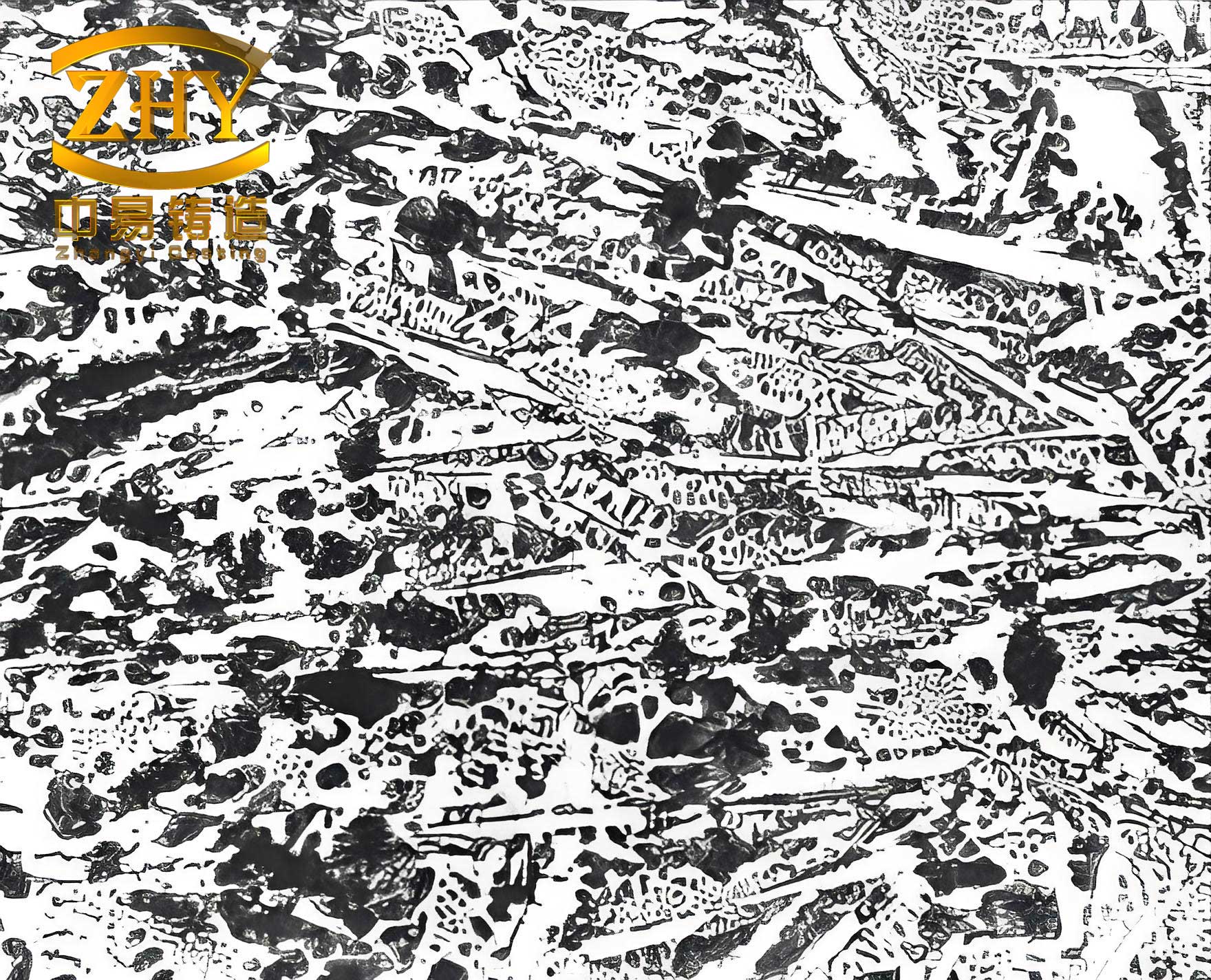
Microstructural analysis of the heat-treated V-blocks revealed a typical over hypereutectic white cast iron structure comprising approximately 60% carbides (M7C3), martensite, retained austenite, and fine secondary carbides. The carbides appeared as polygonal blocks, elongated rods, or絮状 particles, with cross-sectional sizes predominantly 40–50 µm and maximum below 80 µm, meeting our refinement goals. This refined microstructure is instrumental in achieving the high wear resistance and toughness of white cast iron.
Field trials in high-concentration, low-stress abrasive mining conditions demonstrated that the K63 white cast iron guard plates and shells outperformed A05 components, with a service life 3–4 times longer. This confirms the success of our strengthening and toughening approach, making K63 white cast iron a viable material for demanding slurry pump applications.
Conclusions
In this study, we developed and optimized an over hypereutectic high chromium white cast iron, K63, with carbon content 4.60%–4.70%, chromium content 37.50%–39.00%, achieving hardness ≥63.0 HRC and impact toughness Ak ≥ 4.0 J/cm². Key to this achievement was the integrated design of chemical composition, modification treatment using KX-9 refiner, and a tailored heat treatment process. The composite modification effectively refined and spheroidized primary carbides, while the heat treatment promoted a martensitic matrix with dispersed secondary carbides, balancing hardness and toughness. Trial production of 12/10 slurry pump guard plates and shells confirmed the manufacturability and performance of this white cast iron, with field service life 3–4 times that of conventional A05 white cast iron. This research underscores the potential of over hypereutectic white cast iron in severe wear applications and highlights the importance of microstructural control through advanced processing techniques. Future work could explore further alloying variations or computational modeling to optimize white cast iron properties for even broader industrial use.