
In modern manufacturing, sand casting remains a pivotal method for producing complex metal parts, especially for aluminum alloys, due to its cost-effectiveness and adaptability. As a researcher focused on foundry technologies, I embarked on a project to design and optimize the sand casting process for a gear box body, which is a medium-sized, thick-walled aluminum alloy component. This article details my comprehensive approach, from three-dimensional modeling to simulation analysis, highlighting the critical role of sand casting in achieving high-quality castings. Throughout this work, I emphasize the versatility of sand casting, which allows for intricate designs while minimizing defects such as shrinkage porosity and cold shuts.
The gear box body, with its irregular shape, varying wall thicknesses, and internal cavities, presents significant challenges in casting. My objective was to develop a robust sand casting process that ensures dimensional accuracy and mechanical integrity for batch production. I utilized UG software for 3D modeling, designed a gating and riser system tailored to aluminum alloys, and employed cold-core box precision core assembly for molding. To validate the design, I performed solidification simulations using AnyCasting software, which enabled me to predict and mitigate defects. This iterative process underscores the importance of simulation in modern sand casting, reducing trial-and-error and enhancing efficiency.
Sand casting is particularly suitable for this gear box body because it accommodates complex geometries and allows for the use of resin sand cores, which improve surface finish and dimensional stability. In the following sections, I delve into each step of the process, supported by tables and formulas to summarize key parameters. The integration of simulation tools exemplifies how traditional sand casting can be augmented with digital technologies to achieve precision and reliability.
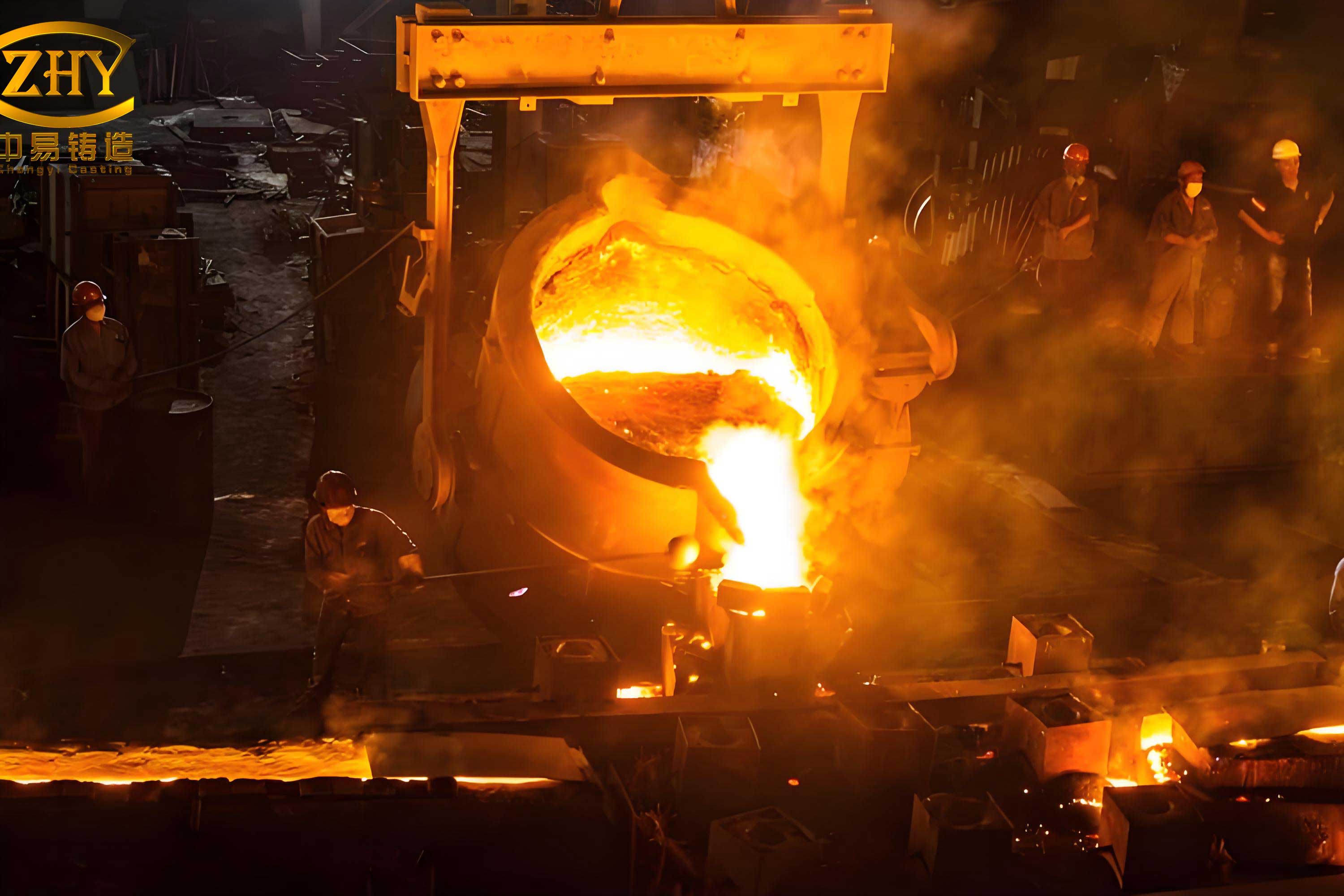
The image above illustrates typical sand casting parts, showcasing the complexity achievable through this method. For the gear box body, similar intricacies require meticulous planning to avoid defects. My work begins with a detailed analysis of the component’s structure, followed by process design and simulation, all centered on optimizing the sand casting approach.
Three-Dimensional Modeling and Casting Analysis
Using UG software, I created a detailed 3D model of the gear box body to facilitate process design. The model captures the external contours, internal cavities, ribs, and bosses, which are essential for determining parting lines, core placements, and gating locations. The gear box body has overall dimensions of 751 mm × 400 mm × 291 mm, with main wall thicknesses ranging from 10 mm to 12 mm. This classifies it as a medium-sized thick-walled casting, necessitating careful control of solidification to prevent defects.
In sand casting, the mold cavity is formed by packing sand around a pattern, and for complex internal features, cores are inserted. My analysis revealed that the gear box body requires multiple cores due to its intricate internal geometry. I designed the mold with a parting plane along the upper surface of the central rib on the front side, splitting it into upper and lower halves. Additionally, a side core was incorporated to accommodate ribs on the left side, and an internal core was used for the cavity. This core assembly approach, typical in sand casting, enhances precision and reduces draft angles.
To summarize the casting characteristics, I developed Table 1, which outlines key parameters relevant to the sand casting process. This table aids in selecting appropriate materials and process conditions.
| Parameter | Value | Description |
|---|---|---|
| Material | AlSi7Mg0.3 | Aluminum alloy with good castability |
| Dimensions | 751 mm × 400 mm × 291 mm | Overall size of the casting |
| Wall Thickness | 10–12 mm | Primary wall thickness range |
| Casting Weight | Approximately 15 kg | Estimated weight for gating design |
| Production Volume | Batch production | Indicates suitability for sand casting |
The modeling phase also involved adding machining allowances to surfaces that require post-casting processing. In sand casting, allowances are crucial to compensate for shrinkage and ensure final dimensions. Based on standard sand casting practices, I applied a machining allowance of 2–3 mm to critical faces. Holes smaller than 20 mm were not cast, as per sand casting guidelines, to avoid core fragility and cost inefficiencies.
Casting Process Design in Sand Casting
The success of sand casting hinges on a well-designed process that addresses material behavior and mold dynamics. For the gear box body, I selected a sand casting process using alkaline phenolic resin self-hardening sand for manual molding. This choice is common in sand casting for aluminum alloys due to its good collapsibility and surface finish. The process steps include pattern making, sand preparation, molding, core making, assembly, melting, pouring, shakeout, cleaning, and inspection. Each step was optimized for sand casting to minimize defects.
Molding Method: Cold-Core Box Precision Core Assembly
To achieve high dimensional accuracy, I adopted a cold-core box precision core assembly method, which eliminates the need for flasks. This technique is advantageous in sand casting as it reduces sand waste and improves core alignment. The cores were made using resin sand, and the assembly sequence was: lower mold → internal core → side core → upper mold. This approach ensures that complex internal features are accurately reproduced, a key benefit of sand casting when dealing with intricate parts.
The mold and core structures are designed to withstand the thermal stresses of pouring. I applied alcohol-based coatings to the mold and core surfaces to create a refractory layer, preventing metal penetration and improving surface quality. Any cracks or imperfections were repaired with patching compounds, a standard practice in sand casting to maintain mold integrity.
Gating and Riser System Design
In sand casting, the gating system must facilitate smooth metal flow to avoid turbulence, oxidation, and slag inclusion. For aluminum alloys like AlSi7Mg0.3, which have high shrinkage tendencies, the design is critical. I designed a gating system with a sprue, runner, and ingates, as illustrated in Figure 3 of the original context. The runner was placed at the parting plane to simplify molding, and it was stepped to buffer metal flow. Two ingates were positioned on machined surfaces for easy removal, and slag traps were included near the ingates.
To filter impurities, I incorporated ceramic foam filters at the connections between the pouring cup and sprue, and between the sprue and runner. This is a common enhancement in sand casting to improve metal quality. The gating system’s dimensions were calculated based on hydraulic principles. The minimum cross-sectional area, \(A_{smin}\), was determined using the formula:
$$A_{smin} = \frac{G_L}{K t \sqrt{H_P}}$$
where \(G_L\) is the pouring weight (approximately 15 kg), \(K\) is the flow factor (taken as 0.9 for aluminum in sand casting), \(t\) is the pouring time, and \(H_P\) is the average pressure head. From prior sand casting experience, I estimated \(t = 16\, \text{s}\) and \(H_P = 200\, \text{mm}\). Substituting values:
$$A_{smin} = \frac{15}{0.9 \times 16 \times \sqrt{0.2}} \approx 4.1\, \text{cm}^2$$
Based on this, I selected a sprue diameter of 25 mm, giving a cross-sectional area of 4.9 cm². For sand casting aluminum, the typical gating ratio is \(\sum F_{\text{sprue}} : \sum F_{\text{runner}} : \sum F_{\text{ingate}} = 1:2:2\). Thus, the total runner area is 9.8 cm², and each ingate area is 4.9 cm². The ingate length was set to 223 mm, runner length to 382 mm, and sprue height to 270 mm. These dimensions ensure adequate flow rates in sand casting, reducing the risk of cold shuts.
The pouring temperature was controlled between 700°C and 720°C to minimize hydrogen absorption and oxidation, which are common issues in aluminum sand casting. The pouring time was estimated using an empirical formula:
$$\tau = B \delta^P m^n$$
where \(\delta\) is the wall thickness (taken as 11 mm), \(m\) is the casting mass, and \(B\), \(P\), and \(n\) are coefficients derived from sand casting databases. For aluminum sand casting, \(B = 2.0\), \(P = 0.5\), and \(n = 0.3\). With \(m = 15\, \text{kg}\), the calculation yields:
$$\tau = 2.0 \times (11)^{0.5} \times (15)^{0.3} \approx 16\, \text{s}$$
This corresponds to a rise velocity of 33 mm/s in the mold, which is acceptable for sand casting to ensure complete filling.
For feeding, risers were placed at thermal hotspots to compensate for shrinkage. In sand casting, riser design is vital to prevent porosity. I positioned risers as shown in Figure 4 of the original context, and for areas inaccessible to risers, chills were added to promote directional solidification. Table 2 summarizes the gating and riser parameters, emphasizing their role in sand casting.
| Component | Dimension | Function in Sand Casting |
|---|---|---|
| Sprue Diameter | 25 mm | Controls initial metal flow |
| Runner Cross-Section | 9.8 cm² | Distributes metal to ingates |
| Ingate Cross-Section (each) | 4.9 cm² | Introduces metal into cavity |
| Pouring Temperature | 700–720°C | Optimized for aluminum sand casting |
| Riser Locations | 4 positions | Provides feed metal for shrinkage |
| Chill Locations | 3 positions | Accelerates cooling in thick sections |
This comprehensive design leverages sand casting principles to address the gear box body’s requirements, ensuring that metal solidifies progressively from the mold walls inward.
Simulation Analysis of Solidification in Sand Casting
To validate the sand casting process, I conducted simulation studies using AnyCasting software. Simulation is indispensable in modern sand casting as it predicts defect formation and optimizes parameters without physical trials. I focused on the solidification process, which directly influences shrinkage defects.
Solidification Process Simulation
I imported the 3D model and process parameters into AnyCasting, setting the material properties for AlSi7Mg0.3 and the mold properties for resin sand. The simulation tracked temperature distribution over time. Figure 6 (referenced in the original context) shows snapshots at 84 s, 1041 s, and 2613 s, representing early, mid, and late solidification stages. The total solidification time was approximately 48 minutes, which is typical for thick-walled sand casting.
The temperature scale ranged from 555°C to 700°C. Initially, the temperature field was uniform, indicating proper filling. As solidification progressed, cooling proceeded from the exterior to the interior, with slower cooling in thicker sections. This behavior is characteristic of sand casting due to the insulating nature of sand molds. The simulation confirmed that risers were the last to solidify, validating their design for feeding. However, internal cavities showed potential for shrinkage due to uneven wall thicknesses.
To quantify solidification, I used the Fourier equation for heat transfer, which is fundamental in sand casting analysis:
$$\frac{\partial T}{\partial t} = \alpha \nabla^2 T$$
where \(T\) is temperature, \(t\) is time, and \(\alpha\) is thermal diffusivity. For aluminum in sand casting, \(\alpha \approx 5 \times 10^{-5}\, \text{m}^2/\text{s}\). The simulation solved this equation numerically, providing insights into thermal gradients.
Defect Analysis and Optimization
The probability defect map without chills, as shown in Figure 7 of the original context, revealed shrinkage porosity in internal cavities. This is a common issue in sand casting when thermal hotspots are not adequately fed. The defects correlated with areas of slow cooling, highlighting the need for design modifications.
In sand casting, chills are often used to enhance cooling in critical regions. I added chills at three locations, as indicated in Figure 5 of the original context. After re-simulation, the defect map (Figure 8) showed significant reduction in shrinkage, demonstrating the effectiveness of chills in sand casting. The improved solidification sequence ensured directional cooling toward the risers.
To further analyze the results, I compiled Table 3, comparing simulation outcomes with and without chills. This emphasizes the role of simulation in optimizing sand casting processes.
| Aspect | Without Chills | With Chills | Implication for Sand Casting |
|---|---|---|---|
| Solidification Time | 48 minutes | 45 minutes | Chills reduce overall time |
| Shrinkage Defects | High in internal cavities | Minimal to none | Chills eliminate hotspots |
| Temperature Gradient | Irregular | More uniform | Improves feeding efficiency |
| Riser Effectiveness | Moderate | High | Chills enhance riser performance |
The simulation also assessed mold filling, confirming no misruns or cold shuts. The velocity vectors indicated laminar flow, which is desirable in sand casting to avoid oxide entrapment. This aligns with the gating design principles for sand casting, where controlled flow minimizes turbulence.
Conclusion and Implications for Sand Casting
Through this project, I developed a complete sand casting process for the gear box body, integrating traditional design with simulation tools. The sand casting method proved effective for batch production of medium-sized aluminum parts, offering flexibility and cost savings. Key achievements include the use of cold-core box precision core assembly, which enhances dimensional accuracy, and a gating system tailored to aluminum’s properties.
The simulation analysis validated the riser design and identified defect-prone areas, leading to the addition of chills for improved solidification. This iterative approach underscores the value of simulation in sand casting, enabling defect prediction and process optimization without physical waste. The final process ensures high-quality castings with minimal shrinkage, meeting the technical requirements for the gear box body.
Sand casting continues to evolve with advancements in materials and digital tools. My work demonstrates that by combining empirical design with simulation, sand casting can achieve precision comparable to more expensive methods. For future endeavors, I recommend exploring automated sand casting systems to further enhance consistency and productivity. The principles outlined here—from modeling to simulation—are broadly applicable to other complex castings, reinforcing sand casting’s relevance in modern manufacturing.
In summary, this gear box body project highlights the robustness of sand casting when supported by thorough design and analysis. The successful outcome attests to the method’s adaptability and efficiency, making it a cornerstone of foundry operations worldwide.