
As a researcher in manufacturing engineering, I have always been fascinated by the foundational role of casting in modern industry. Casting is one of the earliest metal hot-working processes mastered by humanity and remains the most widely used liquid metal forming technique. The principle involves pouring molten metal into a mold cavity, allowing it to cool and solidify to obtain parts or blanks of a desired shape. In contemporary mechanical manufacturing, the casting industry is a vital component of the manufacturing sector, and its development signifies a nation’s production capability. Whether in developing or developed countries, the position of the casting industry is irreplaceable. Within the casting industry, the automotive sector is the largest consumer of castings and serves as the primary driving force behind the advancement of casting technologies. In an automobile, the mass of castings typically accounts for about 20% of its own weight, second only to steel usage. The engine, being the most critical component of a vehicle, determines the overall lifespan and performance of the automobile. Key engine components such as cylinder blocks, cylinder heads, intake manifolds, exhaust manifolds, crankshafts, and exhaust connectors are predominantly produced through casting processes. The evolution of the automotive industry inevitably influences the closely linked casting industry, making it a major driver for casting development. As casting primarily serves the automotive industry, it faces new challenges in both casting materials and processes due to the continuous advancements and new requirements from automotive manufacturing. It is within this context that the importance of casting production for automotive parts becomes fully apparent.
In this study, I focus on the sand casting process design for a turbine rear exhaust pipe, which is a connecting pipe between the turbocharger and the muffler in an automobile. During vehicle operation, the turbine rear exhaust pipe must withstand exhaust gases produced by the combustion of fuel-air mixtures in the cylinders, necessitating properties such as shock resistance, wear resistance, heat resistance, and airtightness. This part is produced using sand casting in industrial settings. The design and optimization of such sand castings are critical for ensuring performance and reliability.
Sand casting is a casting method that uses sand and cores as molding materials to form molds, where liquid metal fills the mold under gravity to produce castings. The mold typically consists of a sand mold and cores combined. For sand casting, the most basic raw materials in production are two types: foundry sand and sand binders. Sand casting offers numerous advantages, such as low cost and easy availability of molding materials, relatively simple and convenient mold-making processes, and broad applicability. It can be used for both single-piece and batch production, making it the most traditional casting method with wide adaptability, low cost, and short production cycles. The process flow of sand casting is illustrated below, highlighting key steps like pattern making, mold assembly, pouring, and finishing. The versatility of sand casting makes it ideal for producing complex sand castings like automotive components.
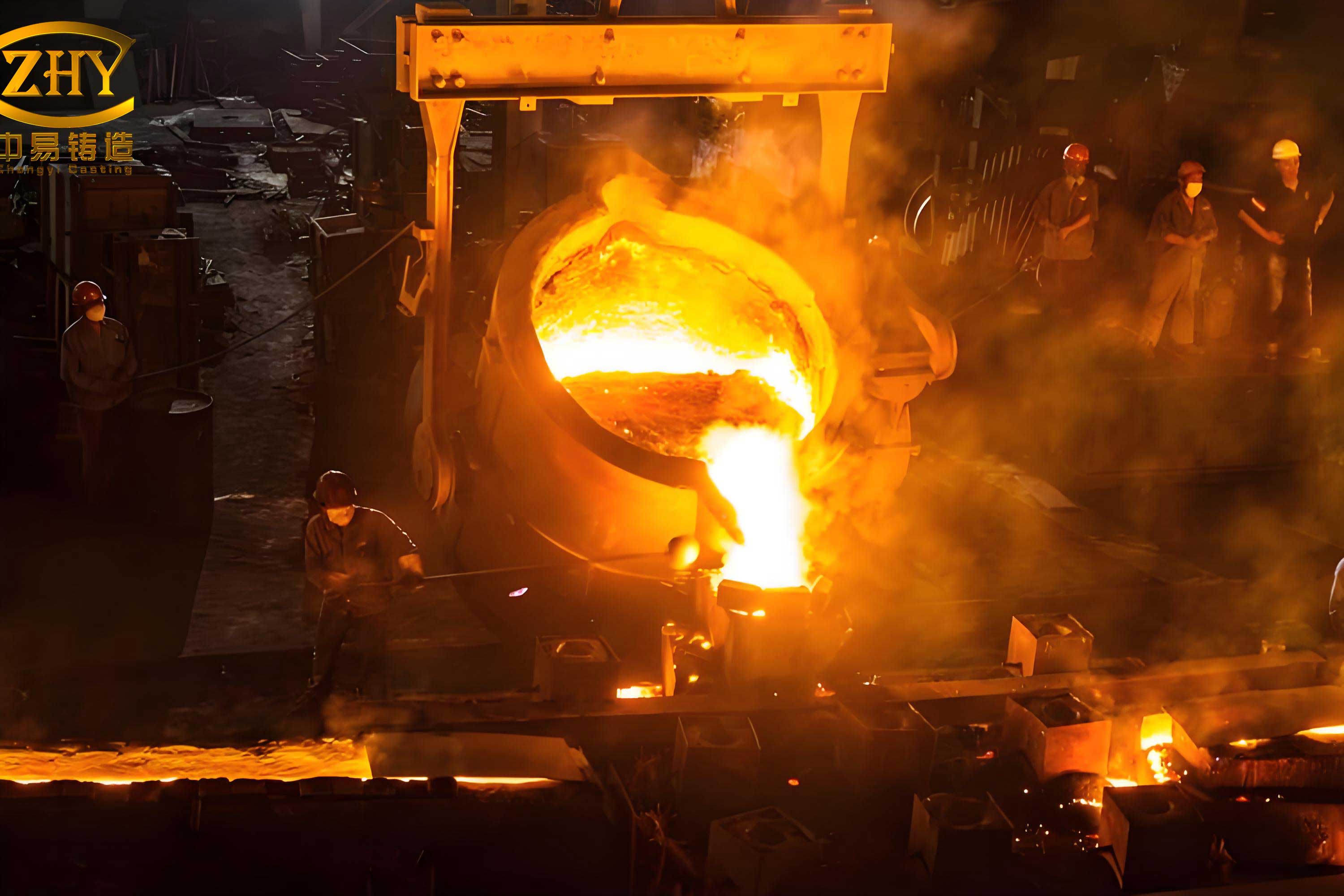
The mold sand used in this project is green sand composed of silica sand and clay mixed together. Green sand uses clay and an appropriate amount of water as the primary binder for the sand, with the mold being assembled and poured in a wet state. This approach is common for producing high-quality sand castings due to its efficiency and cost-effectiveness.
In designing the sand casting process for the turbine rear exhaust pipe, several critical aspects must be addressed: the gating system, risers and chills, and core design. Each element plays a pivotal role in ensuring the integrity and quality of the final sand castings.
Gating System Design
The cross-sectional area of the gating system significantly impacts casting quality. If the area is too small, pouring time increases, which may lead to defects like misruns, cold shuts, or sand inclusions. If the area is too large, pouring speed rises, potentially causing sand erosion and slag inclusions. Therefore, determining a reasonable gating system area is essential for molten metal to fill the mold at an appropriate rate. For the turbine rear exhaust pipe, a semi-closed (or intermediate injection) gating system was selected based on its structure. This type offers slower flow velocity compared to closed systems, provides some slag trapping capability, and ensures平稳的充型, making it widely applicable for small gray iron castings like these sand castings.
The pouring time, indicative of pouring speed, critically affects casting quality. Every casting has an ideal pouring speed, corresponding to a suitable pouring time. In production, empirical formulas are commonly used to determine this time. For gray iron castings weighing less than 450 kg with complex thin-walled shapes, the pouring time formula is given by:
$$ t = S_1 \sqrt{G_L} $$
where \( t \) is the pouring time in seconds, \( G_L \) is the weight of poured metal in kilograms (including the casting and gating system), and \( S_1 \) is a coefficient determined by casting wall thickness. For the turbine rear exhaust pipe, with a wall thickness of 5 mm, it falls into the 2.5-3.5 mm category. The relationship between coefficient \( S \) and casting wall thickness is summarized in the table below:
| Casting Wall Thickness (mm) | Coefficient \( S_1 \) |
|---|---|
| 2.5-3.5 | 1.63 |
| 3.5-8.0 | 1.85 |
| 8.0-15 | 2.2 |
Given \( S_1 = 1.63 \) and \( G_L = 6.5 \, \text{kg} \), the pouring time is calculated as:
$$ t = 1.63 \times \sqrt{6.5} \approx 4.2 \, \text{s} $$
Next, the average static pressure head is determined. For an intermediate injection system, the average static pressure head height is calculated using:
$$ H_p = H_0 – 0.125 h_c $$
where \( H_0 \) is the distance from the top of the pouring cup to the parting plane (620 mm), and \( h_c \) is the total height of the casting in the mold (336 mm). Thus:
$$ H_p = 620 – 0.125 \times 336 = 578 \, \text{mm} $$
The minimum cross-sectional area of the ingate for gray iron castings is given by:
$$ A_g = \frac{G_L}{0.31 \mu t \sqrt{H_p}} $$
where \( \mu \) is the flow loss factor of the gating system. For iron castings, \( \mu \) values vary based on mold type and resistance, as shown in the table:
| Mold Type | High Resistance | Medium Resistance | Low Resistance |
|---|---|---|---|
| Green Sand | 0.35 | 0.42 | 0.50 |
| Dry Sand | 0.41 | 0.48 | 0.60 |
For this green sand mold with medium resistance, \( \mu = 0.42 \). Substituting values:
$$ A_g = \frac{6.5}{0.31 \times 0.42 \times 4.2 \times \sqrt{578}} \approx 156 \, \text{mm}^2 $$
For a semi-closed gating system in small thin-walled castings, the sprue cross-sectional area is typically 1.15 times the ingate area, and the runner cross-sectional area is 1.4 times the ingate area. Therefore:
$$ A_{\text{sprue}} = 1.15 \times 156 = 179.4 \, \text{mm}^2 $$
$$ A_{\text{runner}} = 1.4 \times 156 = 218.4 \, \text{mm}^2 $$
Based on the turbine rear exhaust pipe structure, the ingate area is designed as 178 mm², the runner as 375 mm², and the sprue as 314 mm². This design ensures optimal metal flow for producing defect-free sand castings.
Riser and Chill Design
To enhance metal feeding,合理设置 risers and chills is crucial for casting quality. For the turbine rear exhaust pipe, leakage issues primarily arise from shrinkage porosity defects, while fractures result from misruns and shrinkage. Risers are reservoirs set in the mold to supply molten metal during pouring, compensating for potential shrinkage during solidification and preventing defects like shrinkage cavities, porosity, while aiding in排气 and slag collection. The shape of risers affects their feeding efficiency; designs with minimal surface area for a given volume are preferred to slow cooling and prolong solidification time. For this gray iron casting, cylindrical risers are selected and placed at the highest and thickest sections of the casting, such as the top planar area, to facilitate directional solidification. The feeding distance of risers for gray iron is generally 10–17 times the casting wall thickness or hot spot diameter. With a wall thickness of 5 mm, a feeding distance of 50 mm is chosen. Chills, made of metals with higher thermal conductivity than dry sand, are used to accelerate local cooling in areas prone to shrinkage, such as the lower part of the pipe. By combining risers and chills, the solidification sequence is optimized, effectively mitigating defects in these sand castings.
Core Design
In sand casting of complex hollow castings, core making is a vital step, as cores form internal cavities or holes. For the turbine rear exhaust pipe, a core is essential to create its internal passage. The core material must withstand high temperatures and stresses during pouring. Resin-coated sand, or覆膜砂, is widely used in the casting industry for cores due to its excellent综合经济效益. It consists of sand grains coated with a resin film, offering good dry strength at room temperature and high-temperature strength.覆膜砂 is commonly applied in automotive components like cylinder blocks, cylinder heads, and various pipes, making it suitable for producing precision sand castings. At room temperature,覆膜砂 exists as dry, dispersed granular particles, allowing for long storage in both dry and moist states. For this project,覆膜砂 is selected as the core material.
The core-making machine used is a覆膜砂射芯机, or resin-coated sand shooting machine. This equipment includes a shooting mechanism, sand supply system, worktable, columns connecting the shooting mechanism and worktable, base, and control systems. The core-making process involves sequential steps: opening the sand gate to fill the shooting cylinder, closing the gate, sealing with air, clamping the core box horizontally, lowering the shooting cylinder to press against the shooting plate, closing the exhaust valve, opening the shooting valve for sand shooting, closing the shooting valve, opening the exhaust valve, raising the shooting cylinder, unclamping, releasing the seal, and removing the core. These actions are interlinked and controlled by a PLC system, with temperature regulation via digital displays to ensure uniform mold temperature. The quality of produced cores is verified by几何形状, dimensional accuracy, surface roughness, and color. Well-cured cores typically have a淡黄色 center and黄褐色均匀外表, while over-burned cores appear褐色 or黑色, and under-cured ones show白色 centers and黄色外表. Proper core design and production are fundamental for achieving high-integrity sand castings.
Process Validation and Summary
Sand casting is a prevalent method in manufacturing due to its simplicity, material accessibility, and versatility. This study详细介绍了 the sand casting process design for a turbine rear exhaust pipe, encompassing gating system, riser and chill, and core design.后续, the designed sand casting model was analyzed using casting numerical simulation software to模拟充型和凝固 processes. Simulation results revealed that strategic placement of risers and chills is vital for enhancing metal feeding. Defects such as shrinkage porosity and misruns were identified at specific locations, leading to工艺改进. By integrating risers and chills, the solidification order was improved, eliminating defects in the casting itself under the same pouring conditions. The improved process successfully produced qualified turbine rear exhaust pipes. In trials, the sand castings exhibited no defects like misruns or shrinkage in the main body, with only minor issues in the gating system that are removed during后续加工 and do not affect functionality. This validates the effectiveness of the工艺设计, providing a reliable basis for industrial production of such sand castings. The experience underscores the importance of meticulous design in sand casting to meet automotive industry demands for high-performance components.
Throughout this research, I have emphasized the critical role of sand castings in automotive applications. The design principles discussed—from gating calculations to core material selection—are applicable to a wide range of sand castings. By leveraging empirical formulas, simulation tools, and practical insights, manufacturers can optimize sand casting processes for complex parts. The use of覆膜砂 for cores and semi-closed gating systems exemplifies how traditional methods evolve to meet modern challenges. As the automotive industry advances, continuous innovation in sand casting will remain essential for producing durable, efficient, and cost-effective sand castings. This project highlights how systematic design and validation can lead to successful outcomes, reinforcing sand casting’s enduring relevance in manufacturing.
In conclusion, the sand casting process for the turbine rear exhaust pipe demonstrates the integration of theoretical design and practical execution. Key factors such as pouring time, pressure head, and cross-sectional areas were calculated using established formulas, while risers and chills were tailored to defect patterns. The choice of覆膜砂 and automated core-making ensured precision and consistency. This comprehensive approach not only solved specific quality issues but also provided a scalable framework for similar sand castings. As I reflect on this work, it is clear that sand casting, with its adaptability and cost-efficiency, will continue to be a cornerstone of automotive manufacturing, driving innovation in materials and processes for years to come.