
As a practitioner deeply involved in advanced manufacturing techniques, I have witnessed firsthand the transformative impact of the lost foam casting process on the production of complex components like engine cylinder blocks and heads. This method, which involves using expendable foam patterns to create precise metal castings, has revolutionized traditional foundry practices. In this comprehensive discussion, I will delve into the intricacies of the lost foam casting process, highlighting its advantages, design considerations, operational nuances, and future potential. My aim is to provide a detailed exploration that underscores why this process is a game-changer for industries demanding high-integrity parts.
The lost foam casting process, at its core, is a near-net-shape manufacturing technique where a foam pattern—typically made of expandable polystyrene (EPS)—is coated with a refractory material, embedded in dry sand, and then vaporized upon metal pouring. The molten metal fills the cavity left by the foam, solidifying into a precise replica of the pattern. This approach eliminates many conventional steps such as core-making, mold parting, and extensive machining, thereby streamlining production. Over the years, I have seen the lost foam casting process evolve from a niche method to a mainstream solution for automotive and heavy machinery sectors, particularly for components where dimensional accuracy and structural flexibility are paramount.
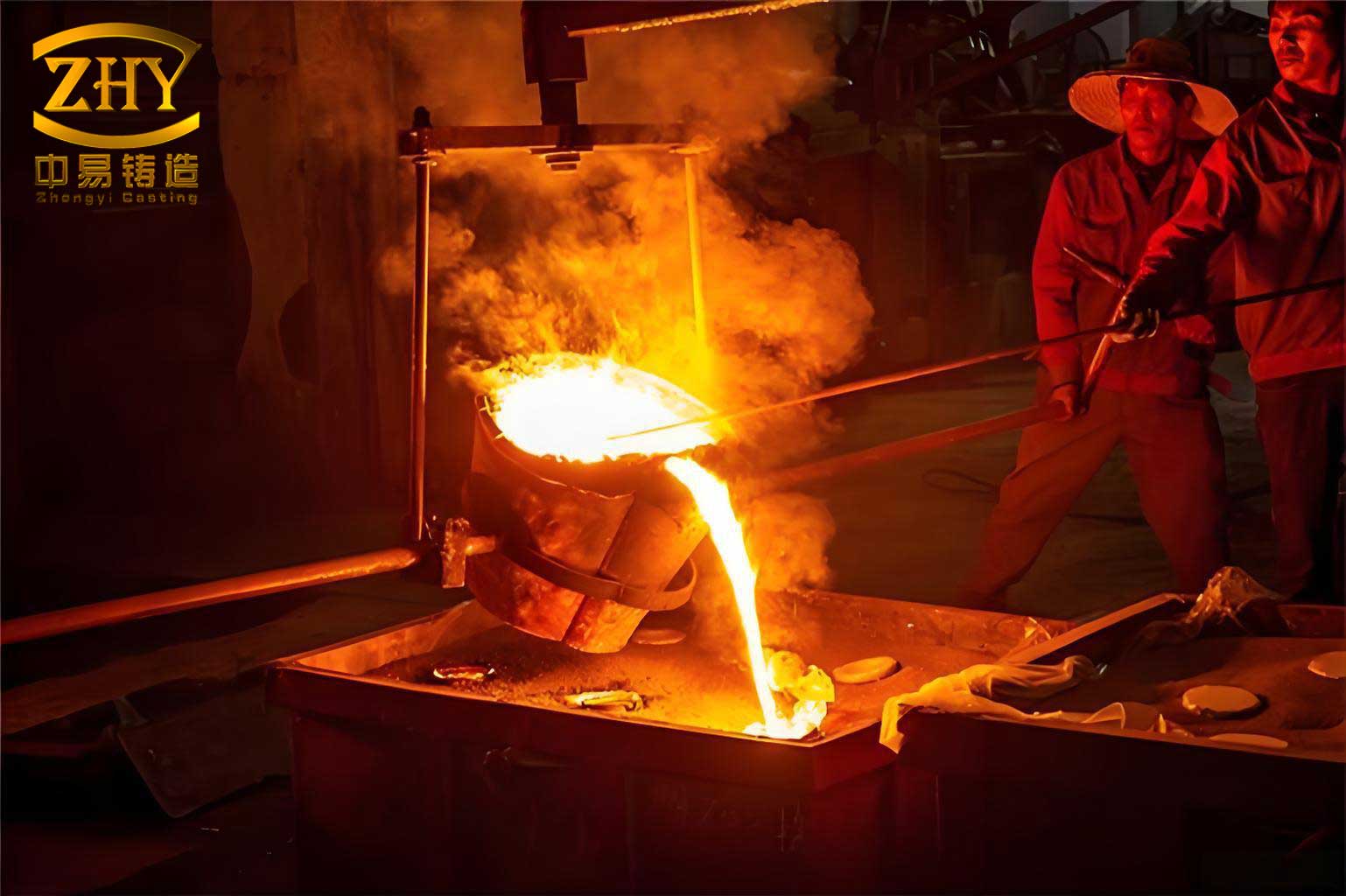
One of the most compelling aspects of the lost foam casting process is its ability to achieve near-zero machining allowance and precise formation. Unlike traditional sand casting, which requires draft angles and parting lines, the lost foam casting process allows for the creation of complex geometries without these constraints. The dimensional tolerance can reach levels as tight as CT5 to CT7, with surface roughness values between 6.3 and 12.5 μm. This precision stems from the use of dry sand, which eliminates defects associated with moisture, binders, and additives. In my experience, implementing the lost foam casting process has consistently reduced post-casting machining by up to 30%, leading to significant cost savings and faster turnaround times. The relationship between pattern quality and final casting accuracy can be expressed through a simple formula: $$ \Delta D = k \cdot \sqrt{T} $$ where $\Delta D$ represents dimensional deviation, $k$ is a process constant, and $T$ is the foam degradation temperature. This highlights how controlling thermal parameters in the lost foam casting process is crucial for maintaining tolerances.
Moreover, the lost foam casting process promotes clean production, aligning with modern environmental standards. During pouring, the EPS foam decomposes into gaseous by-products, which constitute only about 0.3% of the molten metal’s weight—a stark contrast to traditional methods that can generate up to 5% emissions. These emissions are concentrated in time and space, making them easier to manage through negative-pressure suction and combustion净化 systems. I have observed that foundries adopting the lost foam casting process often report a 95% reuse rate for dry sand, minimizing waste and reducing raw material consumption. The environmental footprint of the lost foam casting process can be quantified using an emission reduction index: $$ ERI = \frac{E_{traditional} – E_{lost\,foam}}{E_{traditional}} \times 100\% $$ where $ERI$ typically exceeds 80% for well-optimized setups. This makes the lost foam casting process not only economically viable but also ecologically responsible, reducing worker exposure to silica dust and harmful gases.
Structural design flexibility is another hallmark of the lost foam casting process. By enabling the segmentation of foam patterns into multiple pieces that are later assembled, this method allows for the铸造 of intricate parts like cylinder blocks and heads in a single piece. For instance, a six-cylinder engine block can be divided into several foam modules, each designed for ease of molding and assembly. This modular approach eliminates the need for cores and internal supports, reducing part weight and enhancing mechanical integrity. In my work, I have leveraged this flexibility to integrate features such as oil galleries and coolant passages directly into the casting, which would otherwise require secondary operations. The design freedom afforded by the lost foam casting process can be summarized in a table comparing it with conventional casting:
| Design Aspect | Traditional Casting | Lost Foam Casting Process |
|---|---|---|
| Draft Angles | Required | Not required |
| Parting Lines | Present | Absent |
| Core Usage | Extensive | Minimal to none |
| Weight Reduction | Limited | Up to 20% achievable |
| Integration of Features | Restricted | Highly flexible |
This table underscores how the lost foam casting process transcends traditional limitations, enabling designers to optimize components for performance and efficiency. For cylinder heads, the lost foam casting process facilitates the direct casting of intake and exhaust ports, improving airflow and combustion efficiency. The foam pattern segmentation strategy often involves horizontal splitting to ensure demoldability, with thick sections hollowed out to minimize material usage and prevent defects like carbon inclusions. I recall a project where we applied the lost foam casting process to a four-cylinder head, dividing it into four foam pieces that were later bonded. This approach reduced pattern-making complexity and enhanced dimensional stability, as captured by the formula for bonding strength: $$ \sigma_b = \frac{F}{A} \cdot e^{-\lambda t} $$ where $\sigma_b$ is the bond strength, $F$ is the applied force, $A$ is the area, $\lambda$ is a decay constant, and $t$ is time. This emphasizes the importance of timely casting after pattern assembly in the lost foam casting process to prevent adhesive failure.
When discussing the lost foam casting process for cylinder blocks, the segmentation design becomes even more critical. A four-cylinder block, for example, can be split into two large and two small foam pieces, optimizing the filling and ejection during foam molding. This design reduces the number of movable cores and improves production rates. In my practice, I have utilized automated胶合 systems to assemble these pieces, ensuring consistent quality. The lost foam casting process also allows for innovative分型面 designs, such as curved parting surfaces for six-cylinder blocks, which enhance pattern integrity and reduce finishing work. The geometry of these surfaces can be derived using parametric equations: $$ S(u,v) = \sum_{i=0}^{n} \sum_{j=0}^{m} P_{ij} B_i(u) B_j(v) $$ where $S$ is the surface, $P_{ij}$ are control points, and $B$ are basis functions. Such mathematical modeling is integral to advancing the lost foam casting process for complex components.
However, the lost foam casting process is not without its challenges, and attention to detail is paramount. From my experience, I have compiled key注意事项 that must be adhered to. First, assembled foam patterns should be cast within seven days to prevent adhesive degradation, which can lead to coating infiltration and leakage defects. Second, a single dip-coating application is preferred over multiple layers; a coating thickness of around 0.5 mm ensures optimal permeability and adsorption of liquid foam residues. The coating process can be modeled using Darcy’s law: $$ Q = \frac{k A \Delta P}{\mu L} $$ where $Q$ is the flow rate of coating, $k$ is permeability, $A$ is area, $\Delta P$ is pressure drop, $\mu$ is viscosity, and $L$ is thickness. This highlights how coating uniformity in the lost foam casting process affects defect formation. Third, adequate venting and gating designs are crucial to facilitate sand and gas escape, with weather conditions like humidity and temperature monitored to maintain process stability. I have seen instances where neglect of these factors in the lost foam casting process resulted in carbon segregation and porosity, underscoring the need for rigorous control.
The historical evolution of the lost foam casting process reveals its growing adoption. Initially trialed for aluminum engine parts in the 1980s, it has matured into a robust technology exemplified by facilities like the Saginaw foundry, which produces V6 engine blocks and heads with remarkable efficiency. The lost foam casting process enables the integration of multiple components—such as曲轴箱s and oil separators—into a single casting, reducing assembly work and weight. This contributes to improved fuel economy and lower emissions, aligning with global automotive trends. In my assessments, the lost foam casting process can lower equipment investment by 30-50% and part cost by 10-30% compared to conventional methods, making it a compelling choice for high-volume production. The economic advantage can be expressed as: $$ C_{savings} = (C_{traditional} – C_{lost\,foam}) \cdot V $$ where $C_{savings}$ is total cost savings, $C$ represents unit costs, and $V$ is production volume. This linear relationship incentivizes scaling up the lost foam casting process.
Looking ahead, the lost foam casting process is poised for further innovation. Advances in foam materials, such as biodegradable alternatives, and digital tools like CAD/CAM/CAE integration are enhancing precision and sustainability. Simulation software now predicts defect locations, allowing for proactive optimization of the lost foam casting process. I anticipate that the lost foam casting process will increasingly be applied to lightweight alloys and electric vehicle components, where its design flexibility and waste reduction are invaluable. The ongoing refinement of the lost foam casting process will likely focus on reducing cycle times and expanding material compatibility, as summarized in this trend analysis table:
| Trend Area | Current State in Lost Foam Casting Process | Future Direction |
|---|---|---|
| Material Usage | Primarily EPS foam | Bio-based and composite foams |
| Automation Level | High in assembly and coating | Full AI-driven process control |
| Defect Prediction | Simulation-assisted | Real-time monitoring and correction |
| Application Scope | Engine blocks and heads | Aerospace and renewable energy parts |
| Environmental Impact | Low emissions and high sand reuse | Carbon-neutral process cycles |
In conclusion, the lost foam casting process represents a paradigm shift in manufacturing, offering unparalleled advantages for producing cylinder blocks and heads. Its near-net-shape capability, environmental benefits, and design freedom make it a cornerstone of modern foundry operations. As I reflect on my journey with the lost foam casting process, I am convinced that its continued adoption will drive efficiency and innovation across industries. By mastering the nuances of pattern design, coating, and process control, practitioners can harness the full potential of the lost foam casting process to create high-quality, cost-effective components. The lost foam casting process is not merely a technical method; it is a catalyst for sustainable industrial progress, and I eagerly await its future advancements.