
In my extensive experience within the foundry industry, I have observed that chucks, including self-centering chucks (commonly known as three-jaw chucks) and independent chucks, are among the most frequently utilized components in machine tool construction. The structural strength and overall rigidity of these chucks must meet the assembly precision requirements of the entire machine tool. Their critical performance must ensure stability in clamping force and gripping accuracy during normal variable-speed operation. While the external shape of a chuck may appear relatively simple, casting it presents significant challenges. As high-speed rotating components, chucks must guarantee sufficient stiffness and strength. The required strength depends intrinsically on the density of the cast part, meaning the casting must be entirely free from defects such as porosity, sand inclusions, slag inclusions, and cracks. Furthermore, all internal and external circles, end faces, holes, and grooves of a chuck undergo machining; thus, any surface or internal defect is unacceptable.
Traditionally, chuck blanks were produced in foundry workshops using conventional sand casting methods. Although subsequent advancements introduced resin sand and shell core making for cores, representing substantial progress over ordinary sand casting with good results, these methods still tended to cause defects like sand holes and gas porosity, resulting in relatively low yield rates. Therefore, considering that the lost foam casting process eliminates the need for core setting and mold closing, simplifying the工序, many enterprises specializing in machine tool accessories have opted to produce chuck blanks using the lost foam casting process.
The adoption of the lost foam casting process for chucks requires meticulous design and control. I will delve into the key aspects of gating system design, pattern material selection, and material metallurgy that are crucial for success in this application.
Analysis of Chuck Casting Characteristics and Gating System Design in Lost Foam Casting
Designing an effective gating system for the lost foam casting process begins with a thorough analysis of the chuck’s geometry. The chuck features a generally uniform wall thickness but is divided into three or four equal segments by jaw slots. This segmented structure necessitates a gating design that ensures balanced and equal filling of each segment during mold filling. In my practice, for self-centering chucks, we design three ingates, while for independent chucks, four ingates are used, distributed equally along the upper part of the inner circle. The principle is to follow the solidification rule that critical sections of a casting should be positioned as low as possible in the mold. Therefore, we orient the chuck with its large end face (the one with the internal cavity opening) facing downward. This orientation has proven effective, resulting in minimal defects on the large end face after machining. However, one cannot simply copy sand casting practices; the unique aspects of the lost foam casting process must be accounted for.
A key consideration in the lost foam casting process is the complete removal of foam pyrolysis products. To achieve this, we incorporate a ring-shaped riser at the top, connected via riser necks corresponding to the chuck’s segments (three or four). This riser serves a dual purpose: it acts as a feeder for potential shrinkage and, more importantly, as a collection reservoir for the gaseous and liquid pyrolysis products and un-vaporized residues from the foam pattern. After pouring and cutting the ring riser, examination of its cross-section reveals concentrated carbonaceous deposits and slag, confirming its effectiveness as a “dump” for these harmful by-products. Giving these pyrolysis products a “way out” and storing them away from the casting cavity is paramount to producing high-quality, defect-free castings in the lost foam casting process.
The design of the sprue must consider the特殊性 of the lost foam casting process. To ensure the foam pattern’s decomposition products are fully driven into the riser system, the metallostatic pressure head cannot be too low. With a fixed sprue cross-sectional area, we increase the sprue height appropriately. To avoid excessively long pouring times, a semi-open gating system is employed, ensuring sufficiently large flow channel cross-sections for rapid mold filling. This approach has yielded理想 castings. The following table summarizes key design parameters for the gating system in the lost foam casting process for a typical three-jaw chuck.
| Component | Quantity | Design Principle | Key Dimension/Note |
|---|---|---|---|
| Ingates | 3 | Equal distribution on inner circle top,对应 to jaw segments | Balanced flow to ensure even filling |
| Riser Necks | 3 | Connected to ring riser,对应 to segments | Path for pyrolysis products and feeding |
| Riser | 1 (Ring-shaped) | Collects pyrolysis residue and provides feeding | Inner/outer diameter similar to chuck body |
| Sprue | 1 | Increased height for sufficient metallostatic pressure | Height adjusted based on pattern cluster size |
| Gating Type | Semi-open system for fast filling | ||
Experiments with stacked or “cluster” casting (e.g., “two-in-a-row” or “three-in-a-row”) using common EPS for the gating system resulted in very low yield rates. The pyrolysis residues from the lower pattern’s gating system would contaminate the upper cavities, leading to severe carbon defects and slag inclusions on the upper castings. This reinforces the criticality of material selection for the pattern in the lost foam casting process.
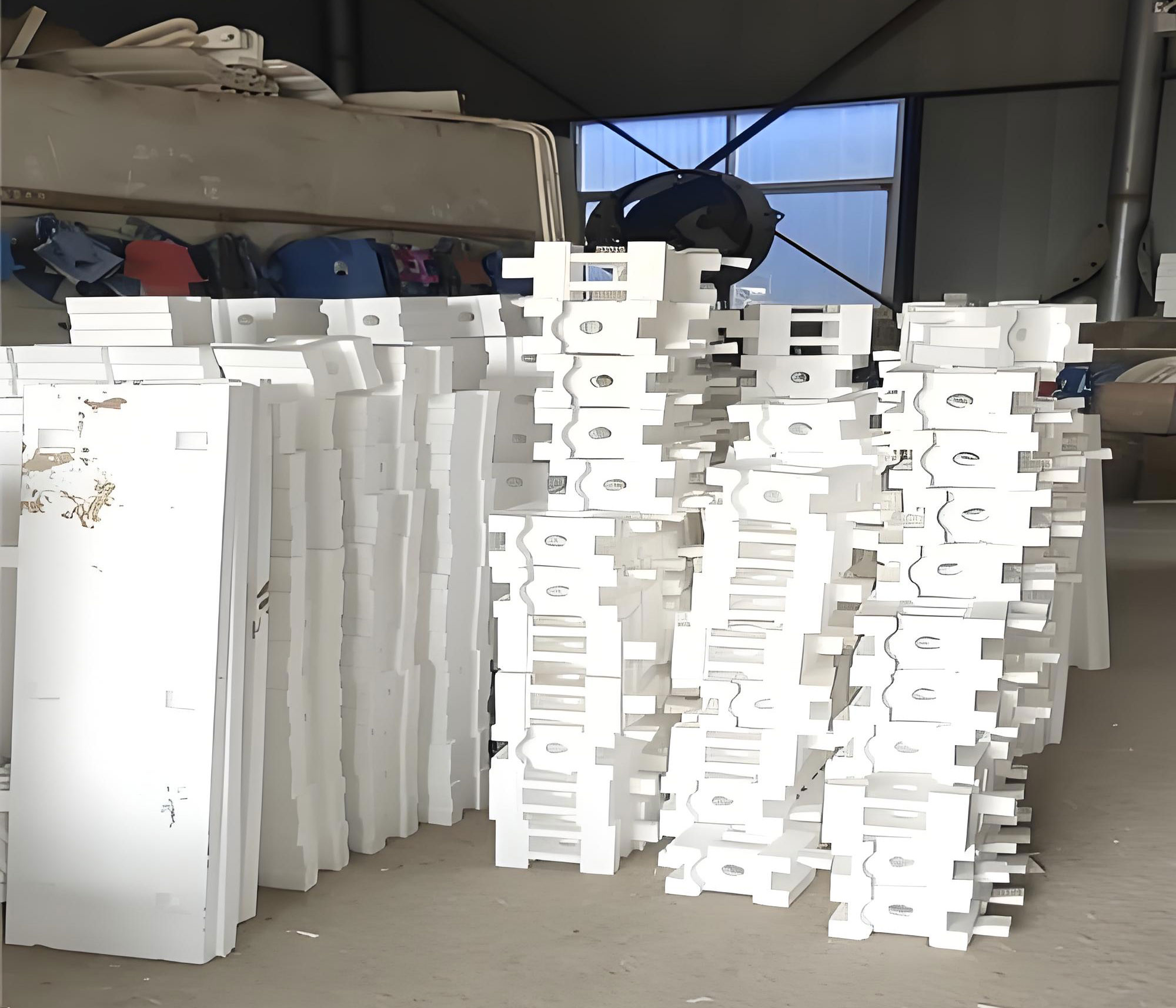
Pattern Material Selection for the Lost Foam Casting Process
The choice of foam material is a decisive factor in the quality of castings produced via the lost foam casting process. Given the high technical requirements for chuck castings—freedom from slag, gas holes, wrinkles, and carbon defects after machining—we must carefully evaluate available materials. Common expandable polystyrene (EPS) is cost-effective but has drawbacks: it tends to leave more carbonaceous residue during pyrolysis and has higher initial gas generation. For critical components like chucks, we opt for co-polymer beads (often referred to as共聚料 in the source text, which we term as specialized high-performance EPS). Although more expensive (approximately 2-3 times the cost of standard EPS) and slightly more brittle, this material vaporizes more rapidly and leaves significantly less residue during thermal decomposition.
Production实践 has unequivocally confirmed the superiority of this choice. Castings produced from patterns made of this高级 material are virtually free from the aforementioned defects after machining. In contrast, initial trials using standard EPS for patterns consistently resulted in scrap parts due to carbon defects and slag inclusions. The following formula conceptually represents the pyrolysis process, where the goal is to minimize solid residue $R_s$:
$$ \text{Foam Polymer} + \text{Heat} \rightarrow G_g + L_l + R_s + \text{Energy} $$
where $G_g$ represents gaseous products, $L_l$ represents liquid intermediates, and $R_s$ represents solid residue (carbon, slag). The advanced co-polymer material minimizes $R_s$, which is crucial for the lost foam casting process.
The table below compares the two primary pattern materials used in the lost foam casting process for this application.
| Material Property | Standard EPS | Co-polymer/Advanced EPS | Impact on Lost Foam Casting Process |
|---|---|---|---|
| Cost | Low (Base reference) | High (~2-3x standard) | Influences overall part cost but reduces scrap. |
| Pyrolysis Rate | Slower | Faster | Faster vaporization reduces chances of liquid residue entrapment. |
| Residue (Rs) | Higher | Much Lower | Lower residue minimizes carbon defects and slag inclusions. |
| Initial Gas Generation | Higher | Lower | Lower initial gas burst can reduce turbulence and gas porosity risk. |
| Pattern Strength/Surface | Good | Slightly brittle but good detail | Requires careful handling but yields excellent surface finish. |
Material Control and Metallurgy for Chuck Castings
The specified material for machine tool chucks is typically high-strength gray iron, such as HT300 (tensile strength $\geq$ 300 MPa). To achieve and consistently meet these mechanical properties, precise control over melting and inoculation is essential. Utilizing medium-frequency induction furnaces provides excellent control. The foundation lies in maintaining the standard five elemental化学成分 within specification. However, the influence of charge materials and trace elements cannot be overlooked.
The charge makeup—proportions of pig iron, scrap steel, and returns—directly affects the carbon equivalent (CE) and ultimate strength. Initially, using a charge similar to cupola practice (pig iron 30-40%, scrap steel 10-20%, balance returns) yielded lower mechanical properties. Increasing the scrap steel content effectively reduced the carbon equivalent, decreasing graphite amount and refining its structure, thereby increasing strength through a larger volume of primary austenite dendrites. The carbon equivalent is calculated as:
$$ CE = C\% + \frac{Si\% + P\%}{3} $$
where $C\%$, $Si\%$, and $P\%$ are the weight percentages of carbon, silicon, and phosphorus, respectively. A lower CE promotes higher strength but can increase chilling tendency and hardness, affecting machinability. Therefore, a balanced approach is necessary.
To obtain high-strength gray iron with tensile strength above 300 MPa, we employ two complementary strategies within the lost foam casting process framework: 1) Adjusting charge composition to increase scrap steel, lowering CE, followed by robust inoculation; and 2) Adding small amounts of alloying elements (like Cr, Cu, Sn) combined with inoculation. The second method allows maintaining a relatively higher CE for better castability while using alloys to promote pearlite formation, refine the matrix, and strengthen ferrite.
Inoculation is a critical step. Adding inoculant (e.g., FeSi75) to the liquid iron creates numerous sub-microscopic nuclei, promoting the formation of eutectic cells in the liquid. Each eutectic cell generates fine graphite flakes, growing into the final structure. More eutectic cells lower the solidification rate, favoring the stable Fe-C graphite system and promoting a Type A graphite distribution in a pearlitic matrix, which is essential for meeting specifications.
However, inoculation fade is a significant concern. The effectiveness of inoculation declines rapidly with time; after approximately 8-10 minutes, it may largely disappear. Therefore, for the lost foam casting process, we mandate that pouring be completed within 6-8 minutes after inoculation. Furthermore, we implement a dual inoculation practice: primary inoculation during tapping and a secondary, minor stream inoculation at the pouring ladle lip during casting. This post-inoculation significantly enhances the效果.
We monitor the effect using chill wedge tests. The white iron depth (chill width) is controlled to 3-6 mm before inoculation and 1-3 mm after inoculation. The relationship between chill width (W) and tendency for mottled or white iron can be expressed as an indicator of inoculation effectiveness and碳饱和度.
The table below outlines a typical target composition range and resulting properties for chuck castings produced via the lost foam casting process.
| Element/Property | Target Range (wt.%) | Role/Effect |
|---|---|---|
| Carbon (C) | 3.0 – 3.4 | Base element; affects fluidity, strength, and graphitization. |
| Silicon (Si) | 1.8 – 2.4 | Promotes graphitization, strengthens ferrite. Influences CE. |
| Manganese (Mn) | 0.6 – 1.0 | Neutralizes sulfur, promotes pearlite, increases strength. |
| Phosphorus (P) | < 0.15 | Should be minimized; increases brittleness and chill. |
| Sulfur (S) | < 0.12 | Should be minimized; hinders graphitization. |
| Chromium (Cr)* | 0.15 – 0.30 | Alloying element; stabilizes pearlite, increases strength/hardness. |
| Copper (Cu)* | 0.3 – 0.6 | Alloying element; refines pearlite, increases strength/corrosion resistance. |
| Carbon Equivalent (CE) | 3.7 – 4.1 | Calculated as $CE = C + (Si+P)/3$; balances castability and strength. |
| Tensile Strength | > 300 MPa (HT300) | Primary mechanical requirement for chuck rigidity. |
| Hardness (HB) | 200 – 250 | Ensures good machinability while providing wear resistance. |
*Optional alloying elements added in small quantities based on specific grade requirements.
Process Management and Quality Assurance in Lost Foam Casting
Implementing the lost foam casting process successfully requires stringent production floor工艺管理. Every环节 must be strictly controlled to ensure stable product quality. For the melting department, raw material management is paramount. Charge materials must be carefully sorted, stored separately, and weighed accurately. Particular attention is paid to scrap steel selection; we meticulously avoid scraps with high levels of elements like Cr, Mo, and V that hinder graphitization and adversely affect machinability.
For the cleaning department, controlling the shakeout time is critical. Premature removal of castings from the sand mold can lead to excessively rapid cooling, causing surface hardness to exceed specifications and creating machining difficulties. The lost foam casting process, with its insulating sand bed, requires careful timing to allow for gradual cooling within the flask.
The工序过程控制 for the lost foam casting process itself must be细化 and rigorous. This includes monitoring pattern density and coating integrity, ensuring proper sand compaction and fluidization, controlling pouring temperature (typically 1380-1420°C for gray iron), and maintaining consistent pouring speed. A minor disruption in any step can introduce defects, underscoring the integrated nature of the lost foam casting process.
Benefits and Comparative Analysis
Adopting the lost foam casting process for machine tool chucks combines the wisdom of traditional sand casting principles—such as orienting critical surfaces downward—with the unique advantages of evaporative pattern casting. The designed gating system with its ring-shaped riser for slag collection and balanced filling is a hallmark of this approach. Compared to traditional green sand castings, the lost foam casting process delivers superior results.
Quantifiable benefits observed include: castings meeting all technical requirements with quality indices surpassing sand casting; a reduction in单体重量 of approximately 10% due to near-net-shape capabilities and optimized design; dimensional accuracy achieving CT8-9 grade per casting tolerance standards; weight accuracy reaching MT6-7 grade; and a reduction in machining scrap rate by around 5%. Additionally, the lost foam casting process reduces raw material consumption (no binders needed for molds/cores), significantly improves the workshop environment by eliminating silica dust and binder fumes, and reduces the physical labor intensity for operators. These advantages collectively demonstrate the profound优越性 of the lost foam casting process for manufacturing complex, high-integrity components like machine tool chucks.
In conclusion, the successful application of the lost foam casting process to machine tool chucks hinges on a systems approach: intelligent gating design tailored to the part geometry, selection of high-performance pattern materials to minimize residues, precise control over iron metallurgy and inoculation, and unwavering discipline in process management. This holistic integration ensures the production of dense, defect-free castings that reliably meet the stringent demands of the machine tool industry, solidifying the role of the lost foam casting process as a vital advanced manufacturing technology.