
In the field of manufacturing high-precision and large-scale components for industrial machinery, the production of casting parts has always been a critical area of focus. Traditional methods, such as furan resin sand casting, have been widely used due to their reliability and stability. However, these methods come with significant drawbacks, including environmental concerns, complex operations, and high post-processing efforts. In recent years, lost foam casting has emerged as a promising alternative, offering improved surface quality, dimensional accuracy, and a better working environment. In this study, I explore the application of lost foam casting specifically for machine tool spindle box casting parts, detailing the process design, defect prevention, and practical outcomes. The goal is to demonstrate that lost foam casting can successfully produce high-quality casting parts for demanding applications, with a focus on optimizing the process for complex geometries and stringent performance requirements.
The journey begins with an overview of the traditional furan resin sand process. This method is known for its high mold strength, surface stability, and thermal resistance, which reduce deformation in casting parts. However, it involves the use of pungent binders that create harsh production conditions. Additionally, the molding and box-assembly operations are labor-intensive, requiring skilled workers and resulting in extensive cleaning and grinding work for the final casting parts. The recycling of used sand is also challenging, leading to waste management issues. In contrast, lost foam casting eliminates many of these problems. By using expandable polystyrene (EPS) patterns that vaporize during pouring, this process minimizes environmental impact, simplifies operations, and enhances the surface finish of casting parts. This makes it particularly suitable for producing complex casting parts like machine tool spindle boxes, where precision and defect-free surfaces are paramount.
To set the context, the specific casting part under consideration is a spindle box for a vertical machining center. This component is integral to the machine’s functionality, housing the spindle and its transmission elements. The casting part has dimensions of approximately 910 mm × 650 mm × 520 mm after machining and is made of HT300 gray iron. Its structure includes multiple internal cavities and mounting surfaces, such as the front hole for the spindle, the top surface for motor installation, and the rear guide rail interface. These features demand high dimensional accuracy and freedom from defects like porosity or inclusions, as any flaw could compromise the performance of the casting part. The complexity of the design necessitates careful process planning to ensure successful production using lost foam casting.
In the initial phase, I conducted a thorough analysis of the casting part for lost foam casting suitability. One key challenge was ensuring proper sand flow and venting during the process to avoid defects. To address this, I collaborated with designers to modify the pattern by adding six Ø40 mm holes in strategic locations. These holes facilitate better sand compaction and gas evacuation, reducing the need for pre-filled resin sand in certain areas. This modification was crucial for optimizing the casting process for such intricate casting parts. After finalizing the design, the pattern was oriented at a 30° angle with the spindle hole facing upward and the slider mounting surface downward. This orientation, combined with risers placed at the highest points, helps in achieving directional solidification and minimizing defects in the final casting part.
The lost foam casting process involves several sequential steps, each requiring precise control. I will now delve into the detailed process design, starting with the pattern-making stage. The patterns for these casting parts were fabricated using EPS material, which is expanded to form the exact shape of the component. The expansion process must be carefully managed to achieve uniform density and avoid distortions. After expansion, the patterns were dried in a controlled environment to remove moisture, which could otherwise lead to gas-related defects during casting. The drying schedule was as follows: 25°C for 2 hours, 30°C for 2 hours, 35°C for 2 hours, and 40°C for 30 hours. This gradual increase in temperature ensures thorough drying without causing pattern deformation, which is essential for maintaining the accuracy of casting parts.
Once dried, the patterns were assembled with gating systems and risers using adhesive. All seams were sealed with masking tape to prevent coating infiltration, which could cause surface defects in the casting parts. The gating system was reinforced with fiber rods to ensure stability during subsequent steps. Areas where the pattern contacted support racks were protected with ceramic plates to avoid damage to the coating. This attention to detail in pattern preparation is critical for producing high-integrity casting parts.
The next step involves applying a refractory coating to the patterns. For these casting parts, I used a specialized lost foam coating with a Baume degree of 70–75. The coating was applied via dipping or spraying in three layers, each with a minimum thickness of 0.5 mm, resulting in a total coating thickness of at least 1.8 mm. This coating serves multiple purposes: it provides a barrier between the molten metal and the sand, enhances surface finish, and facilitates gas permeability during pouring. After each coating layer, the patterns were dried according to a specific schedule: 35°C for 2 hours, 40°C for 2 hours, 45°C for 2 hours, 50°C for 3 hours, and 55°C for 6 hours. This rigorous drying process ensures that the coating is fully cured, preventing issues like cracking or peeling that could compromise the quality of the casting parts.
After coating, the patterns are ready for molding. In this stage, the coated assembly is placed in a flask, and unbonded sand is poured around it while applying vibration to achieve tight compaction. For complex casting parts like spindle boxes, special care is taken to ensure that sand fills all cavities and undercuts. A vacuum is applied to the flask to stabilize the mold during pouring. The gating system is positioned vertically, and a pouring cup is placed on top. The entire setup is then covered with a plastic film to maintain the vacuum. This molding process is relatively simple compared to traditional methods, reducing labor requirements and improving consistency for casting parts.
Now, let’s discuss the melting and pouring aspects, which are vital for the metallurgical quality of casting parts. The charge composition for the HT300 iron was designed to balance cost and performance. It consisted of 35% blast furnace iron, 45% steel scrap, and 20% returns of the same material. The chemical composition was tightly controlled, as shown in Table 1. This blend ensures adequate strength and machinability for the casting parts.
| Element | Range |
|---|---|
| Carbon (C) | 3.1–3.2 |
| Silicon (Si) | 1.7–1.9 |
| Manganese (Mn) | 0.8–1.0 |
| Sulfur (S) | 0.06–0.08 |
| Phosphorus (P) | ≤ 0.06 |
| Chromium (Cr) | ≤ 0.02 |
The melting was carried out in a medium-frequency induction furnace, with the molten iron held at a high temperature for refinement. Specifically, after reaching 1450°C for sampling, the temperature was raised to 1520–1550°C for a holding period of 8–10 minutes. This high-temperature holding promotes grain refinement, deoxidization, and improved inoculation response, all of which enhance the properties of the casting parts. The benefits can be expressed through the following relationship for grain size reduction: $$d = k \cdot T^{-n}$$ where \(d\) is the average grain diameter, \(T\) is the absolute temperature, and \(k\) and \(n\) are material constants. Lower grain size contributes to better mechanical performance in casting parts.
After holding, the iron was tapped into a ladle for cooling and inoculation. A long-lasting inoculant (silicon-barium-calcium) was added at 0.4% of the charge weight, followed by a stream inoculant (sulfur-oxygen type) with a granularity of 0.2–0.7 mm at 0.1%. Inoculation is crucial for promoting graphite formation and reducing chilling in gray iron casting parts. The effectiveness of inoculation can be modeled using kinetic equations, such as: $$\frac{dN}{dt} = -k N^2$$ where \(N\) is the number of nucleation sites, and \(k\) is a rate constant dependent on temperature and composition. Proper inoculation ensures uniform microstructure in casting parts.
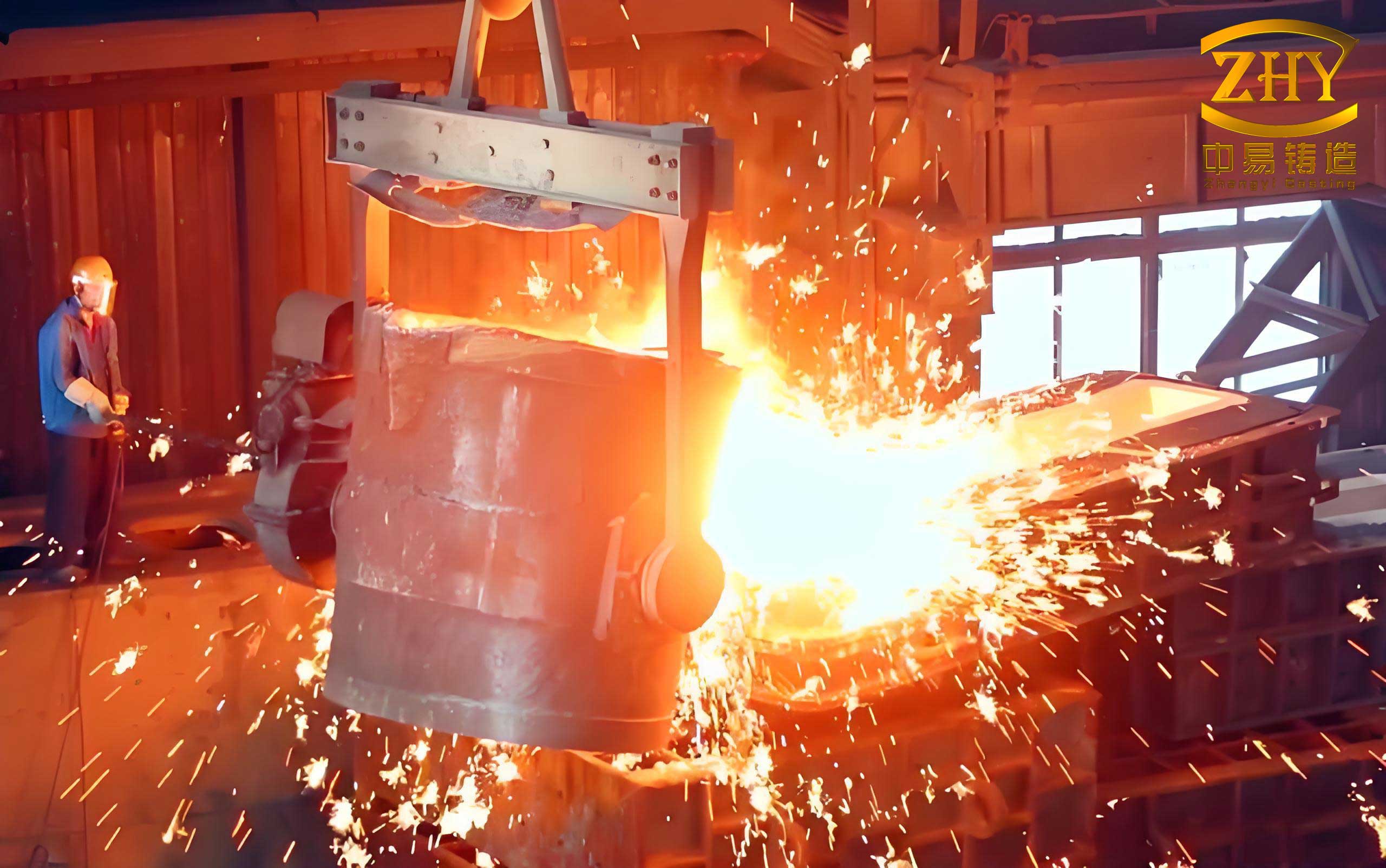
Pouring was conducted at temperatures between 1420°C and 1460°C, with a vacuum pressure of 0.06–0.07 MPa maintained for 15 minutes after pouring. The pouring rate was controlled to ensure continuous flow, preventing air entrapment and mold instability. The vacuum aids in removing gases generated from pattern decomposition, which is critical for defect-free casting parts. The relationship between gas evolution and vacuum pressure can be described by: $$V_g = \frac{P_{atm} – P_{vac}}{R T} \cdot m_{EPS}$$ where \(V_g\) is the volume of gas produced, \(P_{atm}\) is atmospheric pressure, \(P_{vac}\) is the vacuum pressure, \(R\) is the gas constant, \(T\) is the temperature, and \(m_{EPS}\) is the mass of the EPS pattern. Optimizing these parameters minimizes defects in casting parts.
After casting, the parts were extracted, cleaned, and inspected. The results showed that the spindle hole, motor mounting surface, and guide rail surfaces were free from defects, with a qualification rate exceeding 98%. This demonstrates the efficacy of lost foam casting for producing high-quality casting parts. To further illustrate the process parameters, Table 2 summarizes key steps and conditions.
| Process Step | Parameters | Remarks |
|---|---|---|
| Pattern Drying | 25°C to 40°C over 36 hours | Ensures moisture removal |
| Coating Application | 3 layers, total ≥1.8 mm | Provides refractory barrier |
| Coating Drying | 35°C to 55°C over 15 hours | Prevents cracking |
| Molding Vacuum | 0.06–0.07 MPa | Stabilizes mold |
| Pouring Temperature | 1420–1460°C | Balances fluidity and gas evolution |
| Inoculation | 0.4% bulk + 0.1% stream | Enhances microstructure |
Despite the success, lost foam casting is prone to specific defects that require proactive control. I will now discuss the common defects—collapse, sand adhesion, porosity, and slag inclusion—and their prevention methods, all aimed at ensuring the integrity of casting parts.
Collapse, or mold collapse, occurs when the mold structure fails during pouring, often due to inadequate vacuum or slow pouring. To prevent this in casting parts, I ensured a continuous pouring rate to keep the sprue sealed, maintaining vacuum stability. The design of the gating system was optimized to promote rapid filling, and a vacuum pump with sufficient capacity was used. The critical pouring rate \(Q_{crit}\) can be estimated using: $$Q_{crit} = \frac{A \cdot \sqrt{2gH}}{\rho}$$ where \(A\) is the cross-sectional area of the sprue, \(g\) is gravity, \(H\) is the metallostatic head, and \(\rho\) is the density of the metal. Exceeding this rate helps prevent collapse in casting parts.
Sand adhesion, or burn-on, manifests as sand particles sticking to the surface of casting parts. This is often caused by thin coatings, low coating refractoriness, or loose sand compaction. For these casting parts, I increased the coating thickness and used high-refractory coatings. In complex areas, pre-filled resin sand was employed to enhance support. Additionally, pouring temperature and vacuum were controlled to reduce thermal shock. The risk of sand adhesion can be quantified by the sintering tendency: $$S = \int_{0}^{t} T(t) \cdot \kappa \, dt$$ where \(S\) is the sintering index, \(T(t)\) is the temperature over time, and \(\kappa\) is a material constant. Lower values reduce adhesion in casting parts.
Porosity and slag inclusion are internal defects that often appear in the upper sections or blind areas of casting parts. They result from gases and residues from pattern decomposition being trapped in the metal. To mitigate these, I optimized the gating system to align metal flow with gas venting direction. Pouring temperature was kept high enough to allow gas evacuation but not so high as to excessive gas generation. The use of slag traps and risers at the top of casting parts helped collect impurities. The gas evolution rate from EPS decomposition can be modeled as: $$\frac{dG}{dt} = \alpha e^{-\beta / T}$$ where \(G\) is the gas volume, \(\alpha\) and \(\beta\) are constants, and \(T\) is temperature. Controlling this rate is key for sound casting parts.
To summarize the defect prevention strategies, Table 3 provides a comprehensive overview. This table highlights the causes and solutions for each defect, emphasizing the importance of process control in producing high-quality casting parts.
| Defect Type | Primary Causes | Prevention Measures |
|---|---|---|
| Collapse | Slow pouring, poor vacuum, weak gating | Maintain continuous pour; optimize gating; ensure vacuum stability |
| Sand Adhesion | Thin coating, low refractoriness, loose sand | Increase coating thickness; use high-refractory coatings; pre-fill sand in critical areas |
| Porosity | Gas entrapment from pattern decomposition | Enhance coating permeability; control pouring temperature; use vacuum effectively |
| Slag Inclusion | Residues from pattern not floated out | Design gating for directional solidification; add risers and slag traps |
In conclusion, the application of lost foam casting to machine tool spindle box casting parts has proven highly successful. Through careful process design, including pattern modification, coating application, and controlled melting and pouring, I achieved casting parts with excellent surface quality and dimensional accuracy. The defect prevention measures effectively addressed common issues, resulting in a qualification rate over 98%. This demonstrates that lost foam casting is a viable and advantageous method for producing complex casting parts in the machinery industry. The environmental benefits, reduced labor intensity, and improved consistency further support its adoption. As technology advances, continued optimization of lost foam casting will likely expand its use for a wider range of casting parts, driving innovation in manufacturing.
To further enhance the understanding of this process, I have included mathematical models and tables that summarize key aspects. For instance, the relationship between process variables and defect formation can be explored using statistical methods like design of experiments (DOE). The overall quality \(Q\) of casting parts can be expressed as a function of multiple factors: $$Q = f(T_p, V, C_t, P_v)$$ where \(T_p\) is pouring temperature, \(V\) is pouring velocity, \(C_t\) is coating thickness, and \(P_v\) is vacuum pressure. Optimizing these factors through iterative testing can lead to even better outcomes for casting parts.
In summary, lost foam casting offers a robust solution for manufacturing high-performance casting parts. By integrating technical insights with practical adjustments, this process can meet the stringent demands of modern machinery, ensuring reliability and efficiency in production. The success with spindle box casting parts underscores its potential for broader applications, making it a valuable technique in the foundry industry.