
In the realm of advanced casting technologies, lost foam casting, particularly vacuum-assisted lost foam casting, stands out as a revolutionary method often hailed as the “casting technology of the 21st century” and a “green casting technology.” This process involves using polystyrene foam patterns coated with refractory material, placed in a flask filled with dry, binder-free sand, and maintained under a certain degree of vacuum during pouring and solidification. The vacuum aids in removing gases generated from the thermal decomposition of the foam, allowing molten metal to replace the pattern and form the casting. For thin-wall components like gearbox housings made of gray cast iron, this method offers superior dimensional accuracy, smooth surface finish, and reduced environmental impact compared to traditional sand casting. However, producing high-quality thin-wall gray cast iron castings, especially those requiring pressure-tightness for hydraulic leakage tests, presents significant challenges due to issues such as cold shuts, slag inclusions, porosity, and leakage. This article, from my perspective as a practitioner in the field, delves into the systematic optimization of the vacuum lost foam casting process for thin-wall gray cast iron gearbox housings, focusing on gating system design, molding arrangement, vacuum degree, carbon equivalent, and pouring temperature. Through extensive experimentation and analysis, we aim to share insights that enhance casting quality and productivity.
The production environment for these castings involves specific conditions: the base sand has a grain size primarily of 20-40 mesh (over 85%), with a mud content ≤0.3%; the foam patterns are coated with a 1.0-1.5 mm thick layer and have a moisture content ≤1%; the flasks measure 2050 mm × 1500 mm × 1300 mm, equipped with top ventilation and bottom vacuum sources; and the facility operates a vacuum lost foam production line with 70 flasks, using an automatic teapot ladle pouring machine with a maximum capacity of 2100 kg. Three types of gray cast iron gearbox housings for large agricultural machinery were studied, all designated as grade 300 gray cast iron. Housing A has dimensions of 780 mm × 450 mm × 440 mm, a main wall thickness of 5-6 mm (uniform except for flanges and bosses), and a weight of 100 kg. Housing B measures 680 mm × 320 mm × 245 mm with a 6-7 mm main wall thickness and weighs 100 kg, while Housing C is 440 mm × 420 mm × 380 mm with a 5-6 mm main wall thickness and weighs 68 kg. All require a 3-bar hydraulic pressure test for leakage, demanding high integrity and minimal defects. Initial production runs revealed critical issues: high failure rates in hydraulic leakage tests, cold shuts, external slag inclusions, and distortions. To address these, a comprehensive optimization campaign was undertaken, as detailed below.
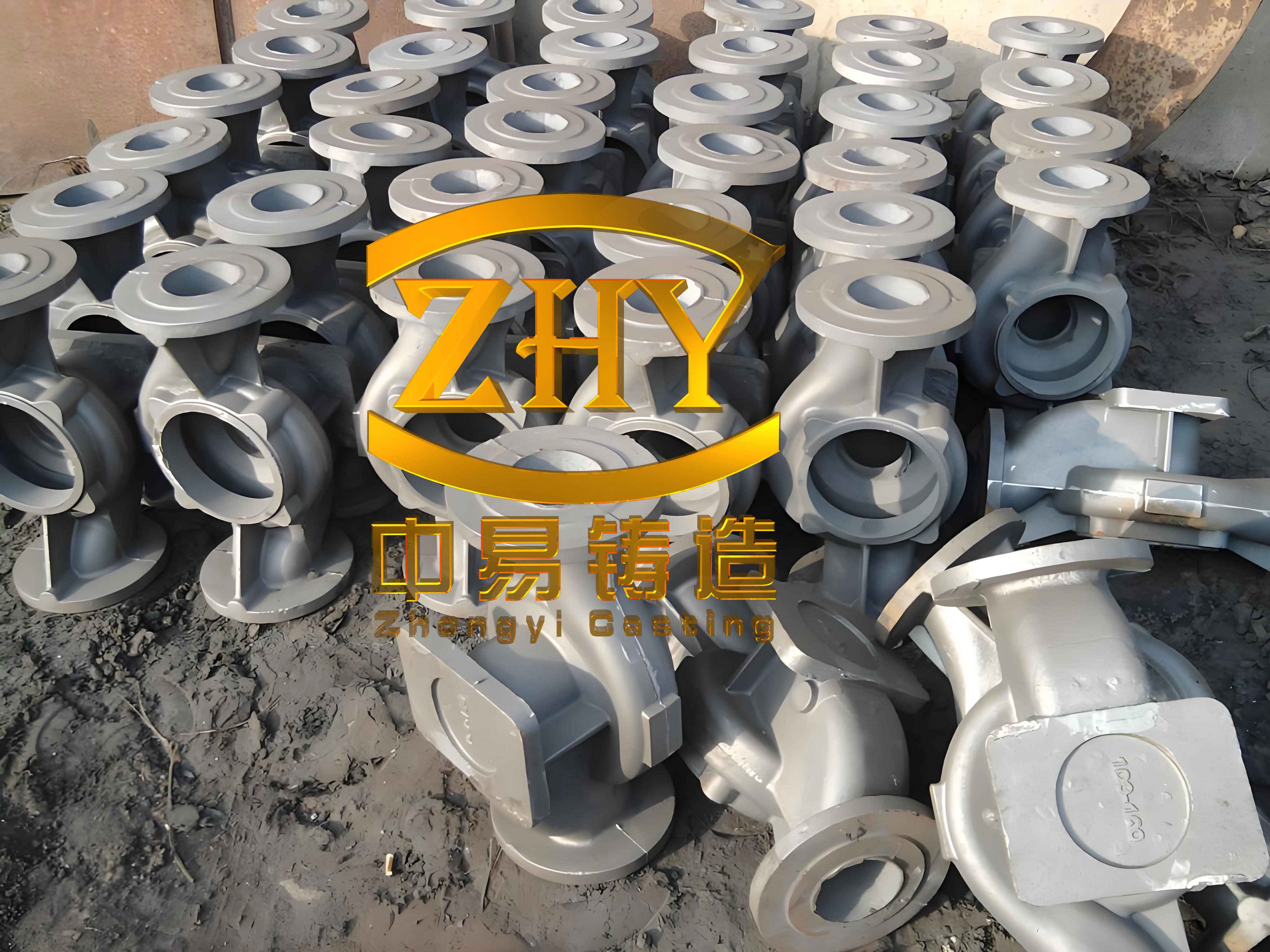
The gating system and molding arrangement are pivotal in lost foam casting, especially for thin-wall gray cast iron components where rapid filling is essential to avoid premature solidification and defects. Initially, for Housing A, a bottom and middle gating combination with a star-shaped stepped system was used: a 50 mm diameter sprue, four 30 mm × 20 mm runners, and eight 40 mm × 10 mm ingates, with an area ratio of sprue:runner:ingate = 1:1.3:1.7, molded with the non-pressure-bearing region facing downward (large opening down) at 6 pieces per flask. Housing B employed a unilateral stepped system with a 50 mm sprue, four 30 mm × 20 mm runners, and six 30 mm × 15 mm ingates (ratio 1:1.3:1.4), molded similarly. However, these designs led to inadequate filling and high defect rates. We explored multiple gating configurations, as summarized in Table 1, to determine the optimal approach for each housing type. The experiments showed that open gating systems with dual pouring points and three-level stepped multiple ingates yielded the best results. For Housing A, a modified system includes a 70 mm diameter sprue, six 35 mm × 20 mm runners per piece, and twelve 50 mm × 10 mm ingates (ratio 1:1.1:1.5), molded with the pressure-bearing region facing downward (large opening up) at 8 pieces per flask. Housing B uses a 70 mm sprue, five 30 mm × 20 mm runners, and seven 50 mm × 15 mm ingates (ratio 1:1.2:1.4), while Housing C adopts a top-gated star system with a 50 mm sprue, four 30 mm × 20 mm runners, and six 40 mm × 10 mm ingates (ratio 1:1.3:1.3) at 16 pieces per flask. These changes ensure faster, more uniform filling, reducing cold shuts and slag entrapment in thin-wall gray cast iron castings.
| Housing Type | Sprue Diameter (mm) | Runner Dimensions (mm) | Ingate Dimensions (mm) | Number of Ingates | Sprue Area (mm²) | Runner Area (mm²) | Ingate Area (mm²) | Area Ratio (Sprue:Runner:Ingate) |
|---|---|---|---|---|---|---|---|---|
| A (Initial) | 50 | 30×20 | 40×10 | 8 | 1926 | 2400 | 3200 | 1:1.3:1.7 |
| A (Optimized) | 70 | 35×20 | 50×10 | 12 | 3847 | 4200 | 6000 | 1:1.1:1.5 |
| B (Initial) | 50 | 30×20 | 30×15 | 6 | 1926 | 2400 | 2700 | 1:1.3:1.4 |
| B (Optimized) | 70 | 30×20 | 50×15 | 7 | 3847 | 3000 | 5250 | 1:0.8:1.4 |
| C (Optimized) | 50 | 30×20 | 40×10 | 6 | 1926 | 2400 | 2400 | 1:1.3:1.3 |
Vacuum degree, or negative pressure, is a critical parameter in lost foam casting that influences mold stability, gas evacuation, and defect formation. For thin-wall gray cast iron parts, an optimal vacuum level helps prevent mold collapse, reduces slag inclusions, and minimizes distortions. We conducted trials on Housing A using the optimized gating system, with pouring temperature fixed at 1470°C, and varied the vacuum degree from 0.04 MPa to 0.052 MPa in increments of 0.001 MPa, assessing hydraulic leakage and slag defect rates per batch of 16 castings. The results, plotted in Figure 1, indicate that as vacuum increases, defects initially decrease, plateauing around 0.049 MPa. The relationship can be approximated by a quadratic function: $$ \text{Defect Rate} = a \cdot P^2 + b \cdot P + c $$ where \( P \) is the vacuum degree in MPa, and \( a, b, c \) are coefficients derived from experimental data. For instance, leakage defects dropped from 35% at 0.04 MPa to 15% at 0.049 MPa. However, vacuum alone was insufficient to achieve target quality levels, necessitating adjustments in other parameters for gray cast iron.
| Vacuum Degree (MPa) | Hydraulic Leakage Rate (%) | Slag Inclusion Rate (%) | Overall Defect Rate (%) |
|---|---|---|---|
| 0.040 | 35.2 | 28.5 | 63.7 |
| 0.045 | 25.8 | 20.3 | 46.1 |
| 0.049 | 15.1 | 12.7 | 27.8 |
| 0.052 | 14.8 | 12.5 | 27.3 |
Pouring temperature profoundly affects the fluidity and solidification behavior of gray cast iron in lost foam casting. Low temperatures can lead to cold shuts and incomplete filling in thin sections, while excessively high temperatures may exacerbate gas evolution and mold erosion. Initially, based on experience with thicker gray cast iron castings, we set the pouring temperature at 1470°C, but this resulted in prevalent cold shuts for the thin-wall gearbox housings. We systematically increased the temperature in 5°C increments, using Housing A with the optimized gating, a carbon equivalent of 3.8, and a vacuum of 0.049 MPa, evaluating each batch of 16 castings. As shown in Figure 2, defect rates declined steadily with rising temperature, with cold shuts vanishing above 1500°C and minimal improvements beyond 1520°C. The data suggests an exponential decay model: $$ \text{Defect Rate} = \alpha \cdot e^{-\beta T} + \gamma $$ where \( T \) is the pouring temperature in °C, and \( \alpha, \beta, \gamma \) are constants. For gray cast iron, a temperature range of 1510–1520°C proved optimal, ensuring adequate fluidity without compromising integrity.
| Pouring Temperature (°C) | Cold Shut Rate (%) | Leakage Rate (%) | Slag Inclusion Rate (%) |
|---|---|---|---|
| 1470 | 18.5 | 22.3 | 15.8 |
| 1480 | 12.1 | 18.7 | 13.2 |
| 1490 | 7.4 | 15.4 | 10.9 |
| 1500 | 0.0 | 12.8 | 9.1 |
| 1510 | 0.0 | 10.5 | 7.6 |
| 1520 | 0.0 | 9.8 | 7.3 |
Carbon equivalent (CE) is a key factor influencing the microstructure and properties of gray cast iron, defined as: $$ CE = C + \frac{Si}{3} $$ where C and Si are the weight percentages of carbon and silicon, respectively. A higher CE improves fluidity and reduces shrinkage but may affect strength. For thin-wall gray cast iron castings, optimizing CE is crucial to balance leak-tightness and defect minimization. With pouring temperature fixed at 1515–1525°C and vacuum at 0.049 MPa, we varied the CE from 3.6 to 4.3 in steps of 0.1 for Housing A, testing 16 castings per step. The results, depicted in Figure 3, show that as CE increases, leakage and slag defects decrease, with diminishing returns above CE 4.2. The trend follows a power-law relationship: $$ \text{Defect Rate} = k \cdot CE^{-\lambda} $$ where \( k \) and \( \lambda \) are empirical coefficients. A CE of around 4.1 (e.g., 3.5% C and 1.8% Si) yielded the best compromise, enhancing the pressure-tightness of gray cast iron housings while maintaining adequate mechanical properties.
| Carbon Equivalent (CE) | Carbon Content (%) | Silicon Content (%) | Leakage Rate (%) | Slag Inclusion Rate (%) |
|---|---|---|---|---|
| 3.6 | 3.2 | 1.2 | 18.9 | 14.5 |
| 3.8 | 3.3 | 1.5 | 15.3 | 12.1 |
| 4.0 | 3.4 | 1.8 | 11.2 | 9.8 |
| 4.1 | 3.5 | 1.8 | 9.5 | 8.4 |
| 4.2 | 3.5 | 2.1 | 9.2 | 8.2 |
| 4.3 | 3.6 | 2.1 | 9.1 | 8.1 |
To synthesize the optimization efforts, we developed a multi-variable model correlating key process parameters with casting quality for thin-wall gray cast iron components. The overall defect rate \( D \) can be expressed as a function of vacuum degree \( P \) (MPa), pouring temperature \( T \) (°C), and carbon equivalent \( CE \): $$ D = \theta_0 + \theta_1 P^2 + \theta_2 e^{-\theta_3 T} + \theta_4 CE^{-\theta_5} + \theta_6 P T CE $$ where \( \theta_i \) are regression coefficients derived from experimental data. This model highlights the synergistic effects of parameters: for instance, higher vacuum and temperature mitigate defects more effectively at optimal CE levels. Validation runs on Housings B and C confirmed that the optimized settings—vacuum around 0.049 MPa, pouring temperature above 1510°C, CE near 4.1, combined with the revised gating and molding—reduce hydraulic leakage rates to below 10% and slag inclusion rates to under 8%, meeting stringent quality standards for gray cast iron gearbox housings.
In conclusion, the successful production of thin-wall gray cast iron gearbox housings via vacuum lost foam casting requires a holistic optimization strategy. Based on our extensive exploration, the following parameters are recommended: pouring temperature should be elevated to 1510°C or higher to ensure complete filling and eliminate cold shuts; carbon equivalent should be controlled at approximately 4.1 to enhance fluidity and pressure-tightness in gray cast iron; vacuum degree should be maintained around 0.049 MPa to stabilize the mold and evacuate gases effectively. Additionally, the gating system should employ open designs with dual pouring points and three-level stepped multiple ingates for rapid filling, while the molding arrangement should orient the pressure-bearing region downward to minimize leakage paths. These optimizations, validated through batch production, consistently yield high-quality thin-wall gray cast iron castings with minimal defects, demonstrating the robustness of the lost foam process for demanding applications. Future work could explore dynamic vacuum control or advanced alloy modifications to further push the boundaries of gray cast iron casting performance.