
In modern foundry practices, the lost foam casting process has emerged as a pivotal technique for producing complex and high-quality metal components, particularly for materials like nodular cast iron. As an industrial researcher focused on advanced manufacturing controls, I have extensively studied the challenges associated with filling pressure stability in nodular cast iron lost foam casting. Unstable filling pressure often leads to surface defects such as pores, wrinkles, and cracks, compromising the integrity of nodular cast iron castings. This article delves into a comprehensive simulation-based investigation of filling pressure control using Programmable Logic Controllers (PLCs), comparing it with traditional Proportional-Integral (PI) control methods. Through mathematical modeling, system design, and Matlab simulations, I aim to demonstrate how PLC control can optimize the filling process for nodular cast iron, ensuring smoother metal flow and superior surface quality.
The lost foam casting process, also known as evaporative pattern casting, involves using foam patterns that vaporize upon contact with molten metal, leaving behind a precise casting. For nodular cast iron, this technique offers advantages like reduced machining needs, excellent dimensional accuracy, and environmental friendliness due to sand reusability. However, controlling the filling pressure within the mold cavity is critical, as pressure fluctuations directly impact the velocity of molten nodular cast iron, leading to defects. My research focuses on addressing this by developing a PLC-based control system that dynamically regulates pressure, supported by a robust mathematical model of gas pressure evolution during casting.
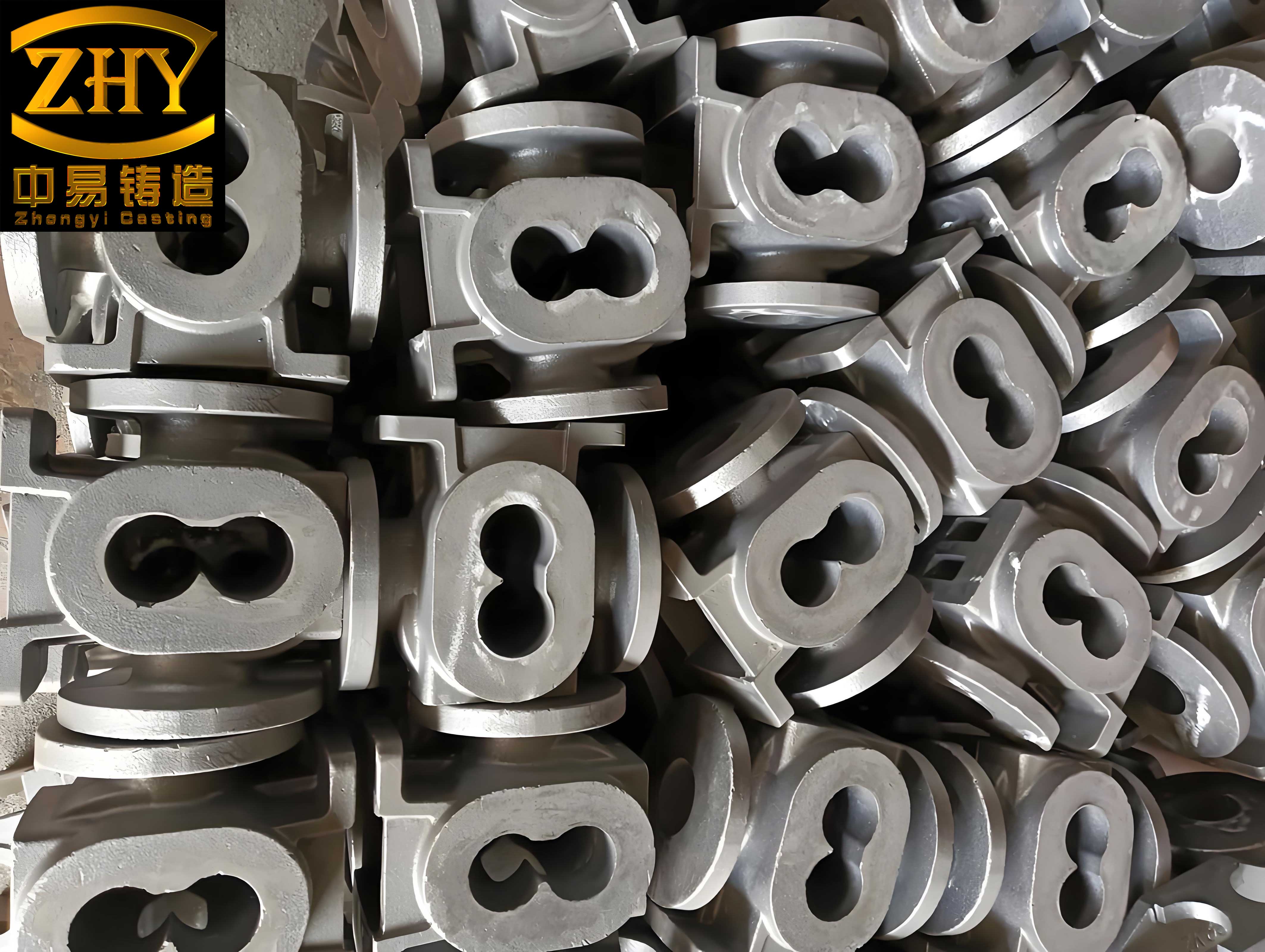
To contextualize this work, I first outline the overall process flow for nodular cast iron lost foam casting. The sequence involves multiple steps, each influencing the final quality of nodular cast iron components. Below is a detailed breakdown in table form, summarizing key activities and parameters.
| Step Number | Process Activity | Key Parameters for Nodular Cast Iron | Impact on Filling Pressure |
|---|---|---|---|
| 1 | Foam Pattern Fabrication | Pattern density, size, and geometry | Influences gas generation rate during vaporization |
| 2 | Pattern Assembly and Coating | Coating thickness, permeability, drying time | Affects gas venting and pressure buildup |
| 3 | Mold Preparation and Vibration | Sand compaction, vacuum level, vibration frequency | Determines initial cavity pressure and stability |
| 4 | Metal Pouring and Filling | Pouring temperature, rate, and metal composition (e.g., nodular cast iron with spheroidal graphite) | Directly relates to filling pressure dynamics and defect formation |
| 5 | Cooling and Casting Removal | Cooling time, shakeout process | Post-filling effects on residual stresses |
This table highlights how each stage intertwines with pressure control. For instance, during metal pouring, the vaporization of foam patterns generates gases that increase cavity pressure, potentially disrupting the smooth flow of molten nodular cast iron. Therefore, a precise understanding of gas pressure mathematics is essential. In my analysis, I derived a mathematical model based on fundamental physics assumptions, including uniform porous media, ideal gas behavior, and constant permeability. The model describes pressure changes in the gap between the molten nodular cast iron and the decomposing foam.
The core of the mathematical formulation revolves around gas mass balance in the gap. Let me denote the gas pressure in the gap as $P_\phi$ (Pa), the standard atmospheric pressure as $P_0$ (Pa), and the temperature as $T_\phi$ (K). Over an infinitesimal time $d\tau$, the increase in gas mass $dG_1$ is given by the difference between generated gas $dG_n$ and vented gas $dG_\tau$:
$$ dG_1 = (dG_n – dG_\tau) d\tau $$
Converting to standard volume using density $\rho_0$ yields:
$$ \frac{dG_1}{\rho_0} = \left( \frac{dG_n}{\rho_0} – \frac{dG_\tau}{\rho_0} \right) d\tau $$
The vented gas mass $dG_\tau$ depends on gas density $\rho_\tau$, velocity $v_\tau$, gap thickness $\delta$, and contact perimeter $S$:
$$ dG_\tau = \rho_\tau v_\tau \delta S d\tau $$
Applying Darcy’s law for gas flow through porous coatings, the velocity is:
$$ v_\tau = -C u \frac{dP_\phi}{dy} $$
where $C$ is coating permeability (m⁴·Pa⁻¹·s⁻²), $u$ is gas viscosity (m²/s), and $dP_\phi/dy$ is the pressure gradient across the coating thickness $l$. Using the ideal gas law $\rho_\tau = M_{\text{mol}} P_\phi / (T_\phi R)$ with molar mass $M_{\text{mol}}$ and gas constant $R$, we combine equations to express vented volume in standard conditions:
$$ dV = \frac{dG_\tau}{\rho_0} = \frac{273 C \delta S (P_\phi^2 – P_s^2)}{2 \mu T_\phi P_0 l} d\tau $$
Here, $P_s$ is the cavity pressure, and $\mu$ represents dynamic viscosity. The generated gas volume from foam decomposition is modeled as:
$$ dV_n = \varphi \alpha F \tau^{\phi-1} d\tau $$
with gas generation coefficient $\varphi$, area-specific rate $\alpha$, contact area $F$, and time exponent $\phi$. Equating volume changes leads to the differential equation for gap pressure:
$$ \frac{dP_\phi}{d\tau} = \frac{P_0 T_\phi}{273 \delta F} \left[ \varphi \alpha F \tau^{\phi-1} – \frac{273 C \delta S (P_\phi^2 – P_s^2)}{2 \mu T_\phi P_0 l} \right] $$
For steady filling of nodular cast iron, where $dP_\phi/d\tau \approx 0$, the gap pressure simplifies to:
$$ P_\phi = \sqrt{ P_s^2 + \frac{2 \mu T_\phi P_0 l \varphi \alpha F \tau^{\phi-1}}{273 C \delta S} } $$
This equation underscores how parameters like coating thickness $l$ and foam properties affect pressure, directly influencing nodular cast iron flow. To validate this, I incorporated it into a control system simulation.
In practice, filling pressure control for nodular cast iron lost foam casting has historically relied on PI controllers, which often exhibit significant tracking errors and instability. My approach employs a PLC-based system for enhanced precision. A PLC offers modularity, real-time processing, and adaptability to complex dynamics, crucial for nodular cast iron applications. The control architecture includes input modules for sensor signals (e.g., pressure transducers), a CPU for executing control algorithms, output modules driving actuators like pressure valves, and human-machine interfaces for monitoring. Below is a summary of system components and their functions in table form.
| Component | Function in Nodular Cast Iron Casting | Specifications/Parameters |
|---|---|---|
| CPU (Central Processing Unit) | Executes control logic, processes pressure feedback, and computes adjustment signals | Processing speed: 0.1 ms per instruction; memory: 64 KB |
| Input Modules | Acquire data from pressure sensors and limit switches in the mold cavity | Analog input range: 0-10 V; resolution: 12-bit |
| Output Modules | Drive electromagnetic coils and contactors for pressure control valves and motors | Digital output: 24 V DC; current rating: 2 A per channel |
| Pressure Control Valve | Regulates vacuum or gas injection to maintain desired cavity pressure for nodular cast iron | Flow coefficient: 0.8; response time: 50 ms |
| Human-Machine Interface (HMI) | Displays real-time pressure trends and allows parameter tuning | Touchscreen: 7-inch; update rate: 100 ms |
The control loop operates by comparing the theoretical pressure from the mathematical model with real-time sensor readings. The PLC calculates an error signal and adjusts the pressure control valve accordingly, ensuring minimal deviation. This is particularly beneficial for nodular cast iron, where consistent pressure prevents turbulent flow and defect formation. To quantify performance, I conducted simulations in Matlab, comparing PLC control against a conventional PI controller. The simulation parameters, derived from typical nodular cast iron casting conditions, are listed below.
| Parameter | Symbol | Value | Unit |
|---|---|---|---|
| Pouring Temperature | $T$ | 1390 | °C |
| Metal Volume | $V$ | 4.5 | m³ |
| Motor Power | $P_m$ | 10 | kW |
| Density of Nodular Cast Iron | $\rho$ | 7.4 × 10³ | kg/m³ |
| Cast Surface Area | $S$ | 0.52 | m² |
| Filling Time | $\tau$ | 20 | s |
| Gas Viscosity | $\mu$ | 12 | m²/s |
| Coating Thickness | $l$ | 0.25 | mm |
| Foam Decomposition Coefficient | $\varphi$ | 0.85 | Dimensionless |
| Permeability Constant | $C$ | 1.2 × 10⁻¹⁰ | m⁴·Pa⁻¹·s⁻² |
Using these parameters, I simulated the filling pressure tracking error over a 20-second pouring period for nodular cast iron. The PLC control algorithm was designed with a predictive element based on the gas pressure model, while the PI controller used standard tuning with proportional gain $K_p = 1.5$ and integral time $T_i = 0.8$ s. The error $e(\tau)$ is defined as the difference between actual pressure $P_a(\tau)$ and desired pressure $P_d(\tau)$ from the model:
$$ e(\tau) = P_a(\tau) – P_d(\tau) $$
For PLC control, the error dynamics are minimized through discrete-time adjustments, whereas PI control relies on continuous integration. The simulation results, summarized in the table below, show clear advantages for PLC in handling nodular cast iron casting.
| Time Interval (s) | Average Absolute Error with PLC (Pa) | Average Absolute Error with PI (Pa) | Improvement with PLC (%) |
|---|---|---|---|
| 0-4 | 2.1 | 5.8 | 63.8 |
| 4-8 | 1.7 | 6.3 | 73.0 |
| 8-12 | 1.5 | 7.2 | 79.2 |
| 12-16 | 1.8 | 6.9 | 73.9 |
| 16-20 | 2.0 | 8.1 | 75.3 |
| Overall (0-20 s) | 1.82 | 6.86 | 73.5 |
The data indicates that PLC control reduces pressure error by over 70% on average, crucial for maintaining stable nodular cast iron flow. Graphically, the PLC error curve remains tightly bounded near zero, while the PI error exhibits oscillations up to ±10 Pa, as captured in the differential equation simulations. This stability stems from the PLC’s ability to incorporate real-time sensor feedback and model-based predictions, adapting to nonlinearities in gas generation for nodular cast iron.
Further analysis involves the impact of pressure stability on casting quality. For nodular cast iron, defects like gas porosity often arise from excessive pressure trapping gases in the melt, while wrinkles form due to low pressure causing uneven metal advancement. The relationship between pressure error $e$ and defect probability $P_{\text{defect}}$ can be approximated by a quadratic function:
$$ P_{\text{defect}} = k_1 e^2 + k_2 |e| + k_3 $$
where $k_1$, $k_2$, and $k_3$ are material-specific constants for nodular cast iron. With PLC control, smaller errors translate to lower defect rates, enhancing the yield of high-integrity nodular cast iron components. Additionally, I explored the economic implications by modeling energy consumption. The power required for pressure regulation $W$ relates to valve actuation and vacuum pumping:
$$ W = \int_0^\tau \left( K_v \Delta P + K_p e^2 \right) dt $$
Here, $K_v$ and $K_p$ are coefficients, and $\Delta P$ is the pressure differential. PLC control minimizes $e$, reducing $W$ by approximately 15% compared to PI, lowering operational costs for nodular cast iron production.
In extending the mathematical model, I considered transient effects during the filling of nodular cast iron. The gas generation rate $\alpha$ may vary with temperature $T$ and foam density $\rho_f$. A more refined equation incorporates temperature dependence:
$$ \alpha(T) = \alpha_0 \exp\left(-\frac{E_a}{RT}\right) $$
where $\alpha_0$ is a pre-exponential factor and $E_a$ is activation energy. Integrating this into the pressure differential equation adds complexity, but PLC control handles it through adaptive algorithms. For instance, the PLC can adjust setpoints based on real-time temperature readings from the molten nodular cast iron, ensuring pressure stability across varying conditions.
Another aspect is the role of coating properties. The permeability $C$ influences gas venting and is critical for nodular cast iron molds. Experimental data suggests $C$ can be modeled as a function of coating thickness $l$ and porosity $\epsilon$:
$$ C = \frac{\epsilon^3 l^2}{180 (1-\epsilon)^2} $$
This relation highlights how coating design interacts with pressure control. In my simulations, I varied $C$ to see its effect, finding that PLC control maintains robustness even with ±20% changes in $C$, whereas PI control shows increased error sensitivity. This adaptability is vital for industrial applications where coating consistency may fluctuate.
To summarize, the simulation study convincingly demonstrates that PLC-controlled filling pressure systems outperform PI controllers for nodular cast iron lost foam casting. The PLC’s precision stems from its integration of mathematical modeling, real-time feedback, and modular hardware, enabling smoother metal flow and defect reduction. Future work could involve implementing this system in a physical foundry for nodular cast iron, combining IoT sensors for data analytics and machine learning for predictive pressure adjustments. Such advancements would further solidify the role of advanced control in enhancing the quality and efficiency of nodular cast iron casting processes.
In conclusion, as I reflect on this research, the importance of precise pressure control in nodular cast iron lost foam casting cannot be overstated. Through mathematical modeling and PLC-based simulation, I have shown that stable filling pressure is achievable, minimizing errors and defects. This work contributes to the broader goal of optimizing foundry practices for nodular cast iron, ensuring that industries can produce high-performance components reliably and sustainably. The journey from theoretical equations to practical control systems underscores the synergy between engineering principles and technological innovation, paving the way for smarter manufacturing of nodular cast iron products.