
In the field of electrical machinery, the motor frame serves as a critical component, providing structural support and fixation for the stator core. In bearing-end cover configurations, it collaborates with the end cover to uphold the rotor and safeguard the motor windings. Among various types, such as integral, split, cast iron, cast steel, welded steel plate, and aluminum die-cast frames, the integral cast iron frame with feet is predominant in small and medium-sized motors. This article delves into the quality enhancement of a specific small motor frame casting made from nodular cast iron, material grade QT450-10. The casting features a barrel-like structure with external dimensions of 286 mm × 276 mm × 296 mm, a maximum wall thickness of 30 mm, a minimum wall thickness of 4 mm at the散热筋板 (cooling ribs), and a weight of 33 kg. The primary challenge addressed herein involves incomplete filling and cold shut defects in these thin-walled ribs, which led to high scrap rates. Through a combination of process analysis, computational fluid dynamics (CFD) simulations, and innovative redesign, a robust solution was developed and validated in production, significantly improving the quality of nodular cast iron castings.
The initial casting process employed a two-cavity mold per box, with an open gating system where two ingates were positioned at the feet of the motor frame. The pouring temperature was set at 1,418°C, which is generally suitable for such geometries in nodular cast iron. However, recurrent defects were observed: the 4 mm thick circumferential cooling ribs exhibited severe锯齿状 (saw-tooth) cold shuts and incomplete filling, particularly at locations farthest from the ingates. Visually, the缺肉 (missing material) issue was more pronounced near the riser side compared to the ingate side, and radially, severity increased with distance from the ingates. This pattern suggested non-uniform temperature distribution during filling, leading to premature solidification in remote thin sections. Given that 4 mm approaches the lower limit for sand casting of nodular cast iron, even minor temperature drops can impede complete mold cavity filling. The root cause was attributed to the concentrated and asymmetrical placement of ingates, causing rapid heat loss in the铁液 (molten iron) as it traversed the mold, thereby creating large thermal gradients.
To quantitatively assess the problem, I conducted CAE simulations using commercial software, modeling the original process with parameters: pouring weight of 87 kg, pouring temperature of 1,420°C, and fill time of 15 seconds. The results vividly illustrated the deficiencies. The velocity field simulation revealed high-speed flow and splashing near the ingates during initial stages, indicating turbulent and unstable filling. This turbulence can entrain air and exacerbate temperature loss. More critically, the temperature field simulation demonstrated significant thermal disparities. At approximately 80% fill completion, the temperature difference between the ingate side and the farthest point on the same horizontal plane exceeded 100°C. The remote rib areas registered temperatures as low as 1,130°C, which is perilously close to the liquidus for nodular cast iron, leading to cold shuts. The governing equations for these phenomena can be simplified for analysis. The fluid flow is described by the Navier-Stokes equations, while heat transfer incorporates conduction and convection. For temperature \( T \) and velocity \( \vec{v} \), the energy equation is:
$$ \rho c_p \left( \frac{\partial T}{\partial t} + \vec{v} \cdot \nabla T \right) = \nabla \cdot (k \nabla T) + Q $$
where \( \rho \) is density, \( c_p \) is specific heat, \( k \) is thermal conductivity, and \( Q \) represents internal heat sources. In casting, \( Q \) is often negligible during filling. The rapid temperature drop in the original design stemmed from prolonged flow paths and excessive heat dissipation to the sand mold, causing \( T \) to fall below the fluidity threshold in thin sections.
Based on this analysis, I implemented a comprehensive process optimization targeting the gating system and mold layout. The key modifications are summarized in the table below, comparing the original and optimized parameters for the nodular cast iron casting.
| Parameter | Original Process | Optimized Process |
|---|---|---|
| Mold Layout | Two castings per box | One casting per box |
| Ingate Location | At the feet (2 ingates) | At the bottom flange (multiple ingates) |
| Number of Ingates | 2 | Increased to ensure uniform distribution |
| Sprue Location | Outside the casting | Through the central轴孔 (shaft hole) |
| Pouring Weight | 87 kg | 45 kg |
| Fill Time | 15 s | 8 s |
| Gating System Type | Open | Modified open with controlled flow |
Firstly, shifting from two to one casting per box reduced the total poured mass, shortening the fill time from 15 s to 8 s. This reduction minimizes the time available for heat loss, preserving the superheat of the nodular cast iron. Secondly, the ingates were repositioned from the feet to the bottom flange, and their number was increased to ensure simultaneous and uniform metal entry around the circumference. This change promotes平稳 (steady) filling, eliminates initial splashing, and provides a more even thermal input. Thirdly, leveraging the barrel geometry, the sprue was relocated to feed through the central shaft hole. This strategic placement drastically shortens the flow path of the molten nodular cast iron from the pouring cup to the ingates, reducing temperature drop. The modified gating system ensures that the铁液 reaches the thin ribs with adequate temperature and velocity.
To validate these changes, I performed another CAE simulation under identical material and pouring temperature conditions (1,420°C). The optimized process showed remarkable improvement. The velocity field indicated smooth, laminar-like flow without splashing. The temperature field at 80% fill completion exhibited much smaller gradients; the lowest temperature in the remote ribs was around 1,139°C, a 9°C increase compared to the original process. The temperature difference across the casting was significantly reduced, enhancing the fluidity of the nodular cast iron in critical sections. The heat transfer dynamics can be further analyzed using Fourier’s law for conduction through the mold, but the primary gain stems from reduced convectional cooling due to shorter flow paths. The fill time \( t_f \) is inversely related to the temperature drop \( \Delta T \), approximated by:
$$ \Delta T \propto \frac{L}{v} \cdot h_{eff} $$
where \( L \) is flow length, \( v \) is flow velocity, and \( h_{eff} \) is an effective heat transfer coefficient. By reducing \( L \) (via central sprue) and increasing \( v \) (via shorter fill time), \( \Delta T \) is minimized.
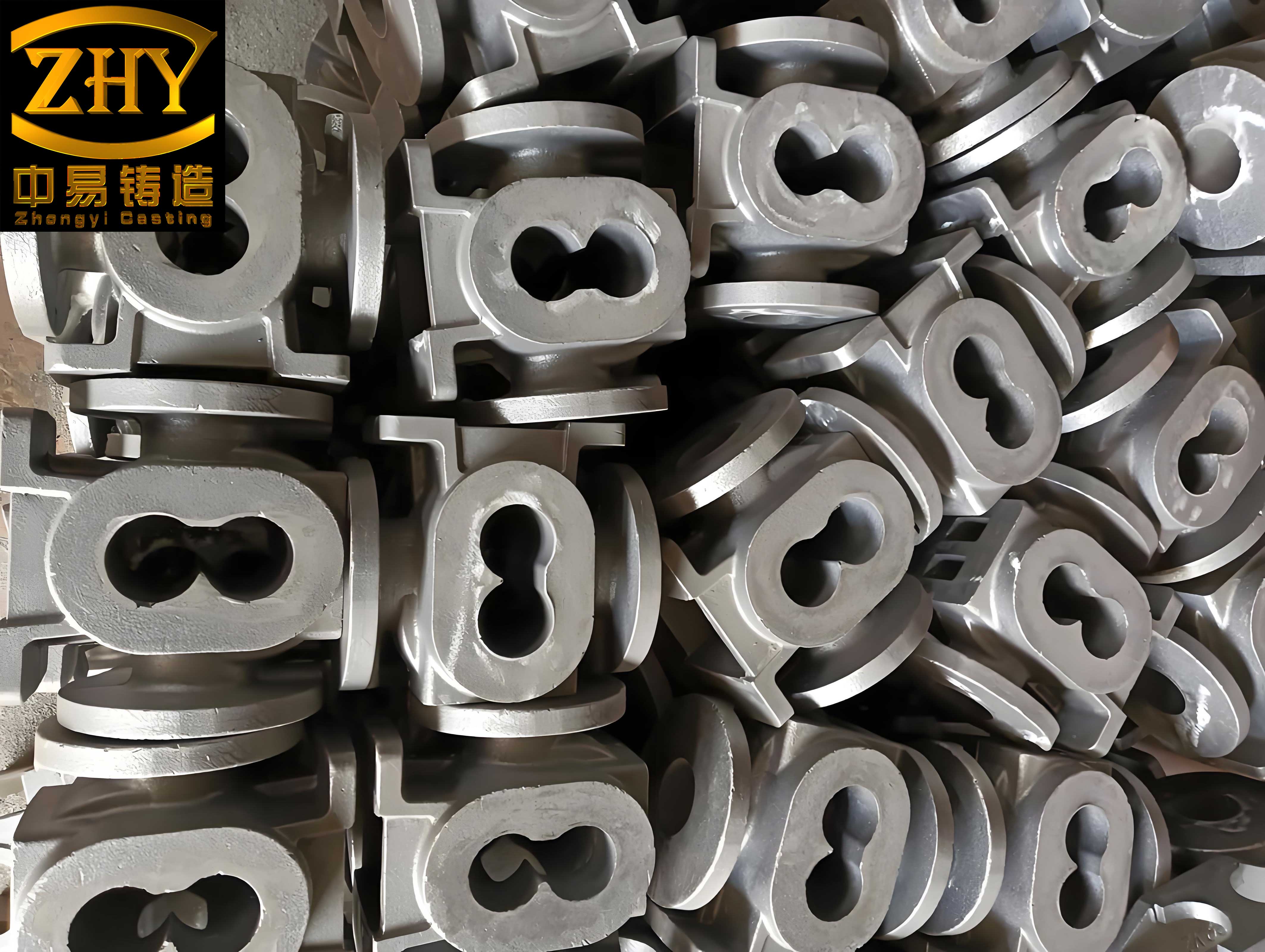
Following simulation approval, the optimized process was put into production utilizing 3D printed sand mold technology. This advanced manufacturing allows for precise fabrication of complex gating systems and mold cavities, ensuring the design intent is accurately realized. The produced nodular cast iron castings underwent only shot blasting for cleaning. Visual inspection confirmed excellent formation of all cooling ribs: they were fully filled, devoid of cold shuts, and exhibited uniform wall thickness without any缺肉. Moreover, the overall dimensional accuracy was high, with minimal flash at parting lines, substantially reducing post-casting cleanup labor. Multiple production runs and subsequent mass production demonstrated consistent quality, with the scrap rate for these nodular cast iron parts falling below 1.5%. The success underscores the synergy between thoughtful process design and modern additive manufacturing for nodular cast iron components.
The quality improvement of nodular cast iron castings, particularly for thin-walled geometries like motor frames, hinges on meticulous control of thermal and flow dynamics during pouring. This study illustrates that defects such as cold shuts and incomplete filling often originate from poorly designed gating systems that create large temperature gradients. By re-engineering the process—adopting a one-casting-per-box layout, increasing and repositioning ingates for uniform feed, and utilizing a central sprue to shorten flow paths—the temperature distribution was homogenized, and fluidity was maintained. The integration of CAE simulation provided invaluable insights for diagnosing issues and predicting outcomes, while 3D printing enabled accurate implementation. For future projects involving nodular cast iron, the following principles can be distilled: prioritize symmetrical and distributed ingate placement, minimize flow length to reduce heat loss, and employ rapid prototyping to validate designs. These strategies not only enhance the integrity of nodular cast iron castings but also boost productivity and sustainability by lowering scrap rates and material waste. As industries demand lighter and more complex nodular cast iron parts, such methodological advancements will become increasingly vital.
In conclusion, the journey from a defect-prone process to a reliable production line for small motor frames highlights the importance of a holistic approach to casting design. Through systematic analysis, simulation, and innovation, the challenges inherent in producing high-quality nodular cast iron components were overcome. The optimized process now serves as a benchmark for similar applications, ensuring that nodular cast iron continues to be a material of choice for durable and efficient motor frames. The continuous evolution of foundry techniques, coupled with digital tools, promises further enhancements in the quality and performance of nodular cast iron castings across various engineering domains.